EFF membership badge

Prompted by EFF, I sent the following message to my representative:

I strongly oppose government surveillance of U.S. citizens, so I’m asking you to please vote no on any bill that includes a clean reauthorization of Section 702. Real reform is possible and has more support than ever. Several bills would do much to rein in Section 702 surveillance and protect Americans’ privacy, and do so without hurting national security. 

We live in a globalized society in which Americans are constantly communicating with people overseas. The Federal Bureau of Investigation (FBI) has proven many times over that they cannot be trusted with discretion to warrantlessly query communications collected under Section 702 of the Foreign Intelligence Surveillance Act. Americans should not lose their constitutional rights to private communications because of a mass surveillance authority that provides federal law enforcement with backdoor access to them. 

Please, reform Section 702. 

I urge you to urge your representative to work to reform section 702. Here’s a place to start:

https://act.eff.org/action/congress-has-until-april-20-to-take-action-on-702-tell-them-not-to-drop-the-ball

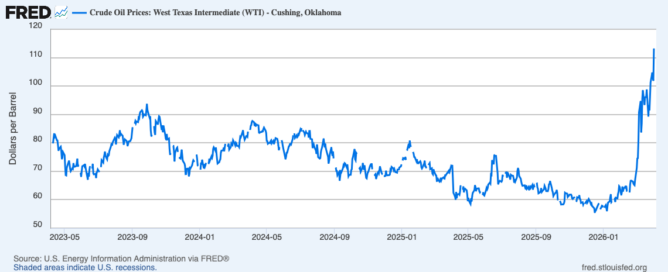
Graph of the spot price for West Texas Intermediate crude oil, showing the recent spike

For no reason I can understand, markets seem to think that (with the cease fire with Iran) things are going to return more or less to normal, more or less immediately. This is false. It is not just false, it is so far from the truth that I don’t understand why way more people aren’t panicking.

There are so many problems with oil supply delivery right now—so many more than just the Strait of Hormuz. A lot of oil and gas production infrastructure is gone. A lot of oil and gas distribution infrastructure is gone. Even where the production infrastructure is still there, since there’s no way to ship out what is produced, production is being shut in. Production that has been shut in will take weeks to get started again. And it won’t be started again until it can be delivered.

At the same time, shipments of oil and gas that came out through the Strait just before it was closed, are probably only now reaching their destinations—meaning that it is only now that refineries are finding themselves without their next input for refining. The refining facilities are going to have to shut down. And just like the production facilities, it will take weeks to get them started again. And they won’t be started again until the people who run them foresee reliable, steady deliveries of crude.

These effects are already obvious in the observed spread between spot prices (the cost of a barrel of crude to be delivered right now), which are high (although not as high as I think would make sense), and futures prices (the cost of a barrel of crude to be delivered in a month), which are also high (but not nearly as high as I think would make sense).

The same is true (with various differences in details) with helium, nitrogen for fertilizer, aluminum, and who knows how many other commodities that used to come though the Strait.

This all matters because the knock-on effects are going to be huge. Higher fuel prices—much higher, and for much longer than the markets are currently anticipating. Higher food prices, due to the shortage of fertilizer reducing food production, especially of corn—which is a major input to both meat production and to ethanol production, meaning another way it feeds-through the higher energy prices. Higher helium prices feed through to shortages of computer chips—which were already under strain due to AI-related data-center demand.

In the background of all these are Trump’s tariffs from a year ago, the impact of which was eased in many different ways (the pause, various rate cuts, firms stocking-up ahead of the imposition of the taxes, the supreme court decision ruling that the worst of them were illegal), all of which delayed the main impacts for months. For some reason, the markets seem to think that those impacts would quit showing up in comparison to the year-ago numbers (since the tariffs were announced one year ago), but in fact are probably only now fully showing up in reported numbers.

My take on all this is that every aspect of the economy is going start getting bad, and then going on getting worse. The getting-worse phase will go on at least for months and months, and very possibly for a year or two or three.

Inflation spiked up to 3.3% last month, but that is only the start. That’s just the energy-price spike. As soon as those effects feed through to other prices, they’ll all go up. And as soon as those high prices start forcing people to cut back on other spending, we’ll see at least a recession, and very possibly worse than that. And that’s all before actual shortages or fuel and food start impacting every aspect of people’s lives.

Oh, and as I’ve said before: Don’t imagine that having some idea about what things are going to be higher-priced or in short-supply gives you the sort of insight that will let you invest to make money off these circumstances. The real-world impact of these things are going to be chaotic enough that any particular investment could go very badly wrong, even if your understanding of the general direction of events is correct. And, of course, the government is going to trying to protect their supporters (oil companies and tech billionaires, mostly) so they may well be bailed out. Any investments that suppose that things will go badly for them in particular may well go spectacularly awry.

Stephen Miller would have ICE agents (and the rest of us) believe that they have “immunity” to perform their “duties.”

This is, of course, false. Depriving any person (not just citizens) of their rights “under color of law” is its own crime. But it is in that light that we should view their position on face masks as admitting that they know they have it wrong:

The administration’s perceived need for face coverings evocative of Iranian secret police and Russian security agents helps us recognize that assertions of state supremacy and citizen insignificance are claptrap…

Source: All the king’s masked and anonymous henchmen

If they were immune, they’d not hesitate to show their faces. The fact that they feel the need to keep them hidden makes it very clear that they know they’re totally exposed in a legal sense.

Okay, I’m going to tag this “allegedly funny,” because that’s the tag I’ve got for this sorta stuff. But this is legit funny:

Instead, FEMA staff have been encouraged to use terms like “freezing rain” in their public messaging, the sources said.

Source: Don’t say ‘Watch out for ice’: FEMA warned storm announcements could invite memes | CNN Politics

A graph showing a line that goes up to the right, with a big drop in April 2025 that is quickly reversed

There’s a broker offering a new product, that I’d have been all over 30 years ago. I think they’re calling it a “generated asset,” where they create a personal stock index just for you (based on a prompt to an AI), and then create an imaginary index fund for that imaginary index, and then (I assume) invest in the underlying stocks on your behalf.

Of course, you could do that yourself, but it would be awkward, probably expensive, and definitely fiddly, with a need to track the index over time.

So, instead of that (I assume), the company just promises to pay you the value of your index, and (I assume) hedges its promise by holding the underlying shares—and since this synthetic investment is a service, they can lump all these promises together and invest in all the underlying shares, and be generally sure that their hedge will be close enough that even very large stock moves won’t cost them more than investors are paying for access to this service.

As I said, I’d have been all over that 30 years ago. Now, not so much. I’ve gotten lazier and more conservative with my investments as I’ve gotten older.

But it did make me think what I’d want to invest in, if I were to create a synthetic index, and it occurred to me that the companies that are putting the least amount of money into AI crap will do much better over the next few years. So I asked confer.to if it could give me “a list of large corporations ordered by how much they talk about AI in their reports to investors.”

Sadly, the answer was no:

Based on the available data, I can’t provide a specific ranked list of large corporations ordered by how much they discuss AI in their earnings reports. While the information confirms that AI is a major topic in 2025 earnings calls across the S&P 500, the detailed company-by-company ranking you’re looking for isn’t publicly available in the sources I checked.

Here’s what we do know:

  • AI is a dominant topic: In Q3 2025, “AI” was cited on 306 S&P 500 earnings calls, the highest number in the past decade.
  • Significant increase: This is a large jump from the five-year average of 136 mentions and the 10-year average of 86.
  • Sector leaders: The Information Technology (95%) and Communication Services (95%) sectors have the highest percentage of companies mentioning AI.
  • Market impact: Companies that mentioned AI in their Q3 2025 calls saw a higher average stock price increase (13.9%) compared to those that didn’t (5.7%) since the end of 2024.

While sources like Yahoo Finance and MacroMicro track the overall trend and volume of AI mentions, they don’t publish a specific, ordered list of corporations ranked by the frequency or depth of their AI discussions in earnings reports.

This type of granular, ranked data is typically compiled by specialized financial data and analytics firms (like FactSet, which provided the data to Yahoo Finance) and is often part of a paid subscription service.

Perhaps the specialized AI tool that this broker uses to create its imaginary indices has access to the fine-grained data about AI mentions in earnings calls with investors. But I don’t care enough to go to the trouble of looking.

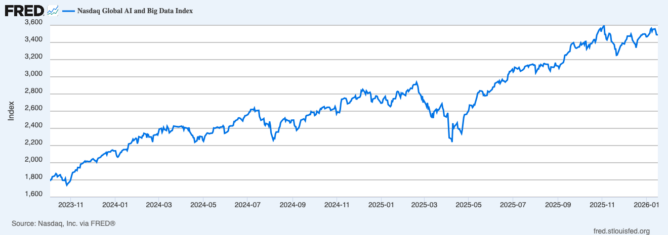
Poking around at the St. Louis Fed’s Fred graphing tool (to come up with a graphic to include for this post), though, led me to the graph at the top, which is of the “Nasdaq Global Artificial Intelligence and Big Data Index,” which “is designed to track the performance of companies engaged in the following themes: Deep Learning, NLP, Image Recognition, Speech Recognition & Chatbots, Cloud Computing, Cybersecurity and Big Data.”

So one option to get what I want would be to just go short on that index.

I don’t think I’ll do that either.

Turns out Cory Doctorow and I think a lot alike about the AI bubble, but he also has stuff to say about how to speed along the popping of the bubble, which would be a good thing. (Bubbles that pop sooner do less damage when they do.)

so I’m going to explain what I think about AI and how to be a good AI critic. By which I mean: “How to be a critic whose criticism inflicts maximum damage on the parts of AI that are doing the most harm.”

Source: The Guardian

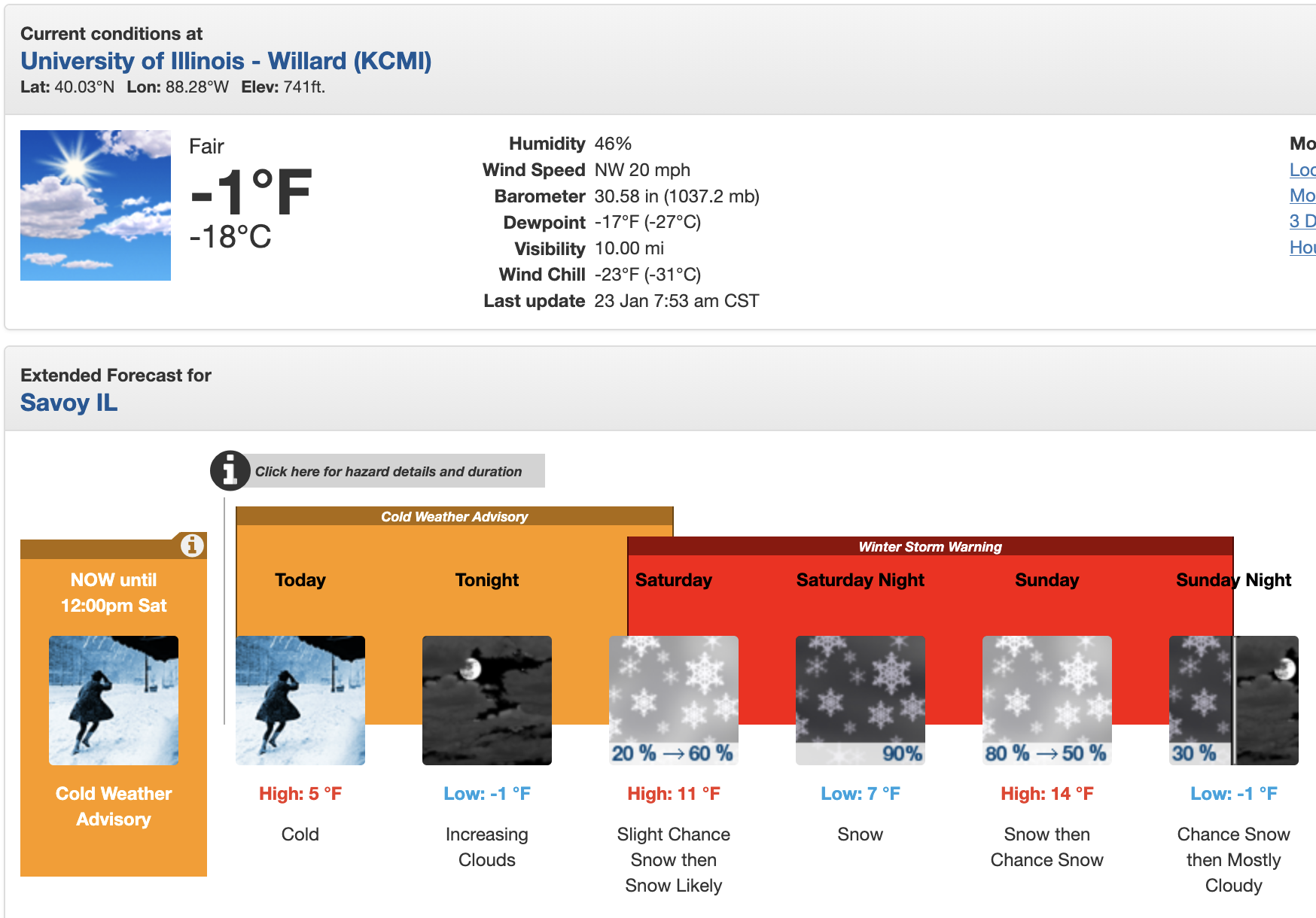
Next weekend is going to be pretty cold in Minneapolis. Maybe cold enough to convince some ICE goons that they’d be better off on disability in Kentucky.

I mean, every ICE goon has probably slipped on the ice at least once. Probably every one of those falls could be turned into a disability claim.

I am (just barely) old enough to remember the Black Panthers in the 1960s, when a group of black people tried to carry legal firearms to protect themselves, before they were mostly murdered by the police, the FBI, and one another.

I also remember the 1980s, when the NRA was trying to convince all marginalized groups (blacks, women, lesbians, gays, socialists, etc.), that arming themselves was a great idea. The NRA was sincere, I think—they just wanted more people to have guns.

Most people, especially black people, were well aware of the fact that walking around armed would make it much more likely that they’d be killed by the police. (They remembered what happened to the Black Panthers, presumably better than I did.)

Over the last couple of years, and especially over the last few days, I think perspectives are changing. First, a lot of white people are walking around armed, and even killing people, with minimal consequences. Second, the increasingly fascist police have been killing unarmed people at increasing rates, and looking like they’ll not only get away with it, but looking like they’re glorying in it.

There are definitely some black people thinking once again that being armed is a good idea. I hope they’re not horribly wrong about that.