A graph of oil prices, showing the peak during the war, and the start of another peak now

A few weeks ago, back before the Iran war heated back up, The Economist wrote a mia culpa, explaining why they’d gotten it wrong about the war being an economic disaster. Briefly, while the MOU was holding up, I was tempted to write my own.

Like The Economist editors, I had thought back in April that Things are amazingly more bad than markets seem to think, but by the beginning of June, it was looking like maybe the risk of catastrophe had eased.

I didn’t write a mia culpa. To be fair, part of that was just laziness. But part of it was looking at things and thinking I was still right. Maybe between some demand destruction and some dribs and drabs of oil getting through the strait, world markets had found a new equilibrium that wasn’t nearly as bad as I’d expected. But I didn’t think so.

The Economist thought so. They thought they’d gotten it wrong for two reasons:

First, we thought that America and Iran would hold out against a deal to reopen the Strait of Hormuz: America because Mr Trump deludedly thought he held the whip hand, Iran because its regime knew its people could be made to endure more pain. In fact, facing the fury of American motorists, Mr Trump all but folded, preventing a disaster. Since the two parties struck a provisional deal in June, enough oil has been getting out of the Gulf to reassure markets that supply is coming back online, even if the future of the strait remains uncertain.

Our second oversight was, like others, not anticipating the staggering degree to which China would be able to slash its oil imports. Crude imports are 5m barrels a day lower than a year ago, despite the fall in prices. China has cut its demand and shored up supply. Its oil reserves are opaque—many barrels are hidden from satellites underground, and there is a blurred line between official reserves and corporate inventories. But they have been shown to be a powerful buffer.

I pretty much bought their second point. China had produced a truly fantastic amount of demand destruction, and had done it with minimal impact on their own economy, by largely shifting the impact onto people in other countries who had bought their oil distillates, before China prohibited exports. They could probably keep that up indefinitely, removing their demand from the world market.

That first point, though, I found doubtful. I mean, yes, Trump always chickens out, which is why we got the MOU and the briefly partially reopened strait. But I think they were wrong in thinking that Iran would go along with what Trump wanted, or that Trump could settle for what Iran would (obviously) want to do. They tried to paper over the cracks for a few weeks. I mean, I believe Trump settling for whatever Iran did and pretending it was a victory was a thing that could happen. But I’m not surprised it didn’t work out. Too many other people in the U.S. government were simply unwilling to let Trump leave the strait in Iran’s hands. And, although oil prices were coming back down, they were not on a trajectory that would improve the Republican’s chances in the midterms.

So, I think The Economist was right in the first place, and wrong to imagine that Trump and Iran could agree that “preventing a disaster” was something they could do.

The oil price graphic above is already out of date. It shows yesterday’s closing price, and things have gotten worse already today. Brent crude is over $100 as I wrap up this post.
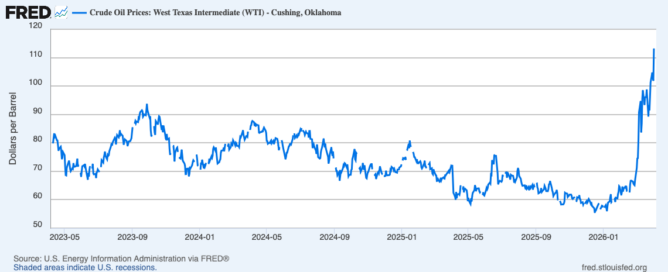
Graph of the spot price for West Texas Intermediate crude oil, showing the recent spike

For no reason I can understand, markets seem to think that (with the cease fire with Iran) things are going to return more or less to normal, more or less immediately. This is false. It is not just false, it is so far from the truth that I don’t understand why way more people aren’t panicking.

There are so many problems with oil supply delivery right now—so many more than just the Strait of Hormuz. A lot of oil and gas production infrastructure is gone. A lot of oil and gas distribution infrastructure is gone. Even where the production infrastructure is still there, since there’s no way to ship out what is produced, production is being shut in. Production that has been shut in will take weeks to get started again. And it won’t be started again until it can be delivered.

At the same time, shipments of oil and gas that came out through the Strait just before it was closed, are probably only now reaching their destinations—meaning that it is only now that refineries are finding themselves without their next input for refining. The refining facilities are going to have to shut down. And just like the production facilities, it will take weeks to get them started again. And they won’t be started again until the people who run them foresee reliable, steady deliveries of crude.

These effects are already obvious in the observed spread between spot prices (the cost of a barrel of crude to be delivered right now), which are high (although not as high as I think would make sense), and futures prices (the cost of a barrel of crude to be delivered in a month), which are also high (but not nearly as high as I think would make sense).

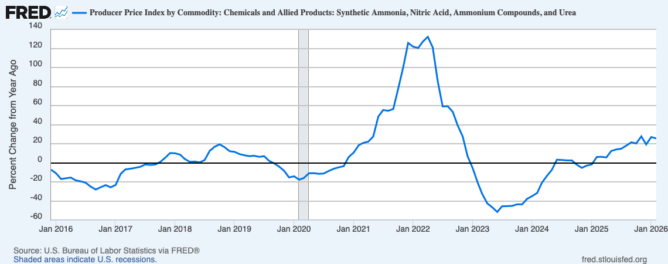
The same is true (with various differences in details) with helium, nitrogen for fertilizer, aluminum, and who knows how many other commodities that used to come though the Strait.

This all matters because the knock-on effects are going to be huge. Higher fuel prices—much higher, and for much longer than the markets are currently anticipating. Higher food prices, due to the shortage of fertilizer reducing food production, especially of corn—which is a major input to both meat production and to ethanol production, meaning another way it feeds-through the higher energy prices. Higher helium prices feed through to shortages of computer chips—which were already under strain due to AI-related data-center demand.

In the background of all these are Trump’s tariffs from a year ago, the impact of which was eased in many different ways (the pause, various rate cuts, firms stocking-up ahead of the imposition of the taxes, the supreme court decision ruling that the worst of them were illegal), all of which delayed the main impacts for months. For some reason, the markets seem to think that those impacts would quit showing up in comparison to the year-ago numbers (since the tariffs were announced one year ago), but in fact are probably only now fully showing up in reported numbers.

My take on all this is that every aspect of the economy is going start getting bad, and then going on getting worse. The getting-worse phase will go on at least for months and months, and very possibly for a year or two or three.

Inflation spiked up to 3.3% last month, but that is only the start. That’s just the energy-price spike. As soon as those effects feed through to other prices, they’ll all go up. And as soon as those high prices start forcing people to cut back on other spending, we’ll see at least a recession, and very possibly worse than that. And that’s all before actual shortages or fuel and food start impacting every aspect of people’s lives.

Oh, and as I’ve said before: Don’t imagine that having some idea about what things are going to be higher-priced or in short-supply gives you the sort of insight that will let you invest to make money off these circumstances. The real-world impact of these things are going to be chaotic enough that any particular investment could go very badly wrong, even if your understanding of the general direction of events is correct. And, of course, the government is going to trying to protect their supporters (oil companies and tech billionaires, mostly) so they may well be bailed out. Any investments that suppose that things will go badly for them in particular may well go spectacularly awry.

Recent news is that a contingent of ground forces have arrived in Iran. The markets still seem expect that Trump will chicken out (which seems likely) and that things will return to normal in the Gulf (which seems very, very unlikely).

My most hopeful guess at this point:

  1. Trump chickens out, declares victory, says we have a deal with Iran, and pulls out.
  2. Europe and Asia make a deal with Iran that conditionally opens the Strait, with Iran deciding who can transit, and collecting large tolls.
  3. Europe and Asia start getting deliveries of oil and gas and fertilizer and helium. Because of the gap already embedded in deliveries, prices spike up in the meantime.
  4. Because the U.S. is an oil and gas exporter, our prices spike up less (but still spike up, because there’s a global market), and reduced supply of fertilizer and other things from the Gulf means other prices spike up as well, producing an inflationary recession that rivals the worst of 2008 and 2020.

All my other guesses are similar, except that my scenario is preceded by a step 0 in which a bunch of U.S. soldiers and marines are killed while failing to reopen the Strait.

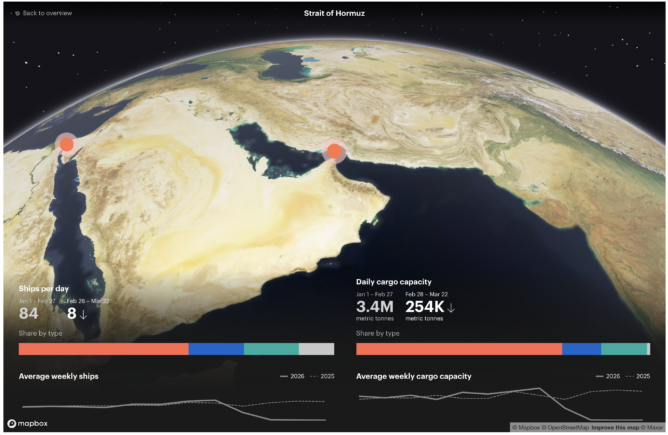
Graphic of data on shipping through the Strait of Hormuz from the International Energy Agency (IEA)

The U.S. has supposedly provided a “15-point plan” to Pakistan which has supposedly passed it on to Iran.

I have no idea what’s in that plan, nor what Iran’s reaction has been. But I do have some ideas about what would be a reasonable response by Iran. If I were in their shoes, this would be my starting point for negotiations:

  • We can resume enriching uranium, and start enriching it to levels that would allow us to build a nuclear weapon.
  • We can proceed to developing a nuclear weapon.
  • We can accelerate work on intermediate and long-range ballistic missiles.
  • We can continue to arm proxy organizations throughout the region.
  • The U.S. and Israel will pay us substantial reparations so we can rebuild destroyed facilities.
  • The U.S. and Israel will apologize for attacking us and killing our senior government officials.
  • Once these items have been agreed to, Israel and the U.S. will stop attacking Iran. Iran will stop attacking Israel, the U.S. and other Gulf states, except that we reserve the right to use military force in the Strait of Hormuz, and against other oil export facilities, such as those on the Red Sea.
  • As progress is made on these items, we will gradually reopen the Strait, under strict Iranian control, with the right to approve, inspect, and tax every cargo, in perpetuity.

[Updated at 16:56: I careless left off “End all sanctions” and “Return all frozen assets” from this list. Sorry!]

Now, I wouldn’t expect the U.S. or Israel to agree to all that, but it seems like a reasonable starting point for negotiations.

Trump is such a moron for having put us in such a situation. And he’s such a crappy negotiator, that I suspect we’ll end up with something very much like that before the war is over.

Oh, and I’m upgrading (downgrading?) my stagflation forecast to be more inflationary and more recessionary than I’d been assuming.