
Walking the dog at sunrise this morning, I paused while walking down the high road through the prairie to capture this photo.
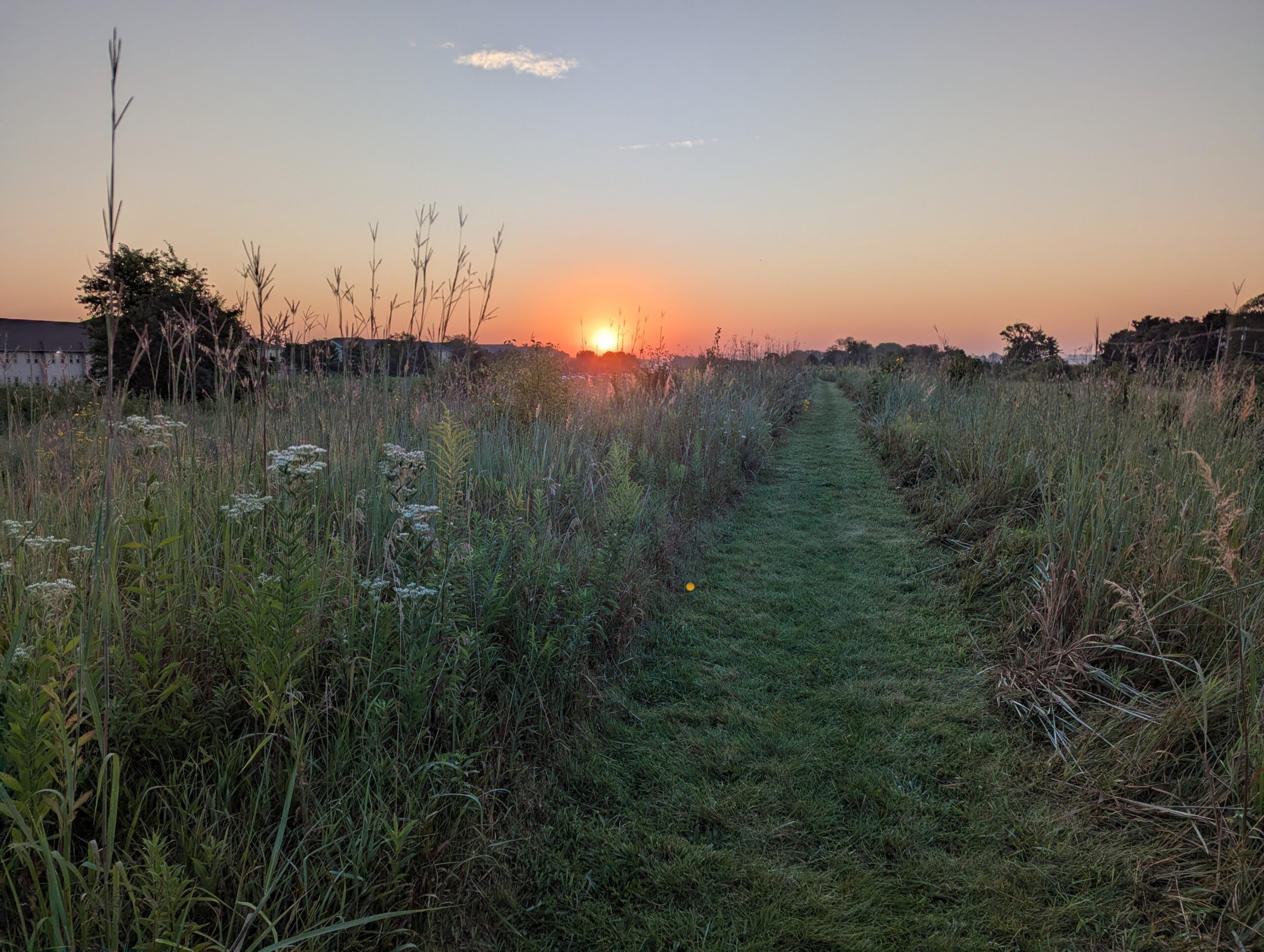
Walking the dog at sunrise this morning, I paused while walking down the high road through the prairie to capture this photo.

It rained yesterday, but not all the time. I was able to get Ashley out in the gaps pretty well. After raining all night, it seemed it was going to rain all morning as well.
I offered Ashley a chance to go out on the patio, and she declined. A bit later, after she indicated that she really wanted to go out. I put on my raincoat and put the leash on her and tried to take her out the front door, but she wasn’t having it. Just a few minutes later, she came and told me she needed to go out, so I tried again, and this time I actually dragged out out the door, into the rain. But No. She went about three feet out the door, then solid turned around and headed right back.
It was a classic case of Ashley wanting to go outside, but not to the outside that actually existed. She wanted me to take her to some other outside.
So I went back to my laptop and my third coffee (twice set aside, but still warm enough) and waited for the rain to let up a little. And it did let up a little, and I got Ashley out then.
We saw an opossum! He was a Very Handsome fellow, with a white face, a naked pink tail, and sleek counter-shading on his body, (I think the sleekness may have come from being very wet.)
Ashley, of course, wanted to play with the possum, and we chased it back and forth (the possum going through the shrubs next to the building, and us going around the shrubs). At some point the possum managed to get out of sight long enough for me to drag Ashley away.
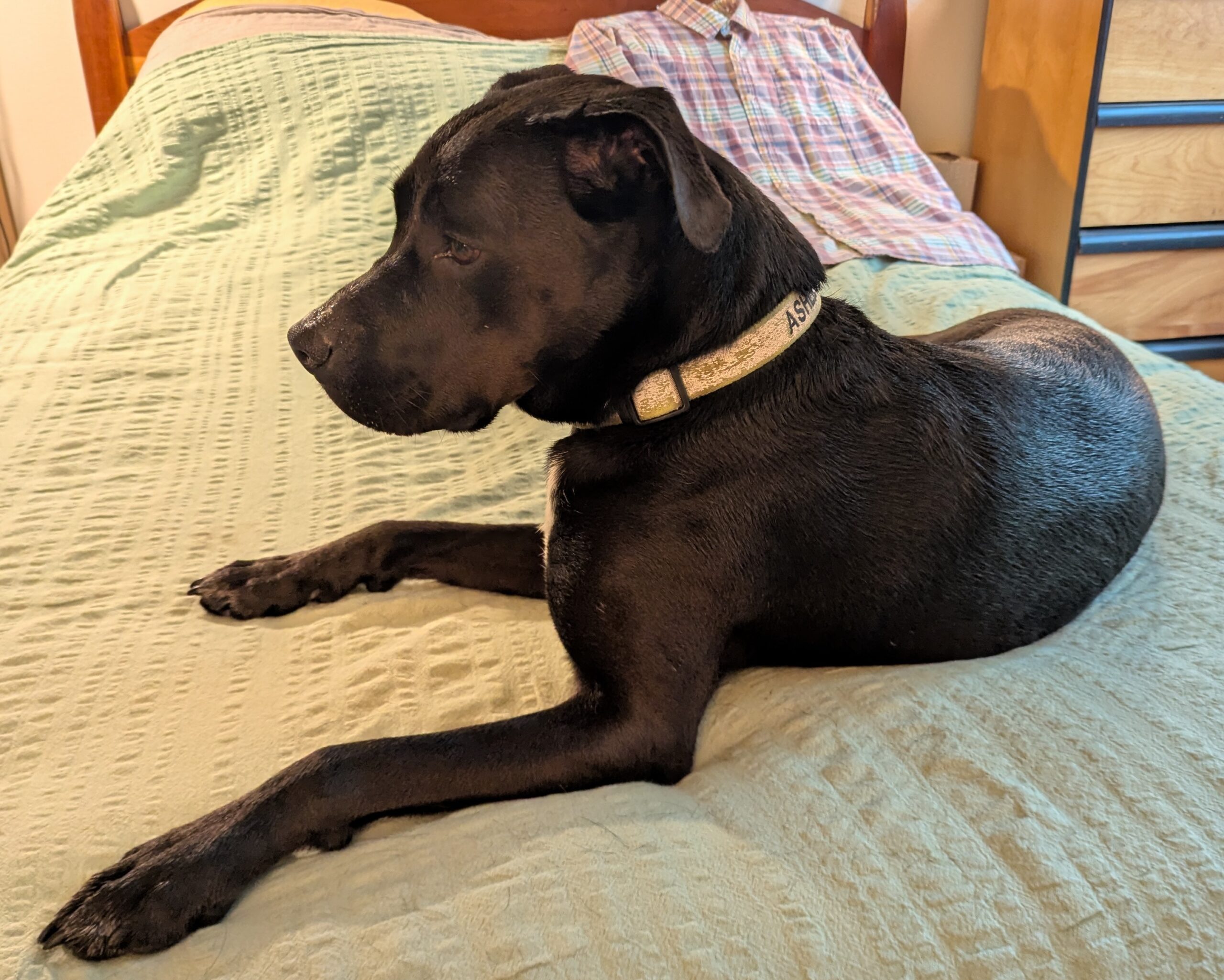
By then the rain had gotten hard again, so Ashley let me take her home, where I did my best to dry her off. But as you can see, my efforts were only partially successful.
There is a flood warning. I’m always a little amused by flood warnings in Central Illinois, because it is so, so flat here. Yes, it is flooding. The little creek is over its banks, sorta. But as soon as it gets over the top of its banks, the water just spreads out. Before it could get high enough to threaten my house (a few feet above creek level), the water would have to flood literally thousands of acres all around us.

That’s not what I learned in 4th grade.
I was out walking Ashley this morning when I saw this painting on top of the recycling bins near my house in Winfield Village.
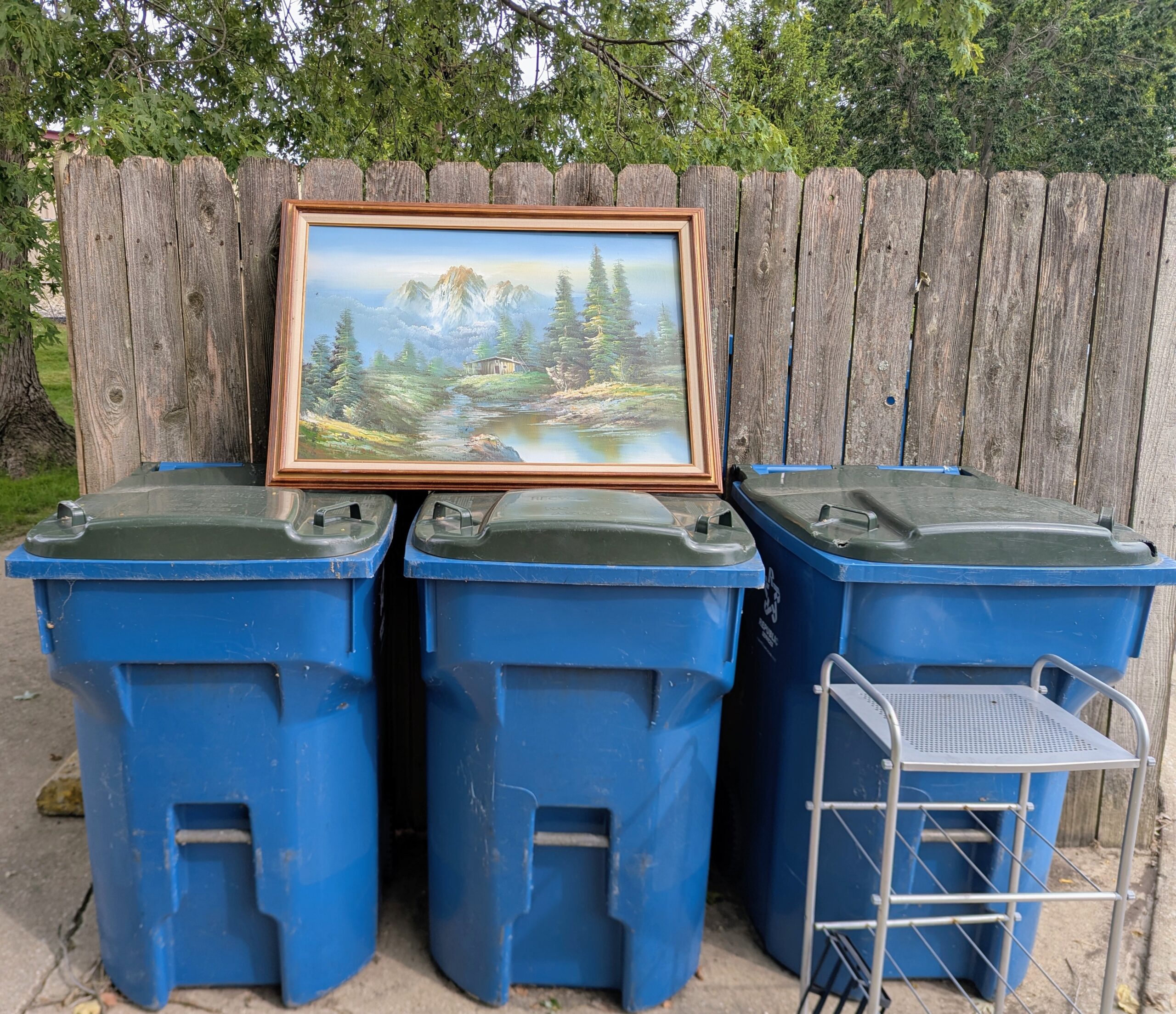
I immediately thought of a guy (probably this guy) who would buy thrift-store landscape paintings and then add a monster to them.
I shared the image above with Steven, who immediately thought of the same guy. (Steven was the one who found that link, before I was even home from walking the dog.)
Isn’t that little lake just begging for a sea monster of some sort standing in it? Or maybe some little cryptids lurking in the trees?
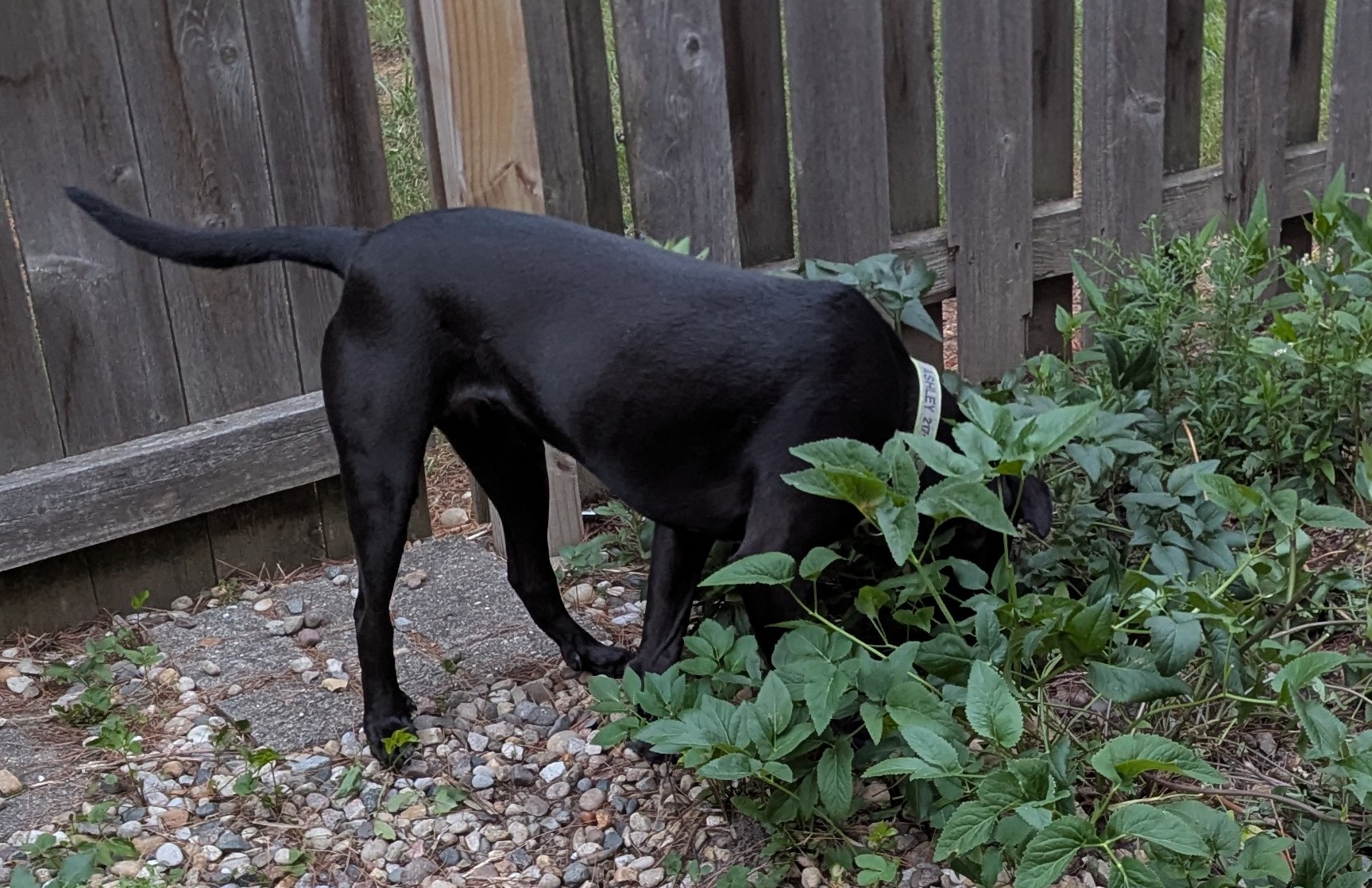
Steven commented while he was visiting on how much fun vole-watching on my patio was.
Ashley thinks so too.
Ashley has caught three voles that I know of (because she was on-leash when she caught them). She may have caught some others on the patio when she was out there off-leash.
One thing that surprised me, because it is so different from our boxers when I was young, was how gentle her mouth is.
Our boxers would promptly dispatch whatever they caught—groundhogs, even raccoons. One shake of the boxer’s head and whatever it had captured in its powerful jaws was dead.
That is not Ashley’s modus operandi. Two of the voles that Ashley captured were released unharmed, after I told Ashley “drop it.” (The third got eaten before I got organized to tell Ashley not to.)
In addition to the three voles, Ashley has caught both one (rather stupid) squirrel, and one (rather immature) robin fledgling. Both of those were released unharmed as well.
I’m not quite sure why. I know some retrievers have very soft mouths, so they can bring back a dead fowl without ruining it. Maybe there’s a gene for that, and Ashley has it? Or maybe it’s just that she was rewarded repeatedly for being very gentle when she took treats from people’s hands?
Whatever it is, I like both aspects of my li’l pupper: truly a mighty hunter, but also a gentle one.
As you’ll know if you subscribe to my newsletter (sign up in the sidebar), my brother and I are attending SFWA’s Nebula Award Conference in Chicago.

Today Steven had SFWA board stuff all day, so after breakfast I went to the hotel fitness center for a workout.
Normally I always do a full warmup before a workout. (This is slightly problematic, as too often I just do the warmup, and then need to walk the dog and fix lunch, and end up never getting to the workout.) Today, because the scheduling seemed to work better, I did the workout first, right after breakfast. Then I did my morning exercises in the early afternoon.
That worked out surprisingly well.
One reason it worked out well was that I did most of the workout on new-to-me machines, so I started with reasonably low weights and worked my way up to working weights, which basically amounts to a warmup all by itself. I did:
I forgot to do goblet squats! There wasn’t a leg-press machine, and I kept thinking, “What can I do to work my glutes?” But I didn’t think of goblet squats. I can do those tomorrow, as well as hitting the other machines (leg curl, biceps curl, and chest press are the ones I didn’t do today).
In con-related news, I have successfully registered! I have a name badge, a program, and tickets for a promised book bag.
I’m expecting Steven’s board-related activities to wrap up shortly, and then we’re talking about heading out to a margarita bar. Or, if his thing runs too late, maybe just having a beer here in the hotel.
I personally am very flexible in this regard.

Have you ever seen a more pleasant garden spot than this sterile bit of lawn, concrete, and pavers at the Crowne Plaza O’Hare? There is no seating at all. There are some walls you can sit on, if you’re reasonably tall, but even the lowest bit of wall is too tall for me to balance a laptop on my knees.
I did find one cigarette butt, so I know the space does not go completely unused.
A while back someone among our local group shared a link to a set of books they’d found on the internet, with interpretations and drills for Meyer’s Art of Fencing. Word among the local group was that the people behind the books publish stuff “based on interpretations that are… subject to debate,” and suggest taking all of it with a grain of salt.
What caught my eye, though, was not the interpretations, but rather the suggested drills.
They reminded me of the sort of drills you find in a certain class of music texts, where they’re going to go on to the advanced stuff, but they want to make sure you’ve got the basics down, so they’ll have exercises like, “Play every major and minor scale in every key for every octave.” Which, you know, if you can’t do it pretty smoothly, you’re going to have trouble doing the advanced stuff, so you might as well know that right from the start.
And that’s what these drills are like. One is to stand in each guard and cut, thrust, or shift to every other guard. Then take a few quick notes. Did moving from that guard to this or that other guard seem easy and comfortable? Did it seem like it would be useful, or just leave you open for your opponent to take some advantage?
The next drill was to stand in each guard, and then execute each of Meyer’s cuts and thrusts. Again, take some notes. What seemed like it worked?
Drills like that don’t seem like they would depend on the author’s hot takes on anything about Meyer. In fact, they seem great on every level. I can get an idea of what might or might not work. I can get some practice doing each of the cuts and thrusts. I can spend some time standing in each of the guards.
Those are all things I can benefit from.
So I started doing some drills along these lines today, starting with Right Ox and Dempfhau.


I want to get a little lower in my fencing stance, and maybe hold my sword a little more forward, but it doesn’t seem as bad as I imagined.
Although Meyer doesn’t say so anywhere I’ve found, Right Ox is the guard you’d find yourself in at the end of drawing your rapier from a sheath. (Thibault says this, I think.) If your opponent drew before you, the very next thing you might need to do is fend off an attack, which suggests to me that Dempfhau might be very useful. So that’s one thing I drilled: Dempfhau from Right Ox followed by a thrust into Longpoint, followed by falling back down on the sword that I’d dempfhaued, and then moving to Iron Gate or back into Right Ox.
Besides that, I did some moving from Right Ox to several other guards (High Guard, Left Ox, Low Guard (on the right and on the left), Iron Gate, Plow, and Longpoint). I need to look more at the low guards and at plow, but the point of the drill is to start putting in the time, not to already be doing everything perfectly.
First tick of the season. I wasn’t even out in the brush! Just walking along in Winfield Village and in Dohme Park!
Doesn’t portend well for the rest of spring and the summer.

All over Europe, farmers are parking their tractors on bridges, in front of fuel depots, and across from government offices, to protest government policies that are making the economics of being a farmer completely untenable.
It’s not happening so much in the U.S. At least not yet. I guess, as long as people are willing to pretend it’s not welfare, farmers are willing to take government money—even as their livelihoods are being destroyed.
But…
But emergency checks are not farm policy. And without a permanent Farm Bill, the next drought, the next bad harvest, the next crisis, won’t have a safety net waiting — just another extension, and another prayer.
Source: Where’s the Smoke? – Offrange