Along with all the other natural movement stuff I’ve been working on, I’ve been trying to recover the ability to do a full squat—heels down, butt just above the ground. I’ve made enough progress to feel like bragging about it.

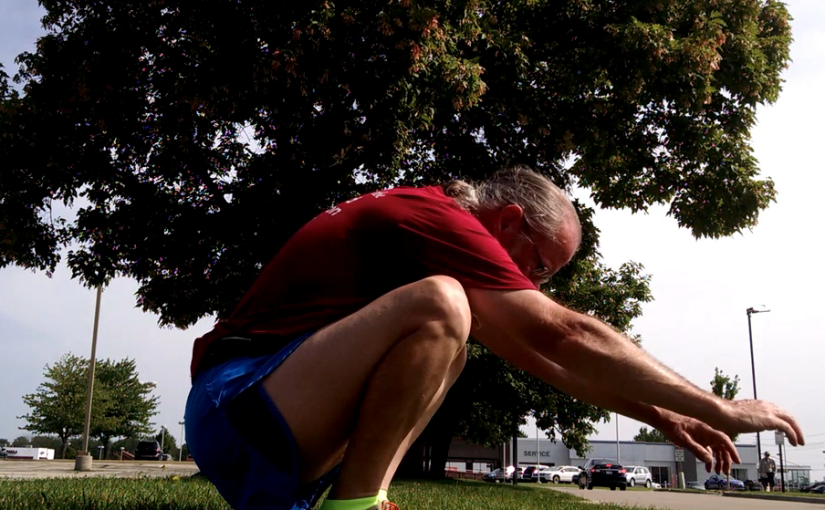
This was almost a surprise to me. I’d been practicing with support—hanging onto a door frame or tree trunk, because I’m not quite strong enough and not quite flexible enough to keep my balance without some help. But a few days ago, while out for a run, I paused to retie shoe, and decided to squat to do it, and found that I could very nearly do a full squat—presumably because the running had gotten me warmed up enough to boost my flexibility.

I do want to criticize my form here: my back is way too round. I certainly wouldn’t want to try to load myself up with weights on a bar and try to push it up with my back like this. But I’m not lifting a bar, just my body weight. As a step toward developing the strength, balance, and flexibility to do a full squat, I’m pretty pleased with this.

I captured a little video. It’s kind of slanty, because I did it by leaning my phone against the base of a tree, but I think it accurately captures my current capability.

Two years we trained for this particular very long walk, without getting it together to make the trip to Kalamazoo during the few summer weeks when the days are long enough to through-hike the Kal-Haven Trail in a day. This year we made it happen.

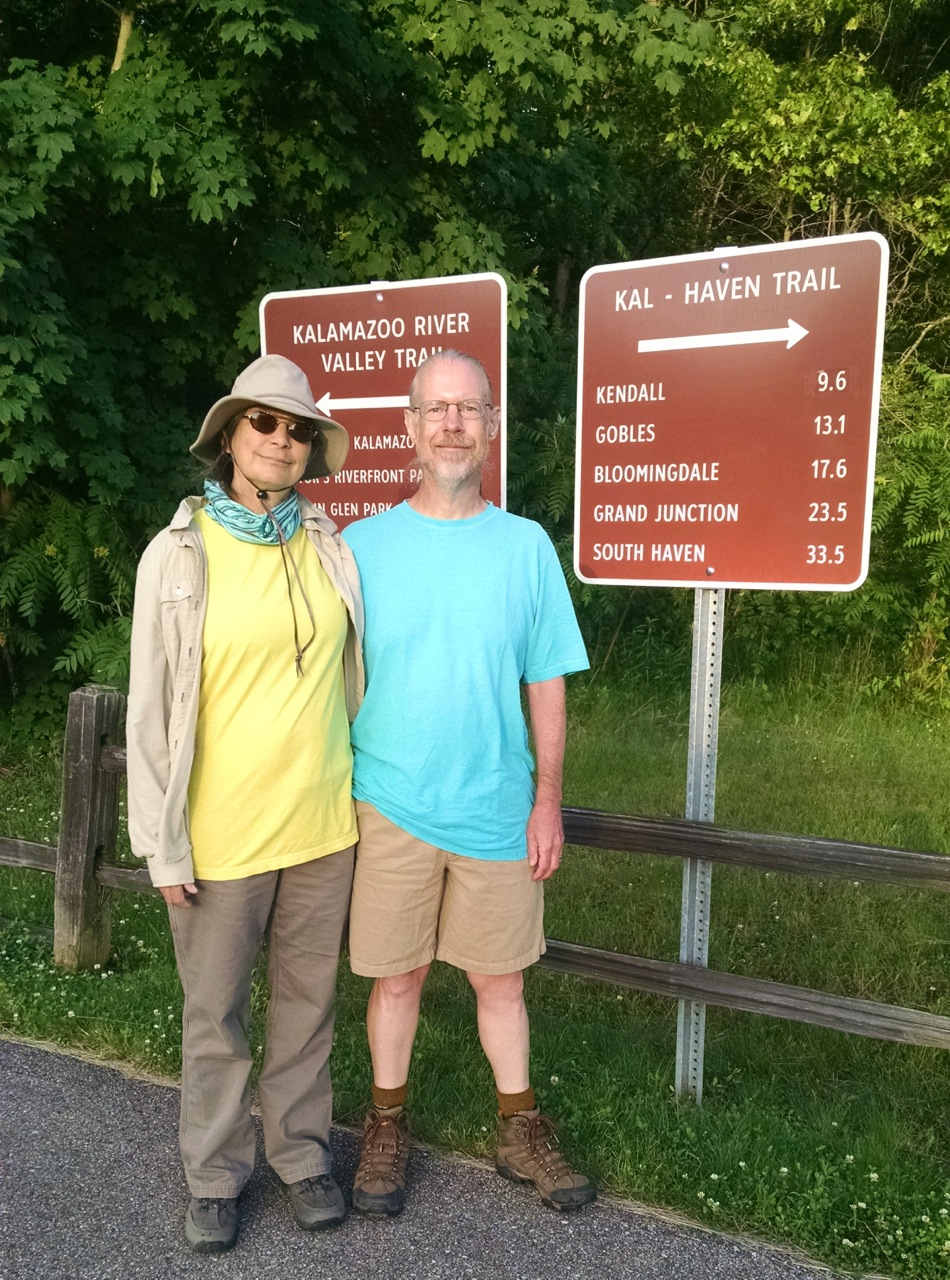
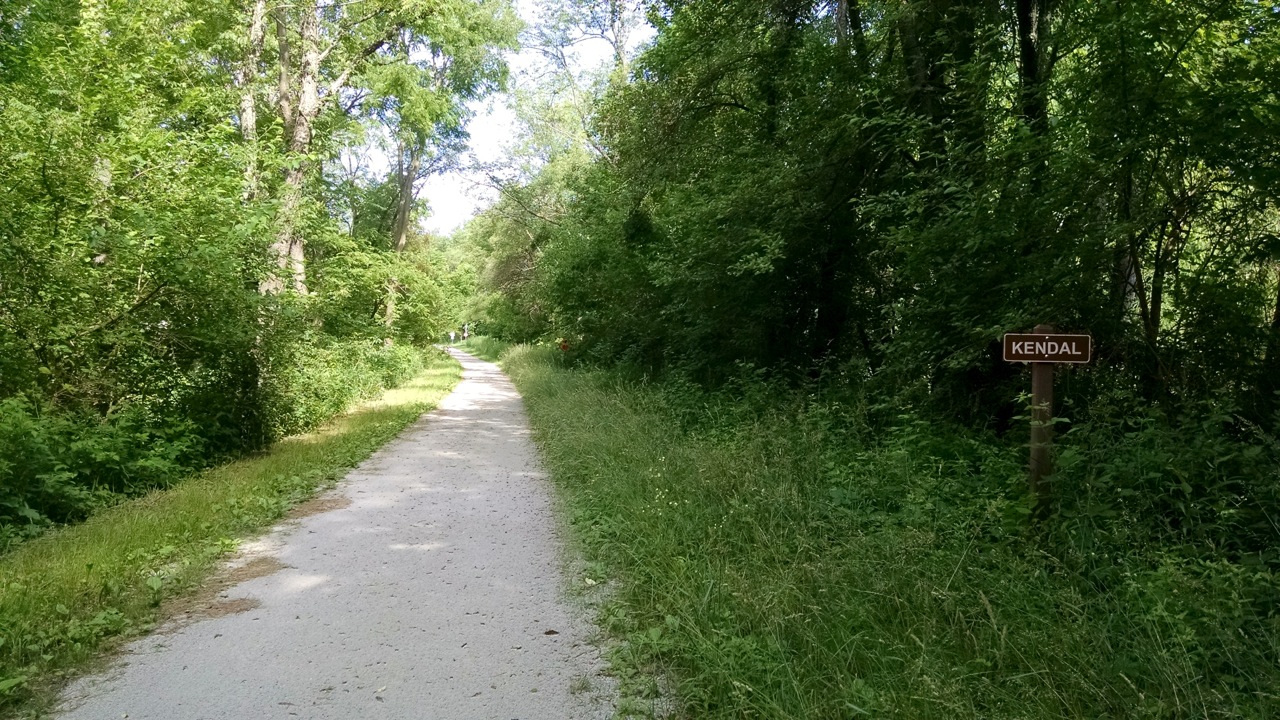
At the trailheadWe meant to be at the trailhead by dawn which was 6:05 AM, but breakfast and final checking of gear took a little longer than we’d hoped. It was almost one hour later when we posed for pictures in front of the sign. We were walking just a few minutes later. Jackie started Endomondo at 7:06.

My brother, Steven Brewer, had offered to drive support, and did a great job. He drove us to the trailhead, met us at four or five points along the way to provide fresh, cold bottles of water, laid out a sumptuous, bounteous feast for lunch, and took pictures along the way. (He has written his own account of the walk.)

We made excellent time through the morning, clocking out a whole series of sub-18-minute miles, and reached Gobles a few minutes before noon.

The crushed limestone surface was great—smooth, level, hard enough for efficient walking, gentler than concrete. (There was one stretch in Bloomingdale that had been resurfaced with asphalt, which was much harder on the feet.)

photo_18363558004_oThere was one downside to the surface, though. Almost as it it were designed that way, my tread caught the limestone and pitched it forwards into my boots. I had to stop every few miles and shake a teaspoon of limestone grit out of my boots.

Still great for walking on, and kinda pretty.

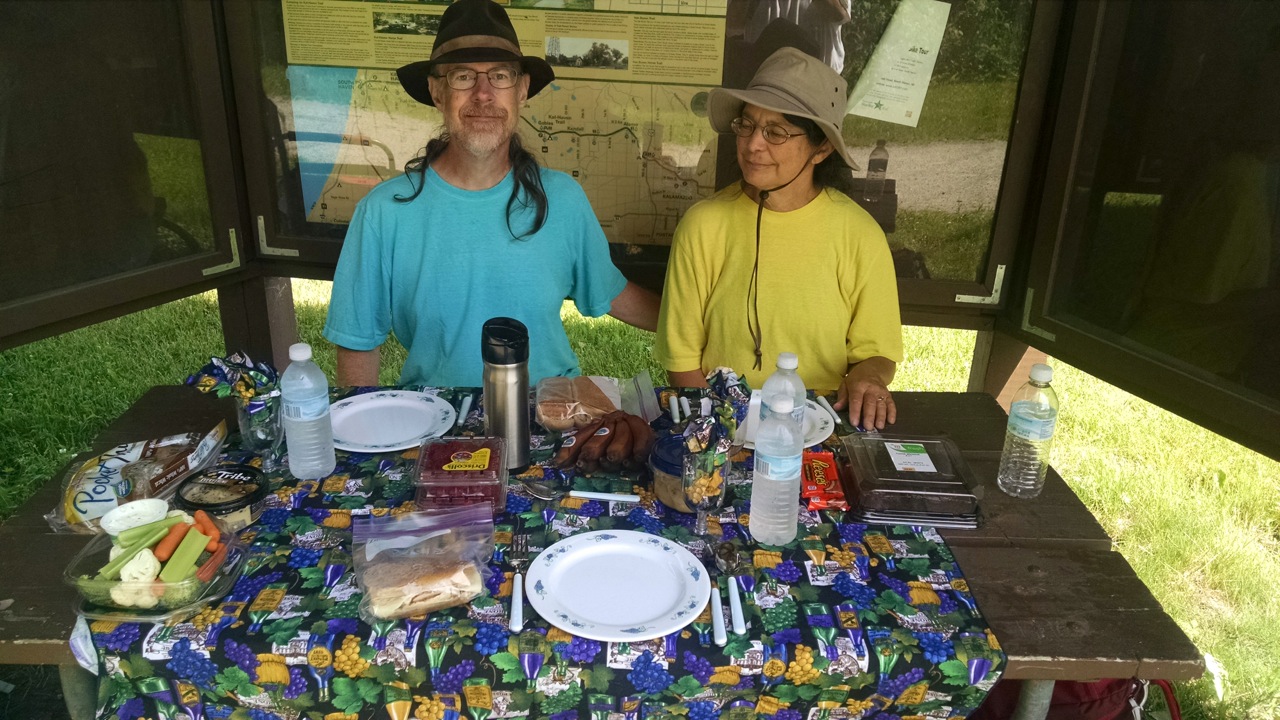
I had made sandwiches, and Steven had gotten all sorts of stuff to go with them—german potato salad, red bananas, hummus, flat bread, raspberries, raw veggies, and brownies for desert.

Trailside FeastBehold our awesome lunch, served trailside, complete with cloth napkins.

It took some minutes to loosen up after we got started going again, but we were almost matching our pace, carrying on with sub-20-minute miles right along until we hit mile 25.

I was still feeling pretty good then. We had slowed down a bit, but as we passed mile 27, I tweeted, “Has blown through marathon distance and is pressing for 33.5 miles. South Haven here we come!”

Pretty much just about then, though, I started dragging a bit. We had walked farther than we’ve ever walked before, and the last few miles were tough.

We pressed on, walking at perhaps a 22-minute pace. Jackie held up better than I did, as you can perhaps tell from this picture, taken very close to the end of the trail. Steven had suggested that we smile, and both Jackie and I did our best:

Approaching South HavenAt that point it was merely a matter of trudging on. We wrapped up at 33.41 miles as measured by Endomondo, and Steven popped us into the car and drove us to the restaurant for a celebratory feast.

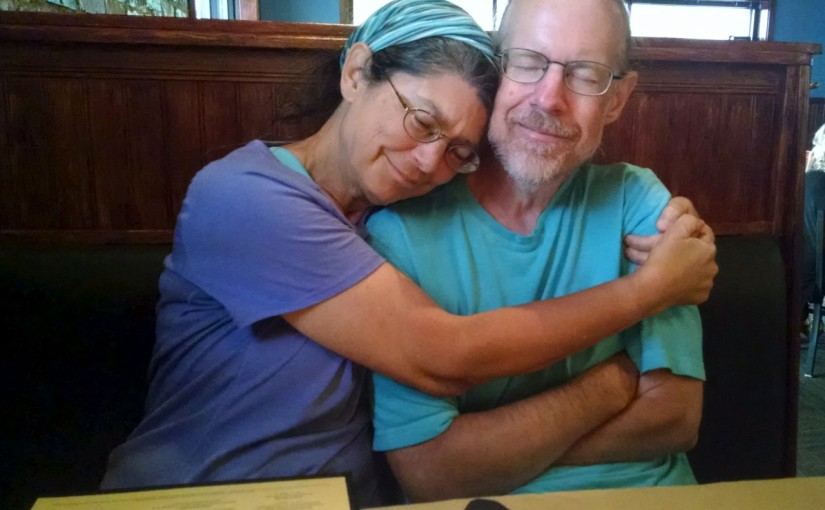
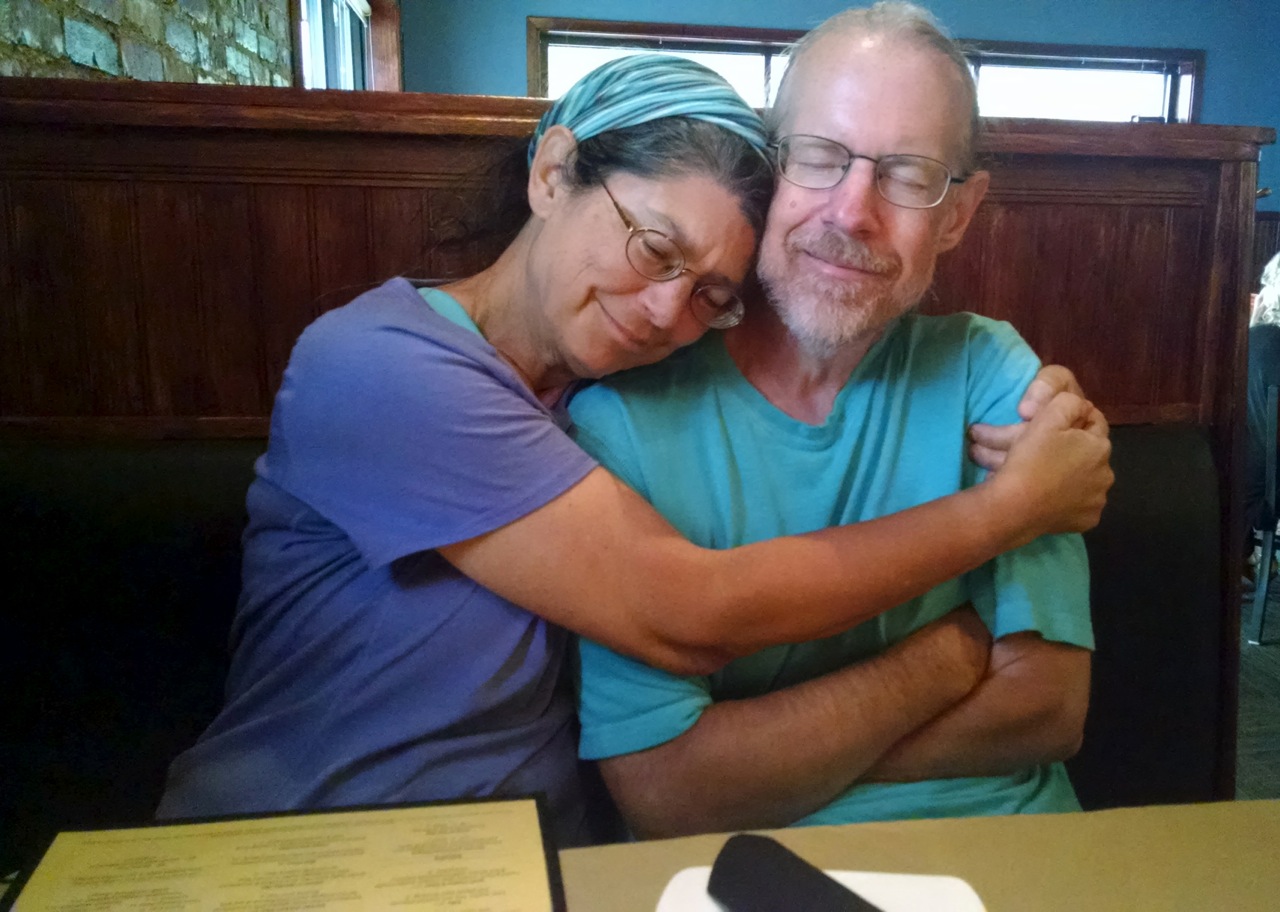
At about that point, my body seemed to have lost the ability to thermoregulate—I was shivering so hard my teeth were chattering in the slightly cool air of the South Haven evening.

Jackie wrapped her arms around me to keep me warm, and Steven got this picture as well:

18964591362_299df20f06_oAfter a good night’s sleep, a big breakfast, and a nap after lunch, I think we’re all largely recovered. I stiffen up a bit if I sit still, but am not really even very sore. In the morning we got out to play Ingress, and I was able to walk around pretty much as usual. I’ll take at least one more day off before I go for a run, but basically I feel fine.

We have no plans for even longer walks, but we’ll certainly keep walking, perhaps expanding to multi-day through-hikes of the sort where your gear is schlepped for you from B&B to B&B.

It was a great experience!

I have always found “deconstructionist” models appealing. For example, I liked the idea that you could “figure out” all the nutrients that you need and then build up a diet that provides the right mix of carbs, proteins, fats (with proper mix between omega-3 and omega-6 fatty acids), the right amounts of fiber, vitamins, minerals, and so on.

Then Michael Pollan came along and (in his book In Defense of Food) completely destroyed that idea. First of all, it’s an impossible problem to solve—the different nutrients interact in the body (and biome) in ways that are intractably complex, plus there are so many micro-nutrients as to make it computationally infeasible (even if we knew what all of them were, which we don’t). More to the point, though, it’s a completely unnecessary problem to solve: our bodies solve it for us, as long as we eat a diet of diverse foods and minimize our consumption of manufactured food-like substances.

I’m not saying this is new news. In fact, this is common knowledge—everybody said this, right from the start. What I’m saying is that, for reasons no doubt having to do with my personality and psychological makeup, I liked the deconstructionist model for analyzing and then constructing a plan for what to eat, despite what everybody said. For some reason, again having to do with my personality and psychological makeup, Michael Pollan’s explanation of how the whole deconstructionist model of designing a plan for eating was fundamentally flawed suddenly made it clear to me (in a way that any number of people—including my third grade health teacher and both my parents—had not managed to do).

All that seems relevant because—I recently realized—for years now I’ve been making the exact same mistake with movement. I’ve been trying to “figure out” an exercise regime that would keep me fit. If you click on the Fitness category over in the sidebar, or the “exercise” tag on this post, you’ll be linked to a long list of my posts on the topic, many of which describe my latest attempt to find the right mix of walking, running, bicycling, lifting, stretching, and taiji to build and maintain optimal levels of aerobic capacity, strength, and flexibility.

Then I ran into the work of Katy Bowman, whose explanations of why exercise is no substitute for movement clicked for me in just the same way, and for roughly the same reason: The problem is intractably complex, and anyway our bodies solve the problem for us—as long as we engage in an ample amount of diverse movement and minimize things like sitting in chairs and wearing bad shoes. (See her book Move Your DNA: Restore Your Health Through Natural Movement.)

Again, this is not really new news; I’m just late to the party because I like the idea of designing an exercise regime that covers all the necessary categories.

However, I think I have come around. Appealing as it is to me to design the perfect exercise regime and then tick off each box as I reach my target for the week, I pretty much have to admit that the whole thing is a fool’s errand. I’d be much better off spending that time walking, stretching, hanging, squatting, climbing, balancing, jumping, throwing, catching, and so on.

I’ll still run (because I enjoy it, probably due to the endocannabinoids, and because being able to run is useful), but I’ll spend a lot less time on things like figuring out how much I can safely add to my weekly mileage. I’ll just run as much as I feel like—while being careful to do so mindfully, and to pay attention to my body, so that enjoying running doesn’t entice me to run more than should.

Still not new news.

For most of my life, my appetite was a terrible guide as to how much I should eat: If I ate until I felt full, I gained weight; if I ate few enough calories that I would lose weight, I’d feel hungry all the time.

Late last summer, this changed. It happened like this.

I had managed to lose quite a bit of weight over a period of about three years, and was nearly down to what the National Institutes of Health consider “normal” weight. But just at that point—only three or four pounds above that threshold—my weight loss suddenly slowed.

This was kind of discouraging—especially so, because it seemed there would be no easy way to push on through those last few pounds. I was already eating a good, healthy diet. It was summer, so I had already ramped up my physical activity. I had already cut way back on things like snacks and deserts.

I thought pretty hard about my options, and came to the disheartening conclusion that I would have to resort to “portion control.”

Although the only thing I could think of, this seemed like a terrible idea. I had spent most of my adult life trying to “eat less,” with roughly the same degree of success that one might have trying to breathe less—I could do it for a while, but only through total focus. It never worked for longer than I could maintain that focus.

The next step would have been to ask Jackie to provide smaller servings. But before I got to the point of actually doing so, something very strange happened: All of a sudden, I didn’t want to finish my meals.

This was a very different feeling from what I used to think of as feeling full. I had always been able to tell when I was about to eat too much—the point where, if I had any more, I’d be doomed to hours of feeling overstuffed. Learning to pay attention to that signal had been a key step in the weight loss I’d managed to this point, but this was something different. Long before I’d eaten that much, I was suddenly feeling like I’d had . . . enough.

After a couple of days of this—of leaving a third or more of my meal uneaten because I really didn’t want any more—I did ask Jackie to provide smaller servings. But instead of a desperate and unlikely measure to lose those last few pounds, it was just a recognition of how much I wanted to eat.

I paid attention to this new feeling of how much I wanted—how much was enough. Sometime in the next few months—as I lost those last few pounds, and then continued losing weight at a slow pace—something occurred to me: This was what it’s like to be normal.

Although there’s a lot of obesity these days, even now most people are normal weight. This is—I had always assumed, and now was experiencing first-hand—because most people have a good sense of how much food was enough.

It was easy to start trusting this feeling when it came to eating less. Now that my experience with it stretches back most of a year, I’m starting also to trust it when it tells me I’m still hungry even after eating a normal amount of food.

This used to happen all the time—unless I was eating too much, I’d always be hungry. To lose weight, I’d had to come to terms with this, come up with strategies for not eating as much as my body thought I ought to have.

That was a hard habit to break, but I’m starting to trust my appetite.

Part of what’s letting me do this is that I’ve been tracking my weight for years. Over the past nine months or so, I began to see a pattern: My weight was declining very gradually—on track to fall to the mid-point of the “normal” range in a year or two.

When I’d eat what I thought was an appropriate amount of food and still feel hungry—when I’d stick to what I thought was appropriate and not eat more just because I wanted more—my rate of weight loss would spike up toward the rates that I saw during the previous three years.

Upon reflection, I decided that the basic trend was probably where I wanted to be. I probably ought to lose some more weight—I suspect that the mid-point of the normal range would be an excellent weight for me—but there’s certainly no rush to get there. In fact, a very gradually declining weight is probably extremely healthy, in terms of blood sugar and lipid chemistry.

I’ve about come to trust my appetite—to have some confidence that it will guide me to an appropriate weight and keep me there, if I just eat right, get plenty of exercise, and pay attention—but I’m in no hurry to put it to the test. I’m actually quite happy staying on a slow downward track toward that point, and feel little inclination to sprint for the finish.

What a luxury it is, to have my body tell me when I need to eat more, and then tell me when I’ve eaten enough.

We’ve decided not to do another even longer walk before we do the big hike of the Kal-Haven trail. (Coming up later this month!)

I’d had it in my head that we’d do a 30-mile walk, but the more I thought about it, the less it appealed. Mainly, it seemed like it would make the main event less special. (“Oh. We walked 3.5 miles longer than our longest training walk. Big deal.”)

We will do one more walk of close to marathon distance, somewhere in the 20–25 mile range, but besides that, we’ve been doing some shorter walks of a more rugged nature, hoping to address some deficiencies that cropped up on the marathon-length walk.

In particular, I noticed that toward the end of really long walks, my hips get tired and seem kind of wobbly when I walk over uneven ground. I thought one way to address that, besides doing more longer walks, would be to find some especially uneven ground to hike on. That’s why we went to Fox Ridge and later to Forest Glen—the trails would let us get in some longish walks with some slightly different sources of stress than just more longer.

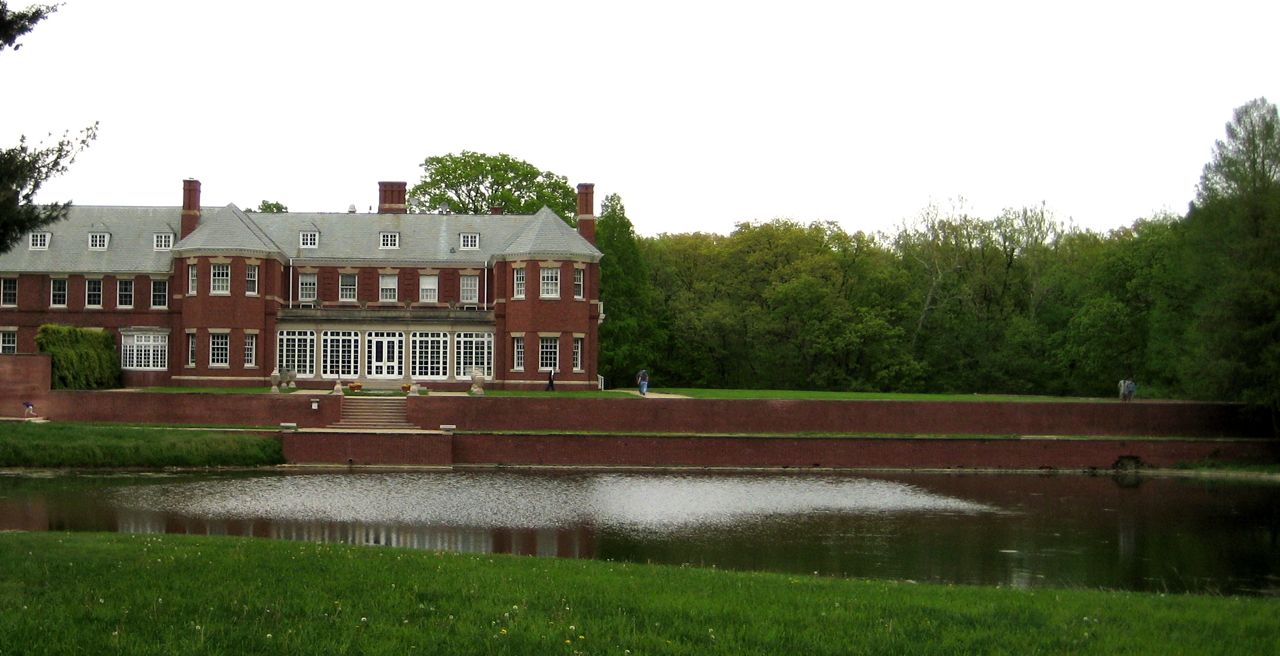
Today we hiked at Allerton Park, doing a bit over 6 miles of some not-too-rugged trails. We’d had it in our heads to do 6 more miles on the other side of the Sangamon River, but decided to skip it due to schedule constraints—we would have had to rush to get home in time to got to my Esperanto meeting and the farmers market this evening.

Besides the hike, we also took half an hour or so to do some taiji in the Fu Dog garden. That was very nice.

Once again, I got to put my parkour practice to use.

There’s a path that leads—used to lead—to the back of the mansion, and there used to be an iron spiral staircase that got you up to the top of a retaining wall the separates the grounds (at one level) from the steep slope down into the forest and the Sangamon.

We hiked up that trail—what’s left of it—only to find that the iron staircase has been removed.

The wall there would be beyond our capability to climb, but just around the corner (separating the mansion grounds from the pond), the wall is shorter—about chest high.

It’s been a long time, but I just did what I would have done as a boy facing a wall of that height—I put my palms on it, then jumped up high enough that I had enough leverage to go ahead and push myself up onto the wall.

Jackie found that she couldn’t jump high enough to get to where she could push herself on up, so she reached over the top of the wall to where she could hook her fingers over the far side. Then she just scrabbled up as best she could, her boots sliding on the bricks, but catching enough that she managed to get herself up onto the wall.

We were both pretty pleased with ourselves. I doubt if we could have climbed that wall five years ago.

I neglected to get a picture of the wall from today, but here’s a picture from a few years ago, looking across from the far side of the pond (click to embiggen):

allerton mansion retaining wallWe were way over on the right, and our climb was from just above the pond. (There are two walls there. We just climbed the lower wall. There’s a path at that level, and then a second retaining wall up to the level of the mansion grounds proper.)

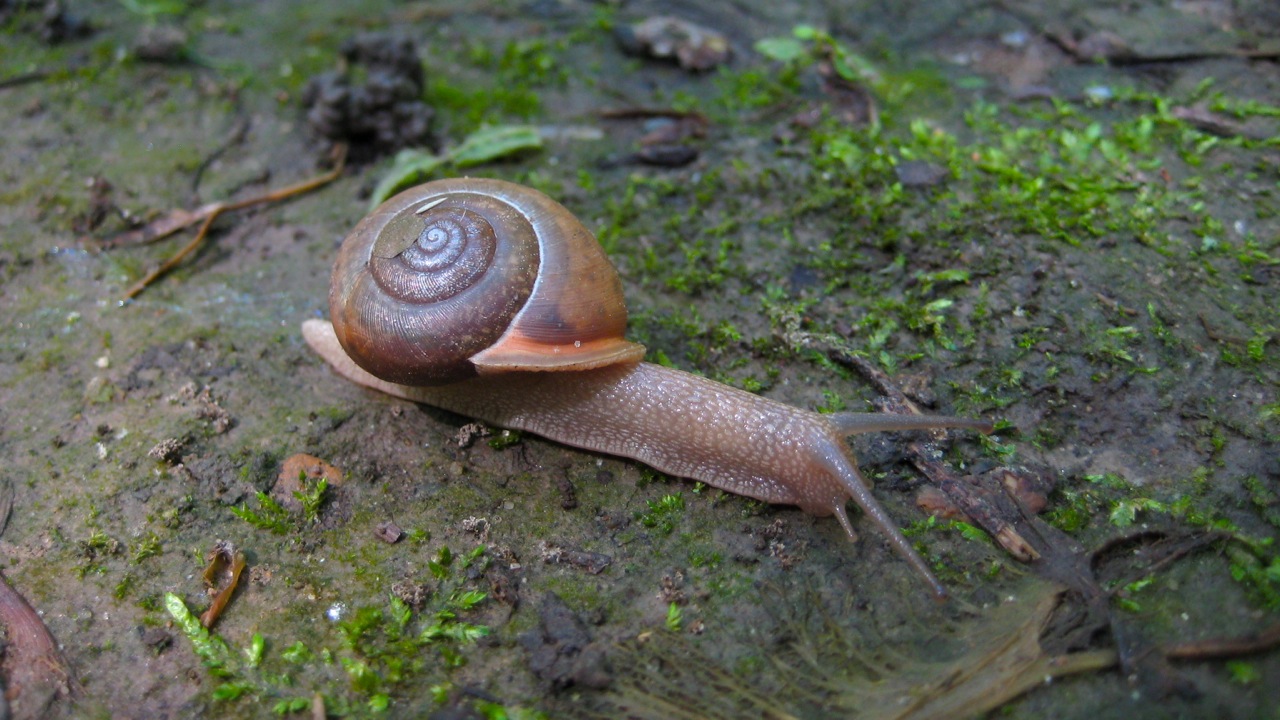
On an unrelated note, today seemed to be Path Crossing Day for the snails. I scarcely took a step down the path without seeing a snail.

Here’s the first snail I spotted:

trail snail at allerton parkIsn’t he a handsome fellow?

I don’t know when I quit crawling. Probably around first grade. I’m not sure why, either. Because it was something babies did, and I was grown up, I expect.

I don’t remember my parents trying to get me to quit crawling, but I’ve seen other parents try to convince their children to stay off the ground, in the interests of either propriety or cleanliness.

At any rate, most people who crawled all the time before they were five years old have so completely lost the habit it doesn’t even occur to them as a possible way to get under or through something.

When I trained with the local parkour group, the first thing the group practiced was quadrupedal movement—crawling on hands and feet.

After that practice session, I added quadrupedal movement to my own practice, and the first time I went out to do it, Jackie decided to come with me.

(It happened like this: I told Jackie I was going to go play in the woods. “What are you going to do?” she asked. “Crawl and roll on the ground,” I said. “Can I come?”)

We did some rolling, both just rolling sideways and shoulder rolls. We also did some crawling, both prone (bear crawl) and supine (crab crawl).

The actual amount of time spent crawling was pretty small—I doubt if it added up to as much as 5 minutes—but it turned out to be a surprisingly successful bit of practice, because just in the week since then, it has usefully informed the way we dealt with obstacles repeatedly.

The first time was last week at Fox Ridge State Park. At one point the trail was blocked by some fallen trees. There was more than one trunk, making the geometry a bit complex for climbing over. There was enough space underneath the bottom trunk that it would almost have been possible to just do a “step under” move, except we were wearing packs, meaning that we needed another eight or ten inches of clearance.

If I hadn’t just practiced crawling, I don’t think it would have occurred to me that the easiest way to get under the trunks was to crawl on my hands and feet. We’d probably have done something complex, like both take our packs off, have me step under the barrier, handed both packs through (or over), and then have Jackie follow under the barrier.

With the recent reminder that crawling is simple and effective, that’s what we did. I tried to step under, found that there wasn’t clearance for my pack, so crouched down further, put my hands on the ground, and crawled on through. Took about five seconds. Got my hands a little dirty. Worked great.

Yesterday we hiked the backpacking trail at Forest Glen, which presented a problem for which supine crawling made an excellent solution.

steep pathIt’s hard to capture the steepness of this bit of trail in a photo. Not only was the trail steep, it was also wet, and the mud was slippery.

Jackie went down first, and quickly found that the combination of steep and slippery made it too dangerous to attempt to go down bipedally. She dropped down and did an inverted foot-hand crawl (aka supine crawl or crab crawl). It made for a quick, efficient, safe way down the steep bit in the path.

I followed behind, just the same way.

Rediscover quadrupedal movement. Besides being a way to get under or through something, it’s also very stable—perfect for dealing with loose, rugged, steep, uneven, or slippery ground.

I mentioned a while back that it looked like Christopher McDougall’s new book had been written just for me. Now that I’ve read it, I can say it was just what I was hoping for.

Natural Born Heroes: How a Daring Band of Misfits Mastered the Lost Secrets of Strength and Endurance by Christopher McDougall.

It’s a book written in three layers. First, it’s the true story of a group of resistance fighters on Crete who kidnapped a Nazi general and undertook to smuggle him off the island into the hands of the British. Second, it uses that story to explore the ancient Greek ideal of heroism, and to talk about how the ancient Greeks had figured out how to make people into heroes. Third, it talks about the author’s own efforts to develop those same traits—strength, skill, compassion—in himself, and to use those capabilities in his travels across Crete in the footsteps of the resistance fighters.

It appealed to me for a lot of reasons, not least of which is that McDougall has followed much the same path I have—running, barefoot running, parkour, then natural movement.

It’s a meaty book. There’s the adventurous war story, there’s the history of the Greek traditions of fitness and martial prowess (and their martial art, pankration), and there’s the personal anecdotes. But even the anecdotes are more than just “I tried these things and they seemed to work.” McDougall does his research, talks to experts, provides his references, and then tries stuff out and reports on his successes and failures.

The stuff on blending endurance exercise with a low-carb diet was fascinating—and new to me, even though the primary work dates from back in the 1980s. Other stuff, such as the work being done on the importance of fascia for strength, power, and speed is genuinely new.

Highly recommended.

While I was waiting for Natural Born Heroes to come out, I was casting around for something to tide me over—something to fill the space of wanting to read about natural movement—and happened upon a book by Mariel Hemingway from a couple of years ago.

Running with Nature: Stepping Into the Life You Were Meant to Live by Mariel Hemingway and Bobby Williams.

This is not a meaty book. Comparing it to McDougall’s book, it’s as if someone left out both of the first two layers, and wrote a book that was just the personal anecdotes. Some of the “information” in it is just wrong and some of the rest is pretty dubious, but I found it easy to read past the nonsense, because much of the rest of the book made so much sense.

Mariel Hemingway—a pretty girl (now about my age) from a family of celebrities—grew up without a good model for how to live a happy life. Prone to depression, and viscerally aware of the malady’s dangers (a frighteningly high fraction of her relatives either committed suicide or ended up in mental institutions), she had to invent her own self-care regimen.

The regimen she came up with has much in common with my own (and this probably has a lot to do with why I like it). It’s pretty obvious stuff: exercise as play, ample rest, healthy food, plenty of sunlight and fresh air—with some very specific notions that I haven’t implemented yet, but that are probably great ideas, such as making your sleeping area really dark.

I recommend it, but I’m glad I checked it out of the library rather than buying a copy.

After finishing the McDougall book, I was again bereft of a compelling book on human movement. Into that empty space came a book by Jonathan Gottschall.

The Professor in the Cage: Why Men Fight and Why We Like to Watch by Jonathan Gottschall.

Gottschall was an adjunct professor of English who came to realized that his career had peaked. All he could expect was years of teaching English Composition to kids who didn’t want to learn until he eventually annoyed a critical mass of administrators who would then quit renewing his contract, leaving him unemployed. At about the point where this realization became something that he could no longer ignore, he noticed that the vacant former hardware store visible from his cubicle had reopened as a mixed martial arts gym.

Looking out the window, he gets the idea that he’ll start working out at the gym, and then gets the idea that he could fight an MMA-style cage match and write a book about it: The Professor in the Cage!

I happened upon this book in an author interview with the Art of Manliness. It sounded like it might be an informative exploration of the intersection of human movement arts generally with the fraction that are martial arts, as well as being a fun story about taking on a challenge.

Part of the reason that it’s fun is that the author is quite open about the genre that he’s writing in. It’s a stunt book, a type of book which has a certain structure—the author gets in over his head, and writes self-deprecatingly of his struggles. He doesn’t try to disguise the fact that he’s doing that: He knows it, and he knows that you know it.

But it’s also very interesting when the author isn’t getting beat up, because it’s not just personal anecdotes; it’s also a scholarly exploration of ritual violence. He talks a lot about why men engage it in, why women mostly do not, how dueling cultures came to develop, and why they die out. Those aspects of the book are well-researched, with extensive notes, and strike a pretty good balance between the evolutionary and sociobiological basis of the difference between male and female choices and the sociological and anthropological ones.

He also looks at the question that the modern “cage match” fights were supposed to answer: which martial art is the best? (Answer: It turns out that wrestling/grappling styles beat punching/kicking/boxing styles. A grappling-focused style of ju-jitsu totally dominated the MMA cage match fights, until all the fighters learned enough wrestling to hold their own.)

It was especially interesting to read after having read the McDougall book. Both look at the Greek tradition of fitness and both talk about pankration, the ancient Greek martial art, which turns out (unsurprisingly, because it’s both a striking and a grappling art) to look a whole lot like modern mixed martial arts.

I recommend it. Very interesting.

Now I am again between books about human movement, and am having to make do with fiction.

I’ve started thinking of my fitness practice more as movement practice. This post is about that shift in my thinking, and if that’s not going to be interesting to you, you’ll probably want to just skip this one.

I have always wanted to be fit, for what I think are mostly ordinary reasons: to be healthy, to look good, to be capable of doing the things that need to be done. For most of my life, my fitness practice fell short of what I thought it ought to be, again for mostly ordinary reasons: I was busy, the weather was bad, I found exercise boring or unpleasant.

I would get my aerobic exercise running and cycling in the summer, and walking year round. When the weather cooperated with a mild spring, I could get in pretty good shape by mid-summer. A couple of years, I even preserved some level of running capability over the winter; one of those years, I ran the Lake Mingo Trail Race, which at 7.1 miles was usually beyond my capability in mid-June when it takes place. But, given the realities of working a regular job (with hours when I needed to be sitting at a computer, rather than out for a run), winter (when I just about don’t cycle or run) and injuries (as my brother likes to say “Running is great exercise, between injuries”), my fitness practice never made me fit for the long term, just fit for a while.

This changed a few years ago, for a couple of reasons.

The less important reason was that my employer closed the site down, and I decided I could get by without a regular job. It means our financial circumstances are a bit straitened, but my hours are my own.

More important, I started practicing taiji.

Taiji gave me balance and control, but much more important, it taught me mindfulness—to be present in my body during my exercise. (I was prompted to write this post at this time because I’ve been reading a blog by Johnathan Mead called Move Heroically, that nicely hits the sweet spot in my evolving interest in fitness. The latest post in particular is on exactly this topic: Embodiment is a Performance Enhancing Drug.)

I like to think of my exercise as building capabilities. I go for long walks because I want to be able to go for long walks. I run because I want to be able to run.

That’s an oversimplification in at least two ways.

For one thing, honesty requires me to admit that I engage in endurance exercise because I like it (perhaps because of the endocannabinoids it generates). A long run at a brisk pace makes me feel good.

More important it’s an oversimplification because specificity of training means that my exercise practice was only building a very narrow slice of the capabilities I imagined. Yes, if I go for a long run every week or two, I do create and maintain the capability to run a long way, but that capability is only barely transferable to other activities. When Jackie and I wanted to go on a century ride, we spent many weeks building up our stamina for long rides. Given how long it’s been since my last long ride, I would not want to stake my life on my capability to bicycle 100 miles without a good bit of training. Maybe fewer weeks because we’re fitter now, but I’d still want weeks of training before attempting another century ride.

It was this realization, in conjunction with my taiji practice teaching me to move more mindfully, that brought me initially to parkour, and more recently to natural movement generally.

Running wasn’t just for fun (although it was fun), and it wasn’t just to be more healthy (although I expect I am). I was explicitly building the capability to run if I needed too. I used that capability sometimes—to catch a bus, to get to an appointment on time—and I imagined that I could use it under other circumstances as well: running away from some danger, running toward someone who needed my help.

But I came to realize that, because of exercise specificity, my capability was a very narrow one indeed. I could run, but I could only barely jump or climb. If I came to a place where I needed to step down I was fine, as long as the drop was only a step or two. But if I needed to jump down by, let’s say, three steps, things got much more problematic. I could climb up a steep path, but am quite daunted if I need to climb up a tree, or cliff, or a wall, or a rope.

That was what brought me to parkour.

Even before I made much progress in the skills of parkour, however, I happened upon natural movement. It shares the roots of parkour, but is less about the specific skills of parkour (vaults and such), and more about basic human movement. Yes, walking and running. Also climbing and jumping and crawling. Balancing. Throwing and catching. Lifting and carrying. Swimming and diving.

So, this is where I’ve come to. I’m very pleased with my walking, and adequately pleased with my running. My climbing skills need considerable broadening. Thanks to taiji, my static balance is okay, but I’m still a beginner when it comes to more dynamic balance. My throwing and catching were never great, and have declined enormously due to a lack of practice since I was a boy. My lifting and carrying skills are deficient, due to too many years lifting weights primarily with machines. If you dropped me in water over my head I could avoid drowning for a while, but unless shallow water or rescue were reasonably close, I would be hard pressed to reach it.

There is a great deal I want to learn (and re-learn) this summer, and I have started in small ways.

weir-behind-winfield-villageThis weir crosses a ditch that runs behind Winfield Village. It’s concrete, a good 12 inches wide, but curved on top, making it a pretty good imitation of a log put across a river to serve as a bridge. I’ve been including it as part of my running route, initially with some difficulty (needing to use the concrete blocks as additional stepping stones), but now crossing on just the weir, and beginning to pick up the pace.

I’m being very careful—Jackie would be quite peeved with me if I injured myself right before our Kal-Haven Trail walk—so I’m not doing much with jumps or vaults yet. But my concept of fitness has broadened greatly, and I’m no longer satisfied with merely a strong heart and strong muscles. I want the full range of human movement capabilities.

Over the past three years, Jackie and I have done a lot of walks where the distance came in at around 20 miles, but we’d never actually reached 26.2. Yesterday we did.

In many ways, this was just another training walk for our planned Kal-Haven trail walk—which is why we hadn’t hit this distance before: We’re much more concerned with not hurting ourselves before the big walk than we are with hitting any arbitrary distance in advance.

Still, I’m glad to have finally walked 26.2 miles, because now I don’t have to feel like an imposter when I wear my rain jacket:

me-in-marathon-rain-jacket
Me in my marathon rain jacket. Photo by Jackie Brewer.

I got this jacket long ago—at least 15 years ago, maybe longer. I remember finding a gore tex rain jacket in the Sierra Trading Post catalog at about an 80% discount. I think it was so cheap mostly because it doesn’t have a hood, which is a deficiency for a rain jacket, but the large marathon graphic on the back may also have put off some people who were not marathoners.

I snapped one up immediately. Only after I had secured mine did I share the catalog with a friend at work who I thought would also be pleased with a cheap gore tex jacket. (He bought one too. For years we were occasional twinsies on warm rainy days.)

All these years it has been my main rain jacket, and all that time I’ve been just a little uncomfortable wearing a jacket so prominently marked as being for marathoners. Now, finally, I can quit worrying about it.

We were walking rather than running, so we were on the road a long time—almost ten and a half hours. (The people who win marathons run them in a little over 2 hours; middle-of-the-pack runners tend to finish in 3–4 hours.)

It was a great walk, although we were feeling pretty tired the last few miles. We went up to our old neighborhood and walked around our old apartment complex. (It looks a bit more empty than when we were there.) We walked up the Greenbelt Bikeway, then headed east to our summer place. (It looks exactly the same as it did when we lived there last year.) Then we walked through the water amenities at Second Street, and onward to Busey Woods. Then down Race Street to Orchard Downs and across through the arboretum and the research park. We went north to Florida to cross the railroad tracks, then headed south along the Boulware Trail and on into Savoy. We went west just a bit to take the path along Prospect down to Curtis and thence to home, taking a slightly long route through Winfield Village (with a tiny diversion into our prairie) to be sure we hit the target mileage.

In the end we went 26.4 miles. Here’s the Endomondo data:

Vox has an article, A brief history of the bizarre and sadistic Presidential Fitness Test, which I find that I have surprising strong feelings about.

As the headline suggests and the article explains, the whole program was wrong-headed and badly implemented. My complaint, though, is not that the whole thing was designed as if for inevitably humiliating me in front of my peers (although it did that). My complaint is that I could actually have done great on the test, if only PhysEd class had taught what we were going to be tested on.

I don’t remember the details—I last took the test in 1970, give or take a year—but I do remember that I was able to do 1 pullup, and almost able to do a second.

The amount of practice is takes to go from being able to do one and three-quarters pullups to being able to do the six or seven pullups that would have been a passing score is really small. A few weeks of my PhysEd instructor spending a few minutes of class time having us actually do pull-ups would easily have done the trick.

The same for all the other exercises. I might not have beaten the speedy kids at the shuttle-run, but I could have gotten to a passing score. There’s a pretty good chance I was already making the mark on the sit-and-reach (I was a flexible kid), and I was definitely killing it on the situps (I could routinely do 100 situps in those days).

But that’s not what my PhysEd teacher did. Instead, several times a week we’d gather and do 10 or 15 minutes of calisthenics, after which we’d do some fake version of some team sport.

We’d play “baseball,” except instead of actually playing baseball, we’d just send half the kids out to stand in the field, with the six or so who were athletic playing the key positions, while the rest of us just stood in the outfield hoping the ball didn’t come our way. Then we’d all get in line to bat, except since there were a whole bunch of us, we’d mostly just stand in line. Maybe we’d get a chance to swing at three pitches, but we never got any batting practice, nor any instruction, so of course we rarely hit the ball. (We also got no instruction on base running strategy, so we didn’t know what to do when we did hit the ball, and no instruction or practice sprinting, so we wouldn’t have had the ability to run the bases well, even if we knew what to do.)

The “basketball” and “football” that we’d sometimes play were similarly crippled versions of the sports, designed not for us to get fit or develop any movement skills, but rather to make it easy for the PhysEd teacher to monitor a whole class full of people.

After a few months of mostly standing around while “playing” some faked-up version of a “sport,” we’d suddenly find out (at some random time) that we were going to be tested for the President’s Physical Fitness Award.

Class would then stop for several days of even more standing around, while the teacher administered the tests. Some could be done in groups (half of us could do situps, with the other half assigned to hold the ankles and count the reps of a person from the other half). Others, such as the pullups, had to be done one person at a time with everyone else watching the one guy trying (and often failing) to reach the designated mark.

Oh, and we weren’t told what the mark was, so we had no idea if we were passing or failing.

Looking back on it, I wouldn’t really have needed the PhysEd teacher’s help. It would have been possible to find out what the standards were that we were being tested against (although without the internet, it might well have required going to the university library and looking through the depository of official government publications). And it would have been possible to put together my own training regimen. For two or three months before the test I could have practiced the specific events, laying out and running on my own shuttle-run course, doing 1-mile runs, working up from my one measly pullup to being able to do the requisite six or seven.

But it sure would have been easier with a teacher who had us actually practice the activities that we were going to be tested on.

It would also have been a lot more useful for the rest of my life. I’d have come out of elementary school with a basic level of strength and flexibility and endurance, and I’d have learned how to design an exercise routine to meet a goal.

That would have been a lot more useful than what I actually learned in PhysEd, which was mainly the best place to stand to reduce the chance that the ball would come my way while playing a fake version of a sport.