We’ve decided to move. The reasons deserve a post of their own, which I’ll write in due course. This post is about our short-term plans.

We’re hoping to move to Winfield Village, an apartment complex that’s unusual in that it’s owned by a co-op of the people who live there. For a while now we’ve been on the waiting lists for either a two-bedroom apartment or a two-bedroom townhouse.

This has been in the works for some weeks, and we’d hoped to have a move-in date by now, but things are moving unusually slowly this spring.

Lacking a move-in date, but with our move-out date set by the expiry of our current lease, we’ve decided to resort to a delaying tactic: We’re getting a summer sublet. There are lots of reasonably cheap apartments available over the summer, and we’ve found one that’s cat-friendly and pretty nice. As a bonus, it’s just two blocks from downtown Champaign. (It’s a straight shot across West Side Park to the Blind Pig Brewery!)

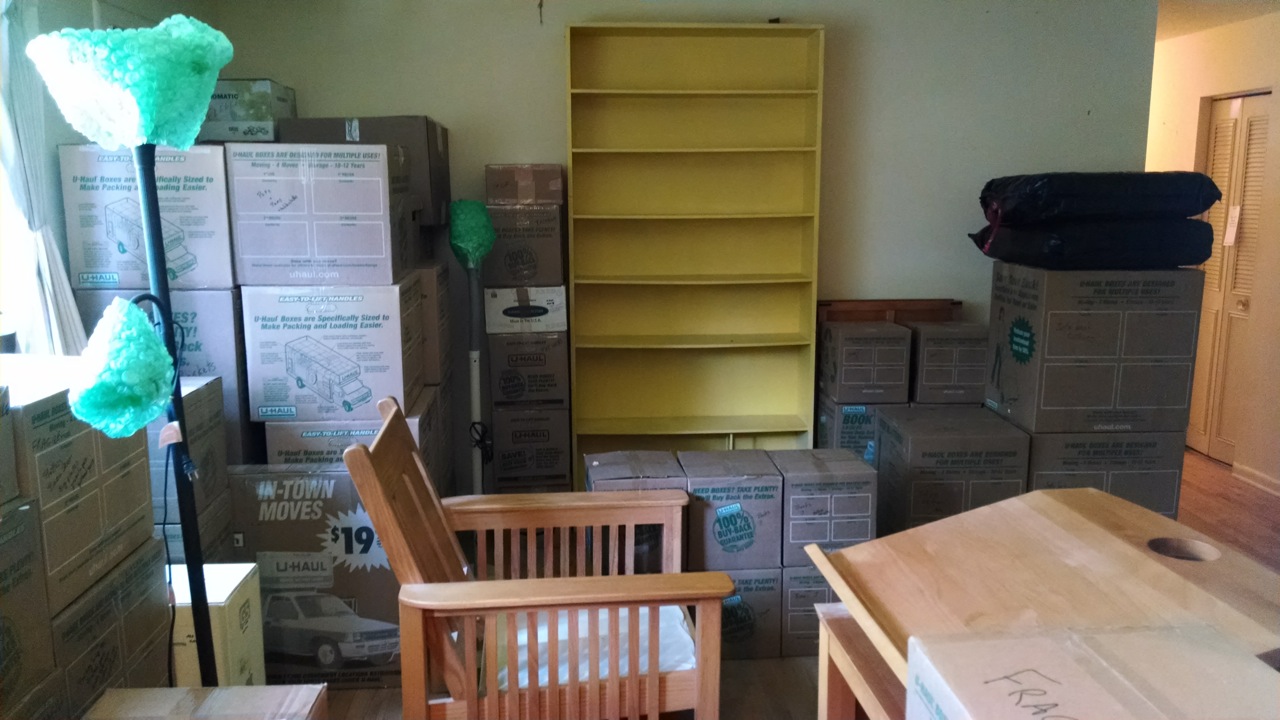
We were going to hire movers to move us anyway. With this delay, our plan is to get the movers to put all our worldly goods into storage, except what we need to bring to the summer sublet. We’re going to limit ourselves to just what we can fit in the car. That sets us up for possible phase 2 of delaying tactics: visiting every single one of our relatives for a week or two. (We’re not especially richly endowed with relatives, but we have enough that we could stretch that out for a good long while, especially if we intersperse visits with bits of camping. In particular, if we end up going to visit Jackie’s brother in California, we’d almost have to drive through southern Utah, and I’ve been wanting for 20 years to take Jackie to Zion and Canyonlands and Arches and Bryce.)

I find myself really enjoying this process. It’s been years since I felt myself quite so footloose.

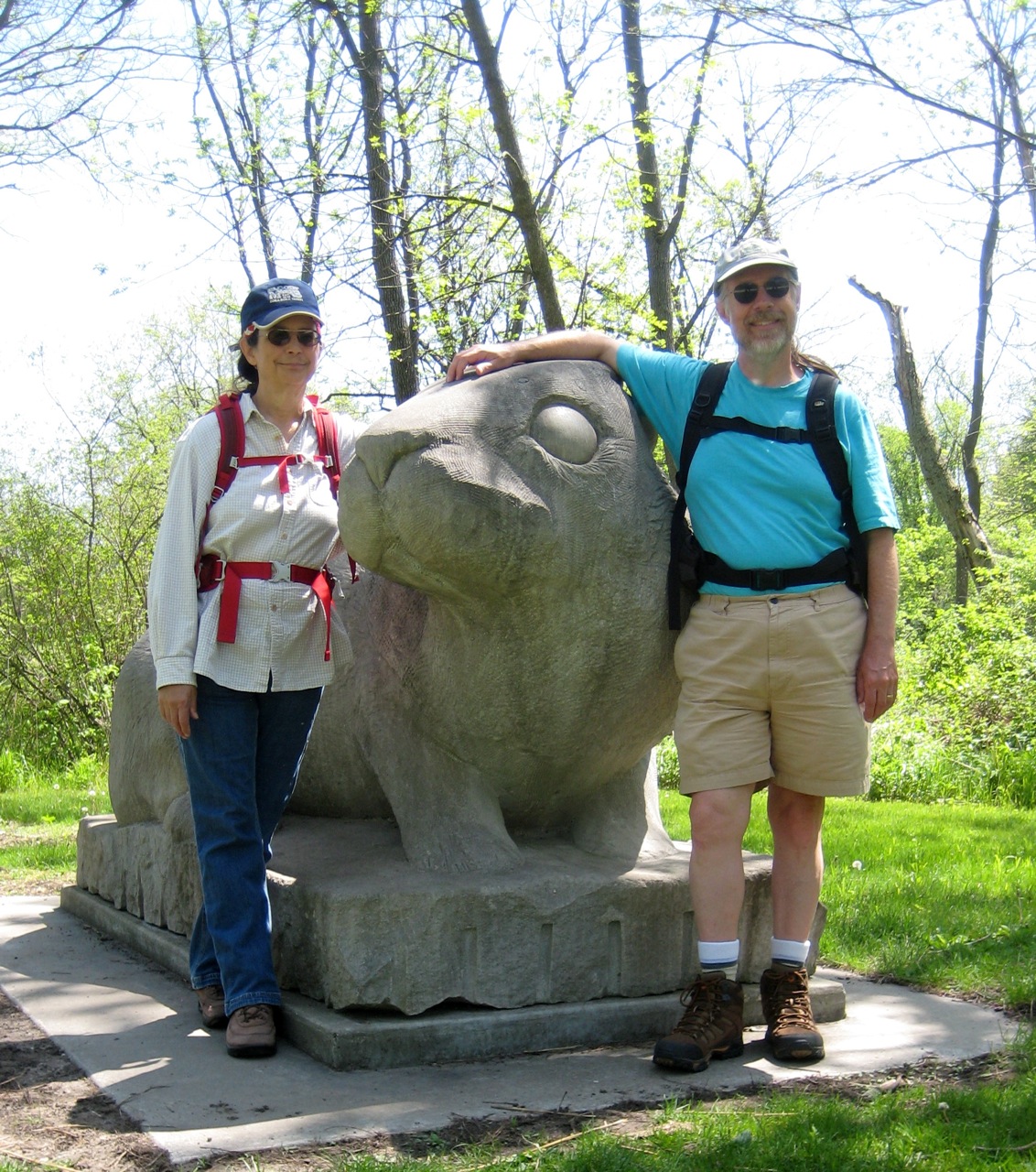
jackie-phil-giant-rabbit
With giant rabbit sculpture in Meadowbrook Park.

We’re just about there. The Kal-Haven trail is 33.5 miles, and yesterday we walked 23.3.

My plan had been “more than 20,” and we managed that, although we went a bit over.

It turns out to be surprisingly hard to plan a route with a very specific distance, if you want the route to be interesting. (It would be easy enough if you were willing to just map about a 2-mile loop and walk it 10 times.)

We did pretty well in the past using Google Maps to plan a route, entering waypoints and then going in and tweaking Google’s suggested route to match what we knew we were going to want to do. I did that again, but with a walk this long, I ran into some limits I don’t remember hitting before. In particular, there seems to be a 10-waypoint limit, and those “tweaks” to the route seem to use up waypoints. I don’t know if that wasn’t true with the old Google maps, or if our earlier walks just didn’t need more waypoints than that.

Without being able to tweak the route to match what we were going to do, I just entered points of interest for each of the corners of our walk, then fiddled with them a bit until I saw that we were at 20.1 miles. Then I figured we could just adjust it on the fly. It almost worked.

The route was pretty similar to our longest walk of last year, except that we’ve decided to carry our lunch on the trail, so we skipped the leg to Milo’s Restaurant. We walked to the Olympic Monument near Parkland College, then to Busey Woods (via downtown Champaign and Crystal Lake Park), then to Meadowbrook Park, where we had our lunch at the Prairie Viewing Platform. (We paused shortly after to get the above picture of us posing with the giant rabbit sculpture.)

The other place I particular thought we ought to stop was Triptych Brewery, which we’d never made it to before, even though they’ve been there for a year. (We go almost right past it several times a week—in particular, when she walks home from taiji class, Jackie passes just three or four blocks away—but always in the morning when it seems a little early for beer, and anyway they’re not open.)

It wouldn’t be a long walk from Meadowbrook to Triptych, if you wanted to walk along Windsor Road, but that sounded unpleasant. Instead we hiked north up Race and then cut across through married student housing and the arboretum, took Hawthorn through the research park, crossed the railroad tracks at St. Mary’s, and then headed back south on the Boulware Trail. That probably added a good mile to our route.

We made it to Triptych around 4:00 PM. The joint was hopping, which was good to see. They had about 10 beers on tap. Jackie had a honey basil blonde ale, which she liked very well. (The honey and basil were very subtle, she said.) I had their dry Irish stout, which was also excellent.

As we were passing through the research park, we’d calculated the distance we were going to end up walking (because of her walks from taiji, Jackie knew just how far it would be from Triptych to home), and we knew we were going to come out over our planned 20 miles. But we really wanted those beers, so we decided to just take the most direct routes and hope for the best. And it worked out fine.

The first 5 miles over our previous very long walk was no problem. After that, things got kinda tough—we were tired and footsore—but there was never a point where we worried that we might not make it. If you’re interested, Endomondo has the GPS track and details. (Ignore the altitude data. When the phone loses the GPS signal, it often inserts a point with an altitude of zero. However, no point in Champaign County is at sea level.)

In my report last week on our previous very long walk, I mentioned that my plan for after the 20-mile hike would be a 25-mile hike. Almost as soon as I’d posted that, I realized that obviously our next hike should be 26.2 miles. Duh.

The Illinois Marathon passes just a few blocks from our apartment. The closest point is very near the midpoint of the race.

I grabbed the map off their website, and figured we could just walk to the nearest point, pick up the route there, walk it until the finish line, cross over to the starting line (just a block or two from the start) and then carry on until we get back to the midpoint, and then go home.

It’s not a plan yet. More of an intention. Maybe just a notion.

Today we’re going to rest, have a mother’s day lunch with Jackie’s mom, and take her out for something fun. Maybe a walk in the woods, or maybe (if the predicted rain arrives) to the art museum.

Jackie and I have gotten back to our very long walks.

Last Saturday we went to Lake of the Woods and cobbled together their 5-mile prairie trail and their 3.3-mile bike path (together with a couple of jaunts down maintenance roads) into an 11-mile hike. (My goal had been “more than 10 miles.”)

It was great.

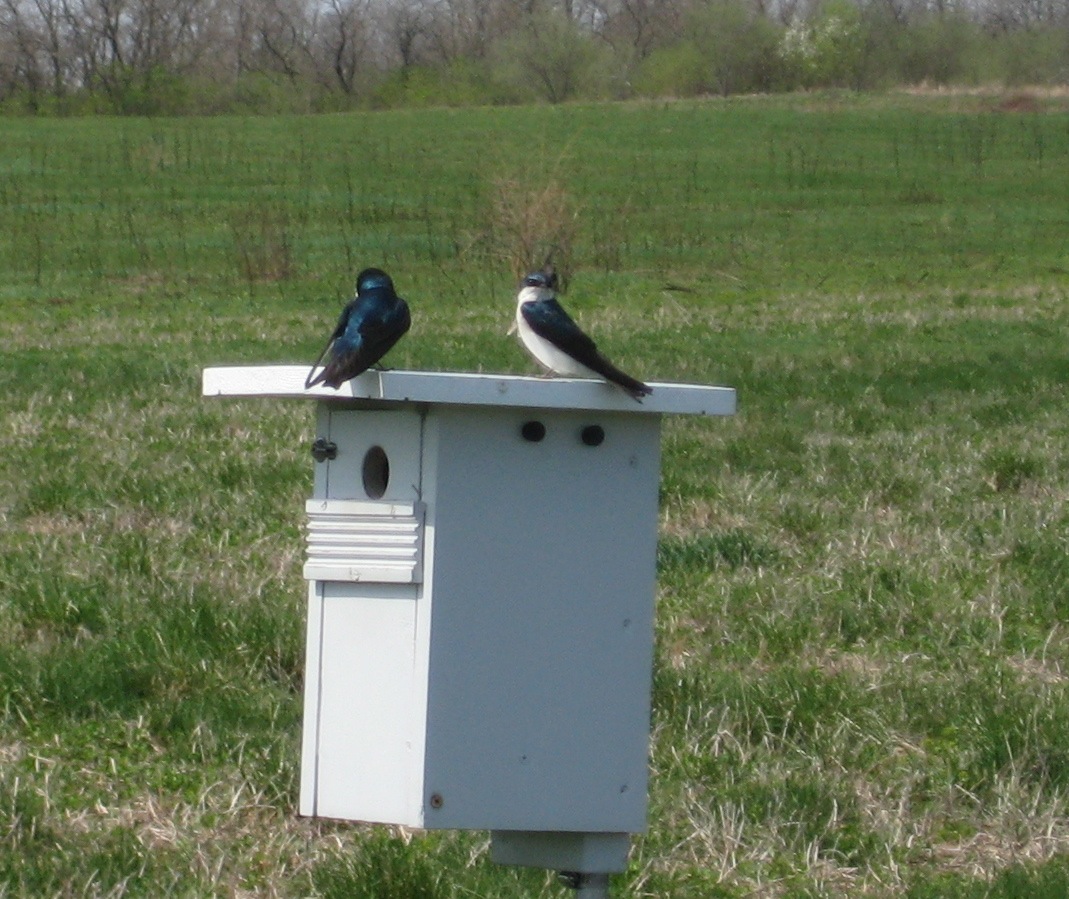
The prairie was full of these bluebird houses that had been occupied by tree swallows.

tree-swallows

The tree swallows daunted me briefly; I don’t remember having seen the species before (although I must have). I spent the whole prairie phase of our walk staring at them, thinking “They’re not bluebirds. They’re not indigo buntings. They’re not purple martins,” over and over again.

I’m sure they weren’t the only interesting species I saw, but they’re the only one that comes to mind now, a week later.

We parked near the Museum of the Grand Prairie, and ate our snack in the botanical garden, which brought to mind the day Steven and I bicycled to Lake of the Woods, which I’d remembered as last year, but which turns out to have been in 2011.

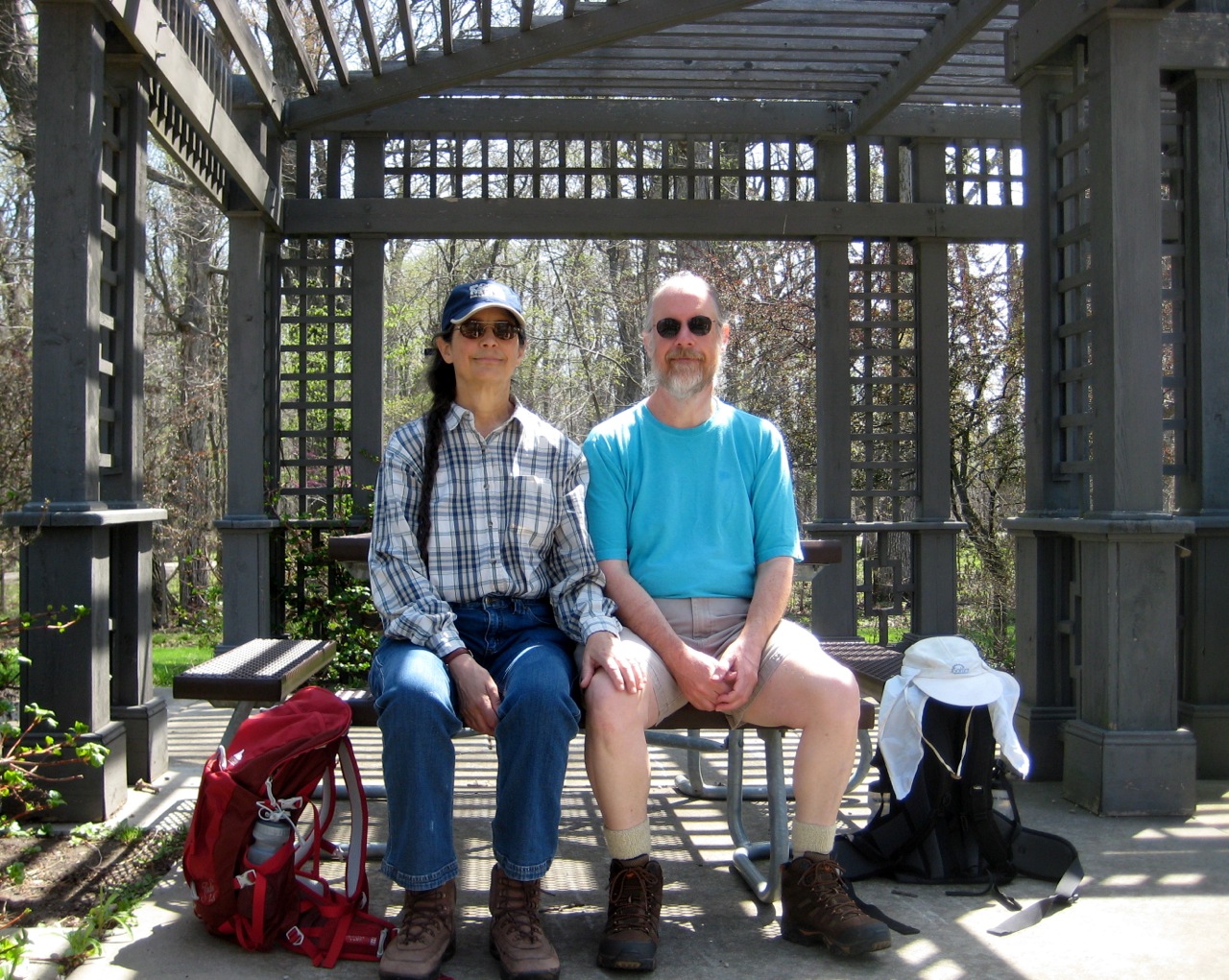
I’d earlier gotten a picture of Jackie and me at the picnic table where we’d later have our snack. I like to think of it as a modern reinterpretation of the Victorian portrait.

jackie-phil-victorian-portrait

Yesterday we did a longer hike. My goal this time was “more than 15 miles,” and we each hit it, although we separated around mile 13, after swinging by the Student Union in time for me to attend my Esperanto meeting. Jackie went on home after drinking some iced coffee. I stayed to speak some Esperanto, then walked on through the water amenities, downtown Champaign, and West Side Park.

Along the way we passed the university’s Agronomy building. We’d passed it a year ago, and I’d neglected to get a picture of the name over the door, and very much regretted it ever since. So this time I made a point of pausing for a photo-op:

agronomy buildingI like the harvest iconography on each side of the name. Very handsome.

To do the whole 33.5 miles during daylight, we’re going to have to set a pretty good pace.

Last summer we did okay when we didn’t have to spend too much time fiddling with things. (It’s surprising how many things need to be fiddled with on a long walk—socks, boot laces, packs and their contents, water bottles and the refilling thereof, intersections both with and without pedestrian walk signals. The list is all but endless, and on more than one hike it seemed like something needed to be fiddled with on virtually every mile, such that we’d get home and look at our speed and remember, “Oh, yes. That mile was slow because we stopped to get a snack, and that mile was slow we had to reapply suntan lotion, and that mile was slow because we stopped to use the restroom. . . .”) When we didn’t stop to fiddle with something, we often finished a mile in not much over 18 minutes, even late in a hike. However, even when we hustled right along, we never broke 18 minutes all summer long.

Last week we did do a sub-18 minute mile, and when we started out yesterday, our first mile came in under 18 minutes again. We were pleased with ourselves and decided to pick up the pace a bit more, and managed to beat our time for the second mile, and then again for the third. By then we were all warmed up and covering a stretch of the route where there was almost no interaction with traffic, so we decided to push the pace a bit more, and managed to do a sub-17 minute mile, which is pretty darned fast walking.

Here’s the Endomondo track of my version of the walk (Jackie’s is the same until we separated along about mile 13):

Up to now, we’ve pushed the distance rather quickly, since we’re just recovering distance that we were doing easily enough last summer. Our next walk, which will be around 20 miles, will be a new “longest walk ever” for each of us. After that, we’ll want to do perhaps 25 miles in late May and then the same (perhaps slightly more) in early June. I think that’s as long of a training walk as we’ll need to do. The whole point is to make 33.5 miles a special effort, something that would be undermined by doing the whole distance in training.

I’ve always quit running during the winter. I found I could make myself get out and run in temps down to about 50 degrees, but when it got colder than that I didn’t enjoy the runs enough to make myself get out and run. I regretted this, because it meant that I did very little running for about six months of the year, but I didn’t regret it enough to get out and run in the cold.

This winter things have been a little different—the two phone-based games I’ve been playing have given me whole new motivations to get out.

I’ve walked 323 kilometers (200 miles!) playing Ingress, which I started playing back in September, almost all of that being walking that I wouldn’t have done without the game. That has stood me in good stead as a way to preserve fitness over the winter (although that includes walking that I did in the fall).

I experimented a bit with Ingress running, but found that although it was fine for the Ingress, it detracted from the run. I spent so much time pausing to play Ingress, that the average speed of my runs made them look like walks. There’s nothing wrong with that, and I may well do some more Ingress running this summer as a way to visit all my local portals without spending all day at it, but I missed the continuous effort of the run. I also missed having a measurable run, one that I could compare with an earlier run and get a sense of whether my fitness was ahead or behind of where it had been that year.

So, the Ingress hasn’t been getting me out to run, although it does get me out to walk.

However, I haven’t needed Ingress for running motivation, because I’ve got Zombies, Run!

It turns out, I don’t need temps above 50 to get me out to run, if I’m playing a Zombie mission. However, I’m still unwilling to run on ice and snow (because I’m not an idiot), and the cold, snowy winter, combined with the fact that people in Champaign-Urbana are the most un-neighborly people I’ve ever encountered when it comes to shoveling sidewalks, has meant that we’ve had conditions that kept me from running for the whole second half of January and most of February.

Today, though, the temperatures got up into the upper-30s, and got the snow and ice melting at speed. It was 36 degrees when I got back from lunch, and I’d seen that many sidewalks were finally clear, so I just changed into running clothes and headed right back out again.

I ran 3.16 miles in 37:11, for an 11:47 pace. (Zombies, Run! reports it as an 11:45 pace, probably due to rounding.)

Looking at my running log from last year, I see I didn’t do a 3-mile run until early May—so I’m a full two months ahead of the game. (Looking at the running log in more detail, I see that the issue wasn’t my aerobic fitness, it was the tendons in my knees that objected when I first ran 2.2 miles, and then again when I ran 2.4 miles. Last year I held my runs at those distances until my knees quit hurting. Being able to check this sort of thing is just what I’m talking about, when I complain about Ingress running not producing measurable, comparable runs. Happily, my knees felt fine today, probably because of all the walking.)

Best of all, the forecast is for highs above freezing every day for as far as the eye can see.

Now that I have my phone-based running games, all I ask is that the sidewalks be clear of ice and snow—and highs above freezing will take care of that.

After a brief lull as I began integrating already written text into my novel, things have picked up again, and the novel progresses apace.

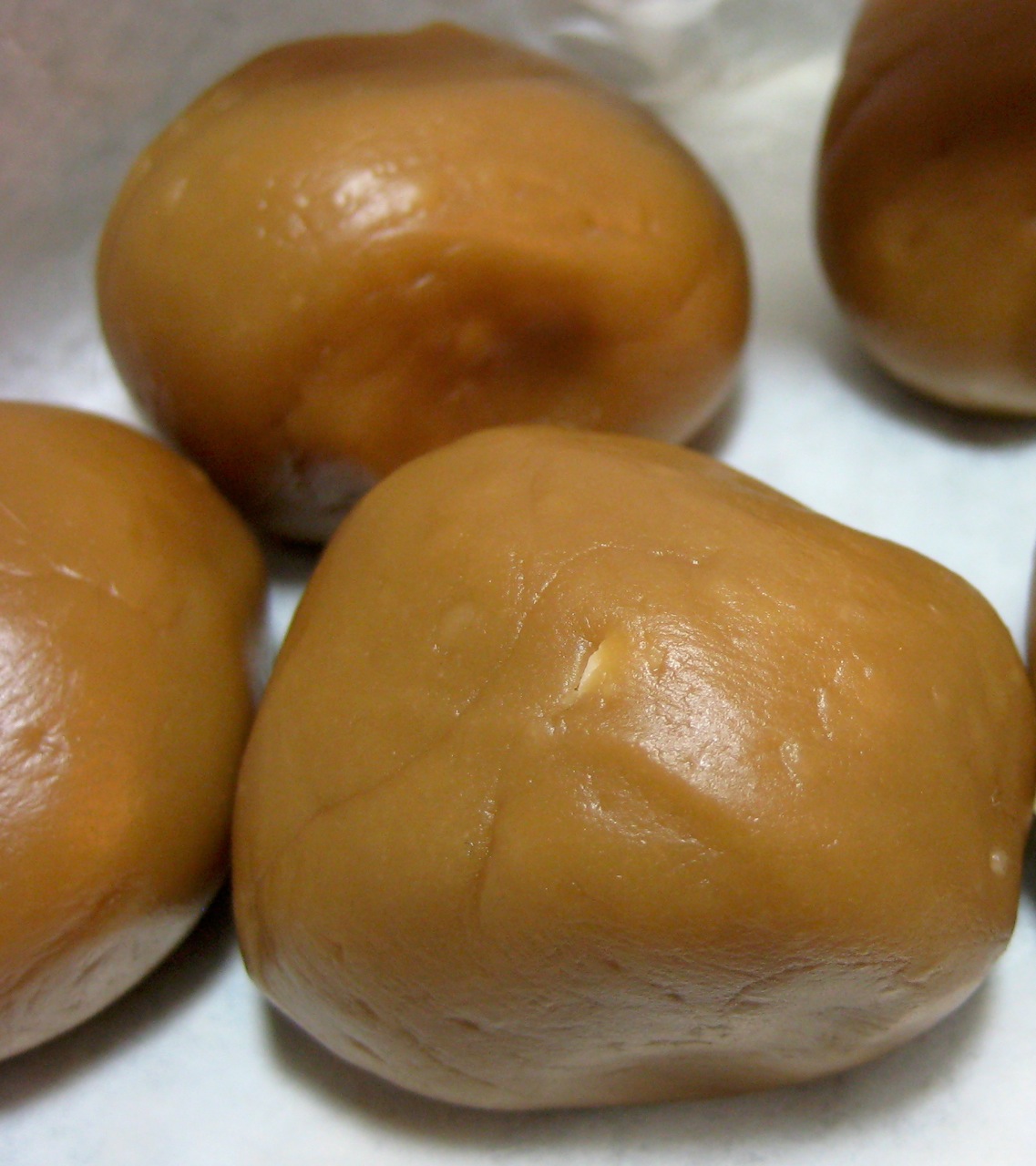
easy karo candyToday would have been a good day to stay in, but I was obliged to teach my taiji class (and four or five students actually braved the weather to show up, so I was glad I’d made it in).

The weather that needed braving was an hour or two of pretty heavy snow, followed by freezing rain.

On paths that had been cleared, the result was about an eighth of an inch of ice. But since the freezing rain followed hard on the snow, most paths had not been cleared. The result was a thick layer of crunchy crystalline mush—not runny like slush, but otherwise kind of similar.

The weird consistency of the stuff reminded me of a failed effort at fudge or frosting—like a thick paste full of huge crystals, instead of tiny ones.

By the time I’d finished driving home in the stuff, I had an irresistible urge to make candy.

I’d have made fudge, but Jackie was doubtful about us having chocolate on hand, but we did have karo syrup and confectioner’s sugar—which, together with butter and vanilla, is all it takes to make Easy Karo Candy.

So, that’s what I made.

My mom used to make me Easy Karo Candy when I was a kid, so it brought back memories. (Even though it was pretty different, because we had dark Karo syrup instead of the light stuff, so it was kind of like Easy Karo Caramel Candy.)

I felt moved to post this because long ago I learned something from making Easy Karo Candy: I learned what candy is. This stuff is basically platonic candy. It contains fat, sugar, and a little flavoring. What makes it candy is the process—cooking it and then stirring in a bunch of confectioner’s sugar—which prompts the formation of the tiny sugar crystals that give things like fudge their distinctive texture. Basically any (non-hard) candy is the same stuff, just with a different flavoring. (A realization that prepared me for the realization that salad dressing is very similar: fat, vinegar, and a little flavoring.)

As a very picky eater, it was cool to figure this out. I vastly broadened the salad dressings I was willing to try, once I realized that they were really all the same. (I tend still to be pretty picky as far as candies go: Fancy candies are all sneaky, with non-candy stuff hidden in a candy layer. But that’s okay. I don’t see any great need to broaden the range of candies I eat.)

I first encountered Andrew Leonard when Steve pointed me to the column “How the World Works” at Salon.com. Filled with keen observations about globalization, right at the moment when globalization was changing everything, Steve spotted it as being just the sort of thing I was interested in at the time.

The column wrapped up a while ago—globalization is just how things are now—but I’ve kept up with Leonard’s writing, so today I spotted his latest essay, The astonishing power of Richard Powers.

I’ve been aware of Power’s novels for a long time, because he was a local sf writer, sort of, on the faculty at the University of Illinois. (I gather he just last year took a position at Stanford.)

His work is only sort of sf; it’s more literary than genre. It’s very well-regarded, but my few attempts to read it were unsuccessful: it seemed deliberately opaque. I grasped that the stylistic choices were intended to make the book’s form echo the book’s intent, but in my couple of experiments, they didn’t work for me.

This essay, though, almost convinces me to give more of his books a try. Certainly I’ll take a look at his latest, Orfeo.

But the essay is interesting beyond that. Despite having followed Leonard’s work at Salon for years, I was completely unaware that his father was “the youngest editor in chief in the history of the New York Times Book Review.”

I found in the younger Leonard’s experiences an echo of my own—choosing to be a writer when my father is one of the best writers I know.

A great essay. Long, but well worth reading.

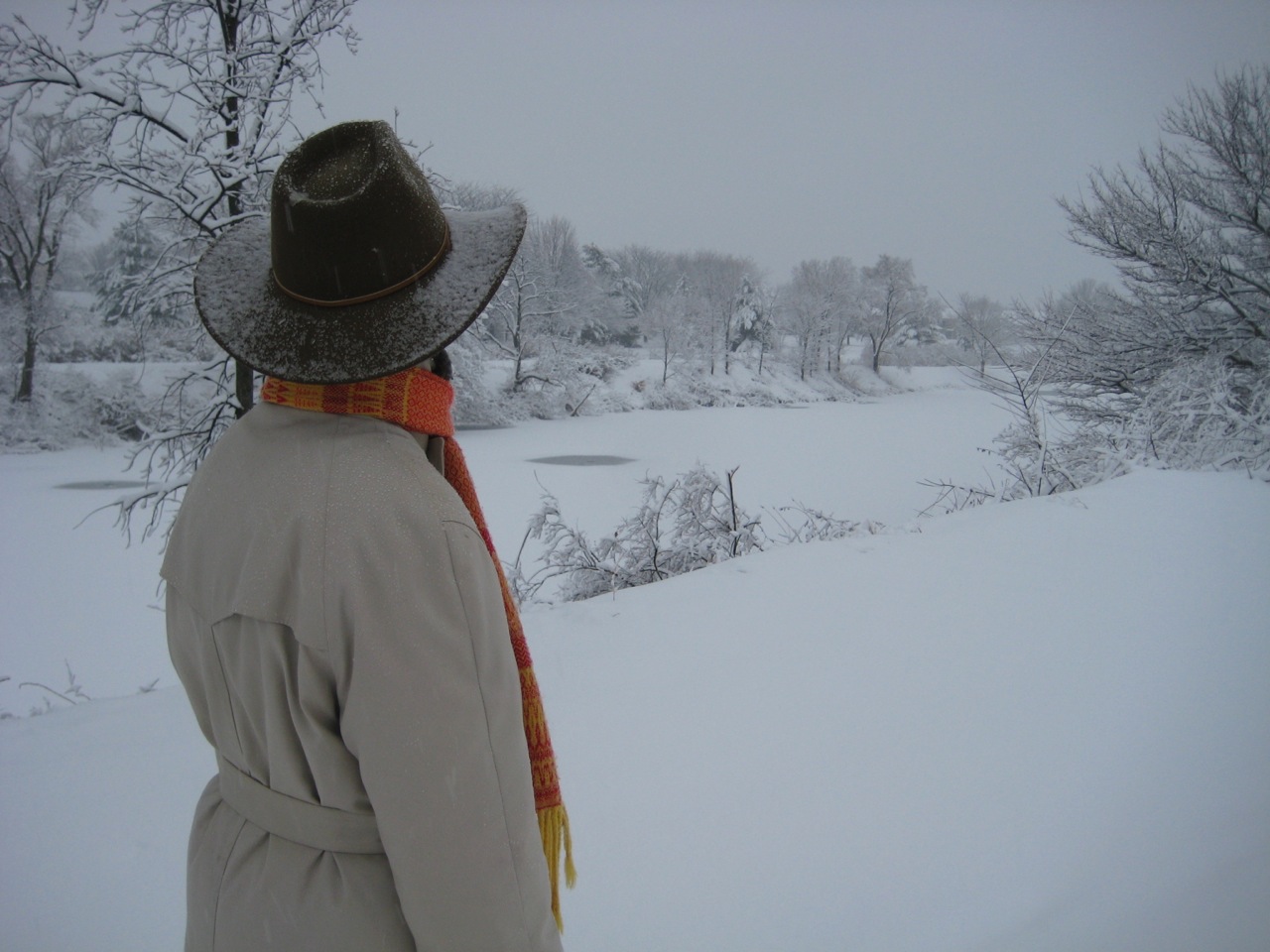
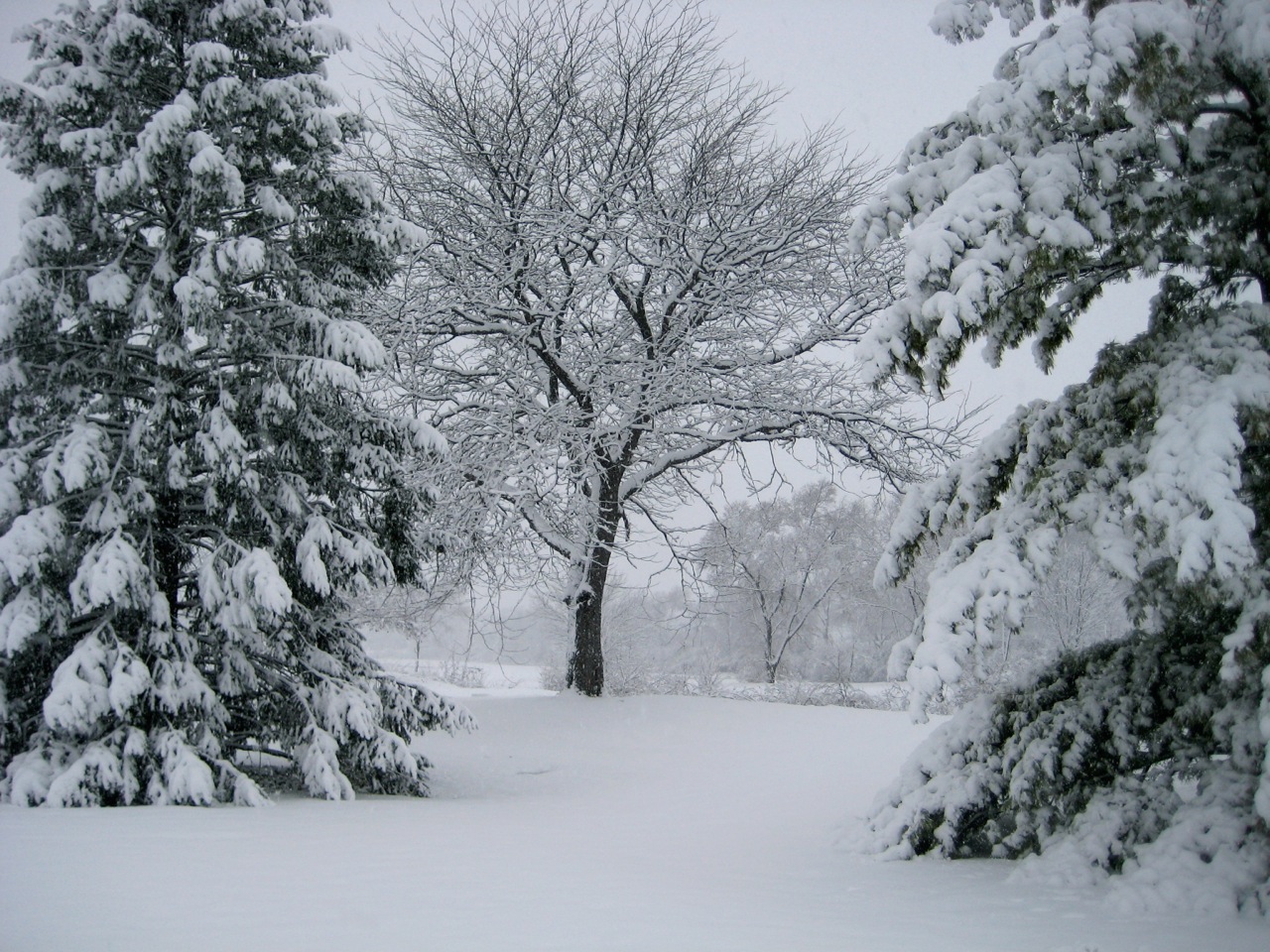
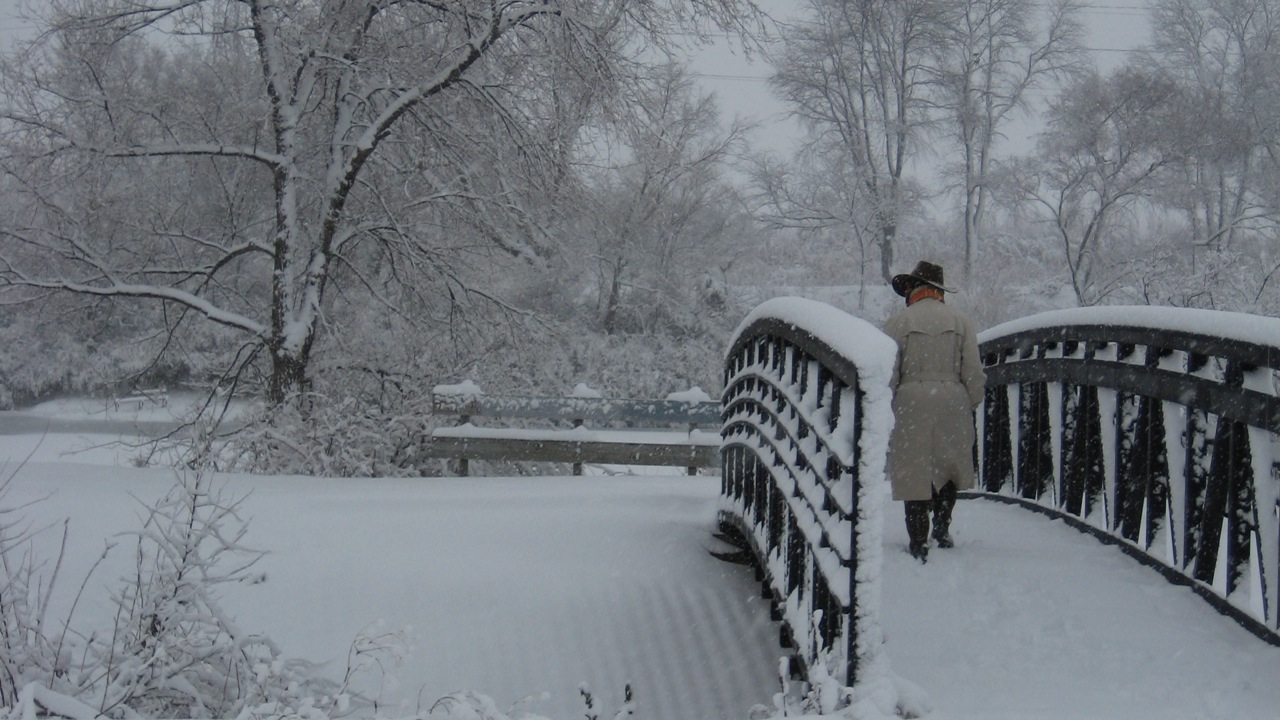
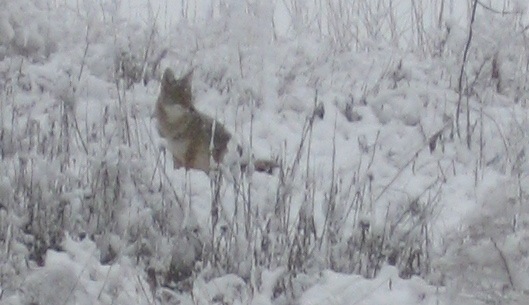
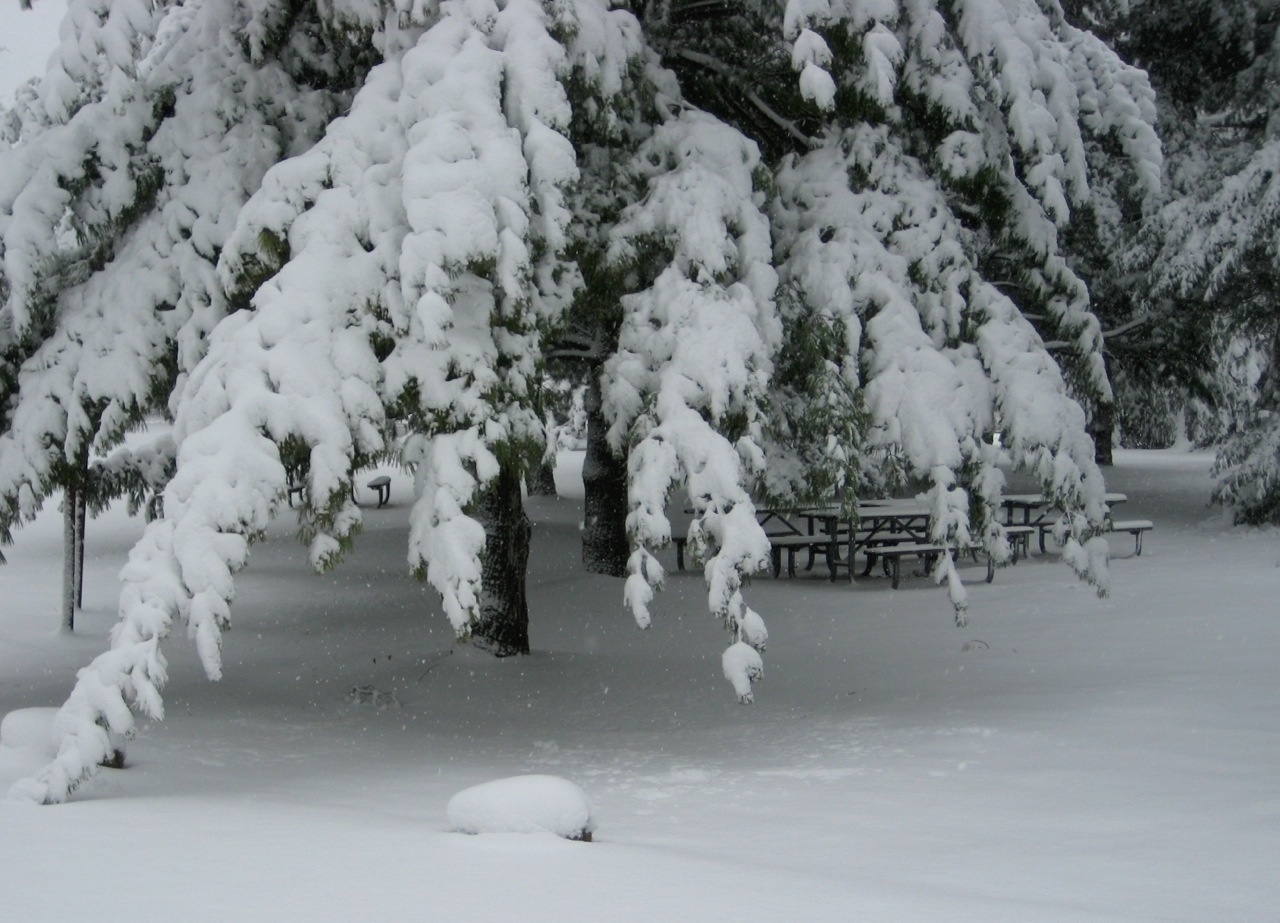
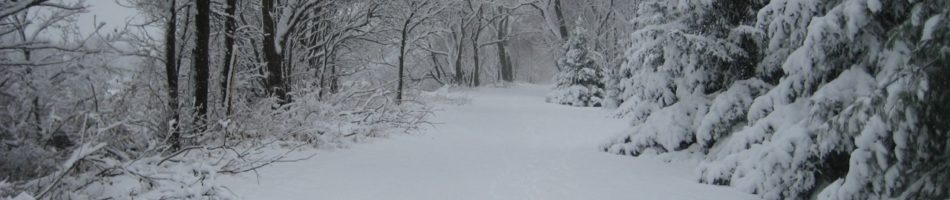
Jackie and I decided to celebrate the snow with a walk around Kaufman Lake park—a walk that yielded more wildlife than usual. (There are larger versions of all these pictures except the one of the coyote, which is already full-size.)
Snowy scene

This spot is just 5 minutes walk from our apartment, part of the Greenbelt Bikeway, but on the other side of the Copper Slough from Kaufman Lake.

From there, we crossed the bridge to the ring road around Kaufman Lake.crossing the snowy bridge

After crossing, we turned right and did a circuit of the lake. The only picture I didn’t take and regretted was one right there. The road around the lake is not really narrow—there’s room for 8 or 10 people to walk side-by-side—but in that spot, with the brush that lines the sides of the path in the summer having been cut back, exposing the steep slopes down to the lake on the left and the slough on the right, it looked really narrow.

We saw a lot of wildlife on this walk. There was a great blue heron on the lake that I spotted from a distance, and then saw take off as we approached. A kingfisher landed on a tree just across the slough, then took off and flew down the length of the slough, giving its distinctive chattering call.

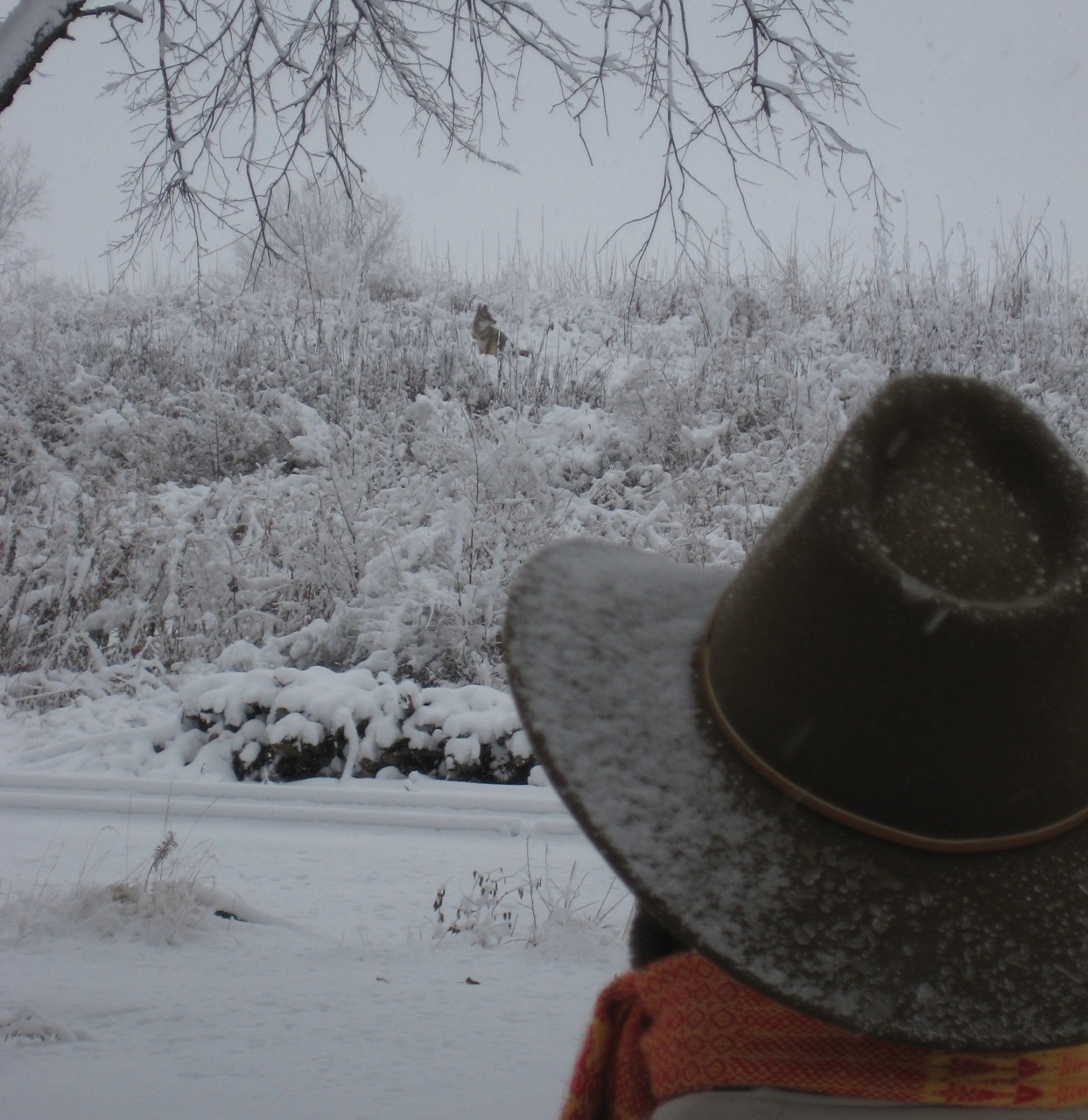
Best of all, though, we saw a coyote! The first one I’ve seen since we moved from Philo. (Not that they were common around Philo either.)Jackie looks at coyote

You can just see the coyote there where Jackie is looking, above and just to the left of the center of the frame. It was really too far away to photograph with my little camera, but here’s the best shot of the coyote that I got:coyote

That was probably the peak of the walk, but we were only halfway around the lake at that point. We proceeded around.

I got a couple of pictures looking back across the lake. Here’s one with Jackie:Jackie looks across the frozen lake

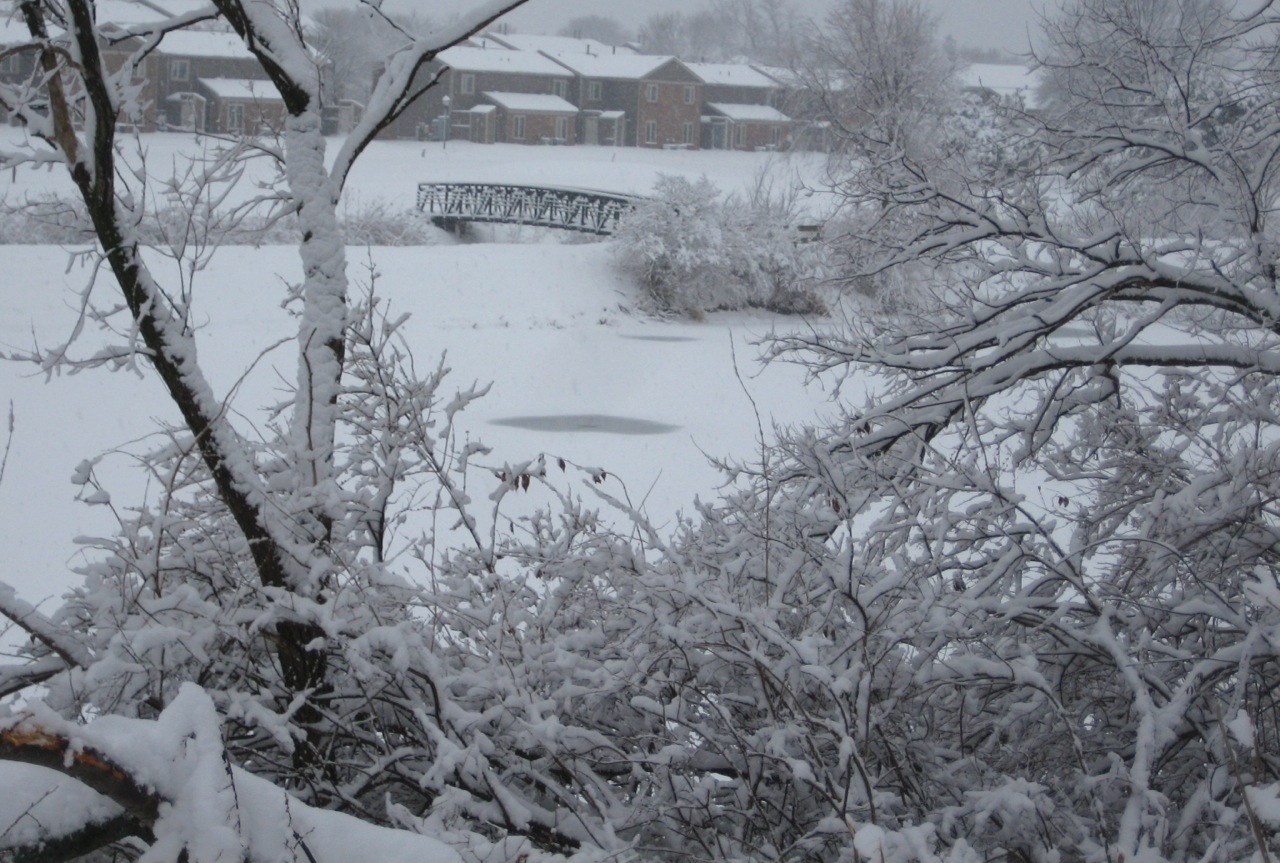
And here’s one taken later, looking back toward the bridge through some snowy branches:bridge from across the lake

At the point where the ring road reaches the south end of the park and curves east and then back north, there’s a little picnic area. I thought it was funny to see it buried in snow:snowy picnic spot

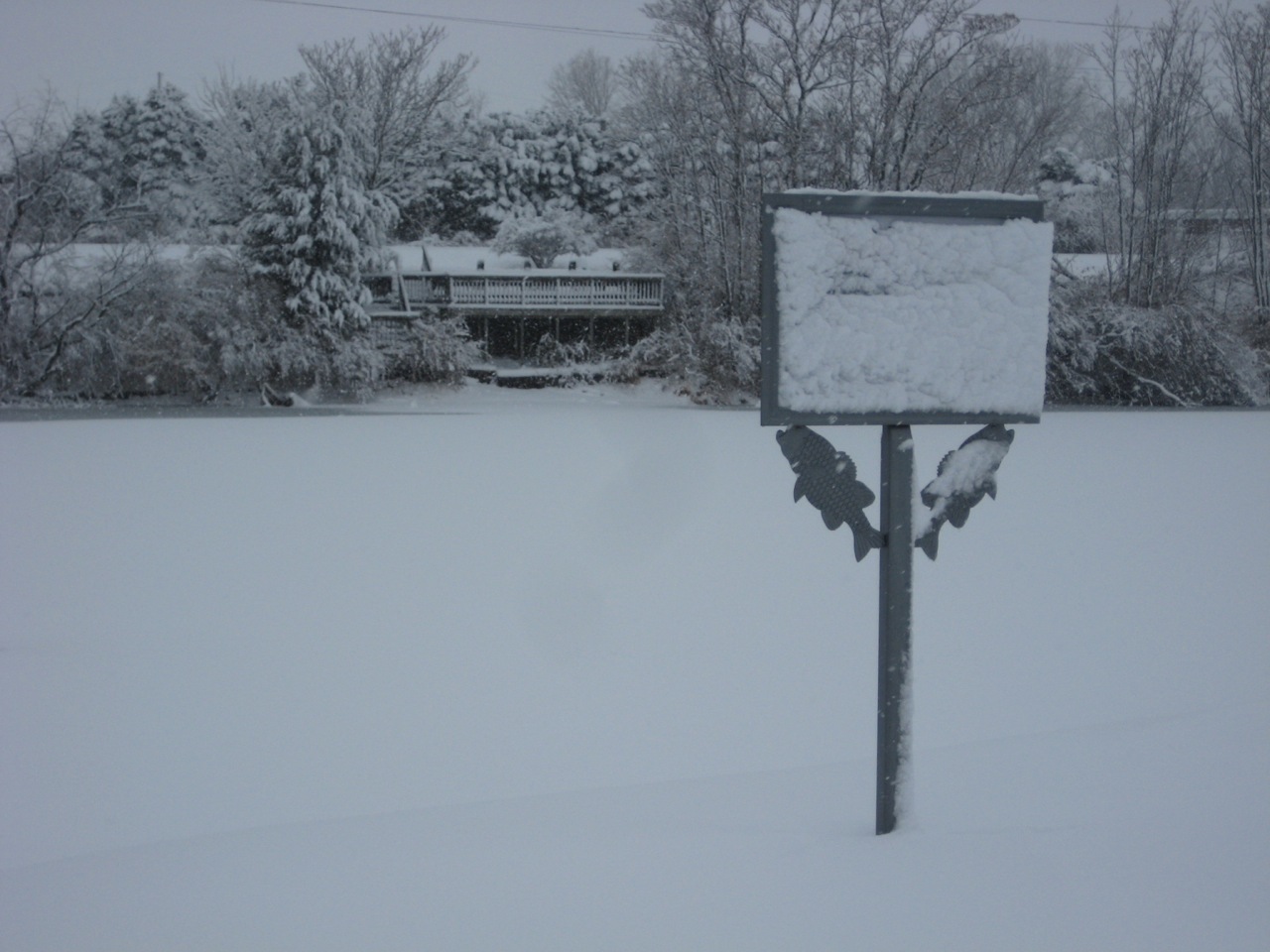
Just before we got back to the bridge and headed home, we passed the two fishing piers near the boathouse, and I got this picture of the sign which, if I remember correct, has the daily fish catch limits:fish catch limit sign

Again, I thought it was funny covered with snow.

As we approached home, I let Jackie walk in front of me, so I could throw a snowball at her. She seemed quite outraged that I’d do something so nefarious. And I can see that it would be a surprise. I’m not sure I’ve ever thrown a snowball at her before. If I did, it was probably 20 years ago. In any case, far too long.

She retaliated, as is only appropriate.

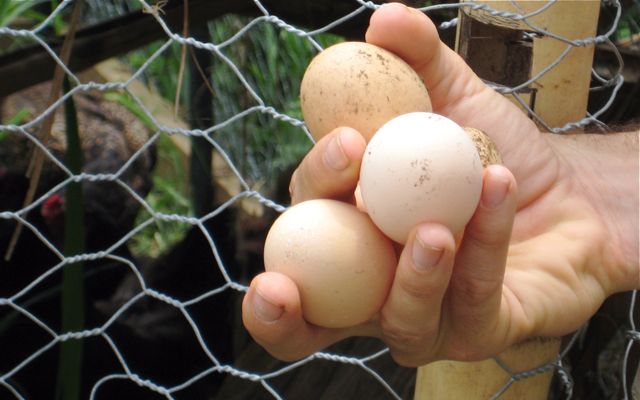
Backyard Eggs
Backyard Eggs

So, the Champaign City Council legalized backyard chickens a while back. You have to file a form, pay a one-time fee, and get a notarized permission slip from your landlord (if you’re a renter), but it all looks quite doable. As I’d mentioned when I wrote about the issue before, this would have been a determining factor in my willingness to buy a house in Champaign, and now it isn’t. The fee isn’t cheap ($50), but figured into the cost of buying a house, it’s insignificant.

But thinking about the fee got me to thinking about why one raises chickens in the first place.

Probably most of the people in Champaign who want to raise backyard chickens are yuppy locavore types looking to reduce their food-miles to minimize their carbon footprint and know that they’re eating organic and cruelty-free. More power to them. But there’s another category of people who might raise backyard chickens: poor people.

Someone who’s poor—someone whose budget barely stretches to cover their other expenses, someone who’s on food stamps, someone who uses a food pantry—is another person who might find raising backyard chickens very attractive. Eggs don’t cost much, but someone who raised chickens might be able to save a few dollars a week and get some high-quality protein and have a surplus that they could share or trade. But a $50 entry fee just about blocks this reason to raise chickens.

I guess I’m not really surprised. Local politicians in Champaign have a lot of incentive to help upper-middle class people eat local and organic—those people vote. They probably don’t feel the same pressure to help poor people get a little high-quality food as cheaply as possible, because poor people don’t vote as much—and when they do vote, the legality of backyard chickens probably isn’t a top issue.

It does bug me just a little that Champaign (which thinks of itself as conservative place) has created this whole big-government scheme with forms and approvals and fees and regulations on chicken coops, while Urbana (which thinks of itself as a liberal place) doesn’t have any of that stuff, just a general rule against letting your animals become a nuisance. But that’s just me, asking for consistency from politicians.

So, half a cheer for Champaign legalizing backyard chickens, even if they came up with a way to do it that only helps yuppy locavores and not poor folks.

I was one of the first people to try to sign up for insurance on healthcare.gov. That turns out to have been a mistake. At least, that’s my theory.

With considerable effort, over a period of a couple of days right at the beginning of October, I’d gotten through the first part (where you verify facts about yourself to confirm that you’re you). Then I’d done the part where they ask about your income, etc.

At that point—when I’d entered all the info about my and Jackie’s contact info, race, ethnicity, income, and so on—I clicked the last “submit” button. . . and waited.

After a long time, the submission timed out.

Not wanting to have to go through all that entering again, I just backed up a screen and clicked submit again. . . and waited again. And it timed out again.

I did that over and over again, hoping that eventually I’d get a successful submission. And at some point I did get one. In fact, I got a bunch—many of those failed submissions had apparently gone through before they failed. But (I now believe), something about them had gotten corrupted at some point.

On the first visit after that, I’d gotten through to the point of seeing what policies were available to me and how much they’d cost. I printed the list and reviewed it with Jackie and investigated the networks offered by a few plans and picked a policy (sticking with Health Alliance, but going for one of their new Silver plans). But when I returned, there was a glitch: I could no longer sign up for insurance for Jackie and myself; it offered me a policy only for myself, with no sign as to whether I’d be able to get Jackie signed up after.

Yesterday, I finally gave up on making my way through the signup process, and called the telephone interface.

Turns out, the people on the other end of the phone go through the exact same interface. So, of course, they ran into the exact same problem I did.

After escalating to the senior tech guys, the proposed solution was to reset my account and have me start over. (Something I would have done a long time before, if that interface were available.)

Sadly, I couldn’t make that work either.

Finally, I started over completely. I created a new account (with a new login name, using a new email address), re-verified my identity, and re-entered all the info about me. This time, having already selected a policy, I pressed straight ahead and enrolled.

So, I have successfully signed up for insurance through Obamacare. It took about an hour, once I started over from scratch. I suspect it would have worked pretty smoothly, if I hadn’t tried so persistently to sign up in those first few busy days.

Despite the aggravations of getting signed up, I’m pretty pleased. Obamacare is going to save me hundreds of dollars a month. Our insurance bill had been our largest bill—quite a bit higher than our rent. Now it will be just another monthly expense—bigger than our phone bill, but less than rent or groceries.

And yet, the cost savings is far from the most important thing. Before, I worried constantly that any major medical problem would ruin us—make it impossible to get affordable insurance; trap us in a policy that all the healthy people had fled, with premiums spirally inexorably higher until they consumed all our money. Now, at last, we have some security on that front. Cheap or expensive, at least our insurance is actually insurance. A major medical problem would still be a big deal—one of us would no longer be healthy. But at least it would just be that, and not that and a financial catastrophe too.

I don’t really think of myself as a poet—the menu on my site, which includes categories for my fiction and my nonfiction, doesn’t even have a category for poetry. However, for many years now, I’ve been writing haiku in Esperanto.

It started specifically because of Esperanto. As a beginner with the language, I wanted something tractable. A haiku was small enough that, even if I had to look up every other word, I could put it together and keep it in my head long enough to compose and finish something.

It was also a shared activity with my brother, who was learning Esperanto as well, and similarly found haiku to be appropriately sized. Our haiku were often rather silly observations on the quotidian details of workaday life, and even more often shared jokes—puns based on elaborated misunderstandings of one another’s haiku, and the like.

A few years ago, Steve started taking his haiku more seriously. He read about the Japanese tradition of haiku. He started focusing on writing better haiku. He wrote a lot, and he shared them with other people who cared about haiku. He didn’t quit writing funny, trivial haiku, but he wrote more serious haiku. Haiku that tried to capture something universal through a keenly observed moment. Haiku that used the tools of the Japanese tradition to express something.

I found myself rather left behind. He encouraged me to make a similar study—he even lent me some books—but I didn’t find myself moved to deepen my understanding of haiku.

A few things happened since then. One was simply being more and more impressed with Steve’s haiku—feeling ever more keenly how left behind I was. Another was the publication, by a Japanese Esperantist we met on-line, of a book Kiel verki hajkojn en Esperanto (How to write haiku in Esperanto), which condensed a lot of the stuff Steve had been talking about and applied it specifically to Esperanto. Most recently, a local haiku poet (who also happens to be past president of the Haiku Society of America, former editor of Modern Haiku magazine, and current editor of the Modern Haiku Press) started a haiku study group that meets at the Champaign Public Library.

Participating in the study group, I took one of those little leaps that anyone who works in a creative endeavor takes from time to time. My haiku are perceptibly better.

And so I now have a published haiku. The same Lee Gurga who leads the study group also edits a weekly haiku feature in the News-Gazette, the local paper. He selected one of my haiku for today’s column. He elided the Esperanto original, so I thought I’d share that here:

Glataj folioj.
Senresta en mallumo…
kota genuo

Oh, and I should mention, this isn’t my first ever published haiku. One of my haiku was used as an example in Kiel verki hajkojn en Esperanto. Oh, and I’ve three times traded my haiku for earrings at the Haiku Earring Parties at WisCon.