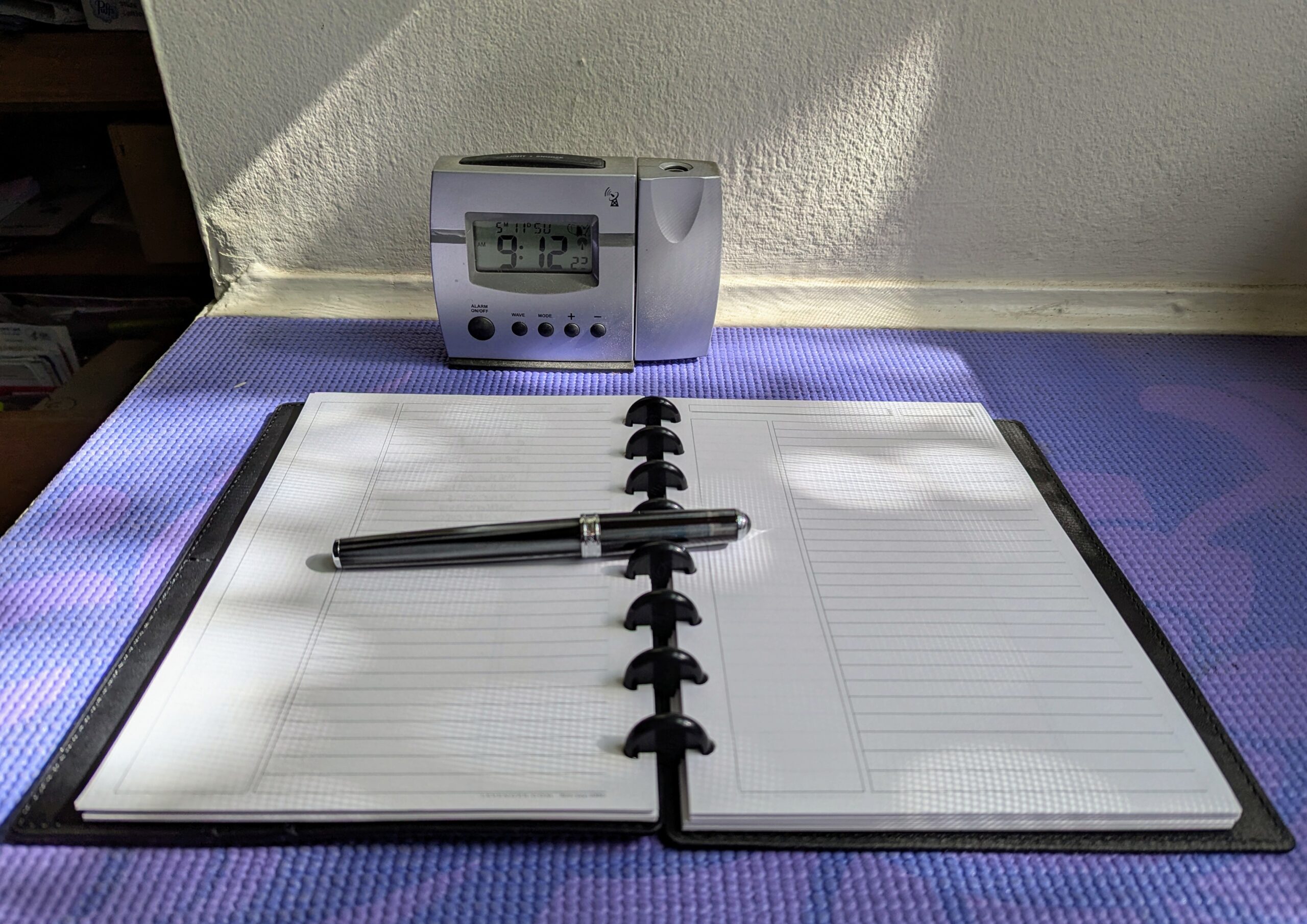
After a very congenial week visiting us, my brother and nephew departed for Kansas City and the SFWA Nebula Awards. Today I am back to my usual routine, with multiple dog walks and a workout. Now I’m sitting on the window seat and reading Asimov’s Foundation for the first time since I was a boy.
In my experience cats are much better than dogs at realizing when you’re sick and need some rest and comfort. So I’m a bit surprised that Ashley is doing such a good job of it today.
The NYT article linked below talks to several people with anxiety or OCD, and somewhat reasonably comes to the conclusion that the Oura ring and similar devices are not for them.
I have a different perspective.
I wear an Oura ring and check it daily, and I’ve had none of these problems. I take what it tells me seriously, but I never let it override my own opinion on how I’m doing.
One fairly new feature is a warning when your metrics (temperature and resting heart rate in particular) suggest that you might be coming down with something. Even though I’m somewhat prone to hypochondria myself, it hasn’t been a problem for me.
Wednesday this week it warned me that I might be coming down with something. I felt fine, so I was inclined to ignore it. By evening I’d realized that I was coming down with a cold. (I felt pretty crappy all day Thursday. Today I feel nearly all better.) Although I was inclined to ignore it, I did take it seriously enough to skip my workout that day, which was probably a good idea.
I did react rather strongly the first time I got that warning, but only because I was visiting my 92-year-old mother, and didn’t want to risk passing something on to her. So I took the warning seriously enough to get and take a Covid-test and to wear a mask around my mom. Maybe that was an over-reaction—I wasn’t sick—but I am sure happier over-reacting than I would have been under-reacting and passing Covid on to my mom.
My brother teases me constantly for wearing such a thing, but I fall very much in the category of people who think, “Why not have as much information as possible?”
“They were like, ‘This is just not necessary information for a healthy, able-bodied person to have.’”
As an annoying privacy/security nerd of longstanding, I’m very pleased to hear this:
Plenty of annoying nerds have been ringing alarm bells since the 90s, going on about code and privacy and open source software and FREEDOM, mostly in annoying ways. And it is genuinely annoying, even to me, to say this, but they were right all along.
I’m pretty down on AI. I view Large Language Models as a very expensive way to generate strings of words. Other things that were called AI when they were purely speculative (for example, chess-playing computers), quit being called AI once the thing actually existed.
I know there are other people who find AI useful as a way to minimize the amount of work they need to do, although again I’m very dubious—as soon as you let AI do something for you without double-checking everything it does, it’s going to screw up badly. (That is, you are going to use an expensive, environmentally destructive, copyright-thieving tool to screw yourself up badly.)
It’s from that perspective that I can see this odd, narrow use of an LLM perhaps useful. (I actually got this idea from a fitness YouTuber, but he said he was going to delete his video, so I don’t see much value in linking to it.)
His suggestion was to use an LLM as a journaling tool. Each day, in the morning or in the evening, dictate a journal entry to an LLM. Do a kind of a brain dump of all the things that are worrying you or exciting you. List the things you need to do and the things you’re expecting other people to do. List your good ideas. List your long-term plans and your progress on your long-term plans. List your successes, your failures, your anxieties, interesting facts you came upon during the day, and so on. Then, once you’ve finished your brain dump, ask the LLM to organize those lists: Give me a list of things to do today. Give me a list of blind spots I haven’t been thinking of. Suggest a plan of action for addressing my issues. Tell me if there’s any easy way to solve multiple problems with a single action.
Now, I think it’s very unlikely that an LLM is going to come up with anything genuinely insightful in response to these prompts. But here’s the thing: Your journal isn’t going to either. The value of journaling is that you’re regularly thinking about this stuff, and you’re giving yourself a chance to deal with your stresses in a compartmented way that makes them less likely to spill over into areas of your life where they’re more likely to be harmful.
The things LLMs do—like generating summaries, making lists, expanding on ideas, suggesting alternatives—are really risky in any use case where getting it right matters. We all know the stories of people who used an LLM to write a legal brief, and the LLM hallucinated citations to cases, complete with footnotes, that were all lies. But I think in this case, none of those things matter much.
You aren’t required to have footnotes in your journal, or even to tell the truth. If you ask your LLM-supported journal to suggest blind spots that you’ve missed, and its suggestions are all either obvious or completely off-point, it costs you nothing but the 10 seconds you waste reading the list. If you say, “What are the top five things I need to get done today?” and it gives you a list that doesn’t include the very most important thing, you’re probably going to notice and get that thing done anyway.
Without having tried it, I can imagine that this might be a useful tool, or at least a harmless one. If all having the LLM in the background does is provide a bit of novelty that gets you started journaling again, even just that seems worthwhile.
One risk to keep in mind: If you’re telling an LLM things that are confidential—business secrets, personal secrets, other people’s secrets—you can’t have any confidence that the LLM isn’t going to feed all that info right into its training data and spit it out to some other LLM user. But pretty soon we’ll all be able to train up our own personal journaling LLM that doesn’t share its info with others, so I don’t think that’s a long-term problem.
Of course, I’m eliding the ethical problem of LLMs having been trained on stolen texts, but I don’t think that’s something the users are obliged to try to fix on their own. Rather, the creators of LLMs should be forced to turn their revenues over to the copyright holders of the people whose texts were stolen.
If you’ve been journaling with an LLM, I’d be interested to hear about it. And if you know of an adequately powered LLM that can be run on a personal computer without sharing any data off the machine, I’d be interested in hearing about that too.
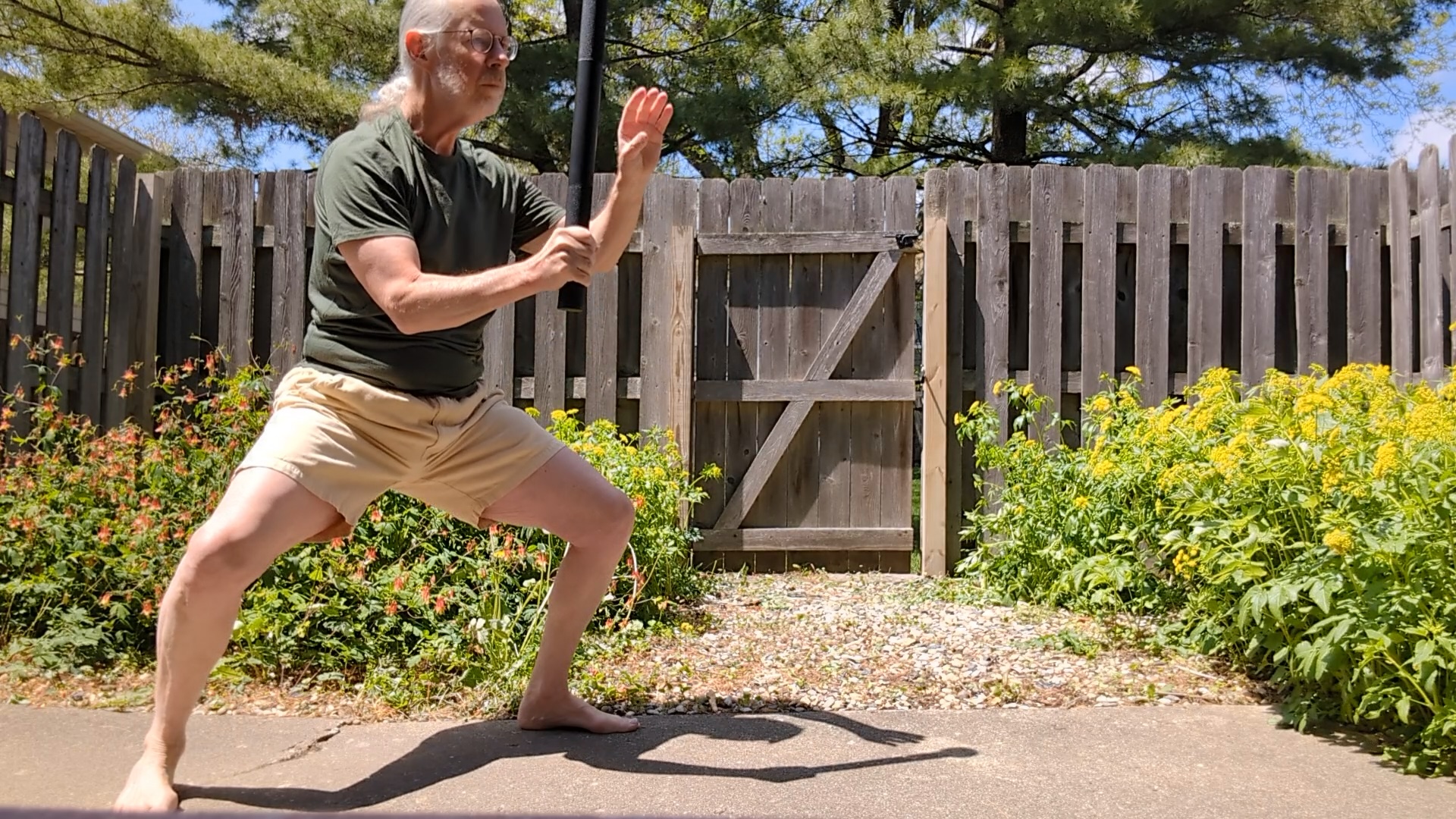
I wanted a workout to practice my Meyer fencing stance—a workout more interesting than just standing in the stance for a minute or two.
Mark Wildman, in one of his a live Q&A videos, suggested the mace drop swing as a useful exercise for someone doing longsword. (It was in response to a question I asked about improving arm strength and endurance for holding your arms forward and overhead at full extension for extended periods, as one does in longsword.) He had suggested doing it in Warrior 2, but specifically mentioned that you could do it in whatever stance went with your longsword style; it just got harder as your stance got wider.
Besides being boring, just standing in a Meyer stance for a minute or two seemed like a missed opportunity; even a modest challenge to your stability in the stance seemed like it might pay off in strength, flexibility, and control of your stance.
So here’s the workout I came up with:
Get in your best Meyer stance, with your mace in your front hand. Execute 5 drop swings, checking your stance after each rep. Shift the mace to your rear hand and repeat. Take one passing step forward. (Your mace will now be in your front hand.) Repeat five swings with the front hand and five swings with the back hand.
That’s one set.
Here it is as a video:
My plan is to gradually add sets until I can comfortably stay in the Meyer stance for 5 or 10 minutes, to build the habit and capability of keeping a good stance while it is challenged by a shifting weight.
I think my stance is okay here. Of course, there isn’t just one Meyer stance. This image from Meyer’s treatise show the range pretty well:
The front two figures are both in what I think of as a basic Meyer stance. The two figures behind them are also in Meyer stances, the one on the right in something of a lunge, the one on the left in a more upright stance.
My drop swings clearly need a lot of work (do not copy mine!), but that basically comes along for free as I do the stance workouts. (I wrote a post called Fitness training for longsword, Mark Wildman style that embeds two Mark Wildman videos of the Warrior 2 stance mace drop swing, if you want to see someone doing it better.)
I’m doing the swings with my 5 lb mace. I have a 10 lb mace that I’ll want to move up to, once I have the drop swings a bit more under control.