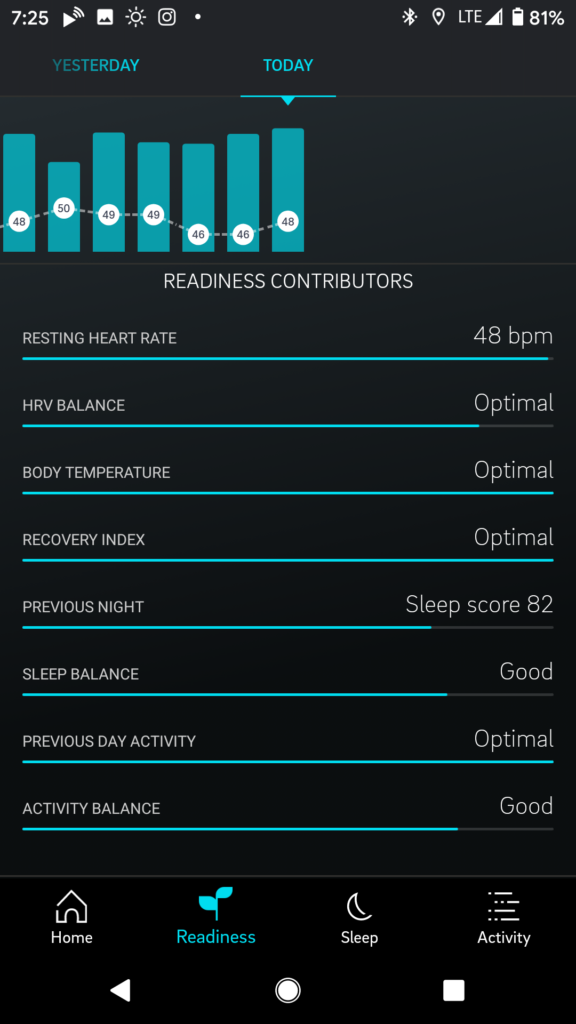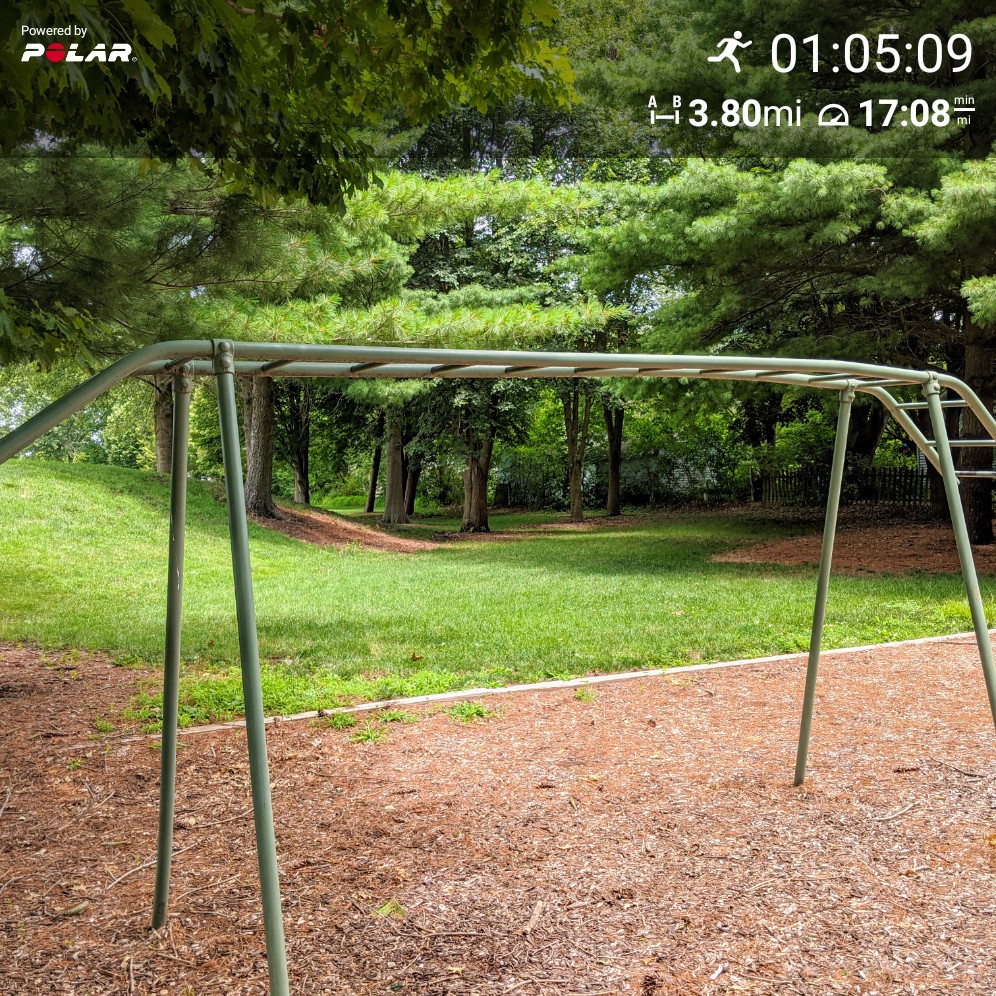
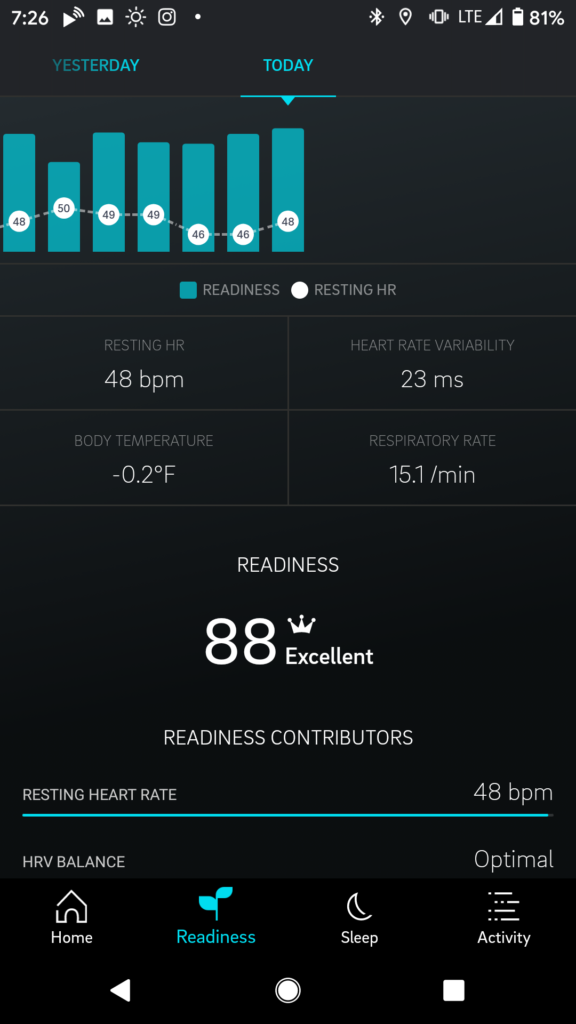
Looking at my “readiness” score for today I’m perhaps slightly less ready than I was five days ago, when I let my Oura ring mislead me into postponing a rest day in favor of some hill sprints.
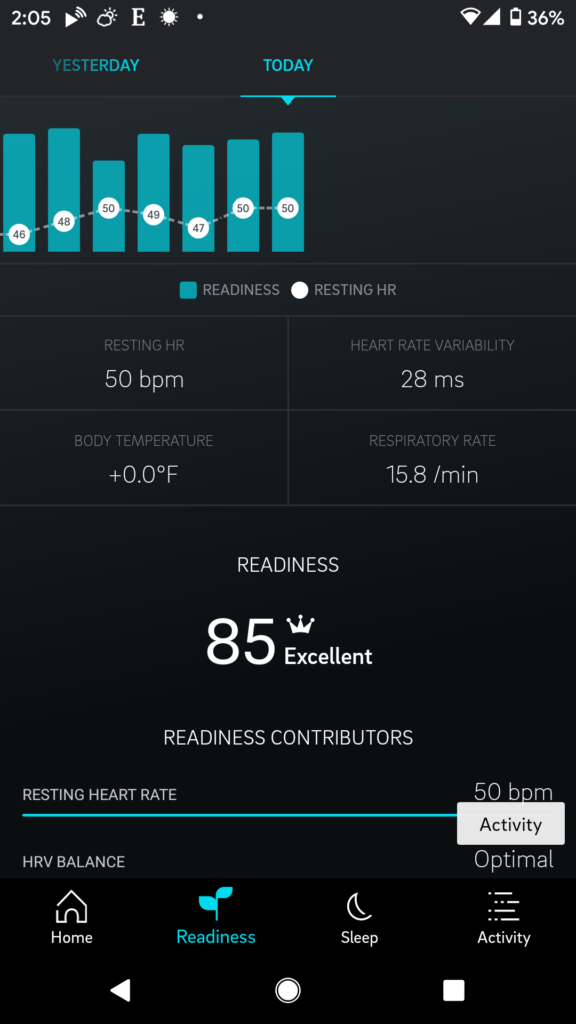
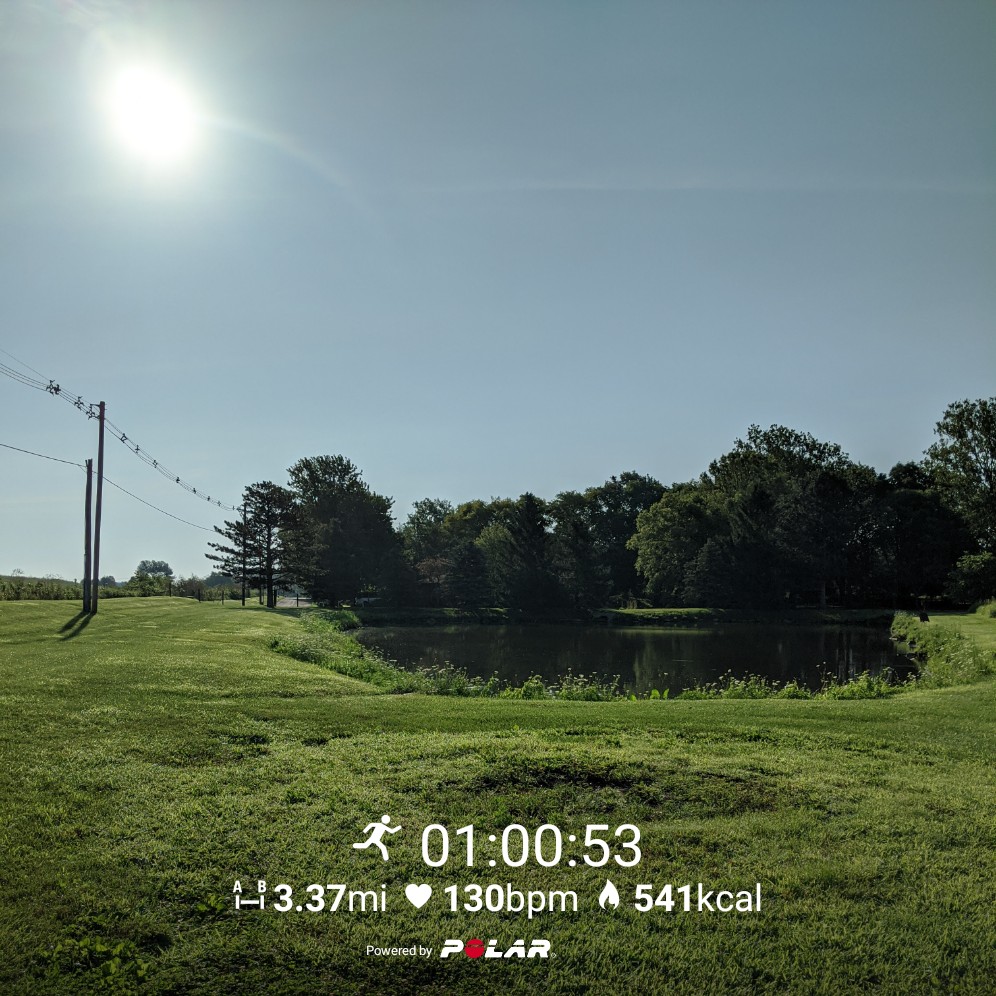
In fact, I felt enormously better today, and my performance shows that. Today’s run was a bare one minute longer than my run at the beginning of the week, but I ran a full mile further:

[sgpx gpx=”/wp-content/uploads/gpx/Philip_Brewer_2020-07-31_08-49-32.GPX”]

I’m not sure there’s anything to learn from this. Maybe “don’t skip rest days” would be a good start. I’m sure “listen to your body” is always good advice. Whatever lame platitude you want to go with is fine with me. As for me, I’m just glad I got in a good run.

In other news, the replacement kettlebell for the one I ordered on July 1st, but which vanished into some black hole at FedEx’s Ellenwood, GA location, only to vanish itself in exactly the same way, seems to have been discovered, and is now supposed to be delivered next week! We shall see.
For a long time, back when I had a regular job, this was all I wanted from life: Welcome Zoomers – Barbados invites you to work from the beach

For a fee… you can take your Zoom calls from a real pristine white sandy beach, instead of merely selecting it as a virtual background.

In actual fact, I’m not well-suited to remote work. I lurch toward polar-opposite failure modes (getting no work done at all, and turning my home into a digital sweatshop). But that doesn’t mean I wouldn’t have jumped at the chance to live and work (remotely) on a Caribbean island.

View from a run

My Oura ring produces a “readiness” score each day, and I’ve found it to be a pretty good indication as to whether or not I’m up for a long run or a hard workout. The times I’ve ignored it when it said I needed to take it easy, I’ve often found it was right and I was wrong. Today was a rare instance of the reverse.

According to my plan, today should have been a rest day. But I wanted to go for a run.

The ring gave me a readiness score of 88 (out of a possible 100), which is rather above my average (my average this month has been 80), and I took that as a license to go for the run I wanted, instead of taking the rest day my plan suggested.

Turns out—this time—my plan was right and my ring was wrong. I went for my run, but I felt tired and sluggish throughout.

It wasn’t a catastrophe. I didn’t hurt myself. I just don’t think I did myself much good. I ran to Colbert Park, did three hill sprints (in actuality, feeble jogs), and then ran home again. But I didn’t have any oomph behind the sprints, so I don’t expect they’ll have done their job in terms of boosting leg strength or aerobic capacity.

The Oura ring’s readiness score has been a very reliable indicator for me—which is why it helped me fool myself this time. So this is a good reminder to me to interrogate all of the factors that go into making a workout decision—my plan, my intuition, my ring, etc.

So one thing I’m doing is looking back at the factors that feed into the score, looking to see if there’s one that looked better than it really was.

Nothing really jumps out at me. Given the same information, I’d also figure that I was ready for a hard workout. (In fact, I had that information, plus my own sense that I felt ready for a hard workout. That’s exactly how I overrode my plan and went out for a tired, tiresome run.)

Oh, well. Insert your own pithy “live and learn” aphorism here.

I’ve been working on dips for a while, but not with great consistency until just the past three or four months.

For a long time I was doing bench dips (where you put your hands behind you on a bench, stretch your legs out in front of you with your heels on the floor, and then push with your hands to raise your hips up to the level of the bench), to try to get my triceps strong enough to do real dips. In the fitness room there are some bars that can be put on the squat rack so you can do bar dips. I wasn’t really strong enough to do a good bar dip, but I’d sometimes do partials or negatives.

For parkour, you want to do wall dips, but I don’t know of any good chest-high walls in Savoy, so I haven’t practiced those in a long time.

Since I got my gymnastic rings around the end of March, I’ve been working pretty steadily on ring dips. (Which are much harder, because while pushing yourself up you also have to be able to stabilize your body.)

I’ve been following pretty much the usual progression—working on just a ring support (where you hold yourself in the top position for a dip), on negative dips (where you just lower yourself), and on partial dips (where you lower yourself only part of the way down, and then back up).

I’ve been gradually increasing the range of my partials, and a few days ago I thought I was doing a full, proper dip. I wasn’t really sure though—there aren’t any mirrors out under the sycamore tree where I hang my rings. So today I got Jackie to come and video me, so I could watch what I was doing:

I think those first two—especially the second—are legit dips. (The third, of course, is just a negative.)

The New York Times offers up a widely-shared article on doomscrolling, which prompts me to realize that I’m actually doing pretty well at staying away from that.

In large measure I credit my decision from right after the election to minimize my exposure to internet content designed to maximize my outrage. Outrage comes with its own little dopamine hit, which makes it a treadmill that’s hard to get off of, but I realized that it was a treadmill that didn’t suit me:

I’m going to follow fewer links—so often they go to articles calculated to produce outrage, and I don’t need more outrage. It’s a fine line, because there has been and will be much that is deserving of outrage. Yet: I do not worry that I will suffer from outrage deficiency.

I did pretty well at that, and I doubled down on it after coming across the ideas of (and then reading several books by) Cal Newport. His book Deep Work reminded me of the satisfaction involved in taking the time and putting in the energy to focus deeply on doing something important and doing it well. (I recommended the book at the time.) His book Digital Minimalism helped me understand the harm that comes from participating in the faux social interactions of social media (things that feel like social interactions, but aren’t—things like hitting “like” on a facebook post).

I don’t want to give an impression of smugness here. I’m certainly not holding myself out as a role model. I’m all-to-well aware that at every moment I’m only a few clicks away from leaping headlong down the rabbit hole of internet outrage. But I’m doing okay. I feel the outrage, but I’m not compelled to feed it. I tend not to share the posts that feed the outrage in others (while still sharing the ones that suggest ways to make things better, both individually, and across society).

Maybe one or another of those ideas would be helpful to you.