I blew right on past the distance of my longest run ever by close to a mile and a half. 🏃🏻♂️ I felt great right on through—no pain at all. I did start feeling tired at about mile 9.5, but I ran pretty strong right to the end.


I blew right on past the distance of my longest run ever by close to a mile and a half. 🏃🏻♂️ I felt great right on through—no pain at all. I did start feeling tired at about mile 9.5, but I ran pretty strong right to the end.
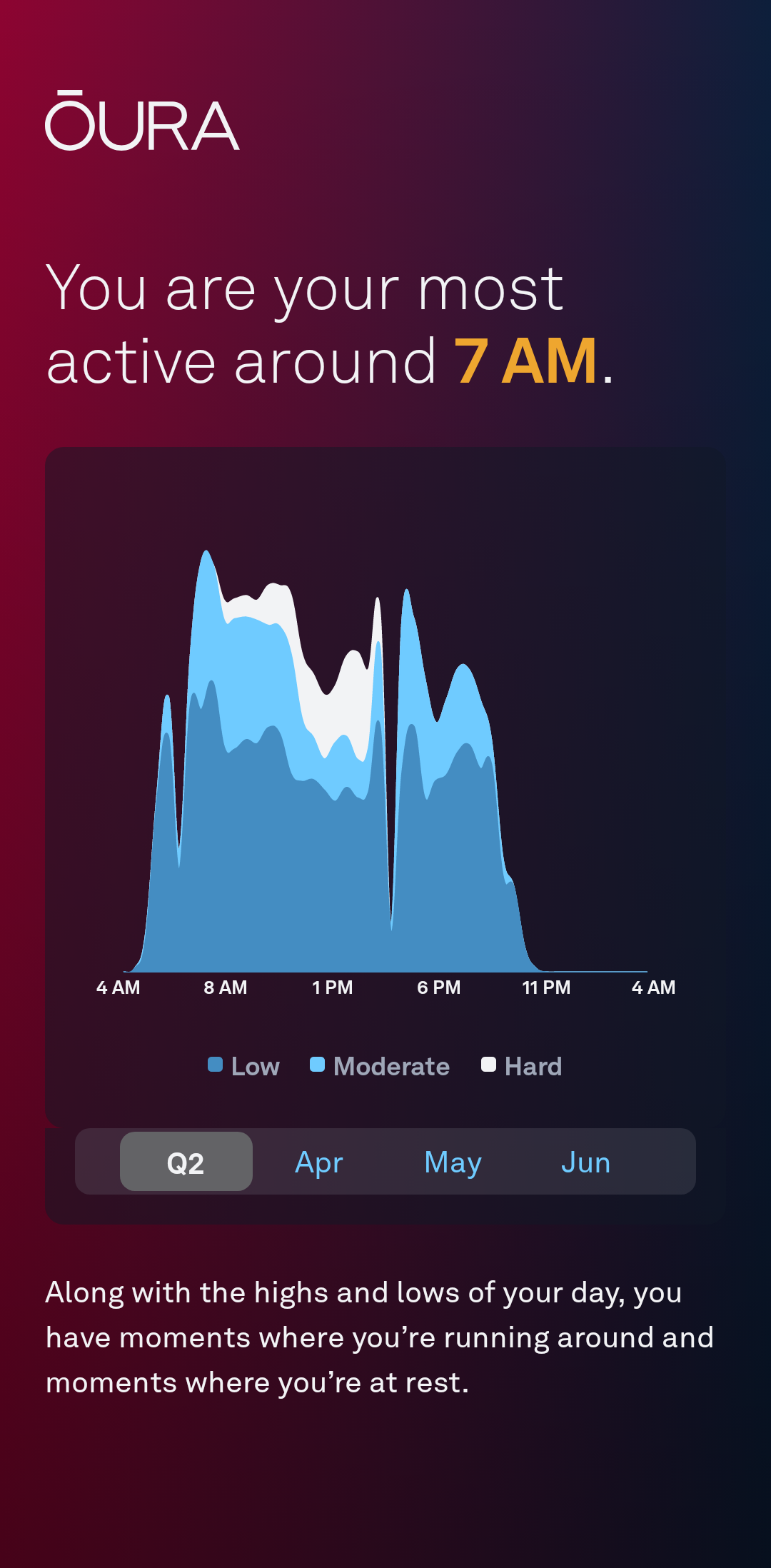
Mildly amusing. Low peak for the first dog walk, notch for drinking coffee and Jumbletime, then my most active time is 7:00 AM, for the second dog walk.
Before I got a dog, my most active time was 11:00 AM, because that’s when I finally get to my workout.
I was not particularly sporty as a child. My dad played catch with me an ordinary amount of time for a father who had no particular aspirations that his son would be a sports star. I played whiffle ball with the neighborhood boy across the street, and threw that ball a good bit. I took tennis lessons, and played quite a bit of tennis, and eventually got sorta okay at tennis, and there’s a certain amount of throwing in tennis, to get the ball to the person whose serve it is. (Plus, a serve and a forehand are both throwing-pattern type movements.)
My point is simply that although I did throw balls around some as a boy, it was never important, and I pretty much quit as soon as I was out of high school.
(And even in high school phys ed there was way less ball-throwing than there probably should have been—the fake, altered versions of sports that they made us play in class provided neither training nor practice for the kids who were not “good at sports.” We were sent out to stand in the field and do nothing except be available to be blamed once every 10 or 15 hours when a ball unexpectedly came our way.)
This was brought home to me a couple of times in the past decade or so. Once, perhaps 10 years ago, while out walking near some ball fields in our old neighborhood, I had a softball roll up at my feet. A player across the street asked me to throw it to him. I attempted to do so, and ended up throwing it perhaps halfway to him.
That was embarrassing.
When I thought about why I did so poorly, my analysis was that there were several issues. One was perhaps just a lack of strength. Just as much was simply having forgotten how hard to throw a ball to get it to go a particular distance—an important skill in many sports, and one that requires quite a bit of training. Mainly, though, I think the issue had to do with having lost the fine motor-control patterning. Throwing a ball involves a bunch of muscles that all have to fire in sequence, each one at just the right moment.
I was reminded of this more recently, because Ashley likes to chance a ball, so I’ve been throwing one for her from time to time.
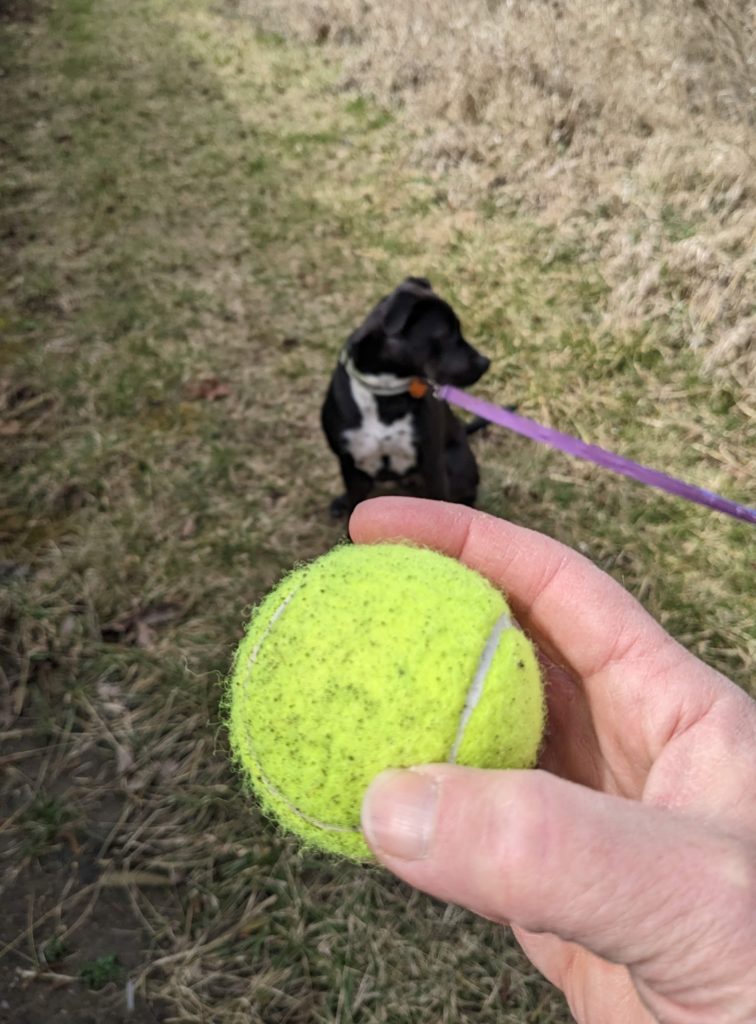
When I started doing this, around the end of November last year, once I had Ashley signed up for the dog park, I was crap at throwing a ball.
I’m still crap at throwing a ball by any objective standard, but maybe 1000 throws, spread out over the course of six or seven months, have gotten me up to being able to throw the ball perhaps three times as far as I could in November, and with quite a bit more accuracy.
I suspect that the main thing is simply the muscle pattern stuff: my nervous system has relearned which muscles to fire at which moment in order to execute a competent throw. Secondarily, I think my heavy club swinging has helped some. Inside Circles are essentially a throwing pattern, and using a 15 lb club lets me build considerable strength in those muscles.
It’s not the exact same motion as throwing any particular ball, so I still need to practice whatever throw I want to be good at, but the muscles are being strengthened in the right patterns, which I’m sure has already helped.
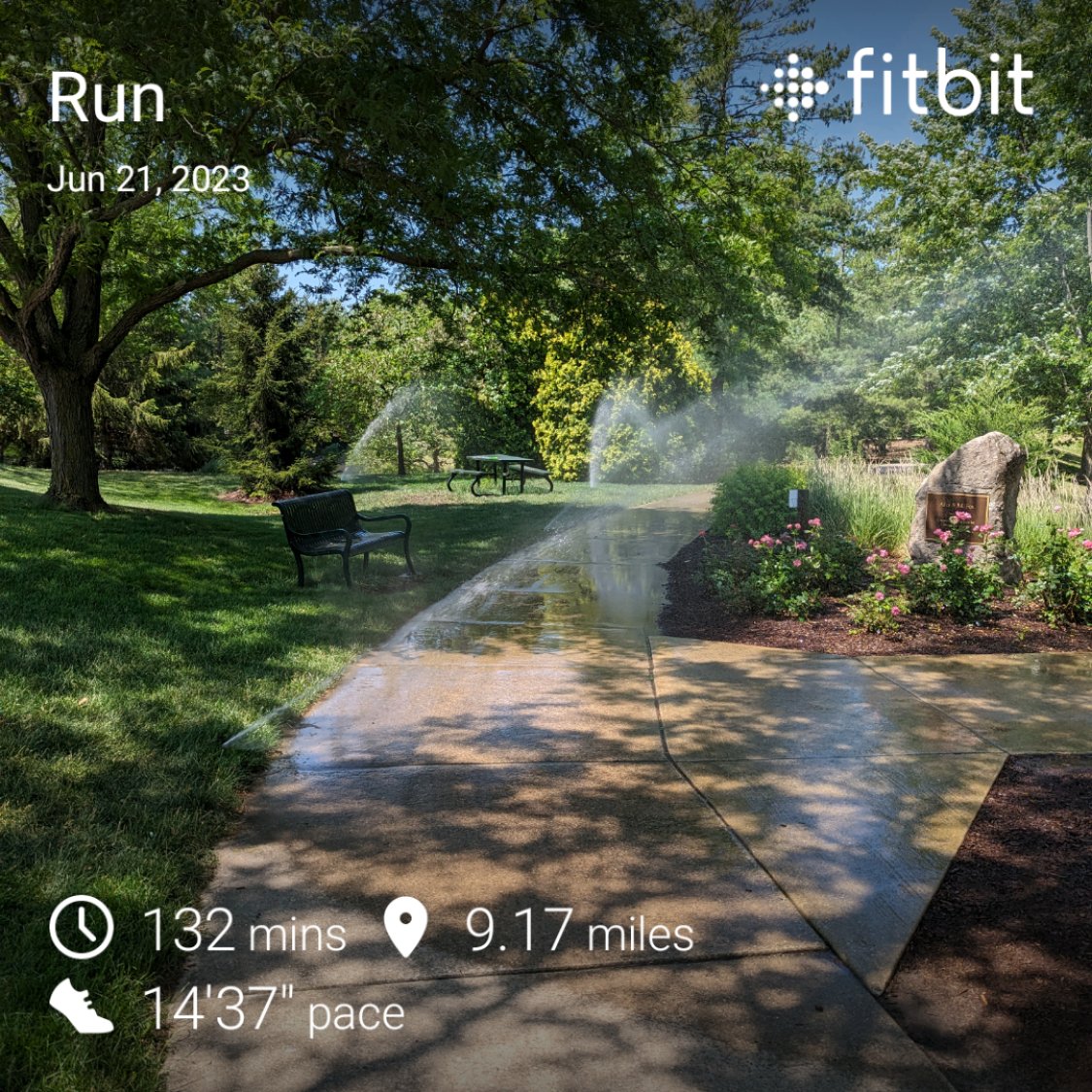
If I’d realized that this run would be 0.01 miles less than my longest run ever, I’d have run another 0.02 miles. I did run it three minutes faster, though, despite the heat. #run 🏃🏻♂️
It may not be obvious from the picture below, but those sprinklers are not only blocking the sidewalk; they cover the entire right-of-way from the detention pond to the drainage creek. To get around it I had to walk through a parking lot, down the street, and back through two more parking lots.
I keep taking Ashley on longer and longer walks, trying to tire her out so I can get stuff done, but (duh) it just makes her ready for yet longer walks.
In other news, Ashley continues to look like a dog fitness model. #dogsofmastodon
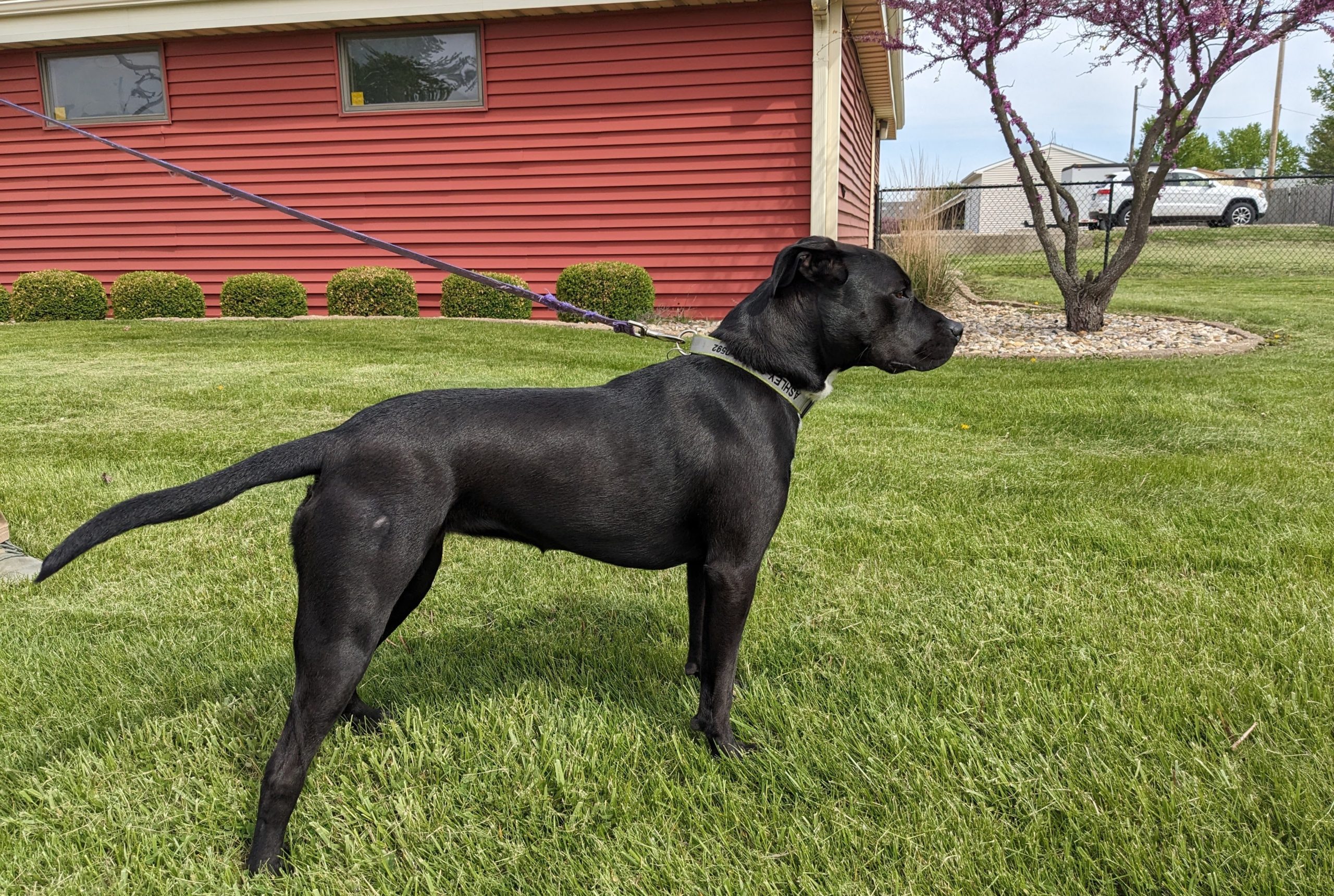
The most obvious goal for someone learning to fight with swords is to get good enough to enter sword-fighting competitions and do well against other sword-fighters. And, I suppose that is my long-term plan. My medium-term plan is less ambitious, but rather specific.
I’ve come up with this intermediate goal because I know that I am not a natural martial artist. My reflexes and hand-to-eye coordination are merely average. Besides that, I am well below average in my ability to watch someone execute a move and then do “the same thing.” I’ve written about this before in my post Learning movement through words.
I hadn’t realized it in advance, but the very nature of Historical European Martial Arts makes it especially well-suited to me: Essentially every HEMA practice is based on a text—in our case Joachim Meyer’s The Art of Combat. The text provides the verbal description that I need to be able to learn a movement practice.
Still, even with the text and the instructors showing us stuff (and correcting our errors) and classmates to practice with, I’m still the guy with merely average reflexes and hand-to-eye coordination (plus a lifetime of no experience with stuff like this, because I was in my 40s before I figured out that I could learn this stuff at all, as long as I have a verbal description to work from), so my expectations for developing the skills of an excellent sword-fighter are rather low.
That would be rather discouraging, so I’ve come up with my own personal medium-term goal. I’m going to focus on executing Meyer’s system very, very well. Success for me will not depend on doing well sparring with opponents, but rather on looking like—moving like—someone who has trained with the best teachers of Meyer’s system.
Expressed in aspirational terms: A year or two from now a modern expert in Meyer longsword will look at me and think, “Wow—this guy looks like he might have trained with Meyer himself!”
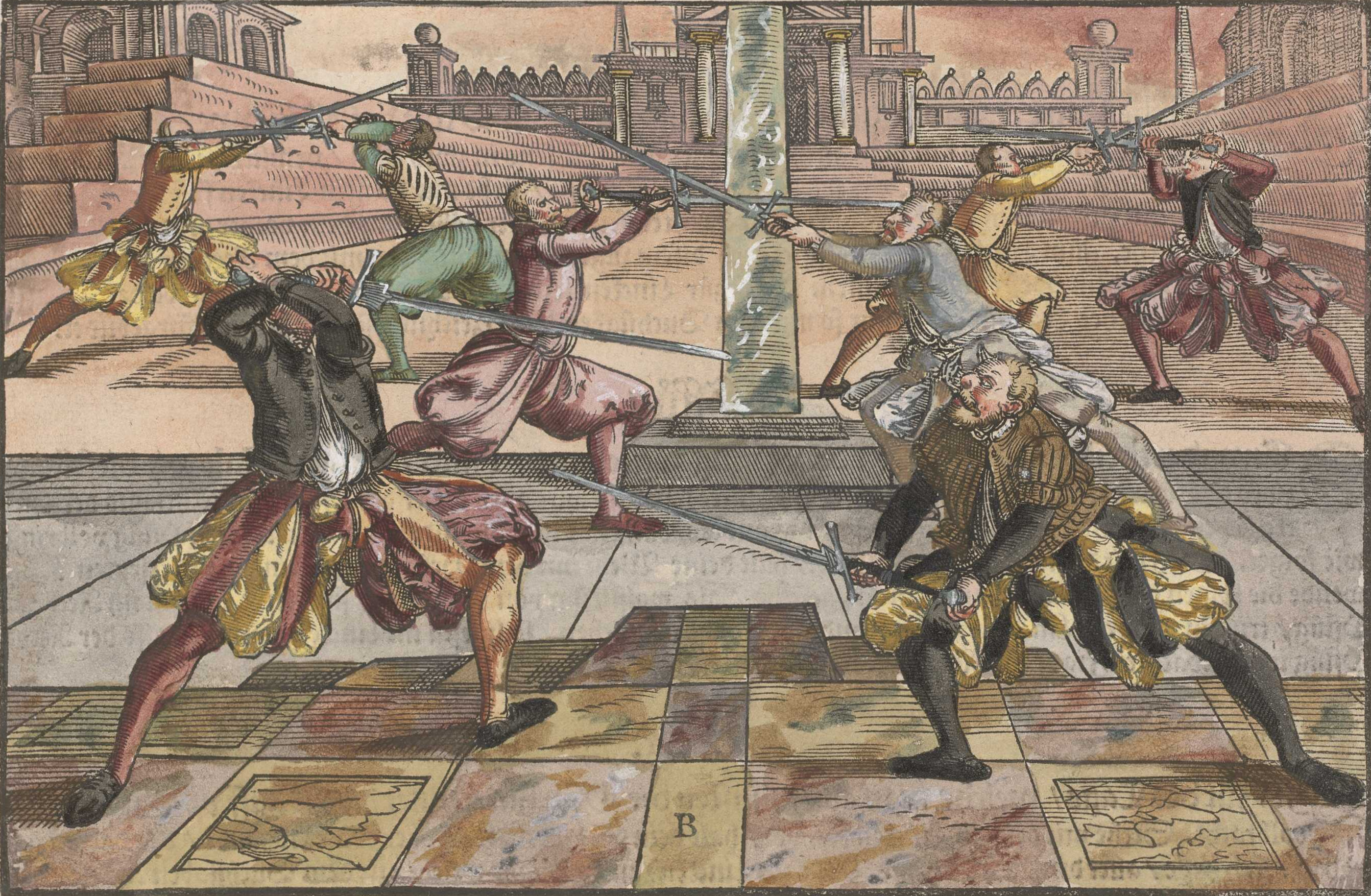
Knowing my own strengths and weakness, this seems like it might be achievable, with the bonus that it will probably be much more effective at making be a better sword-fighter than if I jumped right into trying to figure out how to spar well.
I had been waiting to get the new translation of Meyer that’s coming later this month from HEMA Bookshelf, but decided to go ahead and order a copy of the existing translation. It’s what everyone in the group has been working with for several years now, so the instructors and senior students all know it. I’m sure it’ll remain a useful reference even if everyone switches to the new translation as soon as it’s available. (And I’ll get the new translation immediately myself.)
My short-term plan to support my medium-term plan will be to create my own practice sessions on the foundational stuff: stance, footwork, guards, and cuts. The classes covered stance and footwork on the first day (and then added a third stepping pattern on the second day), but hasn’t returned to those things since then. This makes sense: We’re practicing stance and stepping as we’re learning cuts and parries. But for my purposes, I think and extra 15 or 20 minutes each day specifically working on these items (which are readily amenable to solo practice) will do me a world of good. I’ll also spend a few minutes each day working on the German vocabulary, so I know the names of everything (and know what the thing is!).
One bright spot: I seem to be fit enough. The first week and a half I was just a bit worried about whether I could do a 2-hour training sessions and the recover enough to do the next one and then the one after that, but it seems that my fitness regimen of the past few years is standing me in good stead. I may not be as strong or as fast (or recover as well) as the fitter of the college-age kids, but I’m fit enough to see a practice session through to the end.
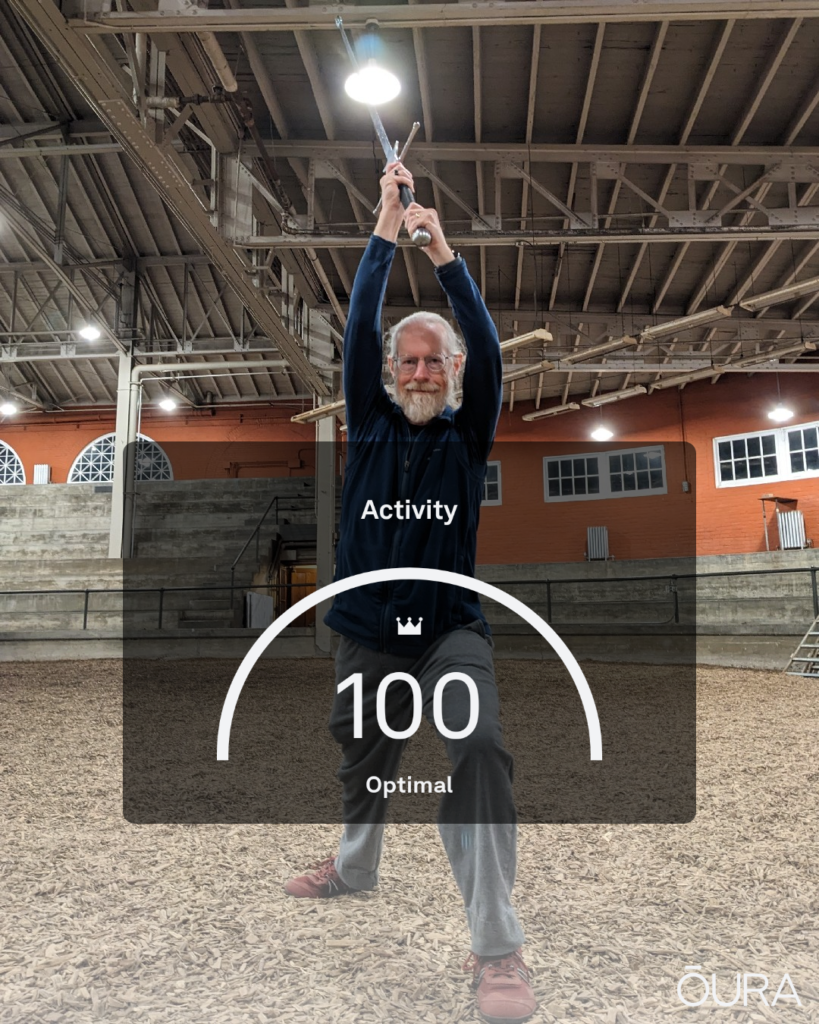
Badge from my Oura ring today. Photo of me from my HEMA class last night (a guard position called Tag).
This week I attended my first and second HEMA classes, and had great fun. I am even (almost) in good enough shape to work out for two hours, although I’m certainly feeling it this morning.
The first class was half devoted to longsword fencing at a conceptual level, looking at key concepts from Joachim Meyer’s The Art of Combat (which serves as the basic text for the local HEMA group), with the second half devoted to stance and footwork.
The concepts section had to do with the “five words” of Meyer: Vor (= before), Nach (= after), Sterk (= strong), Schwach (= weak), and Indes (= during, or maybe between). Quite a bit of time was spent talking about these concepts, which nevertheless remained subtle and (at least to me) rather unclear.
The stance was kind of interesting, purely because of the modest difference between a longsword stance and santi stance.
In Tai Chi, santi stance is described as a spiral: Your back foot is turned out about 45 degrees, your front foot is turned in (that is, the same direction as your back foot) just slightly. Your hips are turned less, kind of between your feet. Your torso turned less. Your shoulders are turned still less, your head is turned only slightly. Perhaps only your forward eye is pointed directly at your “partner” (i.e opponent).
Meyer’s longsword stance is different: Your back foot is still turned out 45 degrees (or up to 90 degrees). But your front foot is pointed straight forward, as are your hips and shoulders.
Once we’d we practiced the stance (getting our front knee directly over our front ankle, making sure our back knee was modestly bent), we went on to footwork, learning the passing step and the gathering step. Passing step is just stepping forward, except of course, that changes which is the front foot (pointed forward) and which is the back foot (turned out). The gathering step is like an advance in fencing: you back foot steps up to about even with your front foot, and then your front foot moves forward to reestablish a proper stance. And, of course, you don’t need to be committed: You can move your back foot up, and then if circumstances warrant, simply put it back where it had been.
The second class began with a pretty extensive warmup. We did some mobility, and then some stretching, and then some practice stepping, which both got us practice and got our heart rates up a bit. Then—one part I had trouble with—a bunch of lunges: regular lunges, backward lunges, jumping lunges. (Click my “lunge” tag to read a bit more about my difficulties with lunges.) We also sprinted just a little, I assume primarily to get our heart rates up.
Then we learned one new step: Triangle step. In triangle step you bring your back foot behind the front foot, taking you off-line from an attack from the front.
We practiced something they called “dancing,” which is a variation on the introductory practice of push hands: you and a partner touch your hands together (finger tips, or fist) and then one leads, stepping forward or back, while the other attempts to remain stuck, by stepping back or forward, so as to remain at the same distance—while, of course, using proper Meyer longsword footwork.
After that we picked up swords for the first time!
We learned the four principal guards, and then four cuts. They all had names, but unfortunately the acoustics weren’t good enough for me to hear most of them. But there are extensive web resources (including translations of Meyer’s book), so I have the technology to track them down and learn them before Tuesday.
We practiced the guards and cuts quite a bit, which (after all the stepping practice) left me pretty tired, and rather achy this morning. Happily, I’m not suffering from any over-use injuries, just feeling like I got in a good workout. (The one exception is my toes, which were slightly strained from the lunges. Hopefully they’ll be all better very shortly. Henceforth I’ll remember to do some toe stretches before each the HEMA class.)
The steel club swinging I’ve been practicing for months now stood me in good stead: my hands, wrists, arms, and shoulders are strong enough and stable enough, which I don’t think they would have been otherwise.
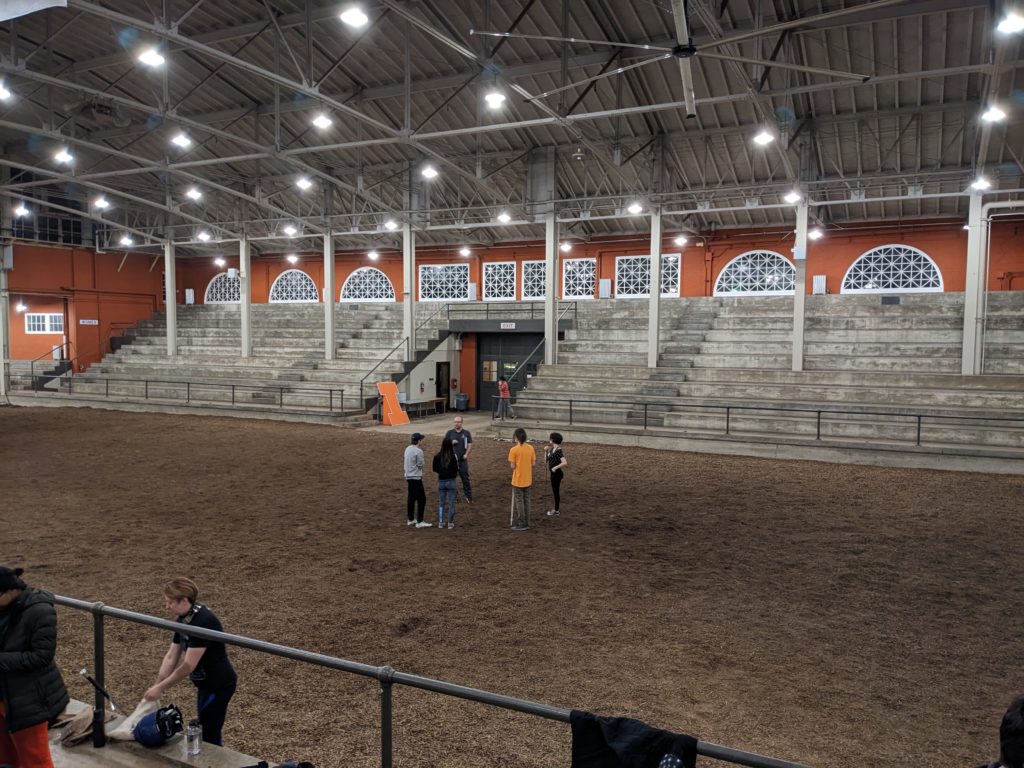
Classes take place in the Stock Pavilion, an old University of Illinois building (constructed over 100 years ago) originally built to support the Ag school’s mission as a place for students to learn about things like cattle judging. It’s a large space with a dirt (wood chip) floor and concrete bleachers, which suits pretty well for sword-fighting practice.
Next thing to do: buy protective gear (mask and gloves). I’ll also want to get a copy of The Art of Combat, which I understand has a new translation coming out next month, so maybe I’ll wait for that.
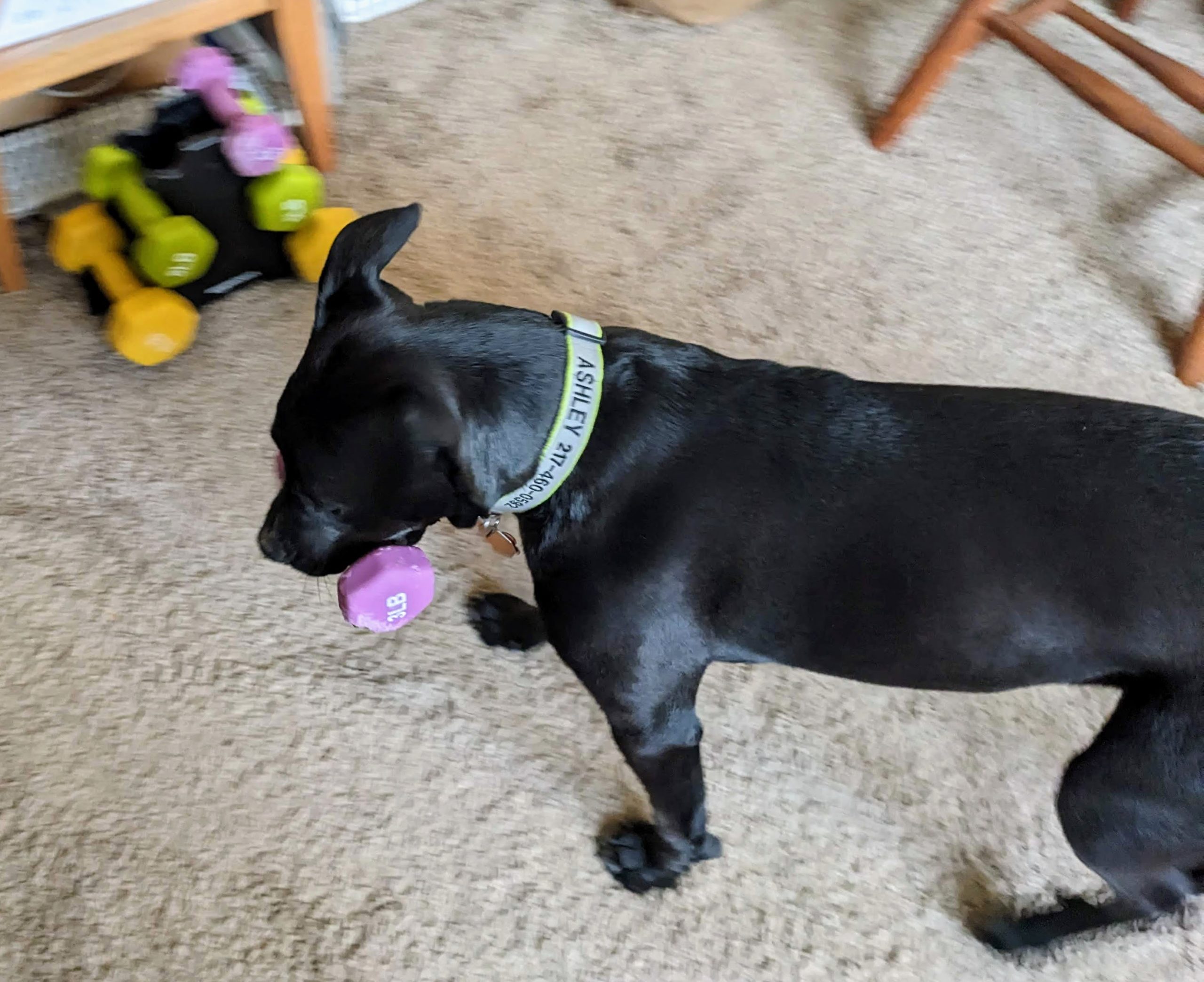
Ashley emphasizing the importance of weighted carries for optimizing overall fitness. 🐕 🏋️ #dogsofmastodon
I forgot to bring my phone on one of my walks, so those steps only got counted twice and not three times!!! I am bereft.