
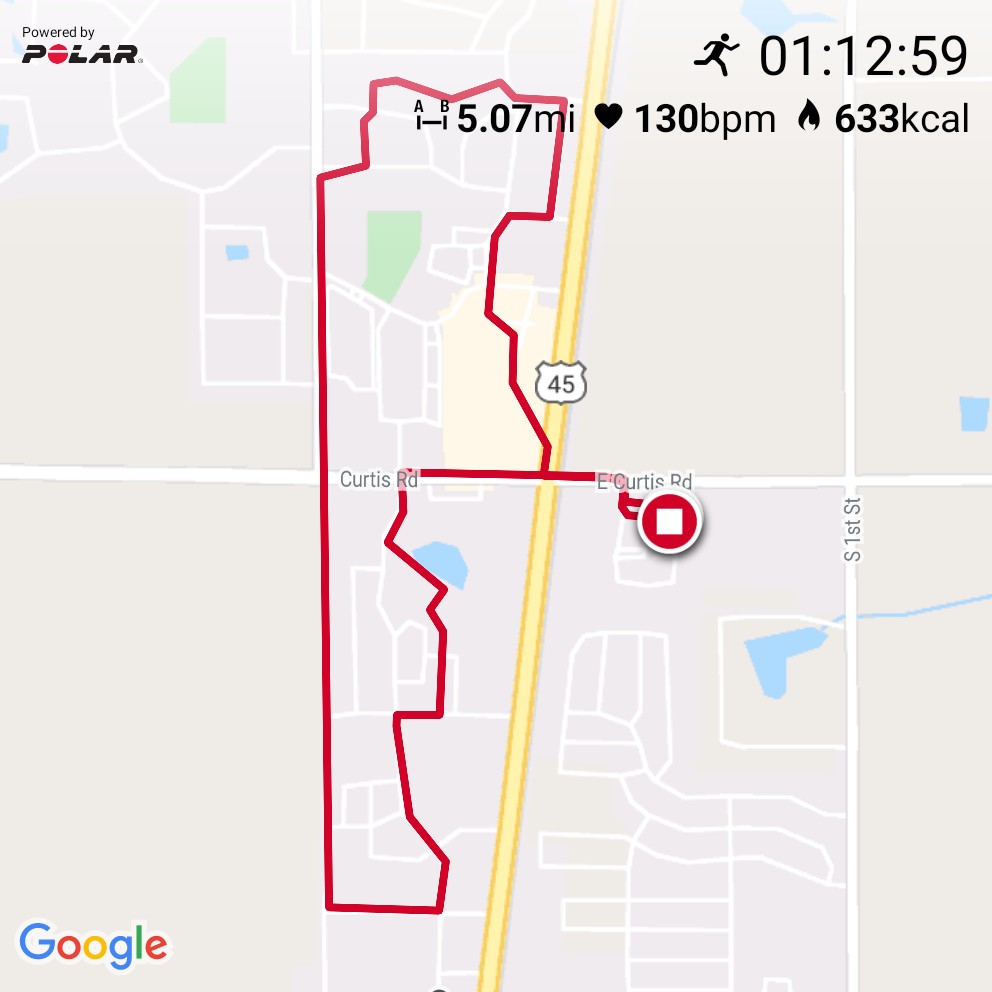
At just over 5 miles, this was my longest run in a very long time. (I just checked: I ran a fraction of a mile farther back in April of last year.) Cold, but I have the clothes for it. 🏃🏻♂️

At just over 5 miles, this was my longest run in a very long time. (I just checked: I ran a fraction of a mile farther back in April of last year.) Cold, but I have the clothes for it. 🏃🏻♂️
With typical wry humor, the Bioneer responds to a common criticism of his training style:
“… that it’s impossible to train such a variety of different traits and skills if you have a busy schedule. People accuse me of having no life! Me! The guy talking about Batman on YouTube!”
He then goes on to effectively answer the criticism with a fully worked-out program.
Source: How Would Batman Really Train?

This year was obviously strange in all sorts of ways, so I figure it’s not so strange that my movement practice got strange.

One thing that seems very strange to me is that I reverted to doing a lot of exercise, after having made a big deal the past few years of scorning exercise in favor of movement. I wrote a whole post on this recently (Exercise, movement, training), so I won’t repeat all that stuff here, except to say that the pandemic response provided me with a lot of opportunities to exercise, while restricting my opportunities to move and to train.
Around the beginning of the year I had a realization that what had held me back from achieving my fitness goals was not (as I had been supposing) a lack of intensity, but rather a lack of consistency. I responded by getting very serious of getting my workouts in, and was pretty pleased about having established a proper workout habit when just a few weeks later the pandemic led to our local fitness room being closed. I found this momentarily daunting.
As I’ve mentioned elsewhere, it was around this time I saw this hilarious tweet:
To which my response was “Challenge accepted!”
The biggest problem with losing access to the fitness room was losing access to the pull-up bar. I looked around for alternatives, found that gymnastic rings were available and affordable, and I ordered a pair.
Easily the best purchase I made last year.
The addition of gymnastic rings made for a big change in my exercise regimen. I use them for three exercises: pull ups, inverted rows, and dips. I had worked pretty hard on pull ups before, but upon getting the rings I redoubled my efforts. As far as inverted rows and dips, I had played around with both, but now I got serious.
I round out my upper-body exercises with push ups.
For lower-body exercises I experimented with a variety of possibilities: squats of various types, kettlebell swings, burpees, lunges, etc.
One milestone was achieving my first pull-up. Another was the first time I did two pull-ups. Later I manged (a couple of times) to do three pull-ups!
I just wrote about how kettlebell swings taught me something about the value of doing lots of reps. Based on that, for my indoor workouts (where it’s not handy to set up my rings), I’ve started doing more exercises for high reps. Not enough data yet to know how that’s going to work, but it seems like a valuable experiment.
For a long time—at least many months, maybe more than a year—I’d had a sore foot that got worse when I ran. I repeatedly cut back or eliminated runs, had my foot get better, and then had it start hurting again as soon as I started running again. This past summer I finally took a full month off from running, which seems to have been what my foot needed.
I’ve very gradually resumed running. For some weeks I kept my runs down around just one a week and just 2–2.5 miles. Then up to a 3–3.5 miles. I did one 4 mile run, which didn’t seem to cause any problems, but then I did a run of nearly 5 miles, which did make my foot sore the next day. I took a break until the pain was completely gone and eased back to 3–3.5 miles, and all seems well.
I’ve just started doing two runs per week, a “long” run (slightly over 3 miles) and a “fast” run (where I hold the distance down under 3 miles, but include a few 10-second sprints around the mid-point of the run). That felt really good the last time I did it. (My running gait seems to improve when I run fast.)
I’ve talked at some length about my adventures in getting a kettlebell during a pandemic, and about my experience with kettlebell swings producing unexpected hypertrophy, so I won’t repeat that here. I’ll just say that cold weather—and especially ice on the patio—have kept me from doing much kettlebell swinging in the second half of December. But literally every day I look out on the patio to see if it is clear of ice, and get out and do some swinging when it seems safe.
I added a jump rope to my exercise equipment a while ago, and back in March and April did enough rope skipping to recover the ability to do it. (That is, I could jump rope for 30 or 40 seconds with zero or one misses.) The problem was that jumping rope hurt my sore foot just like running did. I prefer running, so when I had to set limits on those exercises to protect my feet, I ended up mostly running, as long as the weather was nice.
As the weather turned chilly in the fall, and especially when we started having days when there was an occasional short period adequate weather, but not the sort of reliable block of nice weather that makes me think I can fit in a good long run, I started thinking that an occasional bout of jumping rope might be a great way to squeeze in a quick, intense workout during even quite a brief period of nice weather on an otherwise nasty day.
To make full use of such periods, I paid up for a weighted jump rope. I have to say I’m pretty happy with it. It’s very much the opposite of my old jump rope, which was just a plastic-coated wire—very light and very fast—marketed to martial artists and cross-fit types. Pretty good for getting lighter on your feet, and adequate for a lower-body workout, but not much for the upper body. The weighted jump rope (even the lightest one, at just ¼ lb) definitely turns the jump rope exercise into an upper-body exercise as well.
I haven’t had the weighted jump rope long enough to form a definite opinion about it, but after just a couple of sessions, I’m pretty pleased, and if the weather cooperates, I’m hoping to get multiple HIIT jump rope workouts in over the course of the winter.
My main non-exercise movement is and always has been walking, but I’ve done very little this past year. This was half due to the pandemic, and half due to Jackie having a sore hip that makes it hard for her to walk fast or for long distances. (I’ve been taking Jackie to physical therapy, and she’s getting better. We’ve been doing walks in the woods south of the Arboretum, and that’s going very well.)
With fewer and shorter walks with Jackie, and with walking for transportation almost eliminated by the pandemic, my non-exercise walking has dwindled pretty severely.
Ditto for my non-exercise running.
I have very much had my eye on parkour as the thing I want to get back to this summer. Since I have made great progress on strength training specifically with an eye toward parkour, I’m very hopeful.
I’ve been doing just a bit of training, even without being able to get together with other traceurs.
The most active member of the campus parkour group turns out to have moved to Colorado. I’ve been in touch with him, and he seems to mean to spend at least some time here this summer, so hopefully I can put together some sort of training with him. In the meantime, I ordered one of his t-shirts, so I’ll have something to wear.
Like everything else, the taiji classes I used to teach at the Savoy Rec Center had to be abruptly canceled back in March.
During the spring I led a few group practice sessions via Zoom. They’re better than nothing, and at least keep the group connected.
Once the lock-down restrictions in Illinois eased up a bit in April, my group started meeting in the park, and we continued to meet through the summer. Once the weather turned, I resumed the on-line practice sessions.
Unlike a lot of my students, who don’t feel like they can do the taiji practice without someone to lead them, I can actually do a full practice session entirely on my own. And I occasionally do. But without the group being there, it’s hard to get motivated.
Still, I almost always include some qigong as part of my morning exercises, do the once-a-week group practice session, and occasionally do the full 48-movement form (if only to make sure I don’t forget how to do it).
Looking ahead, of course, is all about the end to the pandemic, something that I have high hopes for. If I can get vaccinated by June, let’s say, then by July maybe I can resume normal activity (while wearing a mask and maintaining social distance, of course, but actually interacting with people other than just Jackie).
Normal would include hiking in the woods, and maybe visiting some natural areas within a few hours drive. (We’ve pretty much completely avoided going anywhere so far that we couldn’t go, hike, and return without having to use a restroom.)
Normal would include practicing parkour with the campus group.
Normal would include resuming teaching taiji in the fall.
I had scheduled a visit to Urbana Boulders to do some wall climbing right when the lockdown started, so that fell by the wayside. I had actually started taking an aikido class when we had to stop because of the pandemic. Either one of those things might happen, once the pandemic ends.
Basically, I have high hopes for 2021.
I found a chest-high wall here in Savoy! It’s a retaining wall along a path I must have run down dozens of times, but it had never occurred to me before that I could use it to practice a parkour top-out. 🏃🏻♂️
Five years ago made a plan to spend the winter trying to build the strength I thought I’d need in order to be successful at (and enjoy) training for parkour. To keep the whole thing manageable, I chose just four specific exercises to work on. And to keep myself accountable, I described a “success” condition to let me know if I had accomplished each one. (I documented my plan here: strength training specifically for parkour.)
I wasn’t successful at meeting most of those goals after that first winter, which was discouraging, and I kind of quit tracking my progress on those metrics after that. But in my preparations for writing my “Movement in 2020” post, I happened upon that post—and was surprised to see that I had pretty much accomplished it!
Squatting is an important transitional posture, into and out of ground movement, and into and out of jumps. (It’s also a basic human capability, but one that requires a degree of strength and flexibility that most westerners no longer have.)
Five years ago I could only just barely squat, and then only when nicely warmed up. Since then I have worked on my squat in a dozen different ways—working on ankle mobility, hip mobility, and strength up and down the posterior chain.
My original benchmark was:
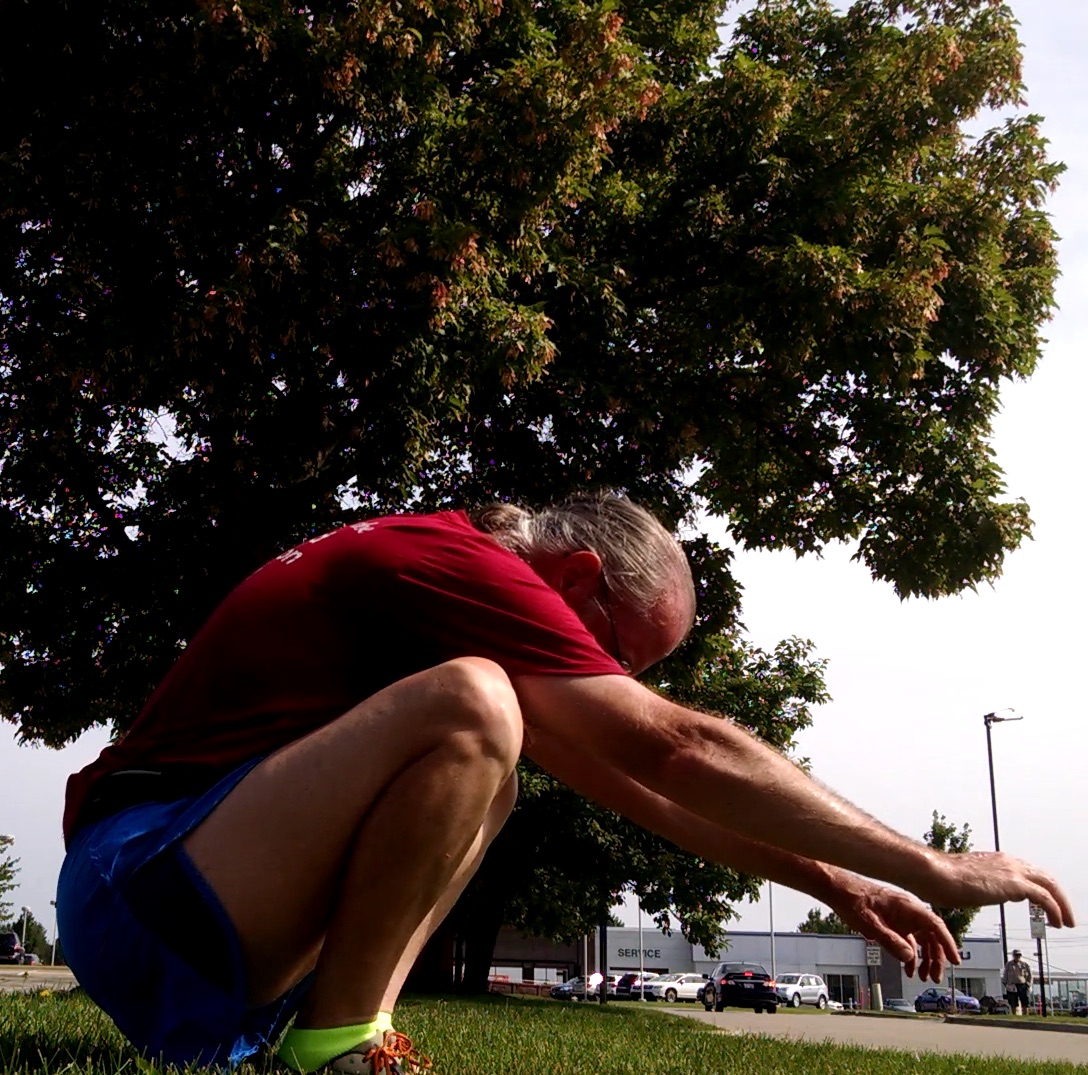
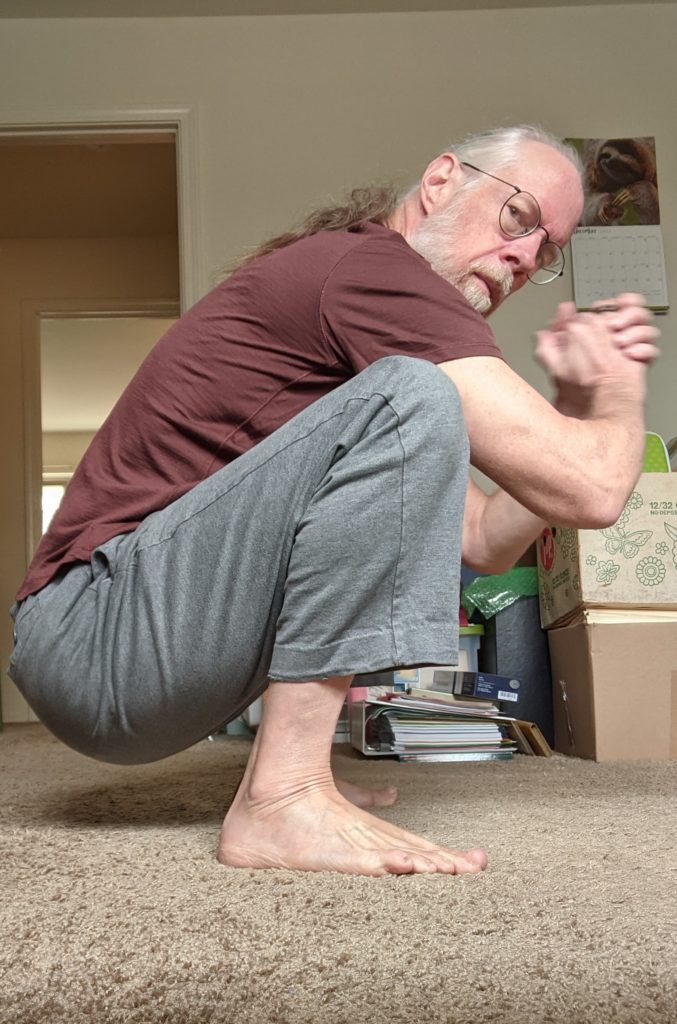
Success will be when I can get all the way down with a straight back, and then use my hands to manipulate things that are nearby.
I can report a considerable degree of success! I can get down into a deep squat, and I can linger there for tens of seconds at a time. I’m now working on improving my mobility while in a squat (looking to each side, up and down, reaching up and down, etc.).
Here’s where I was back then, and where I am now:
Early on my efforts to get better at various natural movements were significantly hindered by a lack of toe flexibility. My toes literally did not bend back at all.
This was actually a long-standing problem. At least as far back as college my martial arts instructors warned that I needed to pull my toes back or I’d hurt myself if I executed the kicks I was learning. But none of my martial arts instructors had even the tiniest bit of advice on how I might acquire the capability to pull my toes back.
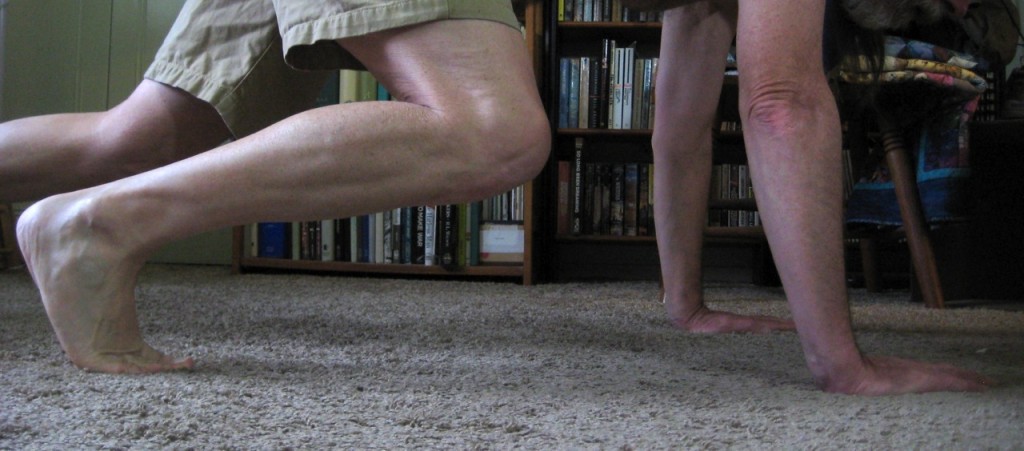
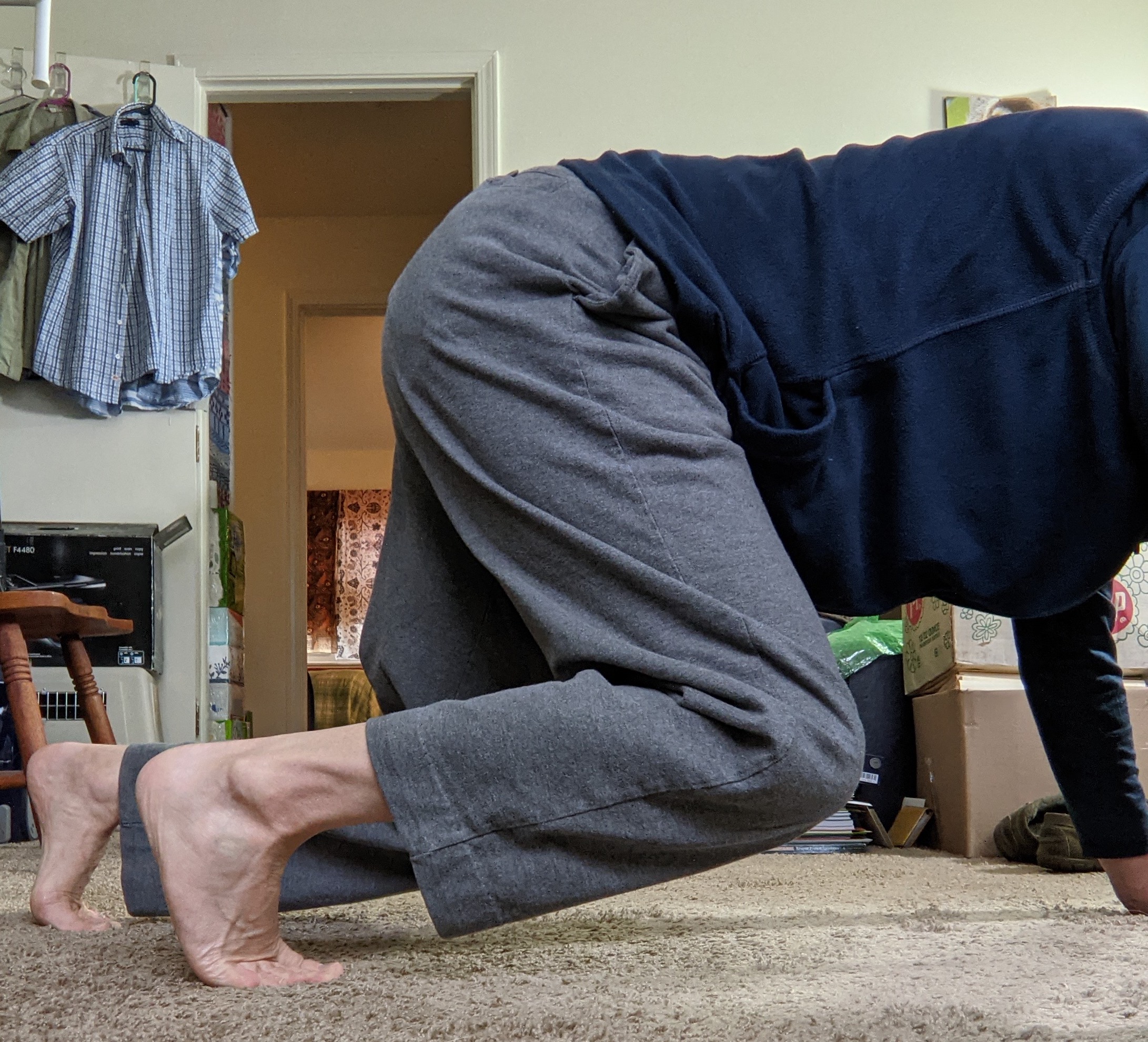
Five years ago I came up with my own idea. I’d get into quadruped position while keeping my weight back on the balls of my feet (meaning that my knees had to be rather higher than ideal), then I gently worked to lower my knees toward the floor. That helped me make some progress.
A couple of years later, Ashley Price suggested an excellent exercise involving using a half-dome to let me gently flex my toes back. I’ve been doing that exercise almost daily since then.
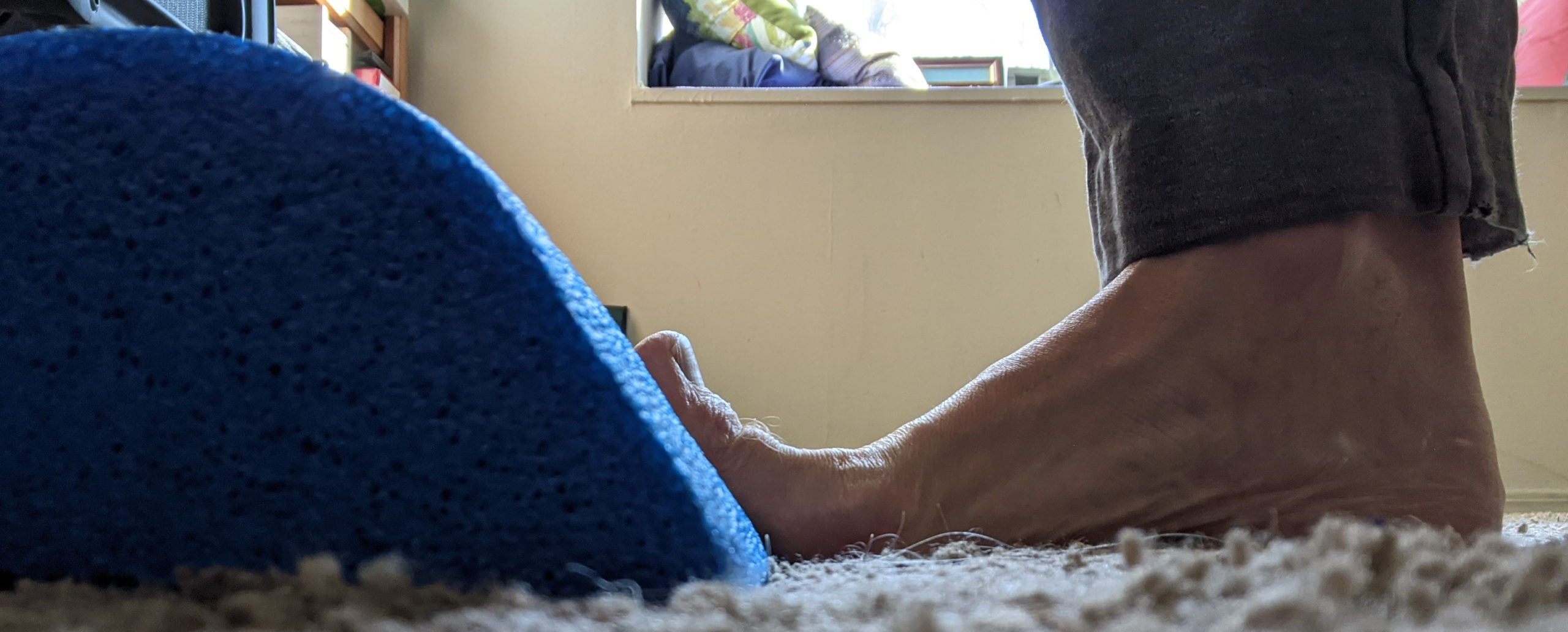
My original benchmark was:
Success will be when I can keep my weight back on the balls of my feet and still get into position for things like planks, push-ups, and lunges.
On that I can report complete success. The only thing that still eludes me is the quasi-martial arts move where you sit seiza (kneeling with the tops of your feet on the floor) then pull your toes back and tuck them under, shift your weight to the balls of your feet, rock back into a squat from which you can stand up. This is useful if you want to move from kneeling to standing while simultaneously drawing a sword, but is perhaps not particularly important beyond that.
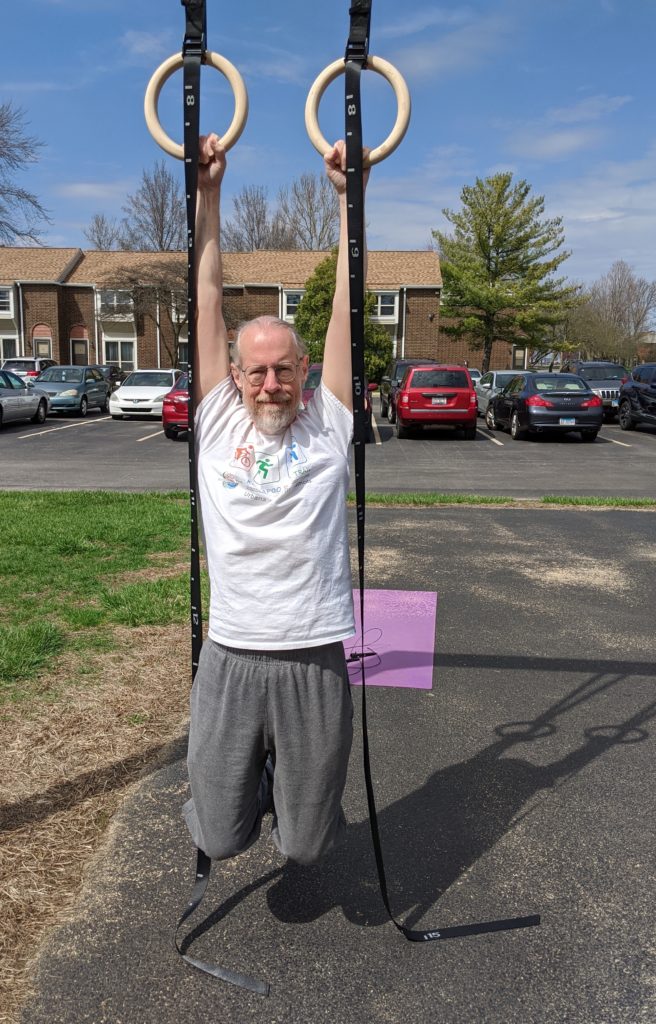
The ability to hang by your hands is crucial for many parkour moves.
Hanging was one of the things I worked on early, and made quite a bit of progress at, working up to being able to hang for a minute no problem. At about the same time I briefly managed to do a chin-up. But until this year I hadn’t done a pull-up since I was in elementary school.
Since I redoubled my efforts on pull-ups back in April or so, I’d largely quit working on hanging endurance, and it has somewhat slipped away—I can do 30 seconds, but a recent attempt at a full minute fell short. Similarly, although I can hang briefly from one hand, I can’t do what I could do a few years ago.
My original benchmark was:
Success will be a single pull-up in good form from a dead hang.
And at that I have succeeded! I can do a pull-up! In fact, on a good day I can do pull-ups in sets of three. Even on a less-good day, I can manage three sets of one pull-up.
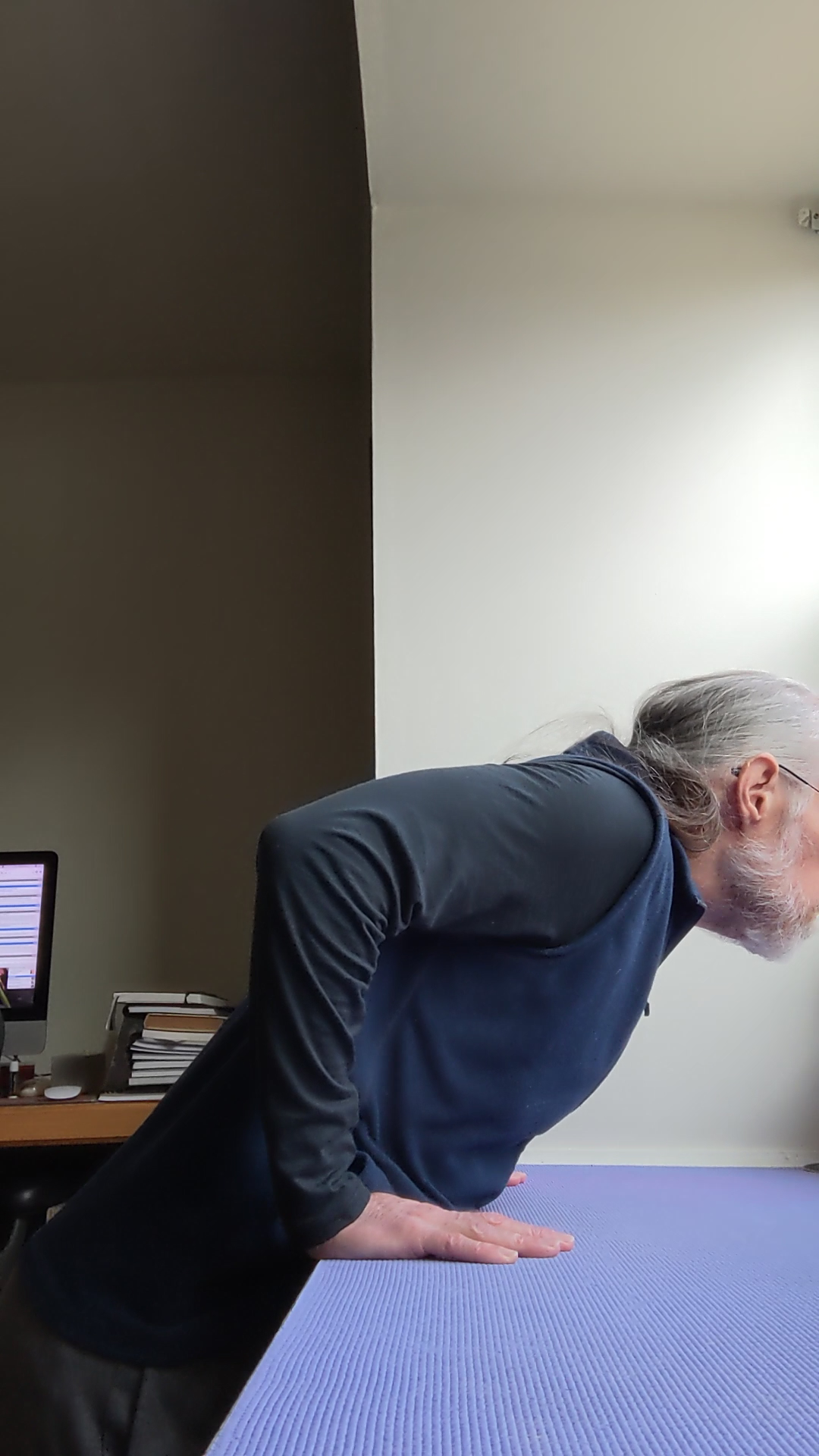
The wall dip is another foundational move for parkour. You use it to get on top of a wall or other structure.
The village where I live seems to have a terrible dearth of chest-high walls (unlike campus, which has lots), so it has been persistently difficult to get in the practice I need, and doubly so during the pandemic.
What I’ve been doing instead this year are ring dips.
Ring dips are actually much harder than wall dips, because the rings are unstable, so you have to stabilize them yourself. As I sat down to write this, I was worried that the limitations of those stabilizing muscles might have kept me from fully training the pushing muscles for the dip itself.
So over the last few days I’ve checked for that, using the edge of my window seat as a wall for practice. (It’s not perfect, because it’s too low, so I have to tuck my legs back to keep my feet off the floor. That configuration doesn’t precisely match the way you’d do a wall dip in parkour, but it does let me fully test the basic pushing motion.)
My original benchmark was:
Success will be when I can do a dozen or so wall dips with good form.
On three different occasions this week I’ve done at least a dozen wall dips, so I can call that one accomplished as well.
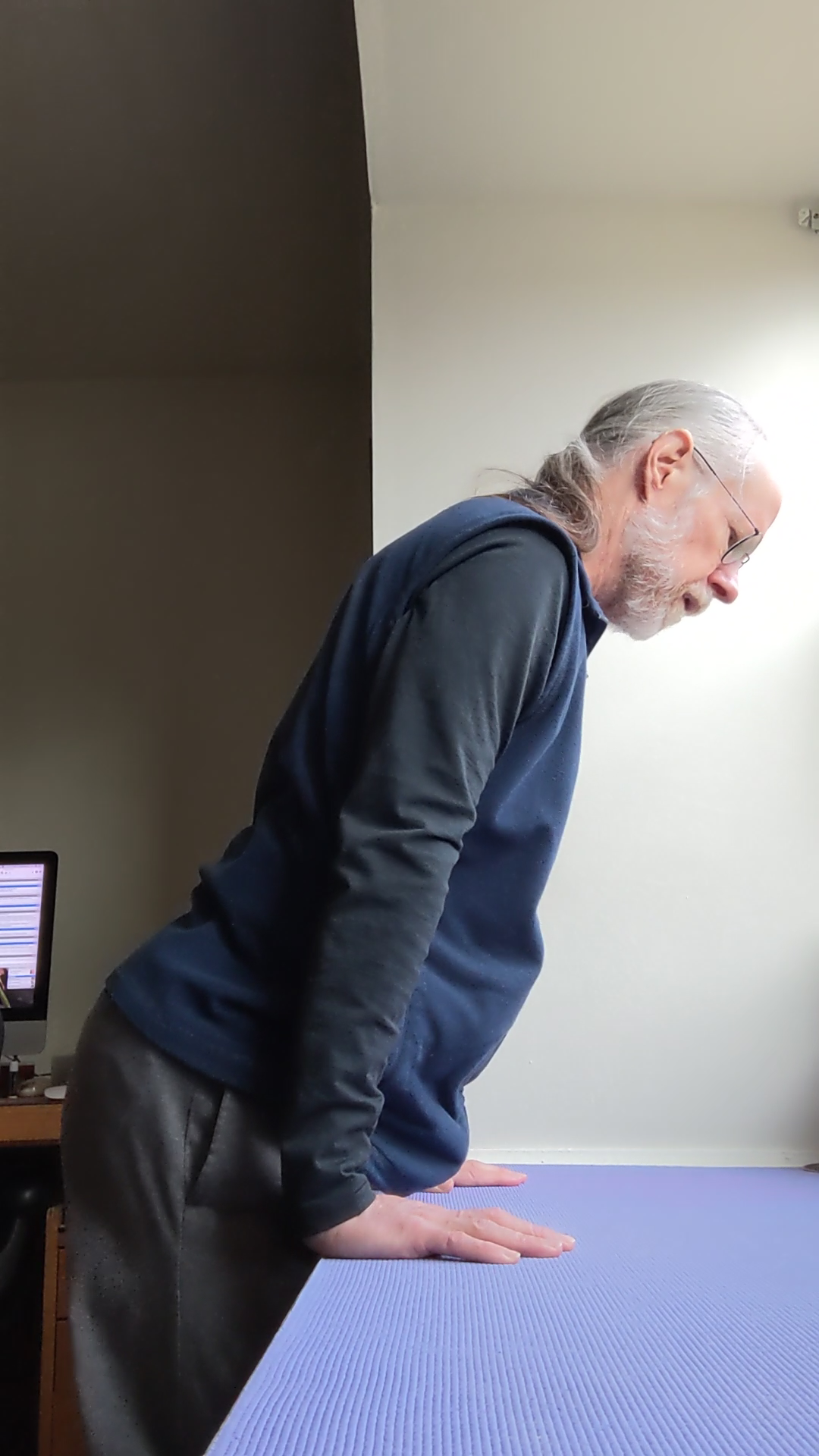
Assuming I can keep it together to do at least some maintenance training during the winter, I can enter the spring with a solid base on which to pick up my parkour training!
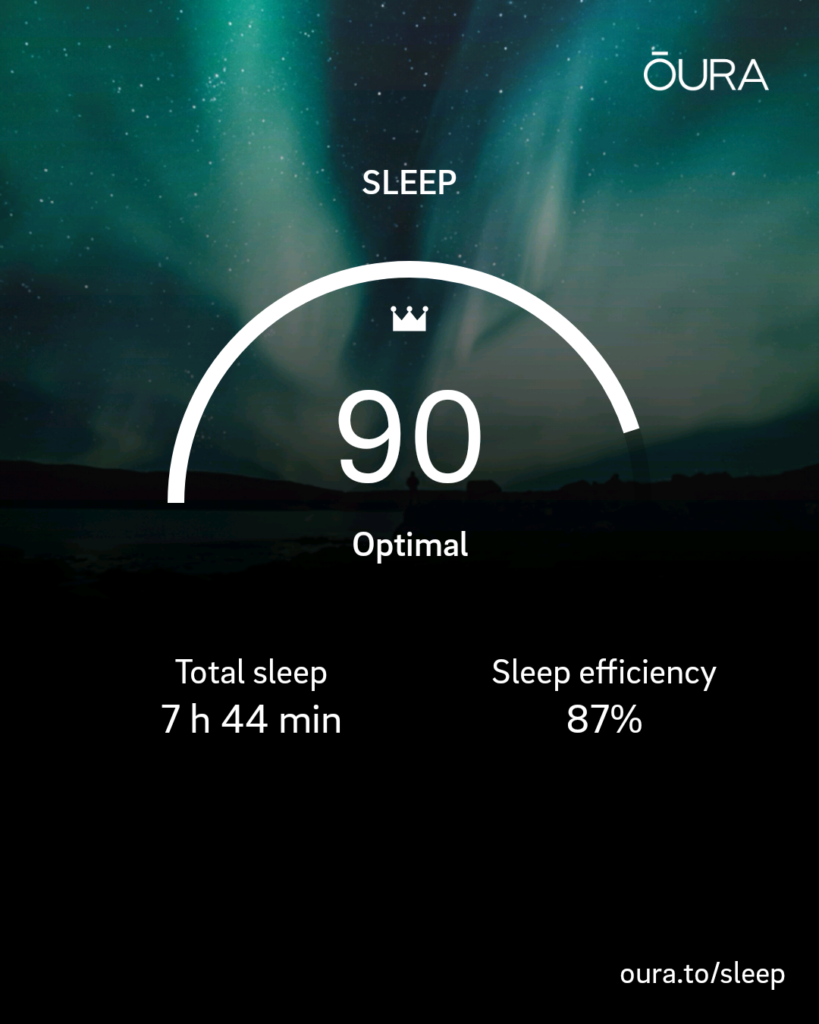
After a couple of nights of poor sleep mid-week due to stress, I’ve now had a couple of nights of good sleep, including last night.
Isn’t this a great line?
“The floor is a hard, unforgiving taskmaster. But the floor never hits you – you hit the floor.”
Source: Put in the Groundwork
The study reported in Exercise for Weight Loss (NYT) implicitly recommends an amount of exercise that is almost precisely I was doing in 2012 when I found a fitness regimen that worked for me.
“In the study, that meant working out six days a week for up to an hour, or around 300 minutes a week.”

Can I keep doing my outdoor 🏋🏻♂️ workouts as the seasons turn? Through November the answer is yes!
Yesterday was workout A: prisoner squats, pull ups, wall sits, push ups, hollowbody holds.
It used to be that I was pretty casual about warming up before exercise. If the weather was nice, I’d go for a 20-minute walk. If the weather was crappy, I’d spend 5 minutes on the treadmill or an exercise bike. I’d do just enough to get my heart rate a little bit elevated, and raise my body temperature a degree or two.
That worked okay for years, but at some point I started having injury problems. I’d hurt my feet when I ran. I’d hurt my wrists when I tried to do pushups. I’d hurt my shoulders when I tried to do pull-ups. Each new injury taught me to warm up that body part a little more carefully.
As I’ve gotten older, I’ve found that it is very much worth the time and effort to do a long, slow warm-up.
I wrote a little while ago about taking some time to check-in with my body and with my exercise venue, but I didn’t talk much about specific warm-up activities. This post is an attempt to capture my current somewhat maximalist warm-up, primarily as a checklist to use myself. (Without one I tend to forget activities, and then only remember them later, when some body part twinges. “Oh, yeah, I forgot to do the shank rotations!”)
Just as a note: If I don’t mention some other rep count, I do most of these for 12 reps. If it’s a bilateral motion, I often do just 6–8 on each side.
I used to start with the neck and work my way down, but I’ve switched to do my feet and ankles up front (because it’s there that I’ve had the most persistent injuries), and then go back to the neck. Here’s what I do:
I don’t do any of those as strengthening exercises, I do them as range-of-motion exercises. At the end of the warm-up (or the end of the workout) I sometimes come back to the calf raises and do a few sets of one-footed calf raises, which can be intense enough to be a calf-strengthening exercise.
The thing I do not do for my neck is head circles. I tell my taiji students that you should never let your head loll around at the end of your neck. (Exception: If you are the heroine in a romance novel and have fainted into the arms of the bare-chested hero. Then your head can loll around at the end of your neck.)
What I do instead is this, an exercise I call “motivated looking”:
I don’t do any of these as a stretch; I keep within my comfortable range of motion at all times. I also don’t close my eyes; the point here is to actually look in those directions, as if to see what’s there. That’s why I call it motivated looking.
I just do about 4 of these in each direction.
Since the pandemic started I’ve been largely focusing on upper-body strength, mostly exercises with gymnastic rings, which hit the shoulders pretty hard. I have found that spending several minutes just warming up my shoulders helps a lot.
I like to go straight from elbow drills to rhomboid pushups to squat prep #1, because they all start from about the same position.
I usually do my wrist exercises in the middle of my shoulder exercises, typically right after my shoulder circles, but there’s a bunch of them, so I wanted to pull them out into their own section.
Let me take just a moment to acknowledge that this is insane. On days that I do a full workout (which was running 4–5 days a week over the summer), I do very nearly this entire set of warm-up exercises. (Up to now I’ve often forgotten several, since until now I haven’t had a list to follow.)
This can easily take me 40 minutes, which is a pretty large chunk of the day to dedicate just to warming up.
Even then I’m not done—I go ahead and do “straight-elbow” versions of push-ups, pull-ups, or inverted rows (to match the full version of any of those exercises that are in my plan for the workout).
I also do a subset of this warm-up even on days that I’m not going to exercise.
The reason I do all this is simply that I feel better when I do. It’s not just my workouts that go better when I’ve gotten in a proper warm-up. Everyday activities go better as well—bending over to pick something up off the floor, standing up from having sat down on the floor, getting something down off a high shelf, etc. Everything I do for the rest of the day is easier and more comfortable, once I’ve gotten properly warmed up.
So, there you go. Feel free to take any or all of these activities to include in your own warm-up routines. If there’s one that isn’t clear, let me know—I could tweak the text, take a photo or even make a video, if that would make it clearer.