
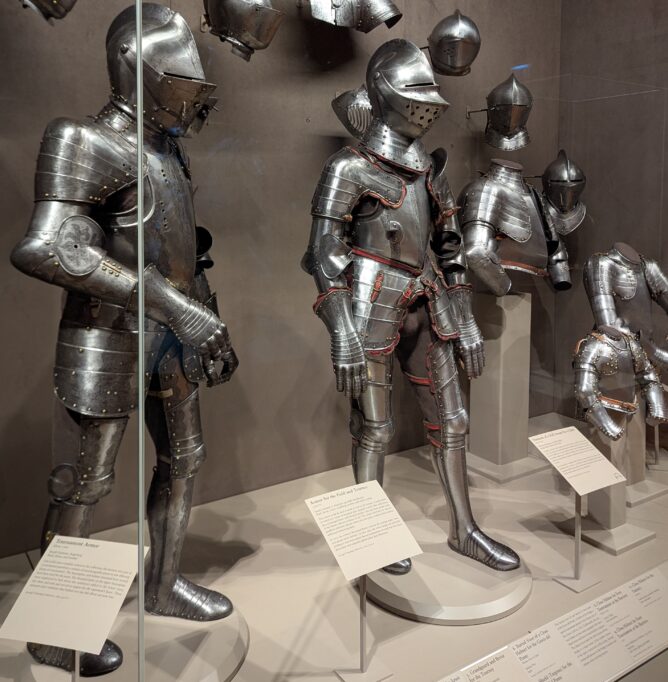
Suits of armor in a display case

I have long had mixed feelings about gameification, where you use the structures that underlie games (like points, achievements, badges, etc.) to motivate yourself to do the things you already know you want to do. I’m dubious about it, but at the same time, I do find myself motivated by such structures, which makes it very tempting to use them. (For exercise in particular, but really everything.)

Just lately, I’ve started thinking about a modest alternative: storyfication, where you use the structures of fiction to motivate yourself to do whatever it is you want to do.

Essentially, you tell yourself a story about what you’re doing, rather than making a game out of it.

Plenty of people do related things. There are several popular YouTube fitness channels that are all about using anime stories and situations, or superhero stories and situations, as inspiration for working out. (See for example JaxBlade, The Bioneer, or Kevin Zhang.) Some of them are primarily about aiming for the aesthetics of anime characters, but some reach into the story lines of specific anime. And some—the most interesting ones—use the underlying structure of anime or comic-book type stories as workout inspiration.

I’ll rough up an example here. Any story structure might be worth trying, but I’m inclined to start with the Hero’s Journey story structure. I’m assuming that we’re talking about doing exercises to get fit, but the basic storyfication thing could work for anything where you need to engage in repeated actions to get better at something—learning to paint, say, or learning to play the violin.

You begin with the Call to Adventure. If we’re talking about exercise, it would be a desire to get fit. Of course, the hero always initially resists the call. (Getting fit is a lot of work that’s hard and sometimes uncomfortable.) But finally the hero (you) chooses to accept the call.

The bulk of what you’d be doing would be “traveling on the road of trials, gathering powers and allies.” (That is, consistently doing your workouts.)

Dividing things up into separate books or seasons makes good sense. It can be very useful to grind away on one or a few things (building strength, say, or building endurance, or explosiveness) for a few weeks or a few months, but you need to include occasional breaks. You might consider each week of workouts a chapter or an episode. Put six or eight or ten together, then take a break. And then, of course, return for the next volume or the next season, perhaps with a new focus.

In the Hero’s Journey structure, the next thing would be to confront evil and be defeated, leading to a dark night of the soul. I don’t see much value in writing this into your plan, but there may be value in keeping the idea in your pocket for when things go awry. And, of course, things will go awry. A major project at work or at home may take so much time you can’t fit in all your workouts. An injury or illness may derail your workouts for a time. Maybe you’ll just hit a plateau in your fitness journey.

When something like that happens, well, you can view it as confronting evil. Remember, after being defeated, you face the dark night of the soul. One thing you might do at this point is think deeply about what obstacle might be blocking your progress. In fitness there are many possibilities: insufficient volume of exercise, insufficient intensity, insufficient recovery, poor exercise selection, poor nutrition . . . . The possibilities are nearly endless, and it is often hard to know which is the real culprit.

For that reason, the next step in the hero’s journey is especially appropriate: You take a leap of faith. Even though you can’t know what’s the best choice, you make a choice anyway. Maybe you ease up on intensity and focus on recovery. Maybe you double-down on exercise volume. Maybe you focus on your diet.

Whatever you choose, you can think of it as confronting evil again. And in a proper hero’s journey, this time are victorious.

Go ahead and write this part into your plan.

The final stage of the Hero’s Journey is that the student becomes the master. Again, there’s no need to write that into your plan. But it is entirely possible that having some success with storyfication will make you feel like sharing your insights with others, which is really what being a master of something is.

I generally view both gameifcation and storyfication as essentially neutral—neither good nor bad, except to the extent that the thing being motivated is good or bad.

Perhaps related to this is a word I’ve just learned:

“hyperstition.” The term, coined by “accelerationist” writer Nick Land, describes the belief that one can manifest future realities by telling compelling stories, and that prophecies become self-fulfilling through repetition and virality.

https://www.thenerdreich.com/silicon-valley-apocalypse-capitalism/

Telling yourself a compelling story can definitely help you put in the time and effort to achieve your goals, just like the structures that underlie games can do the same.

Is anybody else out there interested in using story structure to motivate themselves to exercise (or do something else)? Anybody already doing so, and able to provide some first-hand experience?

Let me know! (See my Contact page for many ways to contact me.)
For years I worried a lot about daily routines. (Just click on the tag for “daily routine” and you can find literally dozens of posts on the topic.) Of late, that seems to no longer be the case. It’s been years since I posted on the topic.

A few days ago though, my brother mentioned me in a toot on daily routines, which prompted me to wonder what my current daily routine actually looks like. Turns out, I do have a daily routine, that I stick to pretty well (with minor adjustments for errands, medical appointments, etc.).

Unsurprisingly, it’s rather sun-aligned.

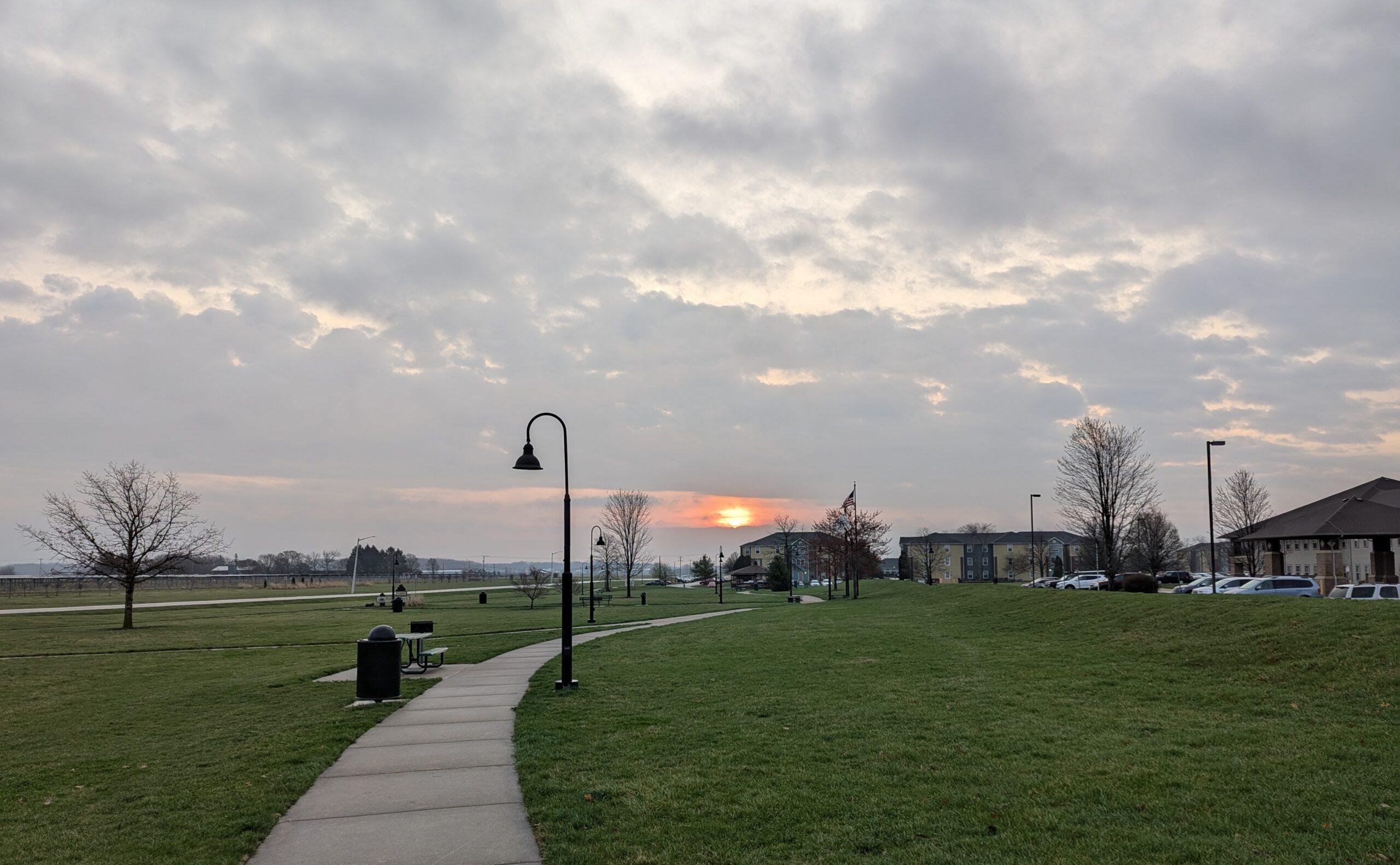
Sunrise through thin clouds viewed across Dohme Park

(6:00 AM) I get up around dawn, which is at different times at different parts of the year, but is around 6:00 AM right now. I drink a (ginormous) mug of coffee (or two). I spend some time dicking around on the internet, check my social media feeds, chat on-line with my brother, and get an update on our mom (who lives with him). I also check my Oura ring, to see how well I slept. (That’s a joke. Of course I know how well I slept. But the information my Oura ring provides is nevertheless sometimes valuable.) We usually do the Jumble via chat during this time as well.

(6:40 AM) Around sunrise I take the dog for her first walk of the day. That’s been around 6:45 lately, but is getting earlier every day just now.

(7:00 AM) After first-walk I might have a third cup of coffee, but I proceed to fixing and then eating breakfast.

(8:00 AM) After breakfast it’s time for the dog’s second walk. This is the long walk of the day. In bad weather it might also be just 20 minutes, but is usually at least 40 minutes, and in really nice weather might be an 90 minutes or longer.)

(9:00 AM) Once I get home from second walk, I proceed to my morning exercises, which I ought to be able to do in 20 minutes or so, but which often stretches out to twice that long. I’m working to shorten it, so I have some hope of getting something else done during the day.

(9:30 AM) After morning exercises (which is really a stretching/flexibility/mobility routine), I proceed to my workout, unless it’s a rest day. That takes 40 minutes to an hour.

Since I started drafting this post three or four days ago, I’ve been tracking the start and end times of my morning exercises and my workouts, with an eye toward collapsing the total time for this stuff down to the 60–80 minutes that it should be. If I can do that, I should be able to finish no later than 10:30, which should give me most of three hours available to get work done, before I need to break for the main meal of the day.

(10:30 AM) Get work done!

(1:00 PM) Jackie and I have moved our main meal of the day to 1:00 PM or 2:00 PM, which provides just a bit more flexibility for getting work done in the morning (although that time gets used up if I need to run an errand, or if I’m fixing lunch that day). Ashley usually gets her third walk of the day either right before or right after lunch.

I generally don’t even try to get anything useful done after that. I might take a nap. I might read. I might spend some more time dicking around on the internet. Just lately, I’ve been trying to get a backup server configured so that my brother and I can backup our backups to each other’s servers, meaning that we’ll have off-site backups.

(4:15 PM) At 4:15 PM we have our cocktail hour call with Steven and my mom. We’ve all cut back on alcohol consumption, so we usually drink water rather than a cocktail, but we’re sticking with the call. It means I get to talk to my mom nearly every day.

(4:45 PM) After cocktail hour I take Ashley for her fourth (and now, finally, last) walk of the day. When she was a puppy I had to take her for eight walks a day (to keep her from peeing in the floor). That ramped down pretty quickly to seven and then six, but it took a long time to get her down to five and then four. But this is actually much more convenient for me, as well as being enough walking for both of us. (I average over 12,000 steps a day, even in the winter. In the summer it’s more like 15,000.)

(5:30 PM) After fourth-walk I usually sit down to watch some video entertainment with Jackie, or else read some more.

Jackie goes to bed quite early most days, a remnant from her days working at the bakery (when she had to get up at 4:00 AM).

I generally like to go to bed a couple of hours after sunset, although not that early in mid-winter nor that late in high summer. Just lately I’ve been aiming to take Ashley out of the patio for one last peeing opportunity in time for me to get to bed around 9:00 PM.

There’s some variability, of course. Mondays I do Esperanto in the early evening. Wednesdays there’s (just recently) a gentlemen’s lunch. Thursdays there lunch with some former coworkers, that’s been going on in some form or another for decades now. Sunday afternoons (and when I’m feeling fit enough, Tuesday and Thursday evenings) there’s sword fighting.

As I said above, the main value of this post to me seems to be around how I might get my warmup and workout done more compactly. I think I’ll write about that soon, and if I do, I’ll link to it here.

I’ve always been jealous of the sort of successful writer who can afford to design and build their optimal space for writing. But I’ve also read critiques of the idea: A real writer can write anywhere.

So I’m glad to see Cal Newport pointing out that “can write” might be true, and yet fall short:

“Putting professors into stark and spacious modern offices is functional. But is it as conducive to deep thought as the fire-warmed study of the Oxford Don?”

Source: On Vampires and Method Writing – Cal Newport

I often describe myself as having an inclination to try and optimize things. I have observed in the past that I tend to bring this inclination to bear particularly on the unimportant stuff, which always seemed odd. But just this minute I have come to understand why: I do it this way to free up time to do the important stuff exactly the way I want, whether optimal or not.

Take reading, for example. There are all kinds of ways to optimize your reading—ways to read faster, ways to absorb more of what you read, ways to organize what you’re going to read, ways to keep track of what you have read, etc. I have no interest in any of those things, because reading is important. I want to do it exactly the way I want to do it.

Figuring out some trivial reordering of exactly how I put toothpaste on my toothbrush so that I can save 5 seconds a day is much more likely to be the sort of thing I’d do—because I don’t care. I have no interest in how I brush my teeth (as long as my teeth don’t fall out), but freeing up 5 seconds a day that I can spend doing what I want to do is motivating out of all proportion to the actual time savings.

(It’s actually not so disproportionate. It takes just 240 days saving 5 seconds per day to break even on spending 20 minutes figuring how how to save those seconds. Every 5 seconds after that is pure gravy.)

Anyway, since I mentioned recently that my optimization efforts tended not to have much payoff, in my post on getting better at life under late-stage capitalism, and having literally just now realized why that was, I though I should add that bit.

I know that I need to write in the morning if I’m going to be productive at fiction. Even just 20 or 40 minutes of early morning writing gets my head into the story space, and once it’s there I’ll continue to have story ideas through the day.

I’ve had trouble making this work since I started teaching taiji. For most of the year I need to start getting ready early enough to be out the door no later than 8:40 AM. I’m only gone for a couple of hours, which isn’t such a big hole in the day, but it’s big enough that it’s made it hard to get in the necessary early-morning writing session.

But after months—years, really—of not getting my fiction writing in, I’m taking a fresh stab at making an early-morning writing session happen.

I started a week ago so I could test-run the new schedule and get the kinks worked out before the last week of August, when the first fall taiji session starts. So far it’s working pretty well. I got my early-morning writing done every day except one, and that day I managed to get in a good writing session in the afternoon.

The obvious thing to do, of course, would be to just start even earlier. That isn’t easy because I’ve put together an early-morning routine that I’m finding really satisfying:

  1. Do a tiny bit of mobility work first thing.
  2. Weigh myself and check to see what my Oura ring says about my sleep.
  3. Sit down at my computer and record that info.
  4. Drink some coffee.
  5. Do the Daily Jumble with my brother and my mom.

After Jumbling and a couple of cups of coffee, I generally have breakfast, after which is my window to get some writing done before taiji.

What I’m doing differently is simply that I’m trying to start breakfast no later than 7:00 AM (ideally a little before), so that I can finish before 7:30.

I need to leave by about 8:40 to be sure I get to the Rec Center in time for my class, which gives me a generous hour to write.

If I manage that—spend enough time writing to get immersed into the story space of whatever I’m working on—then my brain gets started working on story problems. All through the rest of the day I’ll have plot points, possible story twists, clever turns of phrase, bits of dialog, and so on, popping into my head.

Until I start writing, none of that happens. It’s actually kind of awkward when I don’t get a chance to write during the day, and then try to squeeze in a writing session late, because then I’ll be getting those ideas while I’m trying to go to sleep.

Actually, it turns out it can be kind of awkward even when I do what I’m trying to do. Two days last week I skipped the group taiji practice session, but on Friday I did pretty much just what I’m planning to do going forward, and the result was that my brain was fairly fizzing with story stuff at the point I was getting set to head out the door. That’s fine for the summer practice sessions where I’m just a participant and not in charge of anything, but when I’m the teacher it’s my job to be fully present and mindful in the class, not in my latest fictional world.

It was okay this time; my fizzy brain had settled down by the time I was in the car ready to drive. But it’s another thing to take into account as I calibrate this new routine, which is why I wanted to have these couple of weeks for a test run.

Still, if I want to get fiction written, it’s best to get started early. And for a week now, I’ve been managing it. (And as a consequence, have finished a draft of my first new short story in a long time.)

I mentioned a few days ago that I’d got my microblogging working about the way I wanted. There was one exception to that: my “images” workflow.

There’s pretty good “media library” functionality built into WordPress, but I’ve always found it a bit too blog-centric in how it works to be a good general solution to images hosting.

I was a Flickr user from way back, but when the new owners ruined it I decided I should host my own images, and ended up going with Lychee to provide self-hosting functionality.

Lychee works great, but it took me a while to sort out how to integrate images hosted there into my blog.

Here’s what I’ve ended up doing:

  1. Upload images to images.philipbrewer.net. The Lychee software lets me keep them private or make them public, and it lets me organize them into albums. It also produces an RSS feed of all my public photos.
  2. If I want to use one of my photos in a blog post, I select the photo in Lychee, click on the share button, and select “direct link” to get a link to a .jpg file. The default is the full-size image, but I can edit the link to get a link to a medium or small image if I prefer.
  3. In my blog post I insert the image as usual, except instead of selecting the image from my media library, I click “Insert from URL” and paste in the link I acquired in step two. If it’s the main image for the post I also paste it into the “use this image” field in Open Graph (a WordPress plugin I use to generate the metadata so that links shared in Twitter and Facebook use the image I want). If I want to, I can also specify the Lychee page for that image as the target URL if you click on the image.

Here, for example, is an image I took yesterday:

The utilities right-of-way past the U of I research fields is mowed until you get to the solar farm, but after that there’s a long stretch of tall weeds. Not impassable, but not a path either.

Pretty much everything works the way I want it to now. The images are hosted on images.philipbrewer.net, I have access to small, medium, and large versions of the images, and an easy-enough way to include them in a blog post.

Two things that could work better:

  1. A one-click way to get the link for the images pasted into all the right places in a new blog post, so I’m not having to go back and forth to make the image block, get one link, paste it (usually twice), then get the second link, and paste that one.
  2. A one-click way to get a srcset, so that my pages can be more automatically made responsive.

Still, after a bunch of posts where I was testing things out, in which things didn’t work quite they way I wanted them to, I’ve now got things just about set.

Local sf writer Elizabeth Shack has been doing the work of organising a few writers to meet Thursday evenings at a local coffee shop. It’s not a critique group; it’s a writing group. There’s a few minutes of conversation and sharing of news, but the main point of the event is to do the usually solitary writing in a slightly less solitary environment.

I’ve been twice now. (I’ll be going again this evening.) I’ve been highly productive both times so far.

I think Elizabeth would be pleased to have the group who shows up expand. (This sort of thing works better when there are enough regulars that when one or another person has to miss a day there’s still a group.) She’s got a contact form on her web site, if you’re a local writer and want to express an interest in joining us.

On Oliver Sacks: his writing process, how he used notebooks, and his views on creativity. Via Field Notes.

Where making is driven by association and memory, birthing “needs ‘incubation’” and is marked by intuition. But before we hasten to assume that he valued the latter type of creative work more highly than the former, he lists Darwin as an example of a writer who makes and Rilke as one who births, which strongly suggests that he saw the two not as a hierarchy but as distinct, complementary forms of creative work — Darwin was, after all, one of Dr. Sacks’s great heroes.

Source: Inside Oliver Sacks’s Creative Process: The Beloved Writer’s Never-Before-Seen Manuscripts, Brainstorm Sheets, and Notes on Writing, Creativity, and the Brain

I still struggle with the tension between time spent moving and time spent writing, even as I come to recognize that the tension may not even exist. So I love this post by Katy Bowman, on being A Writer Who Moves, A Mover Who Writes.

Culturally, we still hold the belief that the relationship between time and productivity is direct. As if writing consists solely of the output of words, your typing speed being the indicator of how long it would take to write a thousand-word word article (ten minutes) or a novel (one week). But of course, time spent coming up with ideas and themes, and organizing and reorganizing these threads in our minds, is also “writing.” The trouble is, we’ve come to see sitting at a desk as an integral part of the writing process. We imagine the mulling, the idea-forming, the organizing, the process—the creativity—can occur only when the butt–chair circuit is closed. I (and researchers) have found the opposite to be true: movement can be a conduit for creativity.

Today I will live this truth: I will move and I will write.