Both my brother and the local makerspace’s Brian Duggan shared the link to the EFF’s Why We Need An Open Wireless Movement. Steven, because he’s the only person he knows who actually does run an open access point for his home network, and Brian because the local meshing network access point project is already able to provide this part of the necessary functionality.

At the meeting last night with some of access point folks, we got a quick demo of how to configure an access point running OpenWrt so that it provided both a closed network with access to the LAN and an open network that only had access to the WAN (hence, no access to local servers, printers, etc.).

The demo didn’t go as far as to show how to configure the system with quality of service limitations on the open network (so that random strangers can use your network, but can’t suck down all your bandwidth). Figuring that out will be one of my next steps.

There’s some info on OpenWrt’s quality of service page, but it’d be really nice to have an example with some appropriate settings that would allow some basic email and web surfing while leaving most of the bandwidth of a typical cable or DSL connection available for the connection owner. I haven’t found that yet. (Actually, I think I understand why it doesn’t exist. The upload and download speeds are set in kBits/s, so the correct values depend on the speed of your underlying connection. Values that shared 10% of a fast cable-modem connection could consume a large fraction of a DSL connection. Still, it’d be nice if there were some suggested values for typical configurations.)

National Petascale Computing Facility

Jackie and I got a tour of the NCSA’s National Petascale Computing Facility at the University of Illinois today, where they’re getting ready to install the Blue Waters supercomputer.

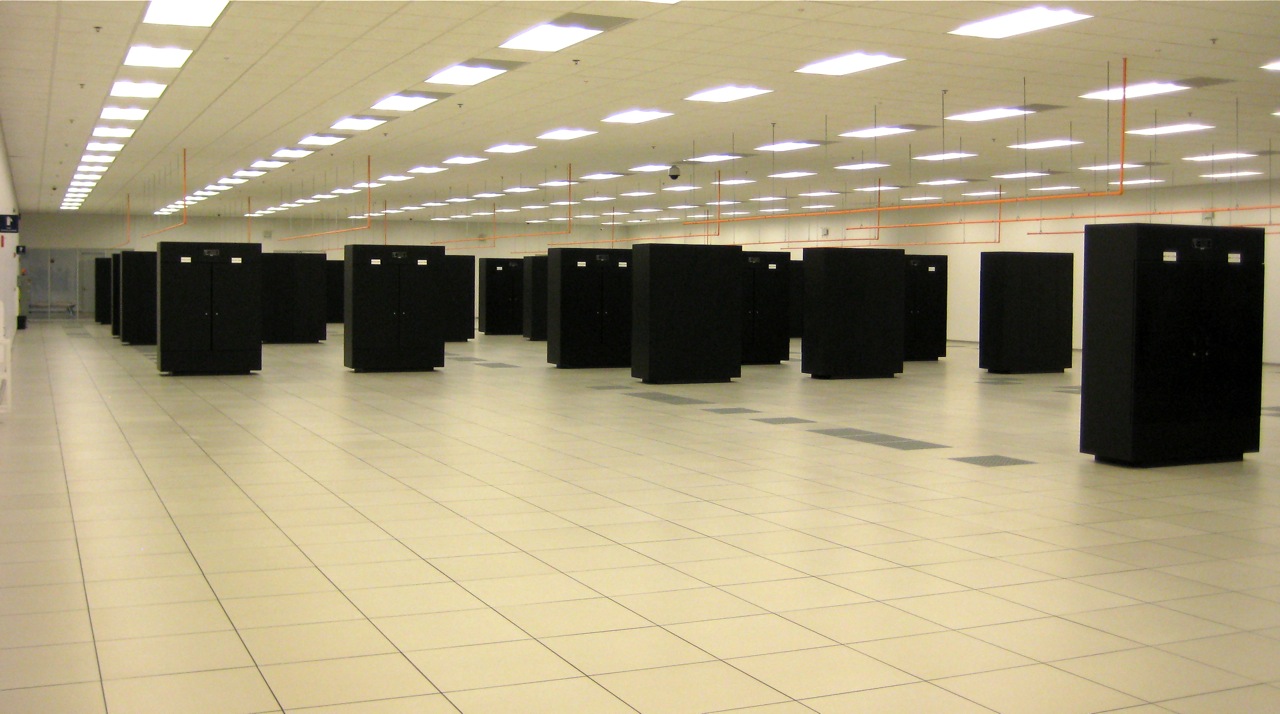
This picture shows just the power stations—all the space between these units will, over the next few months, be filled with rack after rack of water-cooled POWER7 modules. (A big part of the building houses cooling towers to dissipate that heat).

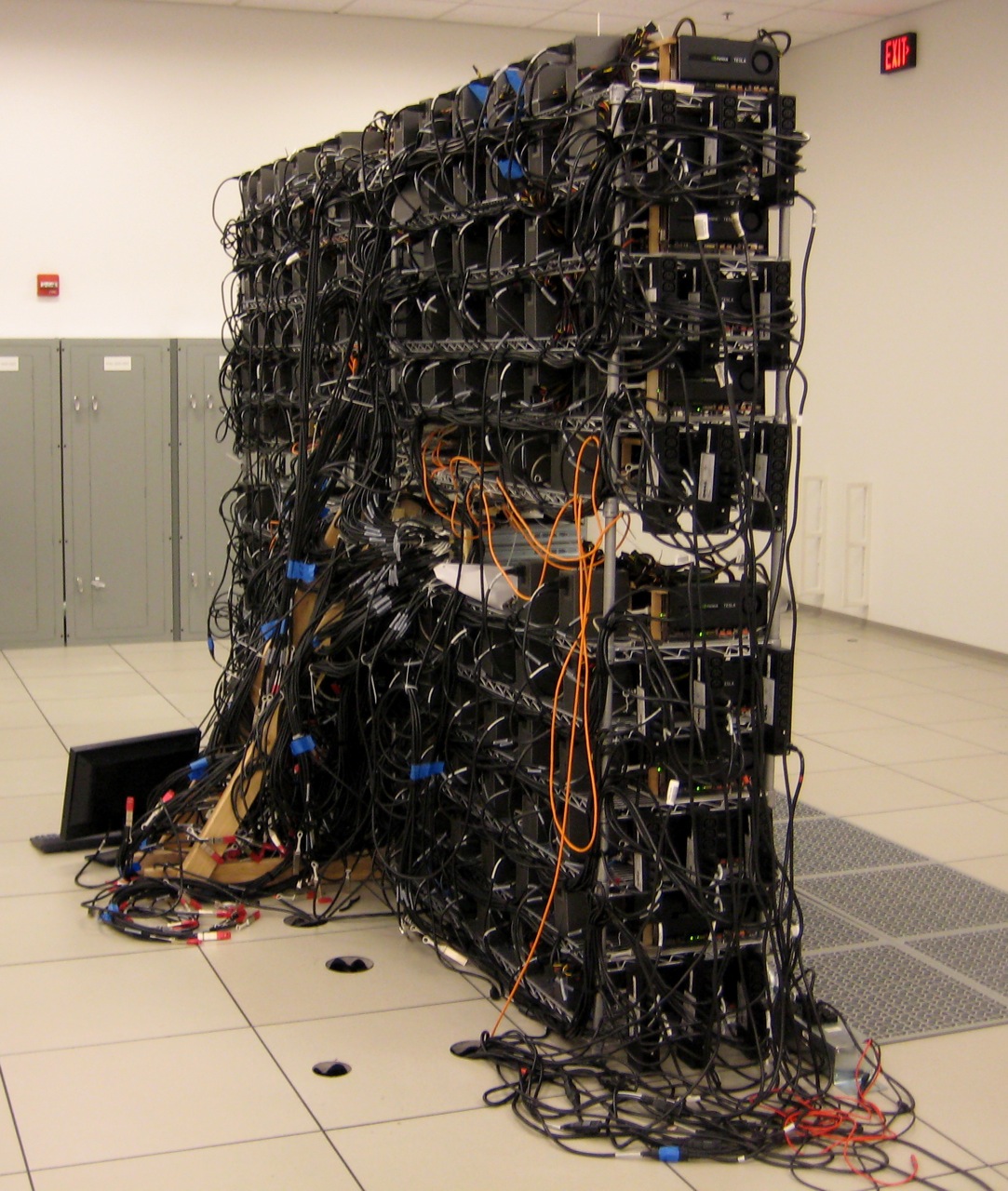
There are a couple of supercomputers already installed at the other end of the room, including the EcoG, designed and built by students to enter into a contest for energy-efficient supercomputers. (It took 3rd place overall , and was declared the “greenest self-built cluster.”)

It was build on ordinary commercial-grade racks, which turned out not to be quite strong enough to support all the hardware they were installing—you can see where they braced it with two-by-fours.

A week earlier, we’d attended a tour of the NCSA’s Data Visualization Lab, where we’d been treated to a bunch of 3D videos (shown on a very large, very high-res screen) produced on various supercomputers. It was pretty cool, but I didn’t get any photos worth sharing.

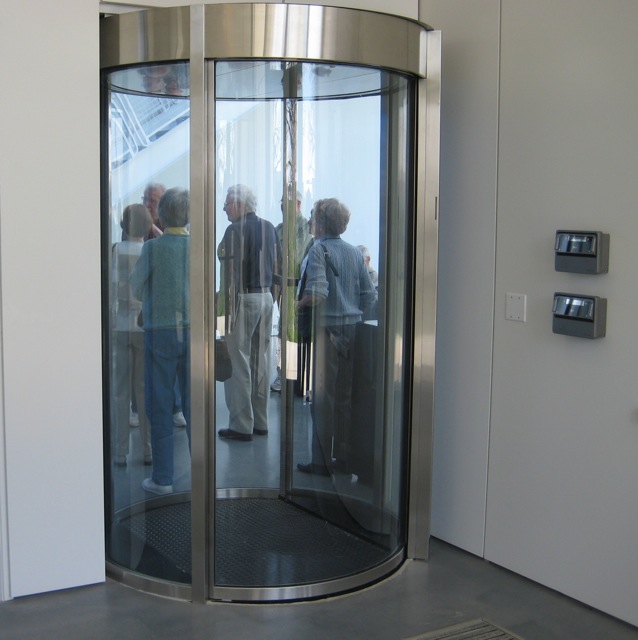
Because I’m a big geek about security and related topics, I was particularly interested in the facility’s secure entry. Employees need to swipe a proximity card and submit to an iris scan. Only after the cylinder closes behind them does it open in front—and it won’t do that if a weight sensor suggests that there’s more than one person in the cylinder.

Secure entry at the National Petascale Computing Facility

Those of us on the tour just walked in through a door next to the secure entryway.

People are bad at comparing risks, and people like to point this out by making comparisons to risks that people tolerate on a daily basis. For example, pointing out that many more people die in car accidents than are killed by terrorists, or pointing out that providing electricity by burning coal kills and injures more people than providing electricity by fissioning uranium.

At one level, I find these arguments compelling. I find it preposterous that we spend so much money on homeland security. That money would be much better spent (in terms of lives saved per dollar) on traffic safety, or probably a lot of other things. I gather, based on the fact that people keep pointing this out without producing any visible change in funding priorities, that most people don’t find this a compelling argument.

I’ve always wondered about that, and perhaps I’ve figured out why in the “coal versus nuclear” argument, which I don’t find compelling.

Plenty of people die to provide us with power from coal. Miners die from accidents. People die in road accidents moving coal from the mine to the power plant. Workers die in ordinary industrial accidents at power plants. People die from respiratory problems caused by or exacerbated by pollution from burning coal. People die in severe weather—which is becoming more common, probably because of global warming.

Except for that last, this is our baseline status. We know the costs and risks, and we accept them. Some people work to improve things—better mine safety, better level crossings for trains, lower emissions from coal burning—but the baseline is accepted. Importantly, an individual can do a lot to reduce his or her risk, such as by not making a career in coal mining, by exercising due care at rail crossings, and by living some place with clean air (and not smoking).

With nuclear power, things are different. The baseline status is safer. Deaths in uranium mining are very small, because the volume of uranium ore needed is so small compared to the volume of coal. Deaths from industrial accidents are small, because the number of workers is small (and, perhaps, because some additional attention is paid to safety at a nuclear plant for reasons having to do with greater regulation and particular concerns about public perceptions of safety). Deaths caused by the release of radiation are very, very small, because we go to vast effort and expense to avoid them.

But although the baseline status is relatively safe, the contingent risks are huge. The problems that led to the catastrophe we’re seeing now at the Fukushima Daiichi plants are replicated all over the world. It’s not just plants built on fault lines and plants built places where tsunamis can occur. It’s things like redundant safety systems that aren’t really redundant. Most especially, it’s committing to providing active safety over a period that’s much longer than human institutions reliably persist.

On the former issue, I have an oddly relevant memory. As a boy I attended public hearings in Kalamazoo on the licensing of the nuclear power plant at Palisades. At one hearing, a lawyer opposing licensing pointed out that a line carrying backup power for the plant ran through the same conduit as a line carrying the regular power. In some clever showmanship, he snapped a pencil in two to illustrate the fact that this produced a common point of failure. Learning that the backup generators at Fukushima were in basements where they would be lost in a tsunami produced an odd echo of that memory.

The latter issue is really more to the point. We are relying on corporations to actively manage the safety of these plants and the spent fuel—corporations that will cease to exist if the cost of this management burden ever grows to the point that it consumes the corporation’s profits.

I think the degree to which these safety issues needed to be actively managed has surprised a lot of people. I’ve many times heard people suggest that managing nuclear waste was no big deal—just put the stuff in a concrete vault and put a fence around it with signs saying “If you come in here you’ll probably die.” I always knew that was dumb, but I was mostly worried about people deliberately coming in to use the waste to make dirty bombs and the like. I didn’t quite realize to what an extent the spent fuel rods depended on a whole complex system of cooling equipment to keep them from bursting into flame and spreading radioactive smoke and steam wherever the wind blew.

So that, I think, is why we accept coal power and think of nuclear as dangerous. We could give up coal power anytime we, as a society, decided that the cost was too high. If we were willing to cut way back on air conditioning, electric lighting, and all the other things we run with electricity, we could just quit the whole thing. The only dangers left behind would be some moderately dangerous holes in the ground, some toxic heaps of ash, and the pollutants that are already in the air. With nuclear power that’s very much not true. We could give up nuclear power today and we’d be on the hook for decades of active management of the high-level waste and generations of (mostly passive) management of the low-level waste.

I think maybe the issue with risks from terrorism is the same. People know what the trade-offs are for driving. If we, as a society, decided to give up driving, we could cut deaths from road accidents almost to zero. But terrorism isn’t like that. There’s nothing we could give up to prevent terrorism, and the contingent risks are huge. An endless stream of terrorist acts that killed tens, hundreds, or thousands of people seems very different from the many other activities that we engage in that cost tens, hundreds, or thousands of lives.

It’s a bummer about nuclear power, though. It would be cool if a network of high-speed electric trains could provide transportation in a post-peak oil world, and I’d begun to think it might be a reasonable alternative. A mere twenty-five years with no major nuclear accidents was enough to make nuclear power start seeming pretty safe again. This is a good reminder that it really isn’t—and that we need to think carefully about the difference between accepting risks for ourselves now, and accepting risks for everyone stretching off into the future.

[Update 2011-03-23: There’s a lot of  misinformation about whether very low doses of radiation are harmful. Here’s a paper with a survey of what we actually know about the effects of low doses of ionizing radiation (from the Proceedings of the National Academy of Sciences).]

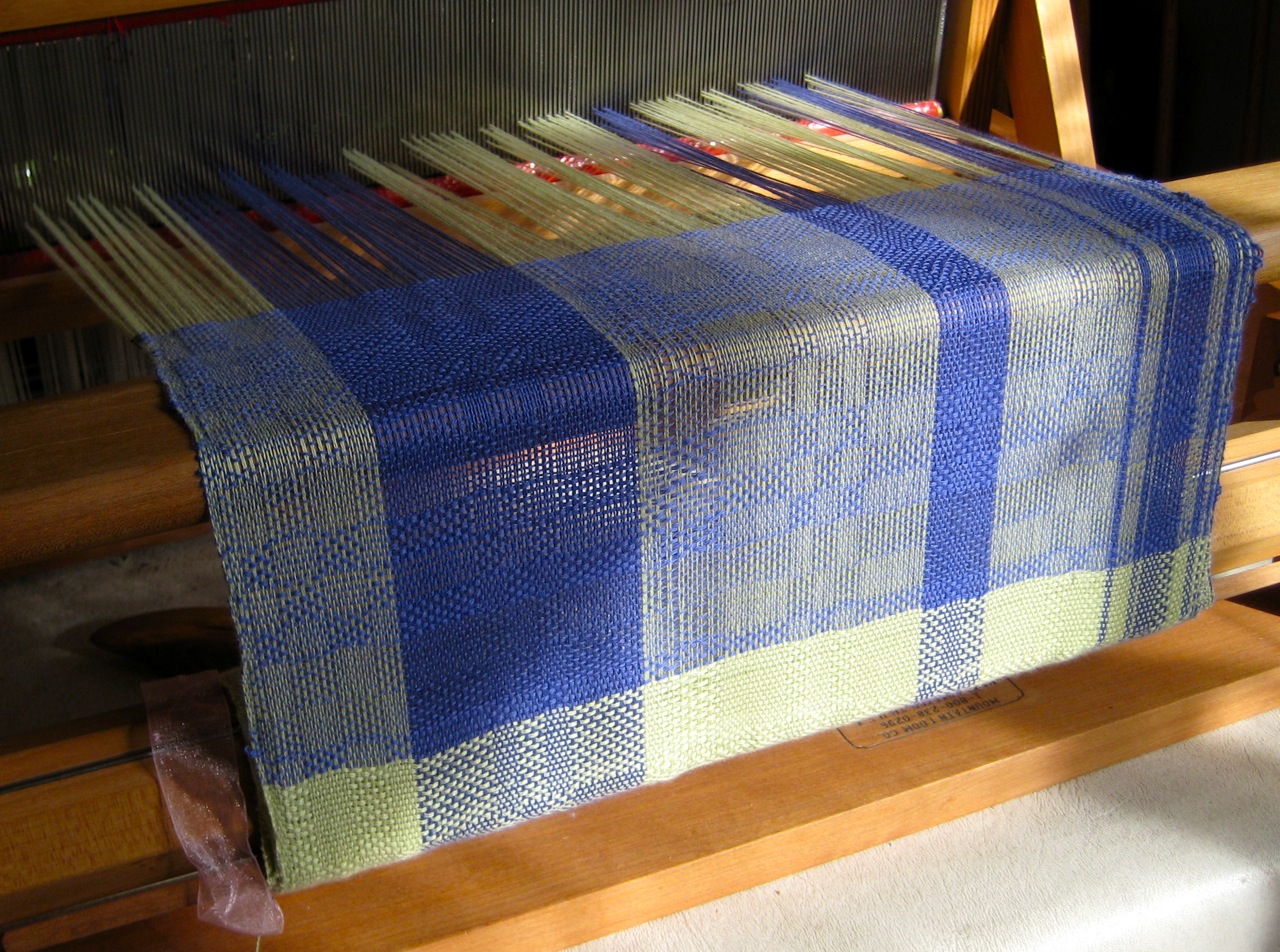
Fabric on loom


[This article originally appeared as a guest post on Self Reliance Exchange, but that site no longer exists and the successor site doesn’t seem to be using my post. Rather than just let the article disappear, I figured I’d post it here.]

Fabric on loom
Fabric on Loom

There’s a reason we don’t see more self-sufficiency: It’s not frugal. It almost always takes more time to make something than it takes to earn enough money to buy one—and that’s without even considering the time it takes to learn the skills (let alone the cost of tools and materials). On the other hand, frugality is a powerful enabler for self-sufficiency. So, how do you find the sweet spot?

My wife spins and weaves. I have a beautiful sweater that she hand knit from hand spun yarn. It’s wonderful—and it’s comforting to know that my household is not only self-sufficient in woolens, we produce a surplus that we can sell or trade. But the fact is you can buy a perfectly good sweater at Wal-Mart for less than the cost of the yarn to knit it.

If you try to be genuinely self-sufficient—in the sense of producing through your own labor everything your household uses, like a hunter-gatherer or a subsistence farmer—you’re going to be poor. Your neighbor who works at a job for wages or a salary is going to be better off by almost every measure.

Oh, his factory-made microwave meals won’t be as good as home-cooked food from your garden and his furniture from Ikea won’t be as good as what you make in your wood shop. But he’ll have so much more! In the time it takes you just to build a kiln he’ll earn enough money to buy a thirty piece set of Corelle ware. Unless he’s only making minimum wage, he’ll probably have enough left over to buy an iPod—and you’ll never be able to make your own iPod from sand and vegetable oil.

That’s why we have trade. If everybody specializes in one or a few things, and then trades with others for what they need, everybody can be better off. It raises your standard of living, but it means that you can’t be self-sufficient.

There are still many reasons to do for yourself. You can make exactly what you want, instead of having to make do with whatever happens to be available on the market. You can use superior materials, and take them from the environment in a sustainable manner. You don’t have to worry that the stuff you use was made in a sweatshop by children or prisoners or slaves. You aren’t dependent on the continued smooth functioning of the vast global economy. But you can’t be self-sufficient in very many things—even if you had the skills and the tools and the land, you’d quickly run out of time.

So, we find ourselves trying to figure out where we belong on the continuum between actual self-sufficiency and ordinary self-reliance. How do you find the sweet spot? Here are my thoughts:

  1. Focus on necessities. It’s a lot more important to be self-sufficient in food, clothing, and housing than it is to be self-sufficient in tennis rackets and rollerblades.
  2. Focus on capabilities. Instead of trying to fill your pantry by hunting and fishing, do enough to maintain and improve your skills—and then start developing your next capability.
  3. Focus on what’s practical. It’s really hard to be self-sufficient in window glass and impossible to be self-sufficient in digital watches. Don’t waste your time.

Start with the few things where homemade actually is cheaper, like gardening. Then move on to things that can be done as a hobby—and that you’d enjoy doing as a hobby. Don’t let point above (necessities) keep you from developing self-sufficiency in something that’s fun and interesting just because it’s not important. It may not be important to be self-sufficient in beer, but the equipment is cheap, brewing is a pretty easy skill to acquire, and the result is better than what you can buy.

Finally, remember that there’s a vast range between being “self” sufficient and being dependent on a global supply chain. It’s almost as good as self-sufficiency to source things from your neighbors. Short of that, it’s still an improvement to source things closer rather than farther—your home town, your region, your state, your country.

Once you set your priorities, don’t hesitate to go with the cheapest option for things that don’t make the cut.  That frees up money that you can use on the important underpinnings of self-sufficiency—things like land and tools in particular, but also things like books, training classes, materials to practice with, and so on.

Then you’re in your sweet spot.

All the smart folks on twitter have been asking questions along this line. If we had civil unrest, would the government try to cut off our internet access? (I have no doubt that if they tried, they’d succeed. Internet and cell phone providers are regulated companies; they’d roll over in two seconds.)

I think that would be bad.

First of all, it would be unconstitutional. At a minimum, such an action would infringe several first amendment freedoms: speech, press, assembly, and to petition the government.

More important, in a stable democracy like the US, I think internet and cellular service would be at least as much a stabilizing force as it would be a destabilizing force. In the event of civil unrest there would be many powerful voices calling for calm and for non-violence. Shutting off the internet would silence those voices along with the voices of those trying to organize protests.

So, I just sent this note to my congressman, urging him to take steps to protect citizens’ access to telecommunications services:

Prompted by the recent news that the Egyptian government cut off internet and cell phone connectivity for its citizens, it occurred to me that this tool of repression should not be available in the United States.

At a minimum, I urge you to oppose any legislation along the lines of last year’s “Protecting Cyberspace as a National Asset Act,” but I think you should go further.

I’d very much like to see legislation that would specifically bar the government from shutting down internet or cellular connectivity for US citizens, and that would bar telecommunication providers from “voluntarily” complying with “requests” from the government that they stop providing connectivity to persons in the US.

Of course, legal solutions only go so far. They would be much strengthened by technological solutions. Cell phones and internet access points can be designed to mesh with other nearby devices. That would make it vastly more difficult for a top-down order to shut down connectivity—hopefully, difficult enough that governments wouldn’t even try.

[Updated 30 January 2011: Here’s a list of ad-hoc meshing protocols that might serve as a basis for making a top-down shutdown impossible.]

I spent the whole decade of the 1990s hoping that the economic upturn would prove that the strategy of letting employees go the instant there wasn’t any work to do was unwise. Surely, I thought, those companies would suffer—missing out on business because they didn’t have the skilled employees to do the work (and screwing up on what business they did get, because rushing to hire new employees would result in picking up some duds).

My hopes remained unfulfilled. Oh, probably plenty of companies did suffer from an inability to hire skilled, reliable workers at reasonable wages. Certainly employers complain that they can’t, especially when they’re lobbying Congress for an expansion of the H1 visa program. But it didn’t matter, because the company’s were profitable. (Profitable companies may do as they please; unprofitable companies must kowtow to the financial markets.)

I’ve written about this before, in a two part series at Wise Bread called “What’s An Employee To Do?” Part 1 laid out the issue in some detail, and part 2 talked about the best strategies for an employee to follow. (There’s actually a lot of opportunity for employees in the current situation, as long as they don’t make the mistake of thinking of themselves as employees.)

Prompted by Tobias Buckell’s recent post Working culture, though, I wanted to talk a little about the broader impacts of the way we’ve come to arrange society, because there were other reasons that employers kept employees on during a business downturn. Business owners kept employees on during a downturn because they cared about them as people, because they were friends and neighbors, because the whole community suffered when one person lost a job.

A small part of the reason that things are different now is that this is less true. Managers are not as likely to live in the same neighborhoods as their employees. They don’t shop in the same stores. Their kids don’t go to the same schools. In any case, the decisions are being made far away. (The local managers were completely out of the loop when the site where I used to work was closed down three years ago.)

But that’s just been an enabler of this shift. The real cause is the behavior of the financial markets, which since 1990 have crushed any employer that tries to resist, by driving its stock price low enough that someone could acquire them and bring in new management—management that would lay off plenty of workers.

This isn’t new, of course. Business owners knew that going public meant putting their business in the jaws of the financial market nutcracker—but they made so much money it was worth it. You occasionally hear about the rare business owner who has declined to go public for just that reason—but you hear about it because it’s rare enough as to be news.

As Toby describes, Germany has structures and institutions in place to support businesses that are small and local. Unions are a big one—including the government support for unions that encourage and enable unions to work together in a block. Also important are rules that lean against market pressures for business consolidation, offshoring employment, etc.

Personally, I used to support a purely market-based approach. That’s why I spent the 1990s waiting for markets to punish the bad actors. I’ve changed my mind. It’s fine to leave the fate of the companies up to the markets, but it unacceptable to leave to the markets the fate of whole communities.

Similarly, I used to support the notion that the right way to address this sort of issue was education (because I believe in free choice). Yes, stuff made by prisoners, slaves, and children costs less. Yes, stuff made by heavy industry costs less if the manufacturers are allowed to wreak environmental destruction all across their supply chain. But surely people would make different purchasing choices if they understood that they’re not only paying to have all this harm done, they’re also putting their friends and neighbors (and themselves) out of work. There again, I’ve changed my mind. It turns out, I simply didn’t understand how much cheaper that stuff was than stuff made locally.

Given the option to have the accoutrements of a middle-class standard of living—clothes, dishes, furniture, gizmos—it’s become clear that most Americans will cheerfully accept any amount of slave labor and environmental destruction (as long as they don’t have to see it) and tolerate the destruction of local businesses and the bankruptcy of their neighbors.

They’ll complain about how it affects property values and how it makes it tough to find a job. But then they’ll take their unemployment check and food stamps and go buy the cheapest stuff they can find at WalMart.

Neither markets nor eduction are going to do the job. The U.S. needs to create institutional support along the lines of what Germany provides.

Via Dmitry Orlov, I happened upon America: The Grim Truth, which I think is worth reading, even though I disagree with both the forecast and the prescription.

It’s worth reading because I think it’s actually pretty good descriptively—it nails the split between the reality of the current situation and the average American’s perception of it. I am persistently amazed at the things that Americans just accept.

On food:

Much of the beef you eat has been exposed to fecal matter in processing. Your chicken is contaminated with salmonella. Your stock animals and poultry are pumped full of growth hormones and antibiotics.

On education:

In most countries in the developed world, higher education is either free or heavily subsidized; in the United States, a university degree can set you back over US$100,000. Thus, you enter the working world with a crushing debt. Forget about taking a year off to travel the world and find yourself – you’ve got to start working or watch your credit rating plummet.

On wealth:

America has the illusion of great wealth because there’s a lot of “stuff” around, but who really owns it? In real terms, the average American is poorer than the poorest ghetto dweller in Manila, because at least they have no debts. If they want to pack up and leave, they can; if you want to leave, you can’t, because you’ve got debts to pay.

On freedom:

Why would anyone put up with this? Ask any American and you’ll get the same answer: because America is the freest country on earth. If you believe this, I’ve got some more bad news for you: America is actually among the least free countries on earth. Your piss is tested, your emails and phone calls are monitored, your medical records are gathered, and you are never more than one stray comment away from writhing on the ground with two Taser prongs in your ass.

Even though I agree with just about all of that, I disagree on the prospects for the future.

First of all, the current situation is still an improvement over most of US history. Through our whole first century and a half, the average American lived a life just as dangerous, just as precarious, and just as vulnerable as the one described above. And if the average American didn’t owe just as much money, it was only because he didn’t have access to that much credit.

My point is not that things are okay now, but rather that the fact that things got better serves as an existence proof that getting better is something that can happen.

Second, although the situation in the US is very bad for someone who has gotten caught in the wage-slave/debt-slave trap, it remains possible in the US to opt out. It’s actually pretty easy, as long as you avoid debt. And avoiding debt is pretty easy: just don’t let yourself be sucked into the consumer lifestyle. There’s an awful lot of crap for sale—don’t buy it. There are plenty of big houses for sale—don’t buy one. You can live in a bigger, nicer apartment if you’re willing to live an hour’s drive from where you work—but if you live where you can walk to work, you don’t have to buy a car. With the money you save, join the rentier class.

I think we ought to change things, and I think it would be great if we could get the government to set rules that would encourage those changes—require uncontaminated food, prohibit predatory lending, protect workers from abuse, etc. But individuals can actually make those changes in their own lives without needing the government to act.

So I don’t see a need to flee the country. But that doesn’t mean that I think things are okay—which is why I think that’s a post worth reading.

I don’t want to say that I’m never going to fly again. I’d fly—if it were necessary to hurry to the bedside of a sick relative or to rescue someone. I might, just possibly, fly in order to take the vacation of a lifetime. But routine flying? I’m done with it. I’m simply no longer willing to participate in the system.

Megan McArdle hits almost the right note in this piece in the Atlantic: Dear Airline, I’m Leaving You. She seems to get the ethical aspect of being a willing participant in an immoral system, although she plays it for laughs.

Through most of the past decade, I flew on business a couple times a year. I got to watch as airport security became more and more a kind of shamanistic ritual better suited to deflecting blame in case of a terrorist incident than actually preventing one.

It always annoyed me—the pointlessness, more than the actual inconvenience. But even more than that, the fact that I submitted to it was a blow to my self-image. I take security seriously—all those business trips were for my work on Bluetooth security. As a person who takes security seriously, I really hated my role in the mock security at airports. Each time I submitted to it, simply because it was the only way to get where I needed to go, I thought less of myself.

I also worry about the TSA agents. Where I was only playing a brief role in the security theater, they were doing it as a career. How soul-destroying must it be when your whole career is performing pointless acts of mock security?

And spending your working life doing mock security is nothing compared to what those poor TSA guys and girls are doing now. Spending your days staring through the clothing of the traveling public? Getting paid to grope a steady stream of tourists and business people? No one with good moral character could do the work—which means that any such people will be quickly driven out of the job. Soon the only TSA agents left behind will be degenerates who don’t understand why what they’re doing is wrong.

And that is what I refuse to participate in. It’s not that I worry about people seeing me naked, nor about someone touching me inappropriately. It’s that the whole system is wrong. It mandates behavior that is uncivilized, unethical, harmful to everyone involved.

If I fly again, it will be because I’m doing something so important that it outweighs the harm of participating in the degrading system of mock security our society has foolishly bought into. That’s a pretty high standard.

[Update: After posting this I discovered TSA Enhanced Pat Downs : The Screeners Point Of View, which shows pretty clearly that many of the screeners know what they’re doing is wrong.]

I live in a nicely cosmopolitan little apartment complex. It’s one of the cheaper places to live in town, so we get a nice mix: single people, young couples, seniors, working-class folks, grad students. Those last two categories in particular add a good bit of racial diversity—African Americans, South Asians, East Asians. It makes for a nice place to live.

Because I like living in places like this, I find myself conflicted on the topic of  immigration.

The largest motivation for opposing immigration (setting aside the wrong-headed opposition that springs from racism) is economic—but most of the people trying to make the economic argument get it wrong. Or maybe they just state it poorly.

Population density

The most important reason that the United States is an attractive place to live is the low population density. This was true from the beginning of European settlement. There was enough land that anyone could be a landowner. The low population meant fewer workers, which kept wages high and working conditions good. Natural resources were abundant, meaning everyone could have and use more timber, more water, more grain, and (especially over the past couple of generations) more coal, oil, and natural gas.

There is high population density in cities, and that’s the best way to arrange things: If most people live in an urban environment, it preserves the maximum amount of land for crops, timber, pasture, natural areas, and so on. Sprawling the people out in subdivisions and exurbs wastes a lot of land. But however you arrange the living and working spaces: the more people you have, the smaller the average person’s share is going to be.

Economists dismiss this argument, on the grounds that people are productive: Each new person produces more than enough to be self-supporting, so each new person can potentially raise everyone’s standard of living. That’s not wrong exactly, but it’s largely a self-serving argument. The monied interests benefit from an influx of new workers, because a larger labor force holds down wages. At the same time, the monied interests don’t suffer as their pro-rata share of nature’s bounty declines, because they don’t settle for a pro-rata share; they buy as much as they want, leaving that much less for the rest of us.

Many people understand this at some level, but view it in pieces rather than as a whole. If they’re workers, they object to other workers willing to work for lower pay. If they’re business owners, they claim that there are “certain jobs” that Americans just won’t do. (A falsehood: it would be easy to find Americans to do any job, if it were a full-time salaried position with health insurance, a pension, and education benefits—just like every job I ever had as an adult.) Others point to the increased demand on social structures when “different” people arrive—people with bigger families (more children to be educated) or people who speak a different language (public safety information needs to be translated). At this level, the pro-business argument is correct: immigrants are productive and the taxes they pay easily cover the costs of the services that they use. But they still increase the population density—and that means dividing all the resources of the country among more people.

It’s an economic issue, a quality-of-life issue, and particularly an environmental issue: there are many things that are only environmentally harmful if the demand for inputs exceed the local environment’s capability to provide them, or if the outputs produced exceed the local environment’s capability to handle them.

So: I’m not against immigration; I’m against population growth. In the context of a stable population, I’d like as much immigration as possible, because I enjoy a cosmopolitan community.

Where the anti-immigrant argument turns really wrong, is when it comes to strategies and tactics of handling a population that includes some immigrants.

Police state

If you’re going to allow people to visit, whether for tourism, cultural exchange, as guest workers, or whatever, some number of those people are going to stay here. They’ll stay for all kinds of reasons—for economic opportunity, for freedom, because they fall in love with someone who lives here, or just because they like the place they’re visiting.

If the number who stay are the number you want to stay, then everything’s fine. But if it’s more than you want, there’s no way to reduce the excess without turning the country into a police state.

I don’t want to live in a police state. I don’t want police to ask me for my papers. It’s annoying. It’s un-American. It’s unconstitutional. (Well, it’s constitutional for the police to ask, but it’s unconstitutional for them to do anything if I don’t present my papers. Note that the Supreme Court seems inclined to disagree with me on this point.)

For one thing, there’s no obligation for a citizen to even have papers. Almost everyone does, because a drivers license counts and it’s so handy to be able to drive, but it’s not required. It’d be pretty tough to get along without a social security number, but you can have a number without having an identity document. (Early social security cards—I still have mine—had no security features at all: just a name and number printed on card stock.)

Since the mid-1980s, employers have been insisting on seeing identity documents, because otherwise they can face penalties if they hire illegal immigrants—an early example of exactly what I’m unhappy about.

Even if you have papers, even if you keep them sufficiently in order that you can present them to an employer when you start a new job or a bank when you want to open a new account, there’s still no obligation to keep them on hand to show to the police.

Still, objecting to being asked to show papers is really just a personal quirk. The real harm comes from having people here who can’t safely use ordinary public institutions. Communities where people are afraid of being arrested or deported are inevitably bad communities.

  • Crimes will go unreported, which will result in more crime—and more violence, as people who lack access to the courts have to resort to self-help to settle their disputes.
  • Sick people won’t seek medical care, producing pockets of disease.
  • Pernicious institutions like check-cashing stores and pay-day lenders thrive where people can’t open bank accounts.

I don’t want to live in a town where there are people who don’t feel safe talking to the police when they get robbed or the department of labor when they get cheated by an employer or the bureau of weights and measures when they get cheated by a merchant. I don’t want to live in a town where lots of drivers don’t have insurance because they don’t have a license because they don’t have the right kind of visa. I don’t want to live in a town where some people have to work for cash because there’s no legal way for them to pay taxes.

As I say, I’m of two minds. I want to keep the low population density we enjoy in the US—it’s a key factor in our high standard of living. At the same time, I enjoy living in a diverse community. But it’s impossible to have it both ways: If you allow foreigners into the country, some of them will stay, and any effort to remove them produces problems that are much worse than the small hit that any one immigrant produces to our standard of living. And yet, in the aggregate, the hit on our standard of living is significant.

In the end I come down squarely against measures like the recently passed law in Arizona—it will do a lot more harm than good. I’m generally in favor of efforts to control the border, to make it tougher for people to sneak into the country, but that’s no panacea—not unless you use control of the border to hold the number of temporary visitors below the number of permanent residents that you’d be willing to accept. I’m not sure there is a solution, except for the rest of the world to become as nice a place to live as the US, and thereby produce a balance between immigration and emigration.

In his article Saving Yourself [Note: article is now behind a paywall] Daniel Akst buries at the end a particularly good statement of the central point I try to make in my personal finance writing:

Thrift is thus a way to redeem yourself not just from the unsexy bondage of indebtedness but also from subjugation to people and efforts that are meaningless to you, or worse. Debt means staying in a pointless job, failing to support needy people or worthwhile causes, accepting the strings that come with dependence, and gritting your teeth when your boss asks you to do something unethical instead of saying “drop dead”. Ultimately, thrift delivers not just freedom but salvation—which makes it a bargain even Jack Benny could love.

To get there, though, he takes you on a wonderful journey through the American history of thrift, from Jack Benny to the Puritans and back again, with a couple of side trips to Sexyland.