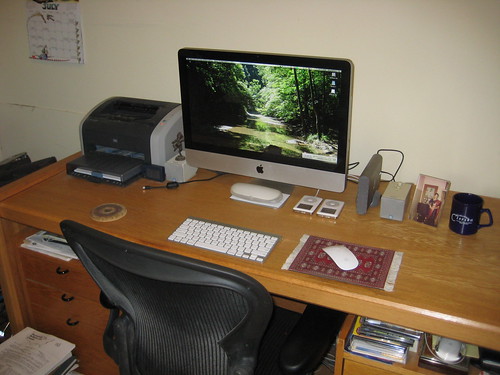
My Workspace, originally uploaded by bradipo.

I haven’t actually been writing at my desktop for the past couple of weeks. While Steve and Daniel were visiting, we were taking our laptops to the library and using one of their “study rooms” as an office.

I’m fixin’ to get back to working here, though.

What’s here:

  • HP laser printer
  • Yamaha speakers
  • Dancing Ganesh
  • iMac
  • Iomega 1T backup drive
  • My and Jackie’s iPods
  • Picture of Jackie taken in India
  • My Clarion mug

Creative Commons License
My Workspace by Philip Brewer is licensed under a Creative Commons Attribution 3.0 United States License.

Just learned that Redstone Science Fiction has accepted my story “Like a Hawk in its Gyre” for publication, probably in early 2011.

I’ve signed the contract and mailed that in already. I still need to write a bio to send along with a headshot. Until I start selling more frequently, I have the luxury of writing a new bio for each sale. (I know some writers find the bio-writing step to be daunting, but I kind of enjoy it.)

It’s hot today. Writing when it’s hot always reminds me of Clarion—of the many sweaty hours sitting at my desk in Owen Hall, writing fiction. And I was already thinking of Clarion. In 2001, Clarion started on June 3rd, so I spent much of May getting ready to go. Since then I’ve found my thoughts turn to Clarion every May.

Thinking about Clarion reminds me how I’d been wrong about which activities would teach me the most. I’d imagined that the benefits would flow from writing a lot and getting critques on my stories. Those activities were beneficial, but what taught me the most was doing a critique of a classmate’s story and then hearing another 20 critiques on the same story. Especially when one of my fellows had a different take on the story from my own, I learned something. Some of those insights were pearls of great value that I secreted away and have used many, many times since then. Even when I disagreed, just the notion that the story could be viewed that way changed the way I thought about stories.

Sadly, I don’t have an active local critique group, so I’m not in a position to recreate that aspect—the most valuable aspect—of the Clarion experience this summer. But that’s okay. I can still write a lot. I can still read a lot. I can still think critically about the stories I read. And on hot days like today it will almost feel like I’m back there again.

Late last summer, I got email from the publisher Gale. They wanted to license my Wise Bread article Bankruptcy is a Good Thing to use in their book Bankruptcy (Introducing Issues With Opposing Viewpoints).

They have a whole series of “introducing issues with opposing viewpoints” books, each of which contains a variety of articles and essays on some topic. I gather that the idea is to help teach students the skill of reading a number of articles, any one of which may be unbalanced or narrowly focused, and then synthesizing an understanding of the topic. It’s a useful skill, and one that’s hard to teach with a textbook, since textbooks generally try to present a comprehensive and balanced viewpoint.

I executed the license agreement back in August. The book came out in April, and the check (payment on publication, of course) arrived today!

It would probably be worth my time to market reprint rights more aggressively, but I enjoy writing more than I enjoy marketing. So, it’s especially nice when the chance to earn a license fee falls into my lap like this.

Because of the nature of (and price of) the book, I didn’t try to negotiate a contributor’s copy. If you happen upon a copy, I’d be pleased to hear a little about it.

I’ve never had a problem with Henlein’s rule one for writers (you must write). I enjoy the writing. I enjoy other stuff too, and want to be sure to get in my reading and exercise and Esperanto and playing of StarCraft, but of all the stages in writing a story, the step I most enjoy is putting the words down. So, I do write, and with enthusiasm.

On the topic of rule two, however, I go back and forth.

I certainly see that you can’t make a career (or even a sale) out of unfinished stories. But I’ve gradually come to see that many of my unfinished stories aren’t really stories at all—they’re just a cool character or a cool situation or a cool idea.

I’ve spent a lot of time trying to “finish” these non-stories. Years of experience shows that I can fool myself for a long time that these particular cool characters, situations, and ideas add up to a story. But the result is days or weeks spent generating prose that never adds up to a story.

I think a much better version of rule two for me is “Finish the stories you start, but ruthless abandon any project as soon as you realize it isn’t a story.”

I could finish two or three stories in the time it takes me to “finish” a non-story.

Toby has a good take on ebook pricing issues.

Very briefly, mainline publishing houses would prefer to go with a pricing model similar to the model for physical books, where books start at a premium price when they’re new and then are sold at gradually cheaper prices. Amazon, on the other hand, wants to sell a cheap(ish) $10 ebook edition of new hardbacks, because that’s a price point and market segment that drives sales of the kindle, but shows no sign of further lowering the price as cheaper editions of the physical book come out. (One supposes Amazon’s theory is that there are a lot of people will pay $300 for a kindle to read the latest bestsellers for $10, but many fewer who will pay that much to be able to read last year’s bestseller for $4.)

The whole issue (Amazon taking down the Buy button for most books sold by Macmillan imprints, etc.) has produced a lot of talk by non-authors about how publishers are obsolete anyway and authors should just produce and market their own ebooks. But that sort of talk just goes to show that they don’t understand that publishers are specialized venture capital firms (as opposed to specialized manufacturing companies).

I published one short story in 2009:

My story submission database isn’t really set up to answer the question of how many new stories I wrote this year, but I see three whose first submission to an editor was in 2009.  Hopefully some of those will appear in 2010.

Two articles of mine appeared as guest posts at personal financial blogs:

I wrote 71 posts for Wise Bread.  I’ve bolded a few where I thought I managed to say just what I was trying to say, and commend them to your attention:

One of my Wise Bread posts (Understand Capital Costs) was featured in in US Airways Magazine (October 2009, page 22).

One weak point in my writing is that I sometimes forget to write in scenes. I’m prone to write continuous action, which leads to pages of people just going places and arranging things. Very dull. Very easy to avoid, though, as long as I remember to do so. Just add a scene break and begin a new scene with, “When they arrived at…”

The problem is, an excessive amount of that is just as bad. It’s not as often, but I sometimes find myself summarizing—writing the whole story as a series of brief descriptions of what happened.

I think that’s where I went awry most recently. As often happens when I’ve made a mistake, I found it very hard to write the next bit, leading to several zero word count days this week. So, today I backed up and replaced some of that summary with scenes.

I think that was the right choice. After all, this is a place where they’re going to be spending some time. So, some full-blown scenes of arriving and meeting people seem appropriate. Plus, I enjoyed writing them, which is usually a good sign.

So, that’s 800 words today. With three zeros, though, my moving average is just 216 words. Hopefully I’m over this rough patch and can start making headway again.

I’ve known right along that I didn’t really know where the novel was going.  On novel-length efforts I haven’t had much success writing to an outline, so I thought I’d try just writing.  (Another thing I’ve been doing differently this time is giving the chapters to Jackie as I go along, figuring that would give me a little extra push to make each one kind of exciting.)

I’ve been putting in little hints of underlying complexity, even if I wasn’t sure exactly what they mean.  I figure some of them will turn into something.  The others I can leave in if they work as texture or remove if they detract.

For some reason, though, the past couple of days it started bugging me that I didn’t know where I was going.  I was at an inflection point in the story and I thought had an idea for what I wanted to do next, but without an idea of where I was going, it just turned into nothing.  The result was two days with zero word counts.

That was bad, but today I figured out I could write another chunk.  I’d made the not-unusual decision to cut the hero off from most sources of help, but I realized today that I could let him call for help without him actually getting help anytime soon.  Plus, this gives me the chance to insert some exposition if necessary–the response to the call for help can fill in whatever background is needed to put his adventures in the context of the greater story.  (I haven’t written it yet, but I’ll write something, and if it isn’t right I can change it later.)

So, even though I still don’t know what the greater story is, I was able to write 500 words today of calling for help.

Although it daunted me for a couple of days, I think I’m past this cycle of worrying about what the greater story is.  The worst that can happen is that I never do, and I’ll have spent a couple of months writing sixty thousand words that never turns into a novel.  But the couple of months would have gone by whether I’d written sixty thousand words or not.

My false starts last week left me with a bunch of words that probably belonged in the novel but not where I’d tried to put them.  The past three days I’ve been working on integrating some of them into the next chapter and moving the rest out of the manuscript.  The result is that I’ve made some forward progress, but without much in the way of net new words.  So, with word counts of 200, 300, and 600, my moving average has slipped under 500.  Still, I’m making forward progress.  In fact, I hit 15,000 words, which is one-quarter of my estimated final length, and I hit it with a neat transition in the story–after having been on the move so far, the characters have finally reached a place they’re going to be for a while.