Graph of the Dow, S&P 500 indexes, and the Apple stock price, all down dramatically

For the last 40 years, I’ve pretty much just enjoyed market declines. Especially in the early days I had very little invested, so even a huge percentage change was a pretty small amount of money to me. That made it easy to simply enjoy the drama—all the serious people running in circles, screaming and shouting.

I have been known many times to say, “If the weather can’t be good, it should at least be bad enough to be interesting.” Big market moves have historically engendered the same kind of feelings in me.

Even the last big decline, the Great Financial Crisis—which happened right after I’d retired, prompting a good measure of black humor (“I wouldn’t want to be someone who’d just retired, right before his stock market portfolio took a 40% hit!”)—didn’t keep me from being able to enjoy the journey.

Today’s decline is not different. At least, it’s not yet different.

Graph of today's Dow and S&P 500 index moves, and the price of Apple stock

A big part of why I could enjoy the early declines was that I had a regular income, with a tidy chunk going into the markets. To a person in that situation, a big decline in stock prices is a big sale. All the stocks just got cheaper to buy.

Now that I’m long retired, that is less true.

As I say, the main reason I’ve long been interested in big declines is that they’re interesting. This one is perhaps more interesting than most, because this could be the AI bubble popping.

Let me be clear that it is much too early to announce that this is the AI bubble popping. It is entirely possible that the markets will take this as a “brief correction” and then zoom off to even more absurd heights before the bubble pops. And it is also not certain that the bubble will pop in any kind of dramatic way. Sometimes these things just work themselves out, with the over-extended stocks pulling back gradually over a few years while other stocks go up, in a way that never produces a dramatic crash to point at.

One thing I do want to observe is this by Paul Krugman:

“… it’s increasingly difficult to see how the hyperscalers can realize their gargantuan investment plans unless someone is willing to take massive losses.”

And there will be massive loses. I mean, even if everybody went “You know, maybe we don’t want to spend so much on data centers,” and quit borrowing and spending, there’s quite a bit of debt that’s not going to get paid back. But if they go on borrowing and spending, there’s going to be a gargantuan amount of debt that isn’t going to get paid back.

Who loses all that money?

Well, to begin with, the people who lent the money to people who couldn’t pay it back. There are also people who guaranteed that debt in various ways; they should be on the hook as well. But we know from the great financial crisis that it won’t be only (or even primarily) the lenders. During the Great Financial Crisis, the banks (who made horrible, terrible, no good mortgage loans to people who had no hope of ever paying the money back) were protected. Instead, the home owners got absolutely screwed by the banks, by the governments, and by the courts.

And this time around, we won’t have home owners to put on the hook for it. The money has been borrowed by Special Purpose Vehicles—companies whose only purpose is to borrow money to fund some activity (such as building a data center), while keeping the borrowing off the books of the big companies who want to use the data centers to run AI models.

The special purpose vehicles will be screwed, which is exactly their purpose. Unfortunately, that doesn’t help, because the companies who loaned the money, and the companies who guaranteed the money (such as by promising to pay to run their models at the data center built by that SPV) are all kind of important to the economy. As I say, the whole purpose of the SPV was that it (and the people who loaned it money) get screwed. But that’s only okay if it’s just the random SPV here and there. If they all go down, then the whole AI sector goes down, and that’s half the stock market at this point.

That observation, along with Paul Krugman’s observation, got me wondering: Who might be stuck with the massive losses?

I mentioned the question to my brother, who suggested it’d be “Mom & Pop who bought mutual funds for their retirements.”

I think that’s exactly right. They’re going to try to stick it to the Boomers. That’s the only group that has the money to cover those losses. (Except for the billionaires, and the whole point is to make sure they don’t have to take it on the chin.)

That somewhat changes my perspective on big declines in the stock market.

Museum exhibit at the Chicago Fed of $1 million in $20 bills

I’ve been warning about the current stagflation since the beginning of last year. It’s good to see others are catching up.

Stagflation, the Scourge of the 1970s, Is Back by Phillip Braun

One point the opinion piece makes is that the one bright spot in the economy—the stock market—is actually (in line with what I’ve been saying about how the markets and the business news have this all completely wrong) a “severe systemic risk.”

If, like me, you had any sort of reasonably balanced portfolio at the beginning of the year (or the beginning of last year), it’s worth observing that it is almost certainly way, way out of balance.

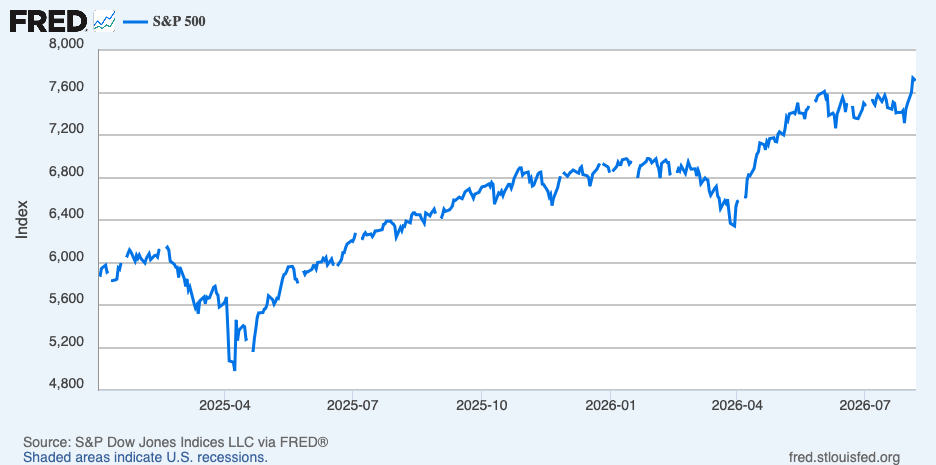
Graph of the S&P 500 since January 1 last year, showing an increase from under 6000 to over 7600

If so, this is your reminder to rebalance your portfolio.

Doing so is admittedly really hard to do. If you had a 60:40 (stocks to bonds) portfolio at the beginning of last year, you might very well have 70% or 80% invested in stocks now, and that probably feels great. You feel like a genius, letting your profits run. If there’s anything better than having 60% of your portfolio grow at 20% a year it’s having 80% of your portfolio grow at 20% a year.

But you know it’s a terrible idea. It’s bad enough to have 60% of your portfolio lose half its value. Having 80% of your portfolio lose half its value is much, much worse.

Knowing that it’s hard, let me point out a little thing that might make it a little easier right now: Bond rates are up nicely. You can get nearly 5.25% on 30-year bonds, or almost 3% on inflation-adjusted bonds. That’s good enough that you don’t really need to agonize about whether you can expect a capital gain or capital loss on the bond. Just buy it and take the coupon.

Of course, I have no idea what balance is right for your portfolio. Maybe it’s 60:40. If you’re young, maybe it’s 80:20. If you’re retired, maybe it’s 35:65. But if you had a sensible balance a year or two ago, and you haven’t rebalanced, it is now way out of whack.

This is your reminder to fix that.

A graph showing a line that goes up to the right, with a big drop in April 2025 that is quickly reversed

There’s a broker offering a new product, that I’d have been all over 30 years ago. I think they’re calling it a “generated asset,” where they create a personal stock index just for you (based on a prompt to an AI), and then create an imaginary index fund for that imaginary index, and then (I assume) invest in the underlying stocks on your behalf.

Of course, you could do that yourself, but it would be awkward, probably expensive, and definitely fiddly, with a need to track the index over time.

So, instead of that (I assume), the company just promises to pay you the value of your index, and (I assume) hedges its promise by holding the underlying shares—and since this synthetic investment is a service, they can lump all these promises together and invest in all the underlying shares, and be generally sure that their hedge will be close enough that even very large stock moves won’t cost them more than investors are paying for access to this service.

As I said, I’d have been all over that 30 years ago. Now, not so much. I’ve gotten lazier and more conservative with my investments as I’ve gotten older.

But it did make me think what I’d want to invest in, if I were to create a synthetic index, and it occurred to me that the companies that are putting the least amount of money into AI crap will do much better over the next few years. So I asked confer.to if it could give me “a list of large corporations ordered by how much they talk about AI in their reports to investors.”

Sadly, the answer was no:

Based on the available data, I can’t provide a specific ranked list of large corporations ordered by how much they discuss AI in their earnings reports. While the information confirms that AI is a major topic in 2025 earnings calls across the S&P 500, the detailed company-by-company ranking you’re looking for isn’t publicly available in the sources I checked.

Here’s what we do know:

  • AI is a dominant topic: In Q3 2025, “AI” was cited on 306 S&P 500 earnings calls, the highest number in the past decade.
  • Significant increase: This is a large jump from the five-year average of 136 mentions and the 10-year average of 86.
  • Sector leaders: The Information Technology (95%) and Communication Services (95%) sectors have the highest percentage of companies mentioning AI.
  • Market impact: Companies that mentioned AI in their Q3 2025 calls saw a higher average stock price increase (13.9%) compared to those that didn’t (5.7%) since the end of 2024.

While sources like Yahoo Finance and MacroMicro track the overall trend and volume of AI mentions, they don’t publish a specific, ordered list of corporations ranked by the frequency or depth of their AI discussions in earnings reports.

This type of granular, ranked data is typically compiled by specialized financial data and analytics firms (like FactSet, which provided the data to Yahoo Finance) and is often part of a paid subscription service.

Perhaps the specialized AI tool that this broker uses to create its imaginary indices has access to the fine-grained data about AI mentions in earnings calls with investors. But I don’t care enough to go to the trouble of looking.

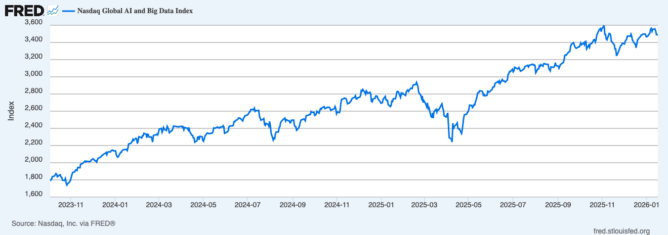
Poking around at the St. Louis Fed’s Fred graphing tool (to come up with a graphic to include for this post), though, led me to the graph at the top, which is of the “Nasdaq Global Artificial Intelligence and Big Data Index,” which “is designed to track the performance of companies engaged in the following themes: Deep Learning, NLP, Image Recognition, Speech Recognition & Chatbots, Cloud Computing, Cybersecurity and Big Data.”

So one option to get what I want would be to just go short on that index.

I don’t think I’ll do that either.

I’m generally unimpressed with Krysten Sinema, whose failure to support Democratic initiatives has generally been harmful. However, I kinda like the tax changes she’s forced into the climate package.

Fundamentally, I like dividends and I hate stock buybacks. So a tax on stock buybacks—even a small one—makes things better.

Now, most economists would have you believe that the two are equivalent. This is false.

Economists can gin up a model that suggests that owning a slightly larger share of a slightly smaller company is “equivalent” to getting paid a share of the company’s profits. Or that getting cashed out completely (by taking the buyback), and then finding a place to invest almost all of that cash in some new company is somehow equivalent. I don’t think either of those things is true even in an economic sense, but I think both are clearly false in a larger societal sense.

New York Stock Exchange

The way things used to work was that a company earned a profit, reinvested an appropriate amount of that profit in growing the business, and then paid out the balance to shareholders to do with as they pleased. (They could reinvest the money by buying more stock, they could spend it on luxuries—or necessities, they could invest it in some other company, they could donate it to charity—the possibilities are literally endless.)

This situation produces a sort of virtuous circle. A company that earns a reliable profit—and shares it with its stockholders—becomes more valuable, because people will pay more for a company that pays a reliable dividend. It’s good for the owners (their stock is worth more), it’s good for the employees (both line workers and managers), it’s good for the community (a profitable company pays taxes, their employees have money to spend, their shareholders have money to spend, etc.).

The non-dividend situation lacks all these dynamics. Instead of wanting to produce a profit, the company has all sorts of weird incentives—to maximize “growth” or “revenue” or “earnings” according to whatever weird metric appeals to Wall Street that week. Owners don’t get cash that they can spend. Instead they get the option to cash out at random intervals. The weird incentive structure encourages companies to make weird decisions regarding investing in growth (or dumping cash into buybacks). Shareholders who would otherwise be living on dividends are constantly having to make difficult decisions about selling small amounts of shares in this or that company for money to live on.

Maybe there’s some technical economic sense in which buybacks and dividends are equivalent, but they are very much not equivalent in a societal sense, producing very different results for ordinary investors and their communities.

The only reason any ordinary person would think a stock buyback was even close to equivalent is because capital gains have been tax-advantaged over dividends. So, something that reduces that tax advantage is all to the good.

Details: Krysten Sinema Agrees to Climate and Tax Deal – The New York Times