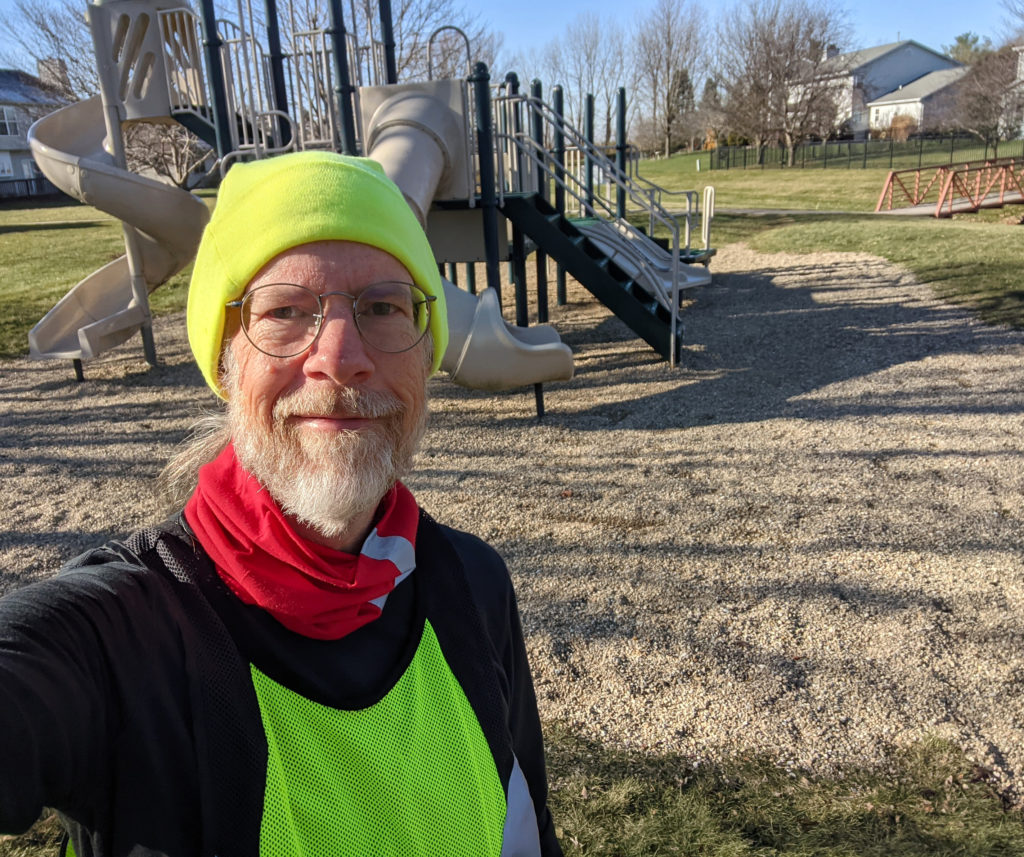
Only very old playgrounds still have monkey bars, jungle gyms, or pull-up bars. This modern playground at least has a horizontal bar at the top of the slides which is suitable for doing inverted rows. I took the opportunity of running past to do a quick set. 🏃🏻♂️
A few years ago I made a shift in my thinking about fitness—a shift from trying to get enough exercise to trying to fill my days with movement. I haven’t changed my mind about that being the right way to go, but this year, especially since the pandemic started, has seen me step back into exercise mode.
I have to say that it has turned out pretty well for me this year.
One thing about exercise is that it gives you a bunch of metrics you can track, and on the metrics I’ve done pretty well. At the beginning of the year I could do 3 pushups and now I can do 4 sets of 12. At the beginning of the year I could do zero pull ups, and now I can do a set of 3 followed by 2 sets of 2.
Having the metrics is great for someone like me who’s a big ol’ nerd about tracking that sort of data, but it’s not just a matter of numbers. Those bigger numbers correspond to real-world capabilities. I’m definitely stronger than I was at the beginning of the year, in all kinds of ways. I’m also leaner. (I have more muscle, plus I let myself lose about 5 pounds in a so-far vain effort to be able to see the abs I’ve built.)
A lot of my fitness goals are related to attaining and maintaining specific capabilities. I want to be able to:
Pick something heavy up off the ground
Take something heavy off a high shelf and lower it safely
Clamber on top of a wall
Jump down from a wall
Jump over a ditch
Run away from danger (or toward someone in need of help)
That’s not a comprehensive list; merely a brief sketch of the sort of things I want to be able to do.
Even a quick glance makes it clear that many of them are skill-based activities. I’ve worked on some of them before (click through the parkour tag to see six or seven years worth of reports about my efforts in those directions), but I felt that my efforts were limited by a lack of strength. That probably wasn’t even really true—parkour is scalable—but to the extent that it was true, it’s much less true now.
The way to get better at a skill-based activity is to practice it. And most of that practice should not be practicing whole activities, but rather individual pieces of them.
There’s a word that means practicing all the individual bits that go together to make a larger move: training—something that’s been really hard to do during the pandemic.
The real reason I’ve switched to exercise is that during the pandemic, although I’ve been able to move, my opportunities to train have been limited.
I’m hoping to spend the summer training. I’m thinking parkour, but if I can’t get it together to do that, maybe I’ll go with rock climbing. (Indoor climbing would be a great winter activity, if the vaccines roll out fast enough that I feel like it’s already safe to engage in indoor activity before summer weather. But there’s no rule against indoor climbing during the summer either.)
It’s possible to do parkour training during the winter, as long as it isn’t too icy. I tend not to get out in the cold or wet to do so, but I’m working on overcoming that—with some success: I’ve been doing pretty well at getting out for runs, even during chilly/damp fall weather. But I’m at the point where I could really use some instruction in parkour, and that’s out-of-bounds during the pandemic.
In the meantime, I’ll go on doing my exercise, figuring it’s the best way to get myself ready for training, once circumstances align.
It used to be that I was pretty casual about warming up before exercise. If the weather was nice, I’d go for a 20-minute walk. If the weather was crappy, I’d spend 5 minutes on the treadmill or an exercise bike. I’d do just enough to get my heart rate a little bit elevated, and raise my body temperature a degree or two.
That worked okay for years, but at some point I started having injury problems. I’d hurt my feet when I ran. I’d hurt my wrists when I tried to do pushups. I’d hurt my shoulders when I tried to do pull-ups. Each new injury taught me to warm up that body part a little more carefully.
As I’ve gotten older, I’ve found that it is very much worth the time and effort to do a long, slow warm-up.
I wrote a little while ago about taking some time to check-in with my body and with my exercise venue, but I didn’t talk much about specific warm-up activities. This post is an attempt to capture my current somewhat maximalist warm-up, primarily as a checklist to use myself. (Without one I tend to forget activities, and then only remember them later, when some body part twinges. “Oh, yeah, I forgot to do the shank rotations!”)
Just as a note: If I don’t mention some other rep count, I do most of these for 12 reps. If it’s a bilateral motion, I often do just 6–8 on each side.
Feet and ankles
I used to start with the neck and work my way down, but I’ve switched to do my feet and ankles up front (because it’s there that I’ve had the most persistent injuries), and then go back to the neck. Here’s what I do:
Roll my feet on a ball. I’ve got a hard rubber ball, like kids used to bounce. I just roll each foot on it, back and forth across my foot, then up and down along the length of my foot, trying to find and linger on each of the numerous joints within the foot, to mobilize them.
Walk on the edges of my feet. I walk the length of my house (not very far, about 15 or 20 steps) first on the outside edges of my feet, then the inside edges, then on my heels, and then on the balls of my feet.
Toes and heels. I shift my weight forward toward my toes, and then back toward my heels. Once that’s comfortable, I go ahead and rise up onto the balls of my feet and then balance briefly on my heels.
Calf raises. Finally, I head to the bottom step of our staircase and do some calf raises, pushing up as high as I can on the balls of my feet and then lowering my heels as far as I can for a good Achilles tendon stretch.
I don’t do any of those as strengthening exercises, I do them as range-of-motion exercises. At the end of the warm-up (or the end of the workout) I sometimes come back to the calf raises and do a few sets of one-footed calf raises, which can be intense enough to be a calf-strengthening exercise.
Neck
The thing I do not do for my neck is head circles. I tell my taiji students that you should never let your head loll around at the end of your neck. (Exception: If you are the heroine in a romance novel and have fainted into the arms of the bare-chested hero. Then your head can loll around at the end of your neck.)
What I do instead is this, an exercise I call “motivated looking”:
Look down and then up. I look down, as if to see if there’s something on the floor near my feet, and then I look up, as if to see a bird in a tree or something on a high shelf.
Tip my head to the side. I tip my head to the side, as if to look around the edge of a corner, or to read the spine of a book on a shelf. Then I tip my head to the other side.
Look left and then right. Turning just my head, I look as far as I comfortably can to the left, and then to the right. After I do that a few times, I repeat it a few more times, except at the far end of the turn I look down, as if trying to peek into my shirt pocket, or look at the floor just outside first one foot and then the other.
I don’t do any of these as a stretch; I keep within my comfortable range of motion at all times. I also don’t close my eyes; the point here is to actually look in those directions, as if to see what’s there. That’s why I call it motivated looking.
I just do about 4 of these in each direction.
Shoulders
Since the pandemic started I’ve been largely focusing on upper-body strength, mostly exercises with gymnastic rings, which hit the shoulders pretty hard. I have found that spending several minutes just warming up my shoulders helps a lot.
Candy wrapper. I hold my arms up at shoulder level, one palm up and one palm down, and then turn them to reverse which palm is up. After I do a dozen or so of these, I take it a step farther: I rotate the shoulder that’s turning palm-down all the way forward, while turning my head to look down the length of my other arm. I just do 3 or 4 of those on each side.
Open and close the chest. This is one of my qi gong exercises. I’ve embedded a video of some of the us demonstrating it below.
Shoulder circles. With my arms relaxed at my sides, I rotate each shoulder forward a few times and then back a few times. I do the shoulders one at a time (trying to keep the other shoulder completely relaxed), and then I do them together, both forward a few times and then both back a few times.
W Stretch. I lift my hands to about head high and make a W shape with my arms (elbows in, hands out) with my thumbs pointed straight backward. Then I squeeze my shoulder blades together (which draws my hands backwards, in the direction my thumbs are pointed), and then spread my shoulder blades apart (which pushes my hands outward—I emphasize that by straightening my elbows and pushing my hands out). I’ve embedded a video of the Tapp brothers demonstrating this one below.
Elbow drills. On my hands and knees, with my elbows slightly bent, I rotate my arms.
Open and close the chest
W Stretch
Back, hips, and legs
I like to go straight from elbow drills to rhomboid pushups to squat prep #1, because they all start from about the same position.
Rhomboid pushups. Still on my hands and knees, but now with my elbows straight, I turn my arms so that my elbow pits are as close to forward as I can get them, and then I lower my torso between my shoulders, going as low as I can while keeping my elbows straight. Then I push my torso up. The lowering move brings my shoulder blades together, the rising up move pushes them apart.
Squat prep #1. I start my hip exercises from the end of my rhomboid pushups. If I’m not already on my toes (as well as hands and knees), I fix that. Then I push my hips straight back. This gets me into essentially the same position as a squat. I explore my comfortable range of motion here, paying attention to where my hips start to tuck if I push them back any further. Sometimes I start by getting into an anterior pelvic tilt at the start, and then push back until the tucking brings me into a neutral hip position.
Perfect squat. Standing with my feet hip-width apart and pointed straight forward, I push my hips back and sink toward a squat while keeping my shins vertical. When I reach the point where I can’t get any lower without my knees coming forward, I stop and explore that position just a bit. I just do a couple of these—they’re an informational exercise, so I can perceive what my current physical state is, not an exercise to get better at something.
Regular squat. I shift my feet to a slightly wider stance and turn them out just a little, and then sink down into a deep squat. With this one I let my knees come as far forward as my toes.
Knee rolls. Lying face up with my knees bent and feet on the ground, I twist to one side, letting my knee on that side touch the ground, keeping my shoulder blades on the ground. Then I twist to the other side and touch that knee.
Hip bridge. Still lying face up with my knees bent and feet on the ground, I lift my hips, trying to make a straight line from my knees to my shoulders.
Prone Angels. Lying face down with my arms stretched past my head palm down, I left my lower legs and knees, and my head and chest. Then I bring my arms arms back and turn them palm up as they approach my hips, and then return them to the starting point. (I sometimes do this with water bottles in my hands as weights as a back-strengthening exercise, but for warm-ups I do it empty-handed.)
Hip circles. I stand with my feet about shoulder width apart and move my hips forward, to one side, back, and then to the other side. After a few circles, I reverse the direction. Sometimes I’ll precede that with a more linear prep motion, starting by tucking and then un-tucking my pelvis, and then shifting it to one side and then back again.
Shank rotations. I stand on one foot and left the other leg until my thigh is horizontal. Then I turn my shank to the left and right. This points the foot left and right, but if you focus on that it’s easy to imagine that you’re turning your shank when actually all you’re turning is your ankle. To check for that I usually put my hands on my upper shank, feeling for the front of my tibia just below the knee, so I can detect that I’m actually turning the whole shank and not just the ankle.
Dynamic hamstring stretches. I sit on the ground with my legs spread as wide as comfortable, and then reach toward one foot and then the other. I don’t do this as a static stretch.
Side sit reverses. I sit on the ground with my legs bent to one side, and then reverse which way my legs point. While I’m on each side, I turn to look over each shoulder as far as is comfortable. I do about 4 reps on each side. I’ve embedded a video with the reverses (but not the looking over each shoulder) below.
Side sit reverse
Wrists
I usually do my wrist exercises in the middle of my shoulder exercises, typically right after my shoulder circles, but there’s a bunch of them, so I wanted to pull them out into their own section.
Wrist circles. Sometimes I do these with my hands in front of me (ether crossed or not), but usually I plant my wrists over my hips and use the friction with my sides to provide some resistance as I rotate my hands one way and then the other.
Aikido wrist exercises. There are three wrist stretches that I learned in a long-ago Aikido class. They’re kind of hard to describe. Basically, you use your other hand to twist your hand one way, then the other way, then into flexion. Repeat a few times on one side and then the other. As best I can recall, the Aikido exercises didn’t include a stretch into extension, but I throw that in anyway (to get ready for pushups).
Fitting it in
Let me take just a moment to acknowledge that this is insane. On days that I do a full workout (which was running 4–5 days a week over the summer), I do very nearly this entire set of warm-up exercises. (Up to now I’ve often forgotten several, since until now I haven’t had a list to follow.)
This can easily take me 40 minutes, which is a pretty large chunk of the day to dedicate just to warming up.
Even then I’m not done—I go ahead and do “straight-elbow” versions of push-ups, pull-ups, or inverted rows (to match the full version of any of those exercises that are in my plan for the workout).
I also do a subset of this warm-up even on days that I’m not going to exercise.
The reason I do all this is simply that I feel better when I do. It’s not just my workouts that go better when I’ve gotten in a proper warm-up. Everyday activities go better as well—bending over to pick something up off the floor, standing up from having sat down on the floor, getting something down off a high shelf, etc. Everything I do for the rest of the day is easier and more comfortable, once I’ve gotten properly warmed up.
So, there you go. Feel free to take any or all of these activities to include in your own warm-up routines. If there’s one that isn’t clear, let me know—I could tweak the text, take a photo or even make a video, if that would make it clearer.
For some time now I’ve been aiming to do my endurance training at my MAF heart rate. MAF stands for Maximum Aerobic Function, and it’s the heart rate where you’re producing the maximum output without having to use anaerobic systems. Although the MAF formula just produces an estimate, there’s quite a bit of data to back it up.
If you do almost all your training at MAF, you’ll get better (run faster) at that heart rate. The idea is that you first do that, and only when your performance plateaus do you need to start doing any sort of speed work (and then not much of it).
As I say, for some time I’ve been aiming to train at my MAF heart rate, but it’s a low enough level of intensity that I’ve persistently had trouble not running too fast. I have a heart rate monitor, but it’s not very useful during a run, because my heart rate is displayed on my phone, and I don’t want to run around carrying my phone where I can see the screen. The upshot has been that I’ve inadvertently done a great deal of my training somewhat above my MAF heart rate, which rather defeats the purpose.
To get a better grip on my MAF training, I finally broke down and bought another heart rate monitor, which displays my heart rate on my wrist so I can check it while I’m running. It also has an alert function, so I can set it to vibrate if my heart rate goes above some value. After looking around a bit, I settled on the Mi Band 4 (which is available for cheap because the Mi Band 5 is now out). It does the thing I want well enough. (It also does a bunch of other stuff that I don’t care about, and some things that I do care about (sleep tracking), but that I do some other way, such as with my Oura ring.)
After a shakedown run a few days ago, where I spent a lot of time trying to figure out how to use the device the way I wanted, today I went out for a run where I tried to use it for some proper MAF training, and I think I was very successful. I probably only spent two or three minutes (out of a 51-minute run) with my heart rate above my target.
This very easy run was nice and gentle. Sitting here at my computer maybe an hour after I got home, my heart rate is already back down to just 64 bpm, which amounts to a surprisingly complete recover. After a run only a little bit faster, I’d expect to see my heart rate stuck in the 70s for several hours.
Now to see if regular training this way produces the speed gains it is reputed to.
Objectively speaking, autumn is probably the best season. Not cold like winter, stormy like spring, or hot like summer, autumn has great weather—totally aside from the pretty colors and Halloween (arguably the best holiday, albeit in a near tie with Groundhog’s Day).
For pretty much my entire adult life I’ve dreaded the cold dark days of winter, and among the many ways that Seasonal Affect Disorder affected my life in a negative way was that it ruined autumn. I could usually get past the summer solstice okay (although in the back of my head, I knew that the best day of the year had come and gone), and I could keep it together through July and August. But by the beginning of September I knew that winter was coming, and I’d spend the last months of nice weather steeling myself against the dark days to come.
It was the dark that bothered me, more than the cold. It’s easy to armor yourself against the cold—flannel, moleskin, fleece, wool, down—there are many ways to deal with cold. But even a Verilux light therapy lamp (which does help) does not solve the problem of the dark days of winter.
All of which is merely an introduction to saying: Last winter I did not suffer from SAD!
I had meant to write something at the time, but I didn’t want to speak too soon, and then once it was spring, it didn’t seem like the most important thing.
I don’t want to jinx anything, and I’m sure the right combination of stressors on top of the cold and dark could once again put me in a bad place, but something more important has changed than just a good year: I’m no longer afraid of the dark days. Maybe I’ll suffer from SAD again, and maybe I won’t, but at least the mere knowledge that the cold and dark is coming is not ruining my fall! In the back of my head I seem to have turned a corner and developed some confidence that I’ll be okay despite the season.
So what has helped?
First, not having to work a regular job. I’m sorry that I can’t recommend something more generally available, but that was the biggest thing that made a difference. Because I don’t have to be productive on a day-to-day basis, I avoid the depression-spiral that used to result from realizing that I wasn’t getting anything done, which made me anxious about losing my job and being unable to support my family, having the anxiety make me more depressed, and the depression making me even less productive. That used to be a killer. On top of that, because I don’t have to be in the office during any particular hours, I’m able to spend a few of the few non-dark hours of the day outdoors, taking advantage of what daylight there is (and making some outdoorphins).
Second, exercise. I always knew it was important, but I took things up a notch each of the last few years, and each new tick up turned out to provide an enormous improvement in my mood. In my experience, all kinds of exercise are good. Endurance exercise is good. High-intensity interval training (HIIT) is good. Skill-based training—ballet, parkour, animal moves, taiji—is good. Resistance exercise (lifting) is perhaps best of all. Letting the dark days of winter compress you down into a lump that seeks (but never finds) cozy because you’re unable to move? That’s the worst.
Third, community. Granted this is not so easy during a pandemic, but even people that you only see on-line are still people you can have a connection with, and having connections is good.
Fourth, something to look forward to. It can be almost anything. Last year I was looking forward to having my family visit. Other years I’ve looked forward to taking a vacation somewhere warm. Even little things help me—ordering some fountain pen ink or cold-weather workout clothes and then looking forward to the package being delivered, and then looking forward to using the newly acquired item.
Fifth, a project that you can make progress on. Ideally something without a deadline—at least, no deadline during the dark days of winter—but a project that you care about. Something that you can spend a few minutes on every day and see some headway that brings you closer to completing it. Creative projects are good, but creativity isn’t as important as just having a thing that you’re working on, and making steady headway.
Not suffering from SAD, even if just for one year, has been wonderful. Having some confidence that things will be okay-enough this winter that I’m not spending all fall dreading it is even more wonderful-er.
Went out a little fast at the start, partially because it’s chilly and I was cold, but mostly because it felt so good to run a little fast. 🏃🏻♂️ Photo from about the mid-point, where I managed to ease it back down a little.
Jackie attended the annual Illinois Master Naturalist’s conference last week, and came away with any number of interesting tidbits, but one in particular stuck with me: Forest bathing is like ergonomics.
Both Jackie and I have had our understanding of ergonomics informed by Katy Bowman, who points out:
Modern ergonomics is not the scientific pursuit of what is best for the human body, but the scientific pursuit of how the human body can be positioned (in one position, for eight or more hours at a time) for the purpose of returning to work the next day, and then the next and the next and the next.
What Jackie learned at her conference was that the Japanese concept of forest bathing (shinrin-yoku) has roots in the same idea. When Japanese salarymen started dying from overwork, a lack of exposure to nature was put forward as a partial explanation.
If the problem is a lack of exposure to nature, then immersing yourself in nature is an obvious solution. But, of course, actually immersing yourself in nature would take too much time out of the workday. Hence the research into forest bathing is all about finding the minimum effective dose. There is little or no research into figuring out the optimum time for humans to spend in nature.
Keep that in mind when you read yet another article about how just looking at a forest scene for 20 minutes reduces salivary cortisol 13.4%, or walking in the woods for just 40 minutes improves mood and boosts feelings of health and robustness.
I’m not so much interested in the answer to the question, “What’s the least number of minutes I can spend in nature and not die early from overwork?”
I’m more interested in questions like:
If I go for a walk in the prairie, is that as good as going for a walk in the woods? Do I get added benefits if I divide my time between them?
Is doing my workout under a tree in a nicely mowed lawn as good as doing it in the woods?
Is running past a cornfield or soybean field nearly as good as running down a forest path? How about running past a row of osage orange trees? A suburban lawn? Between two suburban lawns on the other sides of 6-foot privacy fences?
If I can’t get to an actual natural area, how should I choose among possibilities like a park, an arboretum, a formal garden, a managed forest, or an unmanaged thicket? How do various water features (lake, stream, creek, natural pond, detention pond, drainage ditch, etc.) affect the benefits?
Is just sitting on a concrete patio outdoors better than sitting indoors?
I have my own tentative answers to many of these questions, but very little data.
9:33 AM CDT in Morrissey Park in Champaign, Illinois.
During a pandemic it didn’t seem safe to teach taiji indoors. But we missed the practice and the camaraderie. So we moved to the park, put on masks, and carried on.
I did an experiment a couple of days ago: I tested a combined workout that doubled up two pairs of exercises that I’d been doing separately. Up to now I’ve been doing four sessions each week: two where I do pull ups & pushups, and then two where I do dips & inverted rows. (Together with a leg exercise and a core exercise each workout.)
That was working very well, but it meant 4 upper-body strength sessions each week, which is a lot. Throw in a couple of lower-body strength sessions as well (such as hill sprints or kettlebell swings), plus a rest day, and I didn’t have a day to do anything else. This sort of volume has been well for me so far, but I think I may have reached a limit, and would benefit from a cycle of deeper recovery than just a week of lighter workouts: Except for “de-load” weeks in mid-March and mid-June, I’ve been averaging close to 5 workouts a week since the end of January. I’m thinking I want to take it down a notch.
With that in mind, I’ve been thinking about how I want to structure my training through the fall and winter. One obvious change was to go from four days of upper-body strength training per week to just three. The problem was that I didn’t see an easy way to evenly cover the range of pushing and pulling exercises at a reasonable volume with just three workouts a week, except by doing both pairs in each workout.
Hence my experiment, in which I did just that.
It was not a complete success. I managed to crank my way through the workout, but it was very long and tough. I don’t think I could keep it up three times a week for months.
Happily, while describing my difficulties to my friend Chuck, I had a brainstorm: I could do threes workouts per week—two of them just like what I’ve been doing (one with pull-ups & push-ups, and then another with inverted rows & dips), and then do just one combined workout. That keeps my workouts even, as far as covering all four exercises twice each week, without being quite so overwhelming as trying to do the combined workout three times a week.
With just three upper-body strength workouts per week, I have four days for other stuff, and I can mix and match as I choose. I can do the hill sprints that Anthony Arvanitakis recommends, or I can do kettlebell swings. (Either of those makes a good HIIT workout.) I can go for a run. I can go for a hike. I can do my animal moves. In particular, I can do two rest days, if that seems like a good idea. (Which I think it probably does. At least my Oura ring thinks so.)
This all got started back in February, when I figured out that I was lacking in consistency. (Previously I’d imagined that the problem was a lack of intensity.) Targeting 5 workouts a week has meant that, even when I miss one, I get in more than when I was targeting 3 workouts a week—even if I didn‘t miss one.
I don’t want to give up the consistency, I just want to take the volume down a notch. Hence the struggle. But I think now I’ve got a plan.