I haven’t been running enough, so I went for a run today. The metrics are kinda funny, by which I mean my Fitbit thought it was an insanely hard run. I thought it was interesting enough to post about.

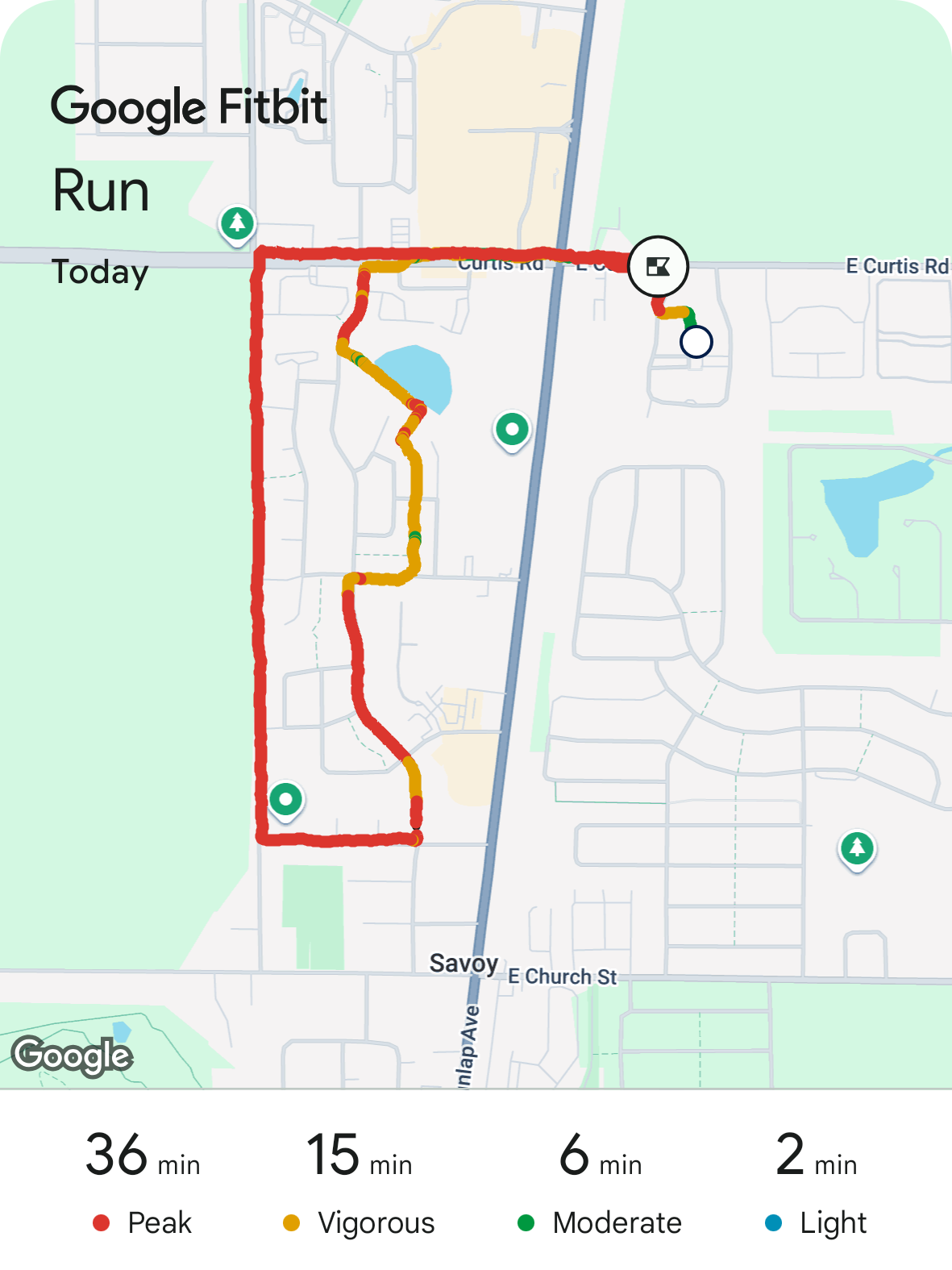
A map showing my running route, color-coded to show that I spent most of the 3+ miles with my heart rate in zone 5

Fitbit calculates heart rate zones based on your “heart rate reserve,” which is your maximum heart rate minus your resting heart rate.

Your resting heart rate (roughly what you’d get if you checked your heart rate right after you woke up, before you started moving around) the device actually measures. My resting heart rate, according to the Fitbit, was 56 bpm. (It actually hit 44 bpm at some point while I was asleep, but your lowest resting heart rate is a different number.)

Your maximum heart rate, though, isn’t measured. Instead, it’s estimated as 220 minus your age. I’m 66, so that comes to 154. So my heart rate reserve is 154 minus 56 equals 98. Then my various zones are calculate as a fraction of the reserve plus the resting rate. Zone 5 (peak activity) begins at 85%, so my zone 5 begins at (0.85 ✖️ 98) + 56, which comes to 83 + 56 = 139. All the parts of my run shown in red in the map above were run at a heart rate at or above 139.

In fact though, my maximum heart rate is way higher than that estimate. I have in the past been somewhat dubious of the maximum readings shown by my Fitbit during a run, because all the wrist-worn devices sometimes sync up at your foot-strike rate, so you get anomalous readings around 180 (a common foot-strike rate). But I also check my heart rate doing other exercises, such as kettlebell swings, where foot-strike rate doesn’t matter. Plus, I get heart rate readings from my Oura ring, which is not wrist-worn, and which doesn’t seem to have the same syncing-with-foot-strike problem. So I know my max heart rate is much higher.

On this run, for example, the maximum heart rate as measured by my fitbit was 169. My Oura ring thinks the peak was 166 (but it averages over 5-minute periods, which smooths out the peaks quite a bit).

Anyway, if you take 166 as my actual maximum heart rate, then my heart rate reserve is 110, 85% of it comes to 94, so my zone 5 range ought to begin at a heart rate of 150, rather than 139.

I find that a lot more plausible. If the Fitbit is right, then I just spent 36 minutes in zone 5, which seems very unlikely. It was kind of a hard run, because I haven’t been running enough, but I not only could have talked while I was running, I actually did sing, which is one of the markers for being in zone 1. (I was listening to and singing along with some Kpop songs.)

So, I think much of that run, even some of the bits shown in red above, were in zone 2 or 3, not zone 5.

Whatever the heart rate metrics, it was a rather slow, rather short run: 3.15 miles in 58min 10s.

Much better than not running.

Updated next morning: I slept great after my run, and woke up feeling great. Legs not sore at all. Overnight heart rate right back down to my current baseline.

For an athlete, being explosive is good. You can jump higher, run faster, hit harder, and (the point of this post) thrust a sword more quickly. Sadly, I’m perhaps the least explosive person around. This is very frustrating when it comes to sword fighting, because my thrusts aren’t quick enough to hit my opponent, whereas their thrusts are quick enough to hit me, before I can parry them.

I can obviously compensate in various ways. I can try and be very deceptive, and then launch an attack that is so surprising my opponent can’t react. I can get very good at parrying, so I can stop an attack with a very small movement that doesn’t have to be so quick. I’m working on these things.

But one other thing I can do is work on explosiveness.

This will have other advantages too. Explosiveness (roughly the same thing as power) is an aspect of muscular strength that disappears early as one ages, and it’s very useful. Just being strong is great, if you want to lift something heavy, but power (or explosiveness) is what you need if you catch your toe, and then want to get your foot out in front of you before you fall down.

I’m going to have to do some research on training for explosiveness, but one exercise that I already know that I can start training right away will be to throw my slam ball. Some people do that facing a wall, so they can catch it and throw it again. But I think I’ll throw it, and then spring forward as fast as possible to pick it up and throw it again, so I can train both explosive arm strength and explosive leg strength.

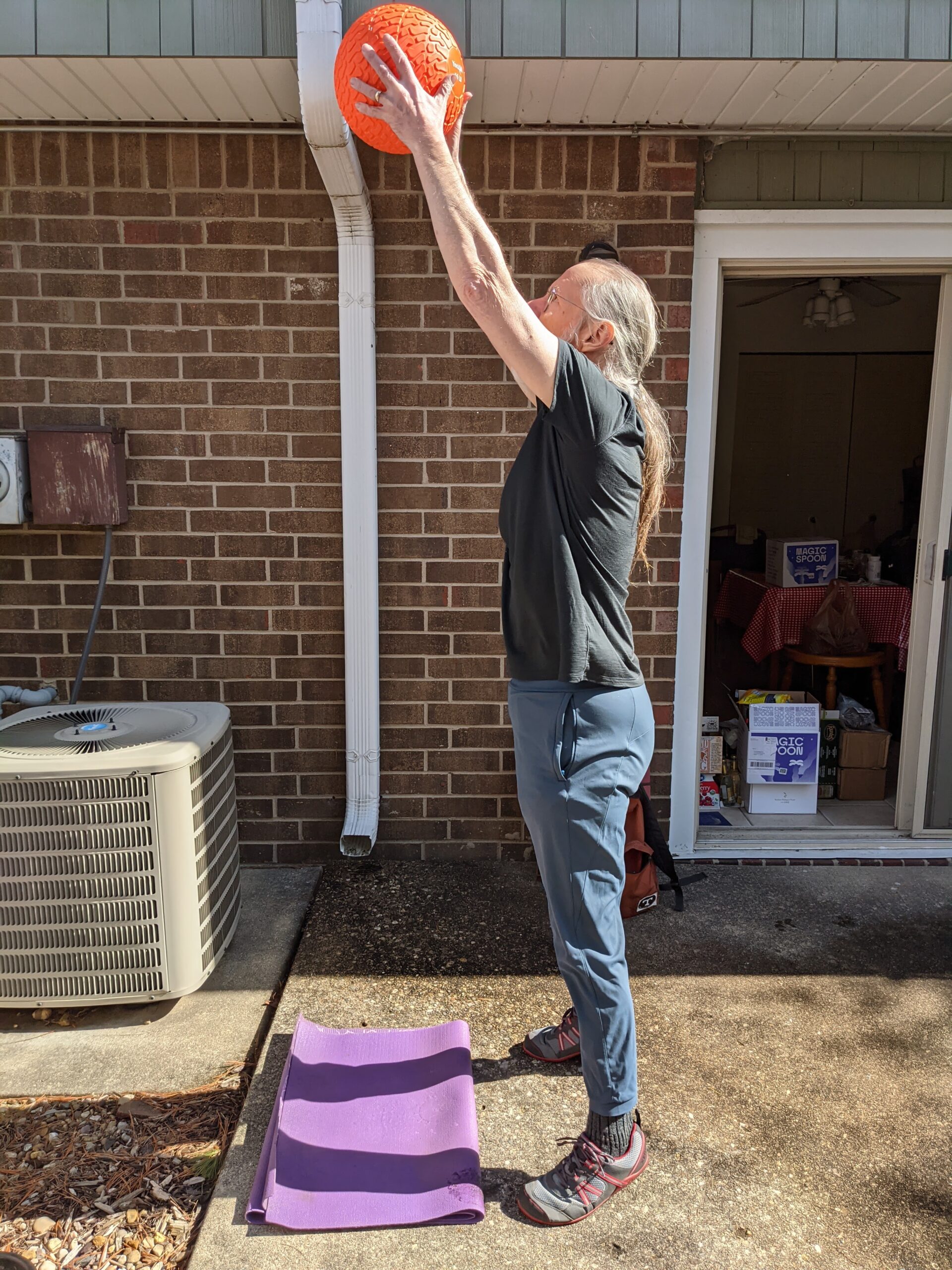
Me holding an orange slamball above my head, about to slam it down
Another slamball exercise to improve power and explosiveness—the classic slamball slam

I’ve finally started getting invited to fitness influencer events! I got email today offering me a chance to get early access to a new line of athleisure clothing if I attend their event!

Sadly, their event is in Los Angeles. And, based on the images, their clothing line is for women. I’d look funny wearing their short skirts and tight tops for skinny girls.

Still, once I show up on one brand’s radar, surely other brands will start noticing me.

Note: I have no interest in being a fitness influencer or a brand ambassador, or getting early access to athleisure clothing. I don’t even really have any interest in free athleisure clothing, although I’m not sure I’d turn it down, because that’s just the sort of ethically ambiguous guy I am.

Pictures of me in exercise clothing, so that future firms know what they might get:

If that doesn’t make you want me wearing your athleisure clothing in my content, well, I guess you probably don’t want me wearing your athleisure clothing in my content.

Jackie and I are in Chicago for the weekend, staying in the Palmer House. We came to attend the opening of a tapestry exhibit at an art center in the West Loop, put on by the American Tapestry Association. The exhibit includes a piece by one of Jackie’s teachers, So Jackie particularly wanted to see it.

Jackie looking at a tapestry showing a woman with a dinosaur
Jackie looking at a different tapestry, this one showing a woman with a dinosaur

After a period where I was being a bit casual about them, for the past few months I’ve been doing pretty well at getting my workouts in, and I didn’t want to let that go, so I went to the fitness center here at the Palmer House. It’s pretty good!

I cranked through a slightly reduced version of my usual morning exercises, then went to the main room of the fitness center for the workout proper. They had an adequate set of kettlebells, so I did two exercises with those:

  • With a 35 lb (16 kg) kettlebell I did 10 x 20 swings emom
  • With a 20 lb (9 kg) kettlebell I did 4 x 5/5 clean&press reverse ladder

Then I found a barbell and loaded it up with a pair of 45 lb plates and did 2 x 5 deadlifts. I’m super out-of-practice with deadlifts, and would not have wanted to do more weight or more reps, but that much was okay.

Having done the tapestry thing, we’re looking to do some other Chicago stuff. Probably the Art Institute. Maybe one of the boat tours where they talk about the architecture. Maybe the Field Museum. Maybe something else! We’ll just see.

I resisted the urge to write about this a few months ago, when it was first published in the New York Times, but instead of the urge passing, it has persisted. I’m finally giving in.

The article is about things you can do to hurt your back, beginning with this thing to be avoided:

“… what we euphemistically call the B.L.T.,” or the bend, lift and twist, said Dr. Arthur L. Jenkins III, a neurosurgeon in New York City who specializes in spinal surgery.

Doing all three actions at once, whether by shoveling snow or extracting a child from a car seat, “maximizes the stress on the disc, making it more likely to rupture,” Dr. Jenkins said. “As a spine surgeon, I would never do it.”

Source: The Worst Habits for Your Back, According to Spine Surgeons – The New York Times

I have never met Dr. Jenkins, but I bet it is false that he never does a bend, lift, and twist movement. Everyone, everywhere in the world, does this movement all the time. And it is almost always harmless, especially when the weight is very low.

The odds that you’re going to hurt yourself by bending and twisting to pick up a tissue that missed going in the trash can are pretty small. Perhaps not zero—if you are out of shape, or overweight, or have a pre-existing back injury, it does become possible to injure yourself that way.

Obviously, if you’re going to pick up a heavy weight, you always want to do that mindfully. Set yourself up facing the weight, so you don’t need to twist. Instead of bending at the waist, hinge at the hips. Then lift.

However (and this is the first half of my main point): You’re going to repeatedly do this, over and over again, over your whole life. It’s simply unavoidable.

If your toddler is about to run into traffic you are going to bend as far and twist as much as necessary to snatch him up. If you need to get your child out of his car seat, and the only parking space you can find doesn’t leave you with anyplace to stand where you can reach in and get him without twisting, you’re going to bend and twist. If there’s something heavy in the back corner of the closet, maybe you’ll spend 10 minutes shifting all the clutter in front of it so you don’t need to twist to reach it. But if there’s something light back there, you’re just going to bend and twist.

The other half of my main point is this: If you’re going to do something repeatedly, over and over again, over your whole life, you should train for that thing. 

I do not mean that you should start doing your deadlifts with a bent, twisted back. I mean, you should build habits, movement patterns, and appropriate strength to do what you need to do. 

I would recommend starting with videos by Mark Wildman. For this action in particular, here are two. The first is a non-twisting version of this movement, that you can use to safely build the strength:

Once you’ve got some strength, move to a lighter weight and then do this version, which first adds some rotation, and then adds more rotation:

Note that the ideal version of this exercise avoids both the bend and the twist! Instead of bending, you hinge. Instead of twisting, you rotate. But in the real world, you’re going to end up bending and twisting all the time, because nobody can be perfect about this stuff all the time.

Avoiding a whole category of movement simply makes you less ready—less capable—of doing that movement when you do it accidentally, or when it becomes necessary to do it on purpose.

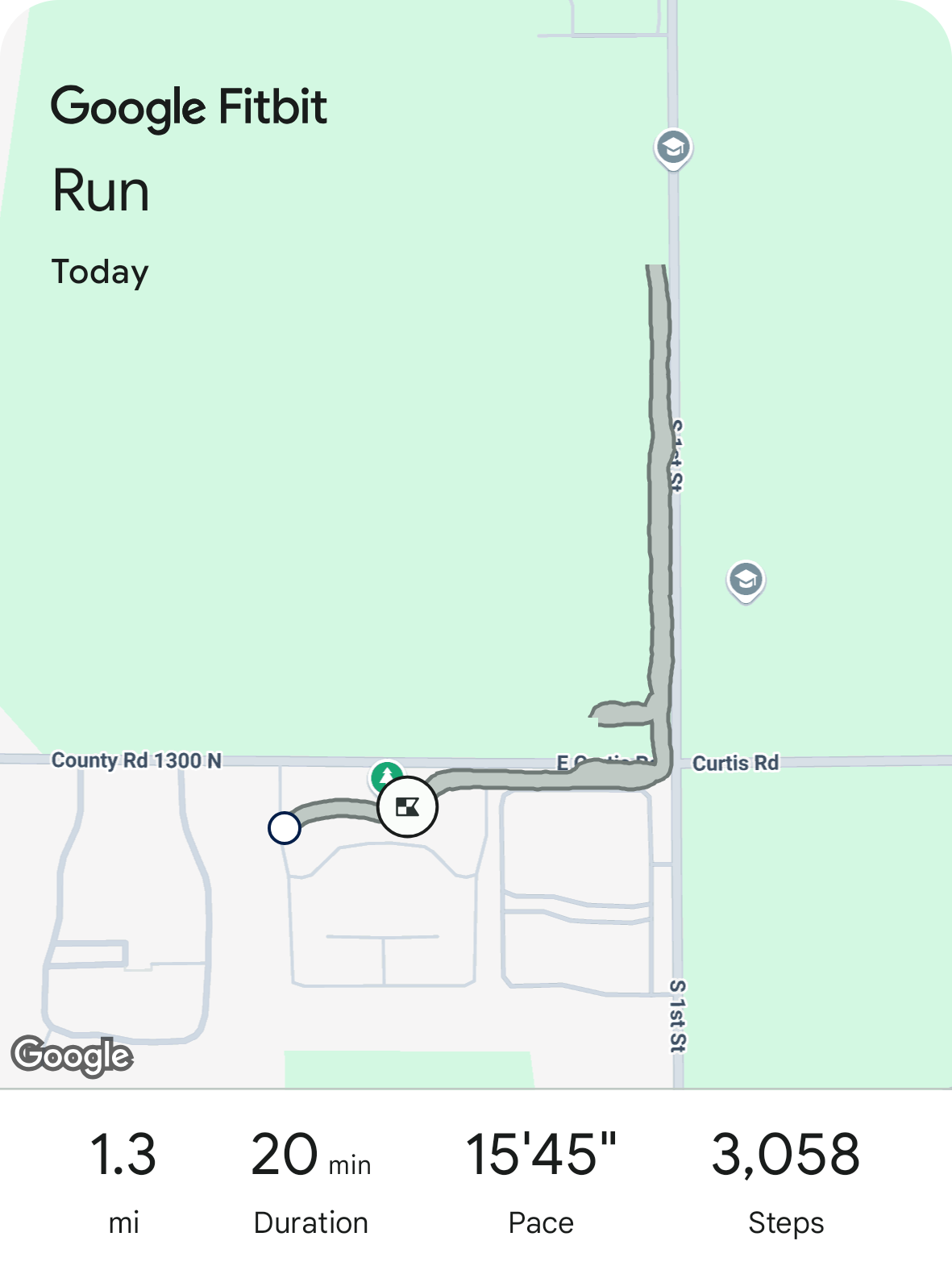
My run was already supposed to be pretty short—about 2.5 miles, across Dohme Park, up First Street to Windsor and then back—but it ended up being even shorter than that, because Ashley wasn’t up to running even that far in the heat of the day.

A map of an abbreviated run

According to my weather app it was already 75℉ when I got home, and I’ve noticed previously that starting at about 72℉ the dog starts to suffer.

You can see on the map a short spur off to the west just after I started north on First Street. That was where we saw a groundhog, and Ashley really wanted to chase it. I indulged her for a minute, hoping the groundhog would quickly find a place to hide, but it wasn’t to be, and I eventually had to drag Ashley back to the First Street path very much against her will.

Anyway, 1.3 miles is a very short run indeed, but I still spent most of 20 minutes with my heart rate up (average was 141, peak was 169). So, a good workout.

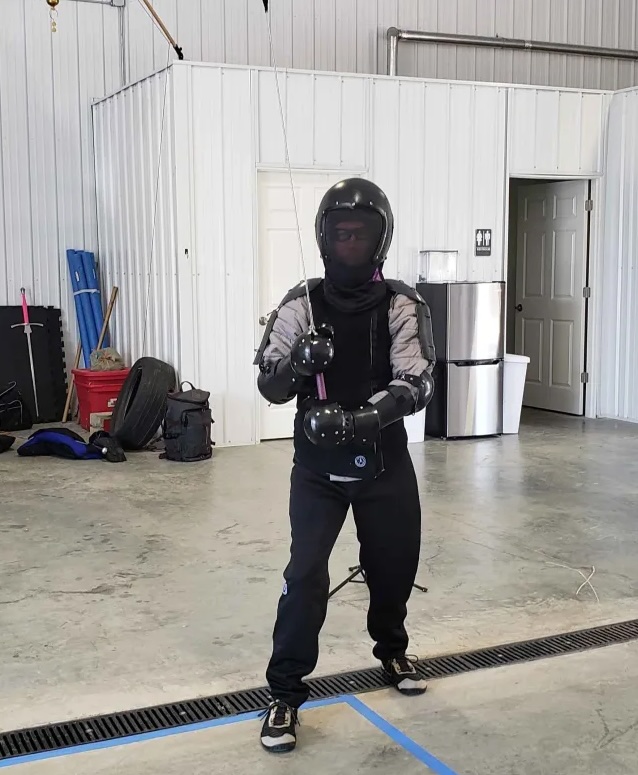
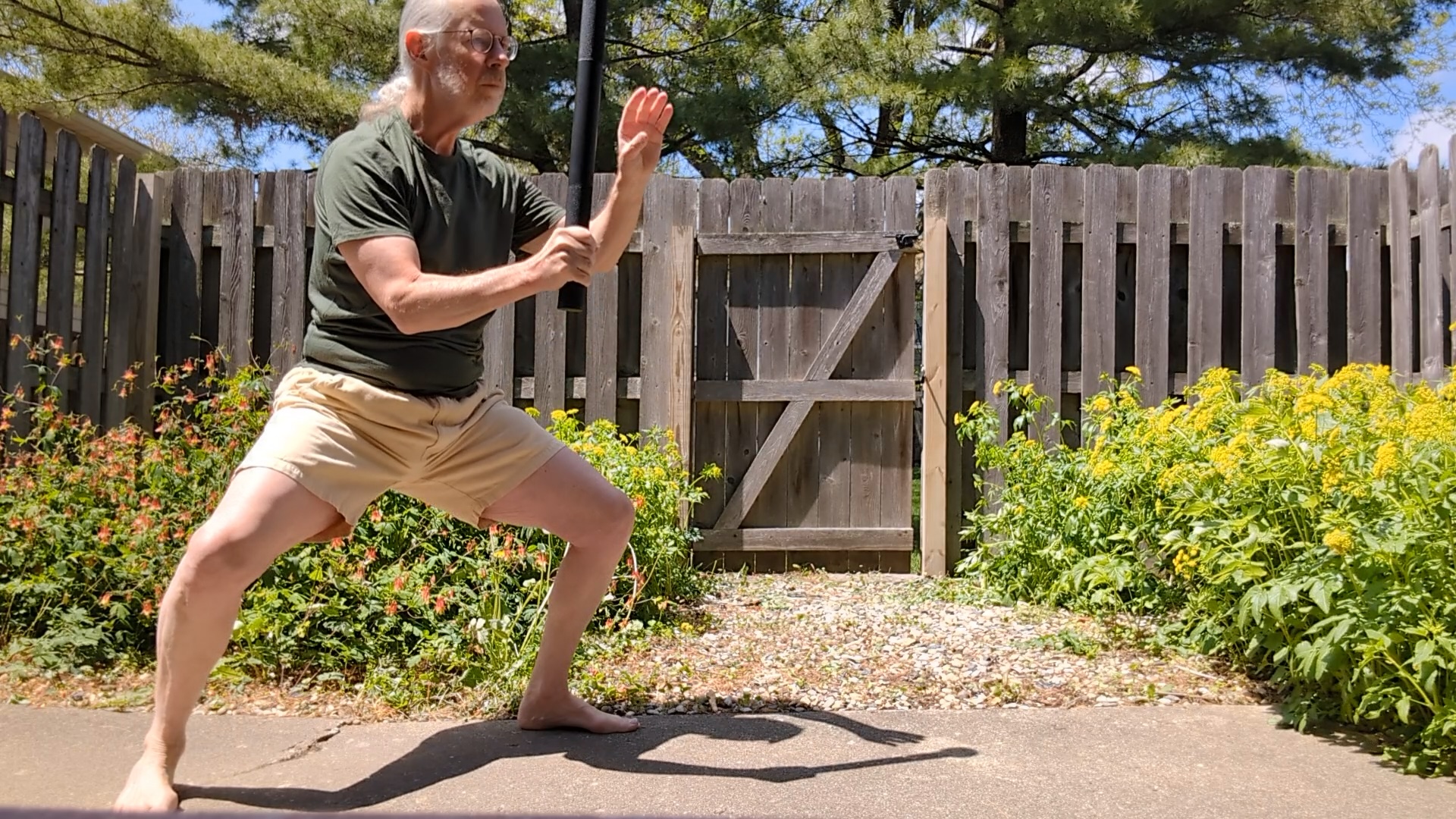
I wanted a workout to practice my Meyer fencing stance—a workout more interesting than just standing in the stance for a minute or two.

Mark Wildman, in one of his a live Q&A videos, suggested the mace drop swing as a useful exercise for someone doing longsword. (It was in response to a question I asked about improving arm strength and endurance for holding your arms forward and overhead at full extension for extended periods, as one does in longsword.) He had suggested doing it in Warrior 2, but specifically mentioned that you could do it in whatever stance went with your longsword style; it just got harder as your stance got wider.

Besides being boring, just standing in a Meyer stance for a minute or two seemed like a missed opportunity; even a modest challenge to your stability in the stance seemed like it might pay off in strength, flexibility, and control of your stance.

So here’s the workout I came up with:

Get in your best Meyer stance, with your mace in your front hand. Execute 5 drop swings, checking your stance after each rep. Shift the mace to your rear hand and repeat. Take one passing step forward. (Your mace will now be in your front hand.) Repeat five swings with the front hand and five swings with the back hand.

That’s one set.

Here it is as a video:

My plan is to gradually add sets until I can comfortably stay in the Meyer stance for 5 or 10 minutes, to build the habit and capability of keeping a good stance while it is challenged by a shifting weight.

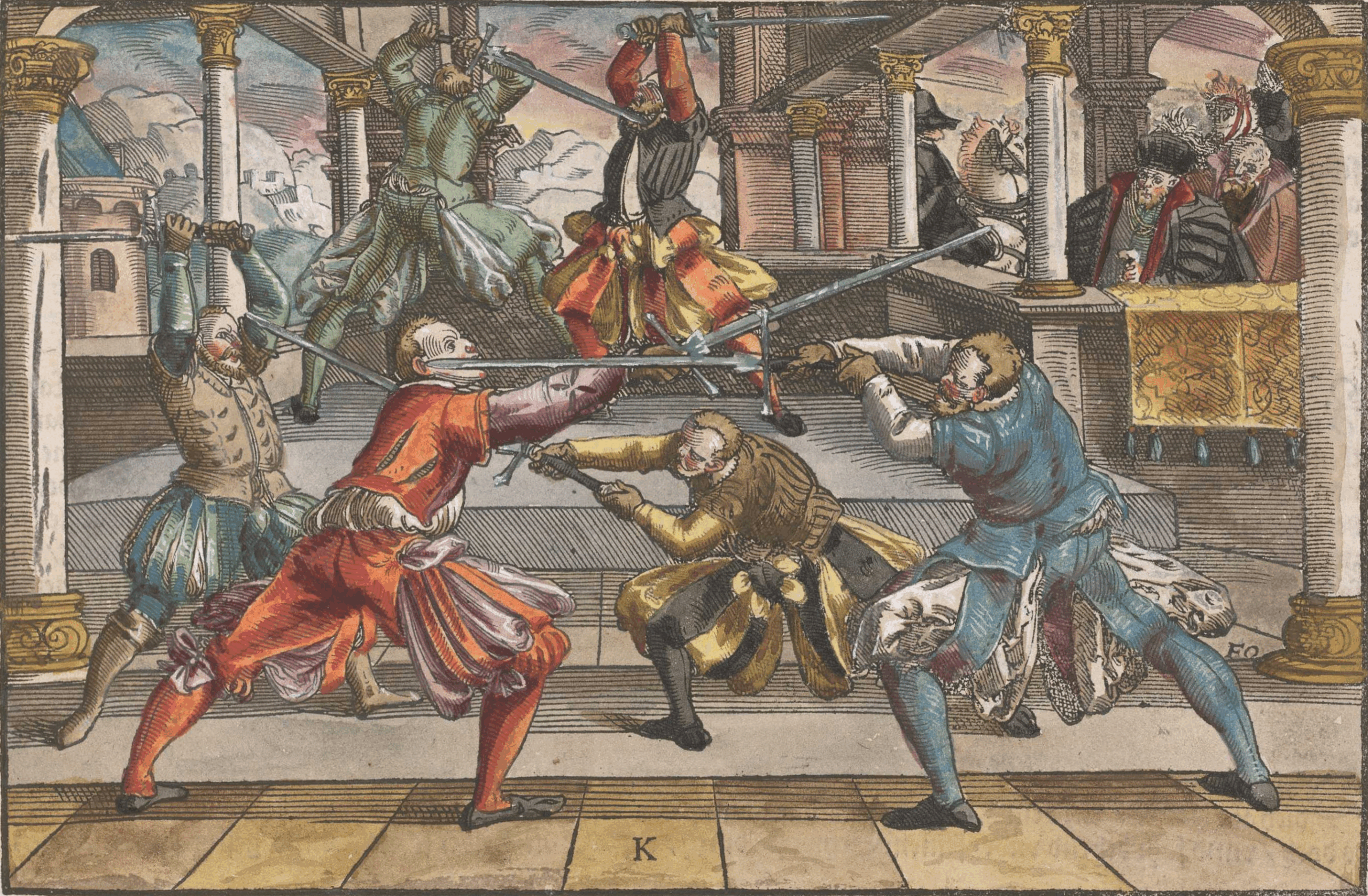
I think my stance is okay here. Of course, there isn’t just one Meyer stance. This image from Meyer’s treatise show the range pretty well:

Plate K from Meyer's treatise, showing fencers in various versions of a Meyer stance
Source: https://wiktenauer.com/index.php?curid=43906

The front two figures are both in what I think of as a basic Meyer stance. The two figures behind them are also in Meyer stances, the one on the right in something of a lunge, the one on the left in a more upright stance.

My drop swings clearly need a lot of work (do not copy mine!), but that basically comes along for free as I do the stance workouts. (I wrote a post called Fitness training for longsword, Mark Wildman style that embeds two Mark Wildman videos of the Warrior 2 stance mace drop swing, if you want to see someone doing it better.)

I’m doing the swings with my 5 lb mace. I have a 10 lb mace that I’ll want to move up to, once I have the drop swings a bit more under control.

Early in the pandemic I bought a set of gymnastic rings, started training with them, and got great results. They have a few downsides, though: Since I hang them up outdoors it’s no fun to us them when its cold or wet or windy. Also, the easiest place to hang them up (the basketball court) is kind of out in public. I don’t really mind people watching me workout, but occasionally it’s a little awkward.

Me at the top of an inverted row using gymnastic rings
I neglected to get a photo today, but this is pretty much what I looked like.

Especially during the winter, I’ve largely switched to steel club exercises. I can do them in my study, and they’re a similarly good workout. Besides that, they add an element of rotation which I find useful to support my fencing.

One downside of club (and kettlebell) exercises is that they’re really not practical to do to failure.

Exercise machines are great to do to failure. With little or no risk of injury, you can know that you’ve gotten the maximum stimulus to strength and hypertrophy. With kettlebells or clubs, training to failure means that a big steel weight goes flying out of your hands and into whatever happens to be in the vicinity—a terrible idea.

The rings are closer to weight machines. I use them almost exclusively for three different exercises: inverted rows, dips, and pull ups. Do any of them to failure and all that happens is you don’t finish a rep. I suppose actual gymnasts do various sorts of inversions and such, where it might be dangerous to fail a rep. That’s not an issue for me.

Anyway, this morning I got my rings out, put them up at the basketball court, and did a version of the same circuit I did many times over the past five years. I did three rounds of:

Jump rope

This was mainly just to get/keep me warmed up for the rest of the round. I did sets of 100 jumps, and was pleased to find that I could still do them with just one or two misses in a set.

Inverted rows

These are a way to work the lats. I’ll hope I can do pull ups again soon, but even then I’ll probably stick to inverted rows for half my lat exercises. I did sets of 8 rows to failure, which is exactly what I was going for.

Slamball hunter squats

This exercise comes from Mark Wildman’s slamball program. You powerclean a slamball, do a double-pivot to turn 90 degrees to one side, which leaves you in a stagger stance. Then you drop down to a hunter squat (about mid-way between a squat and a lunge), holding the slamball in front of you. Then you stand back up, double-pivot again to face forward, and drop the slamball. Then you repeat, pivoting the opposite direction.

I was doing it with a 15 lb slamball, which isn’t terribly heavy, but I was too lazy to carry my heavier slamball out to the basketball court.

I did sets of 6 to 8 reps (3 or 4 each direction), which isn’t enough to reach failure on my legs. I either need to do more reps or else bite the bullet and bring out the 30 lb slamball.

Dips

Somewhat to my surprise, I actually managed to do 1 dip! That was all I managed though, so I satisfied myself with doing negative dips for the rest of my reps. But if I can do 1 dip, being able to do sets of 3 or even 4 is not far off.

Hollowbody hold

This was easier than I’d expected, I guess due to the Mark Wildman ab exercise program I’d been doing for a few months now. I did a 45-second hold each round.

I did a total of three rounds, which is what I did for most of my rings workouts in years past. It felt like a legit good workout.

I’m thinking two of those workouts per week, plus two club workouts per week, plus two runs per week (a long run and a fast run), would add up to a great, well-rounded exercise routine. Of course, I’ll also want to do a fencing class as well, adding up to seven workouts per week, which is perhaps a bit more than would be wise, but I don’t see any alternative.