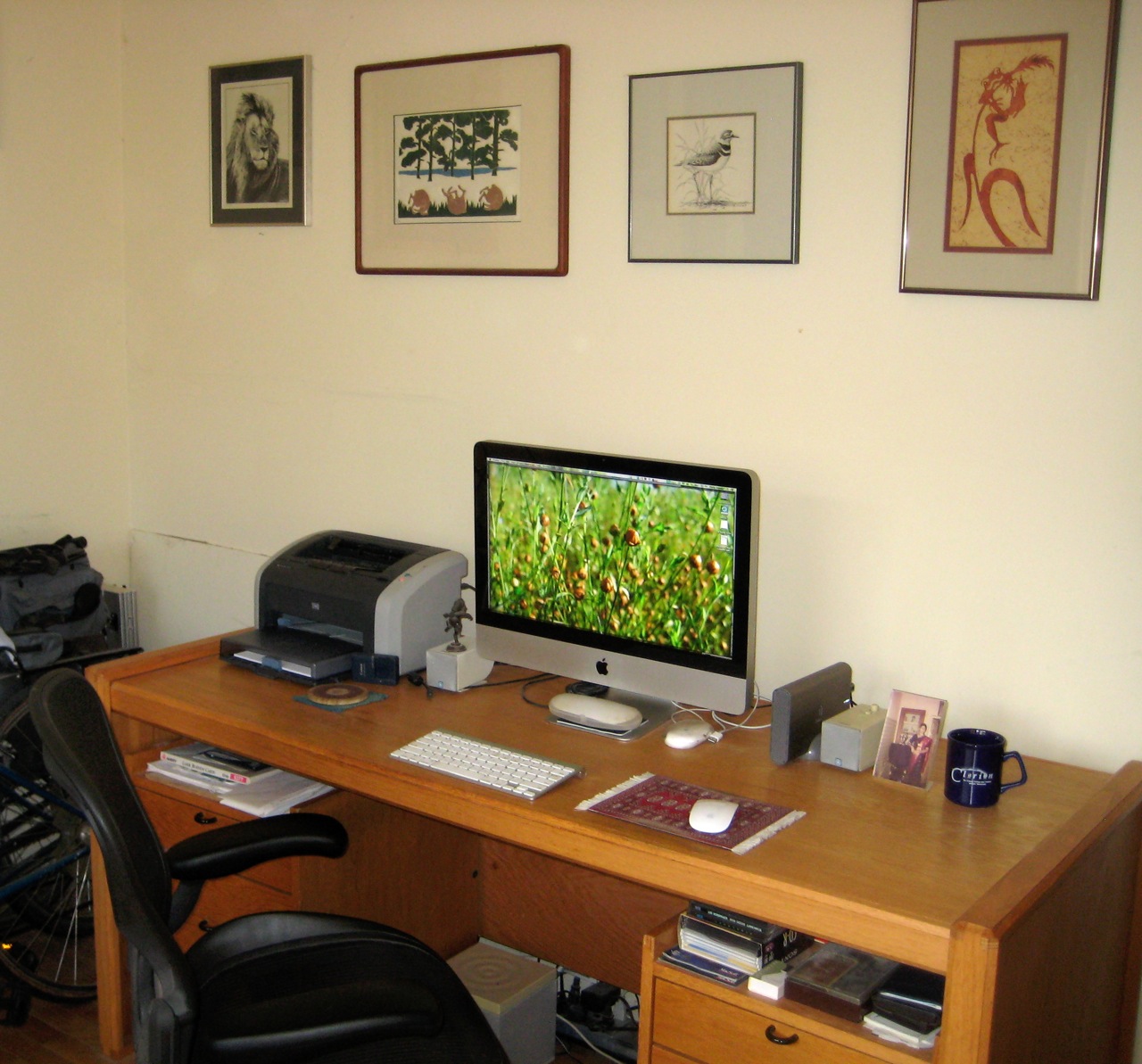
workspace-2013Jackie and I have been working on decluttering the study. We’ve been at it for 3 days now, off and on, and we’re making great progress.

My own focus in the initial phase has been on my workspace. I’m pretty pleased with where I am just now.

I almost didn’t post this picture, as it looks little different from other recent pictures of my workspace, but (on the theory of “pics or it didn’t happen”) I felt like documenting the fact that I’ve actually restored my workspace to its desired uncluttered state.

The area behind me is still not up to being documented. Anyone who had seen it any time before three days ago would be impressed by how much progress we’ve made, but there’s still stacks of boxes, a stack of books, and other clutter.

I think the clutter had been weighing on me, looming up behind me, making it harder to write. Hopefully, this will help.

I’m a huge fan of a particular sort of scenes in stories—the scenes where the hero gets into shape.

I was reminded of this recently, after reading Greg Rucka’s Critical Space, a thriller I read after it was mentioned by Marissa in a recent post, which has an excellent instance of this sort of scene. The getting-in-shape sequence in this book takes the form of a montage (much as you might see in a movie with such a sequence) written in second person. You swim. You run. You do yoga and ballet. You take supplements and you eat lots of fruit. You lift weights. You see the changes in your body. You learn to be an assassin.

I have long been a fan of these scenes, both in books and movies. They’re a key part of the original Rocky movie, of course, and are practically all there is in Rocky III. I’m especially fond of the getting-in-shape sequence in the book Man on Fire by A. J. Quinnell, and I’m still bitter that the movie completely omitted the sequence. (Easily the best part of the book.)

A lot of sf and fantasy stories have versions of these. For example, Steve Miller and Sharon Lee’s Liad books often have characters learning a martial art. In these, as in a lot of fantasy stories, the hero or heroine often turns out to have an especially high level of natural talent for the art. I view this as a negative—it’s more interesting to me when the hero lacks any extraordinary skill, but manages to excel through hard work. Patrick Rothfuss’s Wise Man’s Fear does a particularly good job in the scenes where the hero learns a taiji-like martial art. Instead of the hero having preternatural talents in the area, his success comes from seizing an opportunity (and, of course, having preternatural talents in other areas).

A whole genre of its own is the boot camp story, where the heroes not only become fit and learn a lethal skill, but also learn something about teamwork and camaraderie.

Anybody out there like these sequences as much as I do? Can anybody point to books or movies with particularly good instances?

I think the first advice I ever got from a writer about writing was that I should write every day. It’s also probably the best advice. It’s certainly the most common. In any case, it’s advice that I accept.

Writing daily is good for many reasons.

First of all, it means that you’re making progress. That’s all it takes to eventually get to the end. If you write just one page—250 words—each day, then in less than a year you can write an 80,000 word novel.

Second, you’re making it a habit. I find it a habit that’s easy to keep, if I just do it. Even on the busiest days I can squeeze in a few minutes of writing. But once I decide that it’s okay to skip a day to handle some other major task or allow for some schedule conflict, I find that writing “almost” every day is a much easier habit to let go by the wayside.

Third (and this seems especially the case for writing a novel in particular), you’re inhabiting the world you’re writing about. As long as I’m writing every day, the characters remain fresh, their world remains alive, their situations remain immediate. If I wrote yesterday, I’m vastly more productive today than if there’s been an interruption.

I wrote a while back about the difference between writing every day and exercising every day, because I think they’re very different. Exercise is about stress followed by recovery. You can exercise every day, if you’re smart about making sure that each day’s exercise activities allow for recovery from the previous day’s exertions. In running, alternate long runs with short runs. In lifting, alternate upper-body with lower-body.

It may be that reason number 2 (making it a habit) is a good enough reason to create an exercise schedule that allows for daily exercise, but I don’t think it’s important for creating a successful fitness regimen. It’s perfectly possible to get fit exercising just three or four days a week.

But I think reason number 2 is the least important reason why writing every day is important. Reason number 1 (making progress) is more important. It scarcely applies to fitness. (It’s not like you’re ever going to be done with fitness the way you can be done writing a novel.) And reason number 3 (inhabiting the world of your story) doesn’t even really have an analog in fitness.

This post was prompted by the recent post by my Clarion classmate Beth Adele Long, who has started a public effort to write a novel by writing daily.

But I’d already gotten myself back to daily writing some days ago: since January 21st, I’ve worked on my novel every day. Early on there was day that I only managed to get 41 words written, but I got those words and hundreds more each day since then. All together, I’ve written almost 8000 new words since getting back to daily writing—a tenth of a novel right there.

I’d written the first quarter of a novel some months ago (writing daily most of that time) and then stalled out when I discovered that the middle of the novel was terribly dull. I’ve spent the months since then figuring out where I’d gone wrong, and I don’t think I’m going to have to throw away much of what I wrote. I’ve got most of the already-written part whipped into shape and (I think) I’m ready to jump in on the next part and write the middle of an interesting novel.

So, one question is, if I hadn’t let the fact that I was writing a dull middle of a novel stop me a few months ago, would I be ahead now? After all, I could have written 165,000 words of dull middle in that much time—and very possibly I could have figured out where I’d gone awry sooner than I ended up figuring it out.

On the other hand, in that time I finished two short stories and got them out to markets.

So, I don’t have an answer there. But I am back at work on my novel, and I’m once again writing daily.

For the first time in far too long I finished a draft of a story and sent it out to the Incognitos and a couple other first readers.

The working title of this story is “the demon story” and it is special in that it is by far the oldest story still in my “active” folder. It has its roots in the very first story that I started working on when I started seriously trying to write fiction for the pro markets, back in the 1990s. I have versions of this story dating back to 1995.

It’s also unusual in that it’s the only story that I’ve finished a draft of and then neither submitted nor abandoned.

The usual advice—almost universal advice—is that you not endlessly rewrite the same story. You’re almost always ahead of the game to simply write the best story you can, finish it, start submitting it, and then go on to something new. At some point, if you can’t produce a submittable draft, your time is almost certainly better spent working on a story that you can finish.

For this story, I’ve made an exception. I like it too much to submit a version that doesn’t work.

However, I’m done with it for now. Hopefully, the critiques will tell me that it’s nearly working, and give me a few tips for improving it. If so, it’ll go out to editors very soon.

With a lot of my relatives—parents, in-laws, aunts, uncles—a generation older than me, I’ve started to hear a good bit of short-term thinking. People are talking about doing things “one last time.” People are giving up on long yearned-for possibilities, deciding that there is no longer time to see them through to completion. In the prioritization of projects, people are contemplating that only a handful of top priorities will ever get done.

Worse, I’m finding myself doing that. A few things that I’d always thought I’d do “someday” are beginning to seem unlikely. So far it’s a very few, but it’s more than none.

I’m resisting that sort of thinking as premature, and I have a powerful first-hand experience with premature short-term thinking, that’s turning out to be a big help.

My first car was a VW GTI. I bought it new in 1983. For the first several years I owned it, I made a point of fixing everything that broke, including some trivial little details. This was in large measure a reaction against the way the cars I’d driven up until then had been treated. Their owners (not me) had evaluated each defect as to whether it needed to be fixed for the car to provide safe, reliable transportation. Repairs that didn’t make the cut were evaluated again, against a complex array of criteria—esthetic, comfort, cost, convenience—and those that didn’t make the cut didn’t get fixed.

In several cases, I was the primary driver of the vehicle, but my input into whether this or that defect made such an impact on comfort as to be worth fixing seemed to be treated as a relatively small factor, often outweighed by someone else’s (the owner’s) largely theoretical sense as to whether the impact on comfort justified the cost.

Now, finally, I was the owner of the car, and earned enough money to afford the repairs. I chose to fix everything that needed fixing.

This lasted until the second time a repair failed. The vent windows (I hardly expect anyone younger than me to even remember what vent windows were) were glued to a piece of metal attached to a shaft about which they could rotate. The glue failed. I had them repaired, but the glue failed again. I had them repaired again, and once again the glue failed.

I believe it was that failure, when the car was probably only barely 2 years old, that prompted me to begin measuring every repair against cost and convenience.

When the car was 4 years old, and the loan was paid off, I started letting certain things slide. I think I had a mental target that I’d keep the car for another 4 years—so that I’d have owned it for as many years after it was paid off as I’d spent paying it off. Certain problems just seemed like they weren’t worth fixing, if I was only going to own the car for another few years.

Except that I ended up keeping the car for 17 years.

I remind myself of that, whenever I find myself engaging in short-term thinking more appropriate for people a generation older than me. I try to provide that perspective to my older relatives as well. If you haven’t yet been diagnosed with whatever is going to kill you, there’s every reason to figure that you’ll live for decades to come.

Medicine has not yet made much headway against the fact that nobody makes it past 114, but with so many baby-boomers moving into their late 60s, a whole lot of money is going to get spent on exactly that problem. You can’t count on making it to any age, but you’re making a mistake if you make plans that don’t include the possibility of living to 114, and maybe beyond.

Stick with long-term thinking. I’d have been a lot happier with my car, if I’d spent a few hundred dollars getting things fixed, and I’d not have regretted any of them. I don’t even really regret the $1500 I spent getting the front axle repaired about a year before I ended up selling the car for $300.

Siam Dragon Peppers
Siam Dragon Peppers
We keep harvesting them, but every time we return to the garden a few more of our Siam Dragon Peppers are ripe.

I like to joke that I no longer multitask at more than one thing at a time.

Related to that, I recognized years ago that a certain amount of monomaniacal focus was really useful for successfully completing a large project (such as a novel), but that being able to focus on more than just one thing was important to being more broadly successful.

This is all the more true if you want to accomplish more than just one thing (if you want to, for example, write a series of Wise Bread posts, write an occasional short story, and become physically fit, in addition to writing a novel). And yet, each one of those things requires focus, if I’m to accomplish it.

Basically, I need to be able to be monomaniacal about three or four things at a time.

Like most people, I find that I get caught up in whatever I’m doing, both on a minute-to-minute basis and a day-to-day basis.

On a minute-to-minute basis, when I’m writing something, and especially when the writing is going well, I want to press on. I feel this way, even though I know from both things others have said and personal experience, that it’s always best to stop in the middle of things—to leave a ragged edge, so that I return to the work with a clear entry point, already knowing how the next bit goes. Convincing myself to do this routinely would really help with being monomaniacal about multiple things: I’d be quicker at ending the first thing so I could switch my focus to the second, and I’d be quicker at resuming the first thing when I came back to it.

Just lately, my day-to-day monomaniacal focus has been on running. I don’t run every single day, but I’ve had to make it the first thing I do on the days that I do it, because otherwise it’s too hot to run. It’s been working very well for building fitness, but doing it first has tended to result in it preempting my writing.

I’m not quite sure why. Partly it’s because a good workout leaves me feeling tired. Partly it’s because a good workout leaves me feeling like I’ve accomplished something (so I’m less driven to accomplish something more). Partly it’s just that I’m only at my best first thing in the day, so whatever I do first always ends up being the main thing I do that day.

Once there’s a break in the heat, I want to get back to writing first of all. If I can put that together with taking a fairly early break (leaving the work paused at a ragged edge) and then running (or walking or bicycling or lifting or doing taiji) and then returning for a second session of writing, I think I’ll be more productive at the writing without any loss of success at the fitness thing.

Exactly on topic for the above is Tobias Buckell’s latest meditations on designing a daily routine that provides both writing time and exercise time, while also allowing him to work on different aspects of his work at whatever time of day he’s most effective at that particular thing. Toby is a great writer, but he’s an absolute genius at measuring his productivity and then using that data to tweak his work habits.

I need to improve my own data collection. I already track my productivity at writing, but I need to get a bit more fine-grained about it and track productivity per work session (rather than per day). I’m sure I’m most productive in the first session of the day, but I don’t have any evidence, and I certainly don’t know how much less productive I am during the later sessions, nor to I know whether my productivity declines less if I work on non-fiction (or editing, or research).

The picture, by the way, has nothing to do with this post. I just thought the blog needed another picture, and I’d brought the camera to the garden today.

I told Jackie, “I want to get a slug of fiction writing done, and then take a nap.”

She said, “Does fiction writing naturally come in units of slugs?”

And I said, “Yes. The slug is the natural unit of fiction writing.”

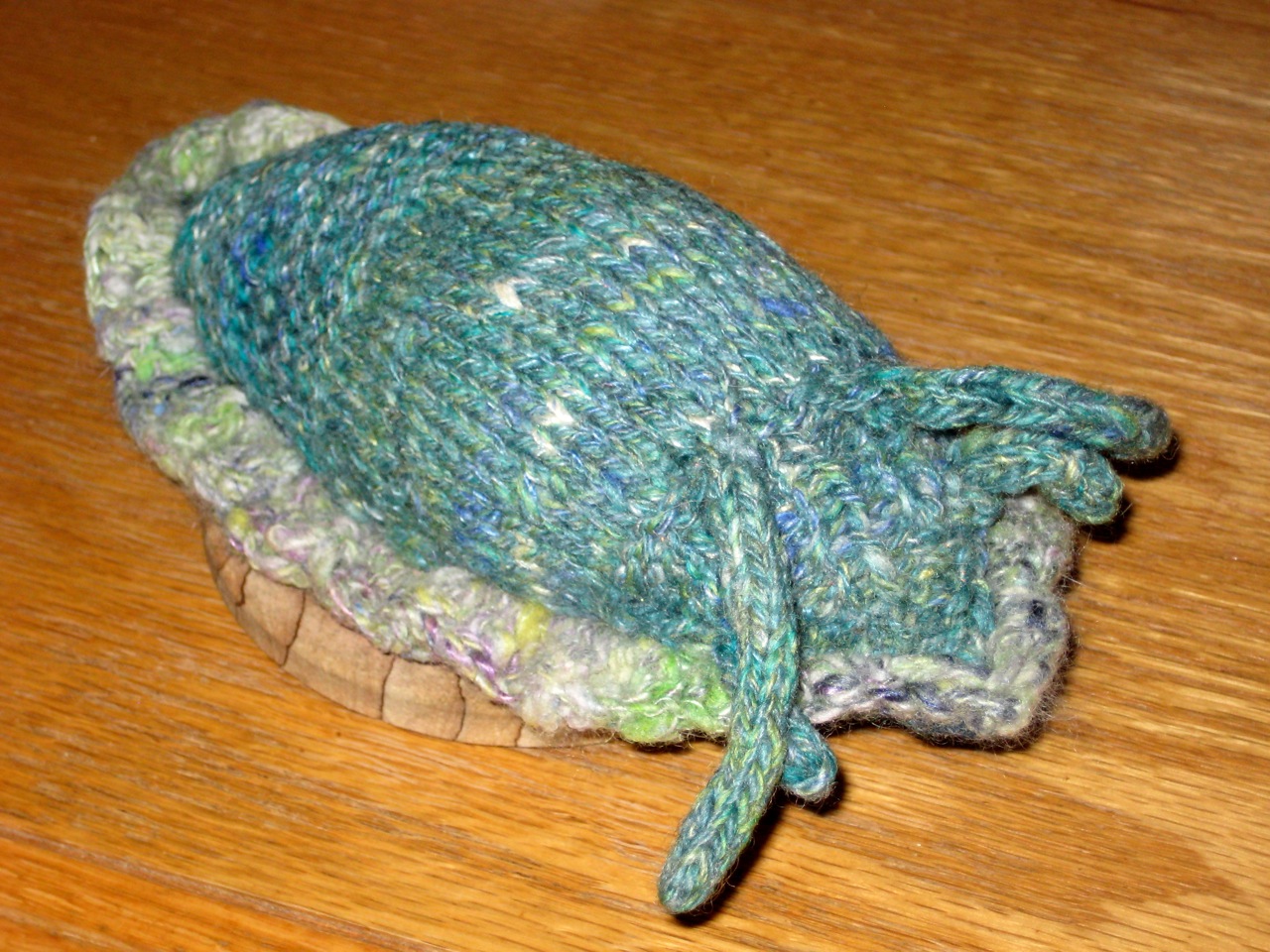
So she said, “Well then, you should be sure to bring along Sigurson.”

So I went and got Sigurson to sit with me while I work on the next bit of this story.

Here’s a picture of Sigurson, sitting on a spare coaster on my desk:

Update: I wrote 745 words. Didn’t get a nap, though.

I’m a student of daily routines. I like to imagine that I’m looking for good models for my own behavior, but that’s only true in an oblique way. By now I understand pretty well the structure of a productive routine; no new routine will be enough better than the routines I’ve already studied to justify the effort of examining them. The value in studying daily routines, for me, is as a reminder to follow my own routine.

For a while there was a great blog called Daily Routines that was very nearly pornography for this inclination of mine to ponder new models. It was there that I found the daily routine for Charles Darwin, which is probably the best model I’ve found so far.

And it is in part because of its similarity to Darwin’s model, that the daily routine of Vestricius Spurinna caught my eye:

At the second hour [after waking] he calls for his shoes and walks three miles, exercising mind as well as body. If he has friends with him the time is passed in conversation on the noblest of themes, otherwise a book is read aloud….

Then he sits down, and there is more reading aloud or more talk for preference; afterwards he enters his carriage [for more private conversation].

After riding seven miles he walks another mile, then he again resumes his seat or betakes himself to his room and his pen. For he composes, both in Latin and Greek, the most scholarly lyrics. They have a wonderful grace, wonderful sweetness, and wonderful humour, and the chastity of the writer enhances its charm.

When he is told that the bathing hour has come—which is the ninth hour in winter and the eighth in summer—he takes a walk naked in the sun, if there is no wind.

Then he plays at ball for a long spell, throwing himself heartily into the game, for it is by means of this kind of active exercise that he battles with old age.

After his bath he lies down and waits a little while before taking food, listening in the meantime to the reading of some light and pleasant book. All this time his friends are at perfect liberty to imitate his example or do anything else they prefer.

Then dinner is served…. The dinner is often relieved by actors of comedy, so that the pleasures of the table may have a seasoning of letters. Even in the summer the meal lasts well into the night, but no one finds it long, for it is kept up with such good humour and charm.

The consequence is that, though he has passed his seventy-seventh year, his hearing and eyesight are as good as ever, his body is still active and alert, and the only symptom of his age is his wisdom.

– (From a public-domain translation of the letters of Pliny the Younger.)

Of course, Spurinna was retired, so one writing session of just an hour or two is probably enough for him. His work when he was younger was as a magistrate and governor, and so probably took place in those conversation sessions that are now just for pleasure.

I think there’s a lot to emulate there. Three walks per day adding up to five miles seems just about right—as long as you include another hour or two of vigorous sport. Of course, he’s in his late seventies. Us younger folk should probably get in a little more than that.

One of my Clarion classmates, Nnedi Okorafor, tweeted today wondering why sometimes authors won’t just say what race a character is. I doubt if she was thinking about me, but I’m one of those writers who is sometimes coy about a character’s race. My answer won’t fit in 140 characters, so I thought I’d write a post.

The most common instance when I do this (just provide physical descriptions, rather than stating a racial identity) is when the viewpoint character doesn’t know the answer.

This is pretty common in real life. There are plenty of people I know whose ethnic heritage is not at all obvious just from their appearance. You’d have to ask.  And these days, I hesitate to ask—some people take offense at the question, and others are simply tired of answering. So, just like in the real world, my characters often don’t know the ethnic heritage of other characters. Sometimes they’ll speculate. Other times they won’t.

The other common instance when I do this is when the whole cultural background thing is complex enough to be a distraction from the story. A character of South Asian heritage might be one whose ancestors had immigrated to Uganda but whose grandparents had been expelled and moved to England. But for story purposes I might decide that all I want to say is that she has straight, dark hair and speaks with an English accent.

Finally, what I’m working on right now is a far-future story where humans have spread to a hundred worlds. Even when they know where on Earth people had a particular skin color, they know no more about the paths their various ancestors took than I know about mine. (I can point to some English, Irish, and Dutch—but there’s reason to believe that one of my male ancestors came from somewhere around the Mediterranean, or maybe Sarmatia.)

I do have one unfinished story where I play around a bit with ethnicity, because the viewpoint character was raised to be interested in it. Due to his background, he’s much better at it than I am, able to look at people and perceive that this one is Celtic, that one Igbo, another Chettiar. It was fun to write those bits, but it got to be a bit much to be just a quirk of the character, without managing to rise to the level of being a powerful driver of the story.

I use a trick for getting into flow state.

Anybody who does creative work knows about flow state, where your surroundings vanish and for a timeless period you’re creating whatever is you create. If you’re a writer, the words just, well, flow.

Many writers have some sort of process for achieving flow state, such as a pre-writing ritual, or a specific place or specific set of tools that they reserve for their creative work.

I’ve seen working writers mock these techniques—making fun of the writer who needs the right kind of tea in the right special cup and the right ink in the right fountain pen before they can write. And I do see the mocking potential. But I find having such a process is highly effective in speeding the process of getting into flow state.

The key here is speeding. If your pre-writing ritual takes twenty minutes, it’s not likely to be faster than just starting to write. (Which is, after all, the only essential step.)

But some very short ritual, or some special place or object, if you start using it when you’re working, will become associated with entering flow state. And once it has become associated, just following it or having it or using it makes it easier and quicker to enter flow state.

In my case, it’s a vest that Jackie made me. I reserve it just for fiction writing. Having written a lot of fiction wearing that vest, just putting it on puts me in the frame of mind that I’m going to write fiction.

I can write without it. I probably write more without it than I do with it. But especially when I have only a short period of time to write, it’s worth the 30 seconds it takes to put my vest on when I sit down to write.

[Update: I just remembered that I’ve mentioned my writing vest before, in my Clarion journal, in reference to Steven Barnes talking about learning to enter flow state.]