When I was a kid or a teenager, my skin would heal from minor scratches almost immediately. A scratch (like from walking through brambles, which I did all the time) would heal up in maybe a day and a half or two days. Then, sort of all at once, when I was about 24 or 25, suddenly it took twice as long. I noticed it when I was living in Utah and hiked a lot in the mountains and deserts, and would get similar scratches, which would now take three or four days to heal.

I figured I was just getting old, and it would just keep getting worse. But it did not. Instead, it stayed like that for thirty-five years. However, just in the past year or two—since I reached my 60s—I’ve observed a fresh doubling in wound-healing times. Now a minor scratch takes a week to heal.

The surprise here is not that the speed of healing declines as one gets older, but the weird stepwise nature of the change—stability for decades, and then an abrupt doubling in time to heal.

I don’t know if that will continue. Maybe I’ll continue to heal at this rate until I’m 105 or so?

I’ve documented this largely for my brother, who once expressed appreciation for the fact that having an older brother gave him a four-year heads-up for this sort of age-related change. (I’m not sure he appreciates it as much now as he did in his 30s and 40s.)

I looked for some research studies as to whether my observation points to a more general phenomenon, but wasn’t able to find much. My brother found a study, which says in part:

The rate of epithelialisation appears to be different in older persons, but the magnitude of the delay may not be clinically important.

THOMAS, D. R. Age-Related Changes in Wound Healing. Drugs & Aging, [s. l.], v. 18, n. 8, p. 607–620, 2001. DOI 10.2165/00002512-200118080-00005.

I guess, as long as you do eventually heal up, the length of time it takes is “not clinically important,” but it’s still kind of a drag to be wounded for week(s).
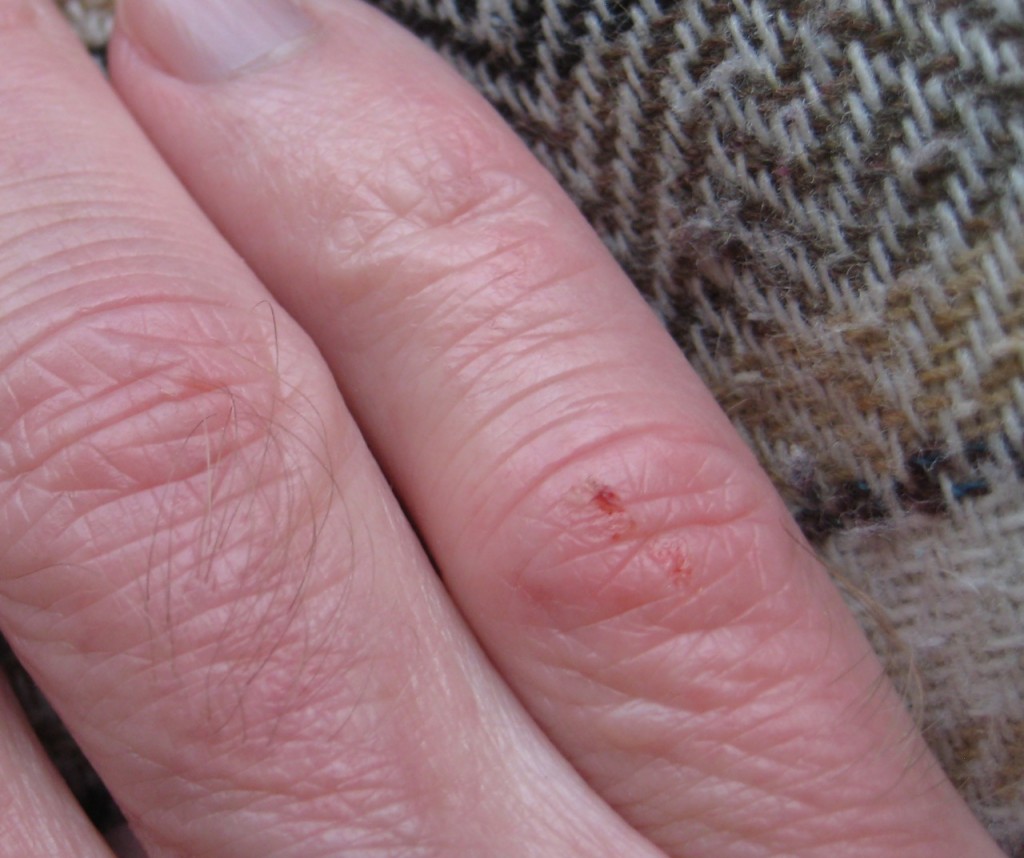

The sort of scrapes that are now taking longer to heal than they used to.

For some time now I’ve been groping toward more “functional” workouts, focused on developing actual useful capabilities—walking & running, crawling, lifting & carrying, balancing, climbing, jumping, throwing, catching, etc. (This in contrast to workouts that focus on capabilities that enable those things, such as pull-ups and dips which help enable climbing.)

This introduces certain complexities into my workouts. Skills-based activities need to be practiced at the start of a workout, when I’m fresh enough to do them with the sort of attention that lets me improve my skills. Likewise, any exercise that involves heavy weights, and any exercise that involves complex multi-joint motions, also needs to be done at the start, to minimize the risk of injury. That’s all well and good, but you can only put so much of a workout at the start before you inevitably find yourself in the middle. And then, what do you put at the end?

Well, one thing you can fairly safely put at the end is MetCon (metabolic conditioning) activity. Today I tried out such a MetCon circuit, with an eye toward doing something similar after my more skills-based workouts.

Kettlebell, jump rope, slamball

The workout was circuits of:

  • Kettlebell swings (53 lb) x 25 swings
  • Weighted jump rope (½ lb) x 60 jumps
  • Slamball slams (15 lb) x 15 slams

I’ve done something similar in the past with 45″ work followed by 15″ rest (and then 2–3 minutes rest between rounds). Today I didn’t feel like fiddling with the timer; I picked those rep counts to hit about the same 45″ duration for each set.

I repeated that circuit for 4 rounds, which took just over 22 minutes. I followed it up with a short suitcase carry of the kettlebell—just one circuit of my patio slab with the kettlebell on one side, and then again with the kettlebell on the other side.

It was a good workout.

Now the question is, can I first do a more skills-based workout and then follow it up with a MetCon circuit, without exhausting myself? If I can make that work, I’ll be a little closer to designing the functional training program that I’m working on.

I just wrote a post about “superhero” workouts, mentioning Anthony Arvanitakis’s Superhero Bodyweight Workout which I did last year. I plan to do it again this year, and this post is about a handful of specific issues I had with the plan last year, and how I’m planning to rejigger things to deal with them this year.

There were a few exercises that I couldn’t quite do—not because I lacked strength or endurance, but just because there was a skill component that I couldn’t master quickly enough to go full-power through the 8-week training program. Here are the specific exercises I identified as ones I had trouble with:

  • Prone angels with weights: I’d never done this exercise, and found it quite challenging. Now though, I’ve spent the winter doing it without weights as part of my morning exercises, and I’ve just in the past couple of weeks started adding in weights. I think I’ve got this one sorted.
  • Superhero (i.e. one-armed) planks: Similarly, I’d just never done one-armed planks, so I needed to develop a bit more core strength for anti-rotation to be able to 30-second holds on each side. (This one I haven’t been practicing all winter, but I’ve just now checked and managed 20-second holds on each side. I’m sure I can get to 30 seconds in short order.)
  • Pike push-ups: Another novel exercise for me, where most of the issue was just not knowing how to do it. I started doing it about once a week along about mid-winter, and I think I can do it okay now (although I should probably get Jackie to do a video of me doing it so I can look and make sure I’m doing it right). 
  • Jumping lunges: This one I can’t do at all. For some reason, lunges were just not one of the moves I learned as a child. (Maybe my Phys Ed teacher thought they were bad for your knees or something.) Anyway, I’ve been trying to learn how to do lunges literally for years now, and have just barely gotten to where I can sort of do a wobbly lunge. I tried last week to do a jumping lunge (where you drop into a lunge and then jump into the air and switch your legs around so that you land in a lunge position with the opposite feet forward and back). It wasn’t as bad as a near-death experience, but it was not a success either. Fortunately, this exercise is always offered as an alternative to uphill sprints (preferred), box jumps, or burpees, so I can just pick one of those.

Besides those specific exercises, there are two other issues I had trouble with last time:

  1. Supersets of pull ups and inverted rows. There’s a logistical complexity here because (if you’re doing them with rings) you have to adjust the ring height very quickly. (Otherwise it won’t be a superset, but just two regular sets.) I’m trying to come up with a plan to address that either by getting more practiced at quickly adjusting the ring height, or else by finding a workout location with a bar at either pull-up or inverted-row height (so I can just set up my rings at the right height for the other exercise and switch between stations).
  2. Pyramids (both dip/push up and pull up/row). The first few times I do a pyramid (or ladder) workout, I find it pretty easy to misjudge where I’m going to reach failure, and the exercise is more effective if you don’t unexpectedly hit failure halfway through an early set—something that happened to me several times. This year before I start I want to do enough sets of these to get a good sense of what the right rep count is going to be, so that I know what I need to do to hit failure only during the last set.

Last year I started in late May (when Anthony released his latest version for the program and led the program). That was fine, but this year I think I’d like to start earlier in the spring—just as soon as we get reliably nice-enough weather for me to have some confidence I can put my rings up nearly every day.

It’s an eight-week program, so it would be nice to start around the first or second week of April. Then I’ll have my superhero body by the beginning of June.

Where I’m starting from