

My workouts these days have tended toward circuits, and each circuit usually ends with a core exercise—often hollow-body holds. When I workout under the sycamore tree, this is what I see during that exercise. 🏋🏻♂️ #mbaug

My workouts these days have tended toward circuits, and each circuit usually ends with a core exercise—often hollow-body holds. When I workout under the sycamore tree, this is what I see during that exercise. 🏋🏻♂️ #mbaug
Looking at my “readiness” score for today I’m perhaps slightly less ready than I was five days ago, when I let my Oura ring mislead me into postponing a rest day in favor of some hill sprints.
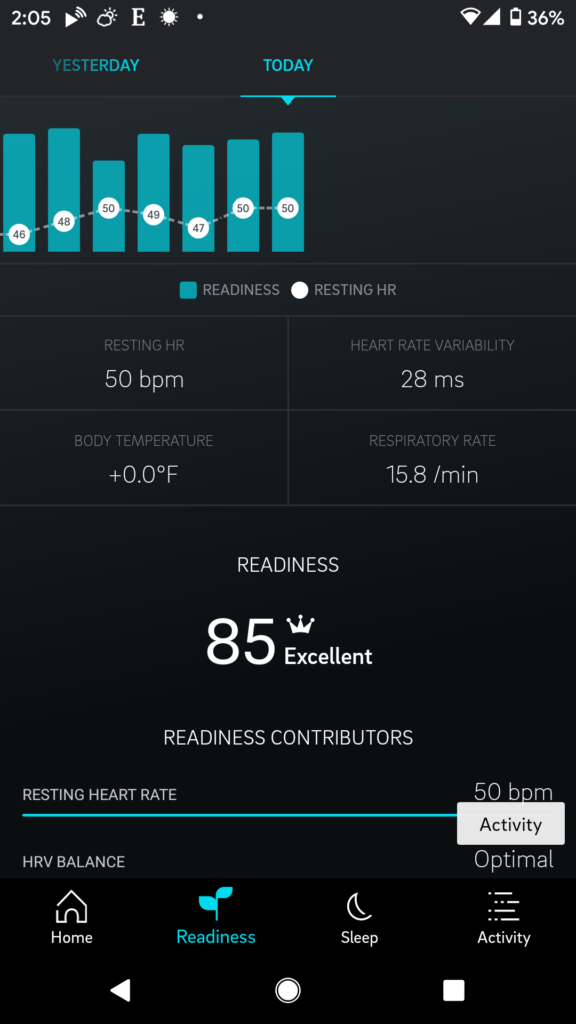
In fact, I felt enormously better today, and my performance shows that. Today’s run was a bare one minute longer than my run at the beginning of the week, but I ran a full mile further:
[sgpx gpx=”/wp-content/uploads/gpx/Philip_Brewer_2020-07-31_08-49-32.GPX”]
I’m not sure there’s anything to learn from this. Maybe “don’t skip rest days” would be a good start. I’m sure “listen to your body” is always good advice. Whatever lame platitude you want to go with is fine with me. As for me, I’m just glad I got in a good run.
In other news, the replacement kettlebell for the one I ordered on July 1st, but which vanished into some black hole at FedEx’s Ellenwood, GA location, only to vanish itself in exactly the same way, seems to have been discovered, and is now supposed to be delivered next week! We shall see.
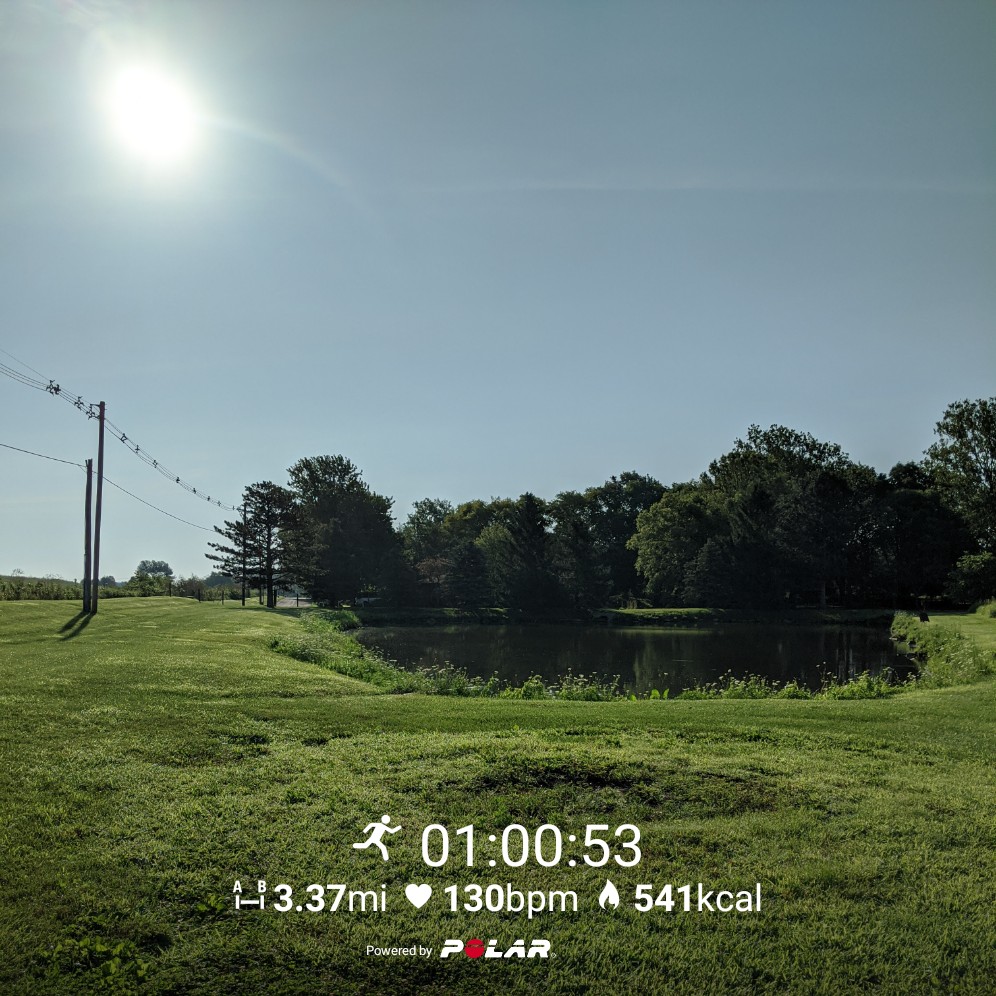
My Oura ring produces a “readiness” score each day, and I’ve found it to be a pretty good indication as to whether or not I’m up for a long run or a hard workout. The times I’ve ignored it when it said I needed to take it easy, I’ve often found it was right and I was wrong. Today was a rare instance of the reverse.
According to my plan, today should have been a rest day. But I wanted to go for a run.
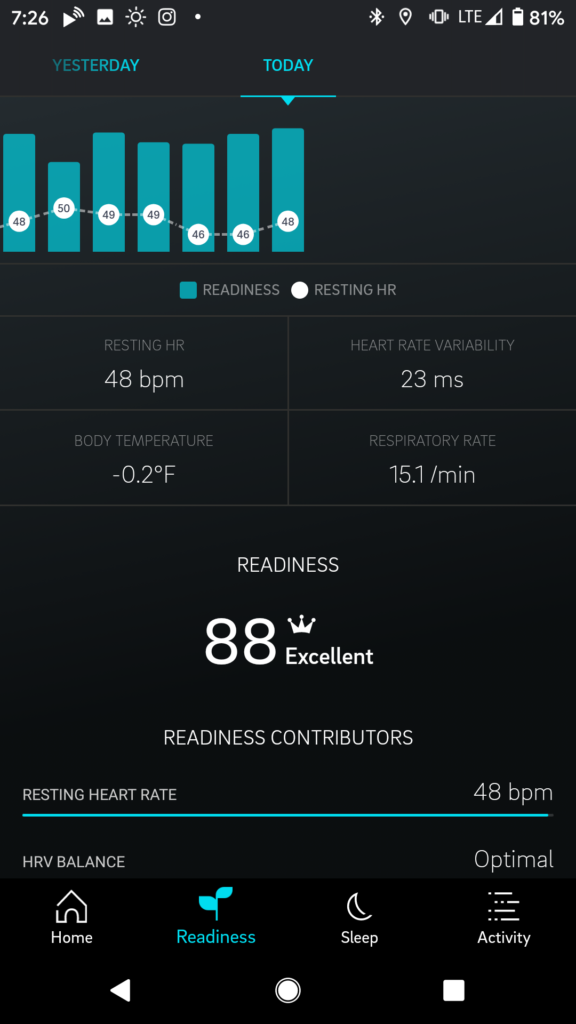
The ring gave me a readiness score of 88 (out of a possible 100), which is rather above my average (my average this month has been 80), and I took that as a license to go for the run I wanted, instead of taking the rest day my plan suggested.
Turns out—this time—my plan was right and my ring was wrong. I went for my run, but I felt tired and sluggish throughout.
It wasn’t a catastrophe. I didn’t hurt myself. I just don’t think I did myself much good. I ran to Colbert Park, did three hill sprints (in actuality, feeble jogs), and then ran home again. But I didn’t have any oomph behind the sprints, so I don’t expect they’ll have done their job in terms of boosting leg strength or aerobic capacity.
The Oura ring’s readiness score has been a very reliable indicator for me—which is why it helped me fool myself this time. So this is a good reminder to me to interrogate all of the factors that go into making a workout decision—my plan, my intuition, my ring, etc.
So one thing I’m doing is looking back at the factors that feed into the score, looking to see if there’s one that looked better than it really was.
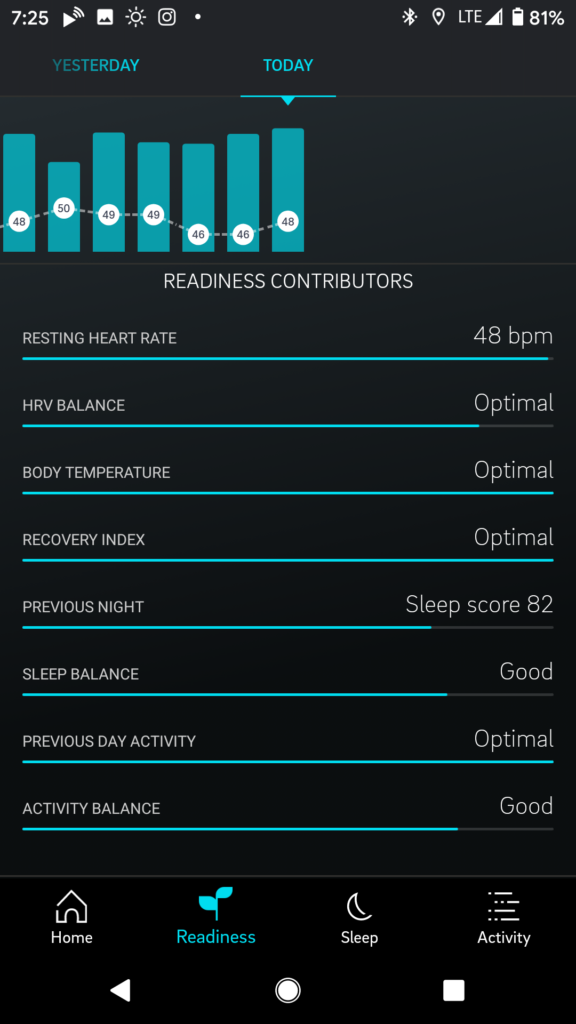
Nothing really jumps out at me. Given the same information, I’d also figure that I was ready for a hard workout. (In fact, I had that information, plus my own sense that I felt ready for a hard workout. That’s exactly how I overrode my plan and went out for a tired, tiresome run.)
Oh, well. Insert your own pithy “live and learn” aphorism here.
Ran to Jones Park and did a couple of almost pull ups (chin to bar, but not over bar), brachiated just a bit, then ran on home. 🏃🏻♂️
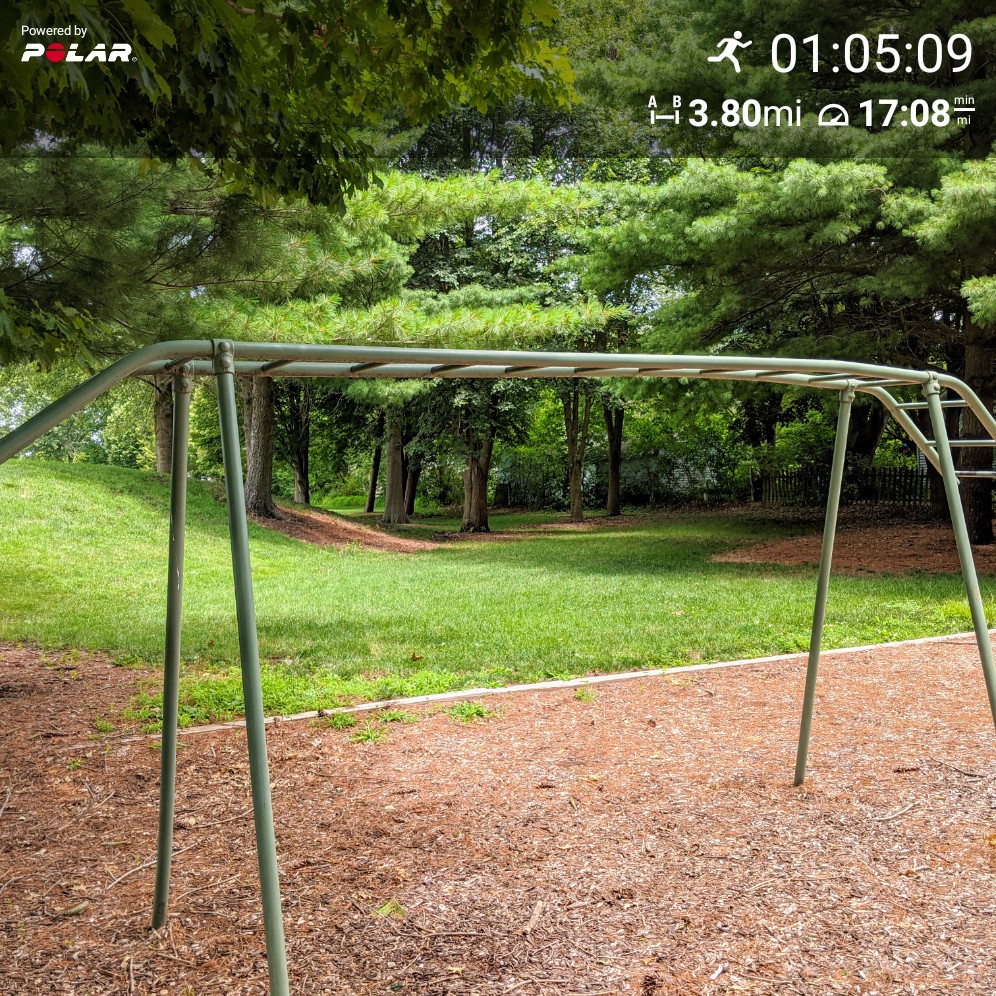
#PolarBeat
I’ve been working on dips for a while, but not with great consistency until just the past three or four months.
For a long time I was doing bench dips (where you put your hands behind you on a bench, stretch your legs out in front of you with your heels on the floor, and then push with your hands to raise your hips up to the level of the bench), to try to get my triceps strong enough to do real dips. In the fitness room there are some bars that can be put on the squat rack so you can do bar dips. I wasn’t really strong enough to do a good bar dip, but I’d sometimes do partials or negatives.
For parkour, you want to do wall dips, but I don’t know of any good chest-high walls in Savoy, so I haven’t practiced those in a long time.
Since I got my gymnastic rings around the end of March, I’ve been working pretty steadily on ring dips. (Which are much harder, because while pushing yourself up you also have to be able to stabilize your body.)
I’ve been following pretty much the usual progression—working on just a ring support (where you hold yourself in the top position for a dip), on negative dips (where you just lower yourself), and on partial dips (where you lower yourself only part of the way down, and then back up).
I’ve been gradually increasing the range of my partials, and a few days ago I thought I was doing a full, proper dip. I wasn’t really sure though—there aren’t any mirrors out under the sycamore tree where I hang my rings. So today I got Jackie to come and video me, so I could watch what I was doing:
I think those first two—especially the second—are legit dips. (The third, of course, is just a negative.)
I’d heard this, but I’m not sure I really believed it.
I’ve been running in “barefoot” shoes for a good 5 years now. The improvement in my gait was dramatic and immediate. But serious barefoot advocates are very firm about the point that it’s only when you run with actual bare feet that you acquire the huge upside that comes with barefoot running.
Reduced injury rates (due to the improved gait) are one of those upsides. Increased running efficiency (due to the improved gait, but also due to not having to carry the weight of a shoe on each foot) is another upside.
But there are alleged to be further sources of improved efficiency that come from barefoot running. When you’re actually barefoot, you’re going to hit the ground much more gently (because without cushioning it would hurt to hit the ground hard). Your foot is going to hit the ground with zero forward velocity (because if your bare foot slides along the concrete, the friction will cause blisters almost immediately).
In both cases—not slamming your foot into the ground, and not grinding your foot into the ground—the upshot is improved efficiency.
But it’s one thing to hear that “improved efficiency” is a thing, and another to actually see it. Check out this comparison of a run from one month ago, versus a run today.
Here’s the first three-quarters of mile of a run from one month ago, wearing minimalist shoes:
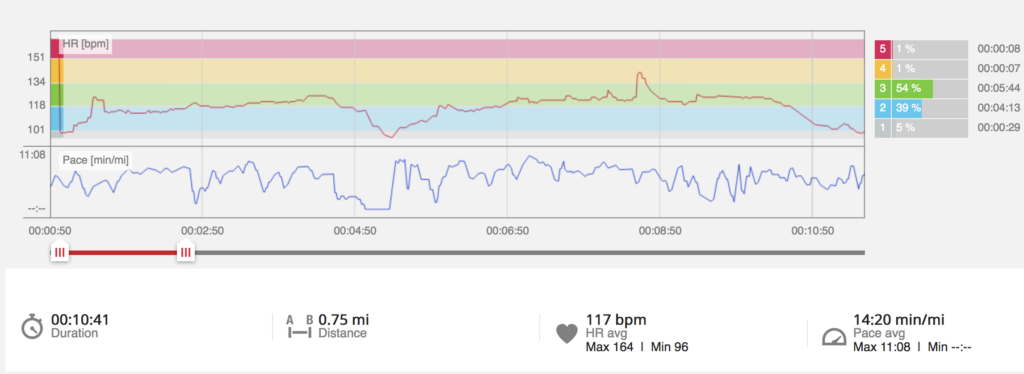
I left off the first few tens of seconds because it took until then for my heart rate monitor to stabilize on my actual heart rate. Then I went on for about three-quarters of a mile (out of a longer run) to match the distance that I ran today.
The things to note are that I ran at a 14:20 min/mil pace (very slow), that my heart rate averaged 117 bpm, and that the majority of my run was spent in zone 3.
Now check out my graph from today’s run, run with actual bare feet:
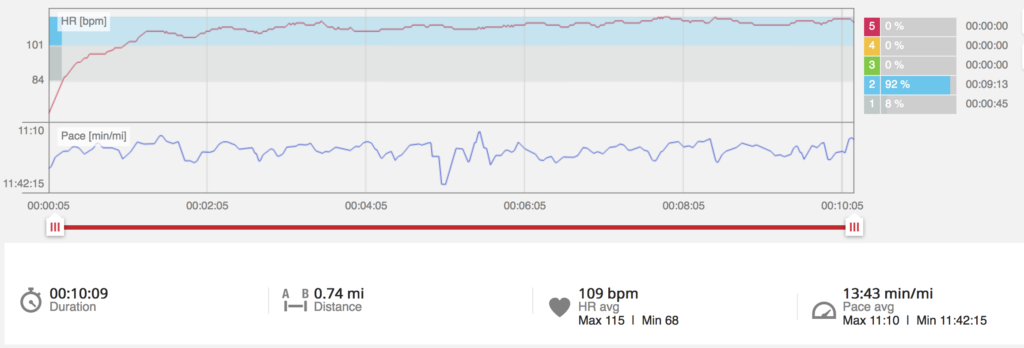
I’ve matched the distances (the former is the first part of a much longer run, the latter my entire barefoot run today). Today’s run was at a considerably faster pace (37 seconds per mile faster), while at the same time keeping my heart rate considerably lower (averaging 109 bpm, entirely in zone 2).
I have to say, this is very promising for future endeavors. I need to boost my confidence a bit, so I feel comfortable going for longer runs barefoot. I also need to get a bit more familiar with pacing—my MAF heart rate is probably more like 124. I need to figure out what it feels like when I run that pace barefoot. Because: who knows how fast I can run at that heart rate barefoot?
(The shortcode below won’t work until I get an updated version of the plugin for displaying GPX maps.)
[sgpx gpx=”/wp-content/uploads/gpx/Philip_Brewer_2020-06-27_08-46-36.GPX”]
I’ve been following a new workout plan by Anthony Arvanitakis (the latest iteration of his Superhero Workout), and one of the points that he makes is the importance of warming up. (“If you don’t have time to warm up, you don’t have time to work out.”)
Warming up is important, but as he’s made clear elsewhere, it’s actually the second step in the pre-workout process.
The first part is checking in.
You want to check in with your body, but even before that, you want to check in with the venue.
I don’t have a good history with this step, which is a big part of the reason I’m writing this post: I’m documenting what I think I ought to be doing as part of the “warming up, but first checking in” procedure, in the hope that it’ll help me remember to do it.
Look around to see who else is there. Is anybody doing anything that might interfere with your workout?
Yesterday the folks mowing the lawn arrived in the courtyard where I’d set up my rings just as I was just starting my workout, and I ended up needing to take my rings down and move elsewhere. That was okay—but if I’d done a better job of checking in with the venue in advance, maybe I’d have been able to find a spot where I could have finished my workout without having to move.
Is there anybody doing anything that you might interfere with as you do your workout? I would have been in the way of the lawn mowing people. Other times I’ve gone someplace where people were setting up to do a family reunion picnic or something similar, and I’d have been in the way.
Especially in these times, there are other things to think about in terms of other people. Is there any chance that police or security guards might take issue with what you’re doing? Any chance that the people you interact with might themselves be malefactors of some sort? Best to avoid them, if you can.
I tend to do my workouts fairly early in the morning, but long enough after dawn that I don’t tend to have to worry much about such things. That doesn’t mean they can be entirely ignored.
Besides other people, look at the space itself. This is especially important for parkour, where you need to look for all kinds of hazards.
If you’re going to do parkour vaults, but also plyometrics, make sure the thing you’re going to put weight on is strong enough. Make sure it won’t tip over, or collapse under your weight, and also make sure that your planned activity won’t damage it.
Make sure that the zone where you’re going to land is free of any slipping or tripping hazards (water, ice, grease, sand). Is there anything that might roll? Is there anything with a point or a sharp edge?
Is there enough room for you to safely execute whatever move you have planned?
This can be before your worm-up, or combined with it. The key is to pay attention.
Are your tendons, ligaments, and joints free of pain? Do you have access to your entire normal range of motion? Does anything catch or click or grind as you begin to move? Are your muscles sore from recent workouts?
Are you focused? Are you confident that you know whether you can go all-out, or need to limit yourself in some way to stay safe?
None of these things would necessarily make you abandon a workout, but (depending on the extent to which they ease up as you begin your warm up), they might prompt you to modify your planned workout.
Anthony has a warm-up video here:
As I say, I’m not especially good at this. I tend to arrive at the venue with a workout in mind, and immediately jump into it.
I’ve gotten a bit better at getting my warm-up in. I have too many body parts (wrists and feet especially, but also ankles, shoulders, hips, and knees) that act up if I try to stress them before they’re warmed up. I’ve learned not to skip this part.
My qi gong practice does a very good job of warming up most of these parts. I also go ahead and do Anthony’s warm up routine as well (very similar exercises), and then throw in specific activities that I know I need in particular due to my own movement and injury history. (I use some wrist warm-ups from my long-ago aikido practice, for example. I use a ball to mobilize the joints in my feet.)
As I say, I’ve about gotten the warm-up part under control. It’s the check-in process that I’m particularly prone to skimp on. Hopefully, writing this post will remind me not to forget this part of a workout.
Looking over Anthony’s older videos, I came upon this one, which talks about a procedure for doing a check-in procedure ahead of the warming up:
It’s pretty good.
I’m glad I ordered my gymnastic rings when I did. I wish I’d gotten a kettlebell at the same time.
“GQ Magazine has coined the current equipment epoch ‘The Great Kettlebell Shortage of 2020.'”

You can’t see it, but a Green Heron just flew into that tallest tree across the pond.
My buff is at the ready, just in case I need to pull it up to serve as a faux mask for virtue-signaling purposes.
#PolarBeat
I actually knew this already, having seen an article about the work, originally serialized in the weekly journal the New York Atlas under the pseudonym Mose Velsor, when it was collected and republished as a PDF (Manly Health and Training) in 2016. But I hadn’t read through the whole thing until this month.
I’ve read a lot of fitness books over the years, and one thing I find interesting is how much they are all the same—including Walt Whitman’s. Of course, every fitness book has its own peculiarities—more or less focus on functional fitness, flexibility, muscle size, body fat, strength, quickness, power, control, aerobic capacity, aesthetics, etc. But the levers available to affect these things don’t really change: sleep, diet, resistance exercise, endurance training, and stretching just about cover the gamut. Aside from the details of the diet, it’s primarily a matter of selection, focus, and combining of exercises.
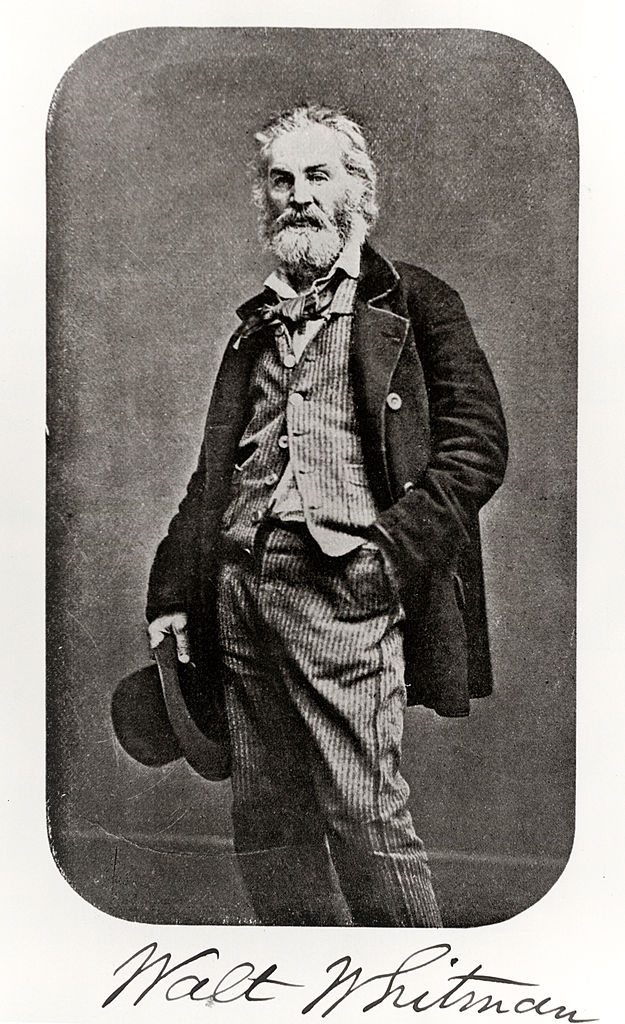
Walt Whitman’s fitness manual offers a nice little selection of exercises, none of which would seem out-of-place in any modern fitness book:
Walt Whitman wants his readers to be exemplars of manly beauty. In fact, based on how he talks about it, you have to assume that increasing the amount of manly beauty around is really the most important thing he hopes to achieve with his book—but that’s a fair thing to do, because:
As regards human beings, in an important sense, Beauty is simply health and a sound physique. We can hardly conceive of a man, at any age of life, who is in perfect health, and keeps his person clean and neatly attired, who has not some claims to this much-prized attribute.
Related to this, he is clearly keen to normalize men caring about aesthetics:
Nor is there anything to be ashamed of in the ambition of a man to have a handsome physique, a fine body, clear complexion, nimble movements, and be full of manly vigor. Ashamed of! Why, we think it ought to be one of the first lessons taught to the boy, when he begins to be taught at all. It is of quite as much importance as any grammar, geography, or arithmetic— indeed, we should say it was of unrivalled importance.
Of course, some things are desirable for more than just their aesthetic benefits:
The beard is a great sanitary protection to the throat—for purposes of health it should always be worn, just as much as the hair of the head should be. Think what would be the result if the hair of the head should be carefully scraped off three or four times a week with the razor! Of course, the additional aches, neuralgias, colds, &c., would be immense. Well, it is just as bad with removing the natural protection of the neck; for nature indicates the necessity of that covering there, for full and sufficient reasons.
An aside, because it touches on both dancing and aesthetics: A few years ago I read a fitness book titled something like How to Have a Dancer’s Body, which I read hoping to get some suggestions for improving strength and flexibility, only to be sadly disappointed. Its advice in those areas, after a brief treatment of stretching and posture, was that the student should find a good dance class and workout under a teacher. (Most of the book seemed to be about normalizing having an eating disorder—which, admittedly, is probably essential if you want to have the body of a prima ballerina.)
Dance’s attractiveness comes, I think, from the way it both provides actual (often astonishing) physical capability along with an aesthetic that I and many other people find attractive. Walt agreed on both counts, although seemed to take issue with the dance fashions of the times:
As originally intended, dancing was meant to give harmonious movements to the whole body, from the legs, by keeping time to music. In that sense, it was a beautiful art, and one of the noblest of gymnastic exercises. Modern arrangements have made it something quite different.
We would be glad to see some manly genius arise among the dancing teachers, who, out of such hints as we have hastily written, would assist the objects of the trainer and gymnast.
As I said, all fitness books are pretty much the same, so I am not really surprised to find things here that read exactly like something I might find in some entirely modern source of fitness advice.
For example, his rant on shoes and feet sounds exactly like what you might expect if Walt Whitman wrote some copy for Katy Bowman’s Nutritious Movement shoe page or Steven Sashen’s Xero Shoes.
Probably, in civilized life, half the men have more or less deformed feet, from the tight and wretchedly made boots generally worn.
In one of the feet there are thirty-six bones, and the same number of joints, continually playing in locomotion, and needing always a free and loose action. Yet they are always squeezed into boots not modeled from them, nor allowing the play and ease they require. For the modern boot is formed on a dandified idea of beauty, as it is understood at Paris and London, and not as it is exemplified by nature.
If you want to see the feet in their natural and beautiful proportions, you must get a view of the casts of the remains of ancient sculpture, representing the human form, doubtless from the best specimens afforded by the public games and training exercises of the Greek and Roman arenas. They exhibit what the foot is when allowed to grow up, with its free, uncramped, undeformed action. There have been no artificial coverings or compressions; and we know that the gait therefrom must have been firm and elastic. We can understand how the Macedonian phalanx, or the Roman legion, performed its long day’s march. We can see the ten thousand Greeks pursuing their daily wearying course through the destroying climate of Asia, marching firmly, manfully, across the arid sand, the mountain pass, or the flinty plain. It is a truthful lesson we may learn, not for the soldier only, but for the civilian.
Probably there is no way to have good and easy boots or shoes, except to have lasts modeled exactly to the shape of the feet. This is well worth doing. Hundreds of times the cost of it are yearly spent in idle gratifications—while this, rightly looked upon, is indispensable to comfort and health.
Simlarly, his principle workout plan sounds exactly like a MovNat combo:
In truth, however, a man who is disposed to attend to the matter of strengthening and developing his muscular power, will be continually finding some means to further that object, and will do so in the simplest manner, as well as any. To toss a stone in the air from one hand and catch it in the other as you walk along, for half an hour or an hour at a stretch—to push and roll over, a similar length of time, some small rock with the foot, thus developing the strength of the knees and the ankles and muscles of the calf—to throw forward the arms, with vigorous motion, and then extend them or lift them upward—to pummel some imaginary foe, with stroke after stroke from the doubled fists, given with a will—to place the body in position occasionally, for a moment, with all the sinews of the arms and legs strained to their utmost tension—to take very long strides rapidly forward, and then, more slowly and carefully, backward—to clap the palms of the hands on the hips and simply jump straight up, two or three minutes at a time—to stand on a hill or shore and throw stones, sometimes horizontally, sometimes perpendicularly— to spring over a fence, and then back again, and then again and again—to climb trees in the woods, or gripe the low branches with your hands and swing backward and forward—to run, or rapidly walk, or skip or leap along—these, and dozens more of simple contrivances, are at hand for every one—all good, all conducive to manly health, dexterity, and development, and, for many, preferable to the organized gymnasium, because they are not restricted to place or time. Nor let the reader be afraid of these because they are simple, but form the daily habit of some of them, without making himself uneasy “how it will look” to outsiders, or what they will say.
The book especially addresses people who are in school, telling them to be “also a student of the body,” but wants to be sure that the reader knows that not only students are the intended audience:
To you, clerk, literary man, sedentary person, man of fortune, idler, the same advice. Up! The world (perhaps you now look upon it with pallid and disgusted eyes) is full of zest and beauty for you, if you approach it in the right spirit! Out in the morning! Give our advice a thorough trial—not for a few days or weeks, but for months. Early rising, early to bed, exercise, plain food, thorough and persevering continuance in gently-commenced training, the cultivation with resolute will of a cheerful temper, the society of friends and a certain number of hours spent every day in regular employment.
I am pleased to find myself so particularly represented! I’m really not a clerk, but I will claim to be a literary man, and will own up to being also a sedentary person, an idler, and arguably even a man of fortune.
There are many reasons to read a good fitness book, but very few reasons to read another after that. Walt Whitman’s fitness book isn’t really an exception. Still, if you are, like me, a connoisseur of fitness books, it’s worth including this one—for his unique prose style, for his place in American literary history, and for his perspective on manly beauty.