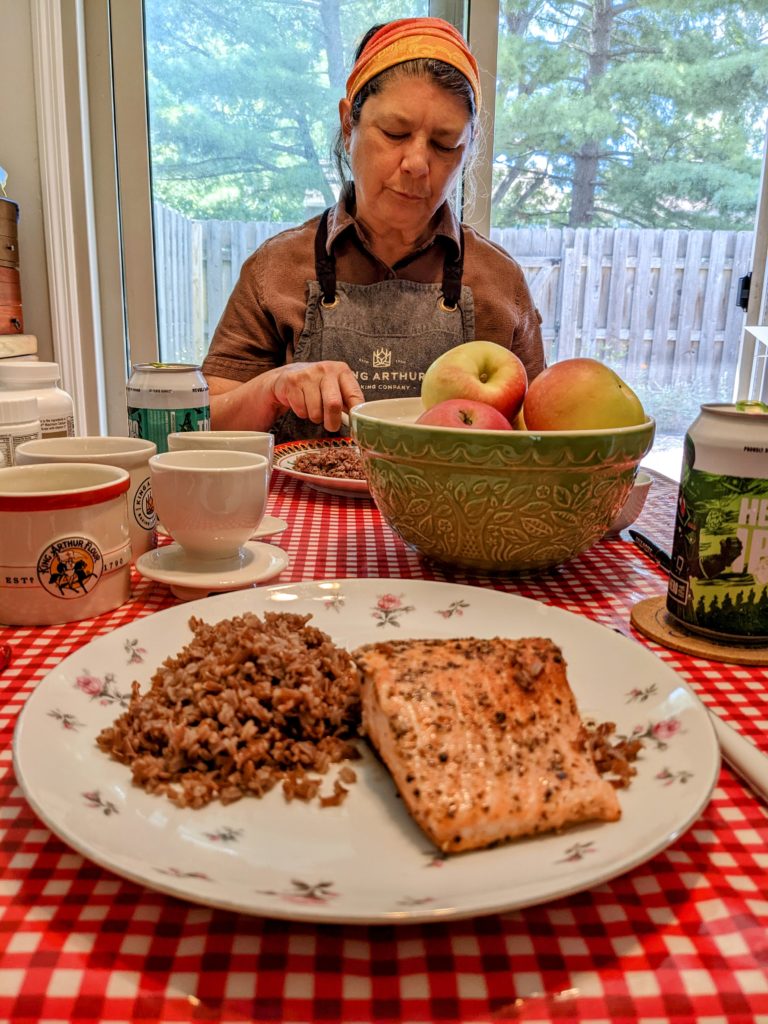
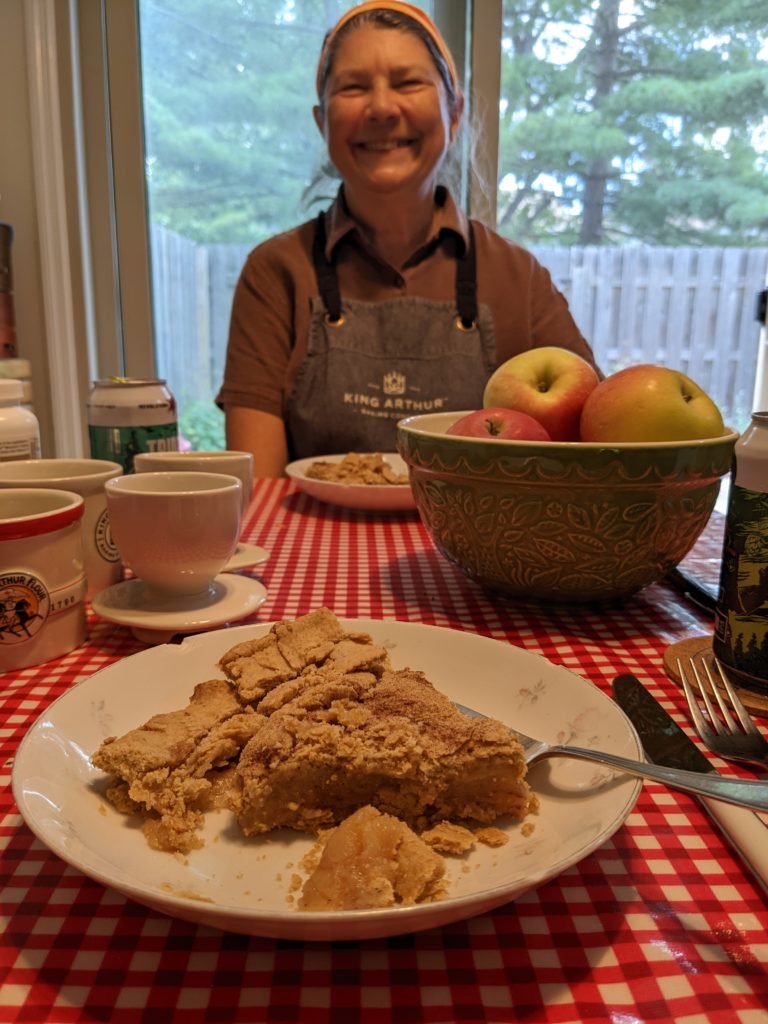
I nipped into Harvest Market this morning to pick up a couple of fillets of fjord trout, while Jackie baked a pie with the Zestar apples we bought a few days ago.
Fillets seasoned with just salt and pepper, and cooked in a cast iron skillet with a little coconut oil. Delicious!
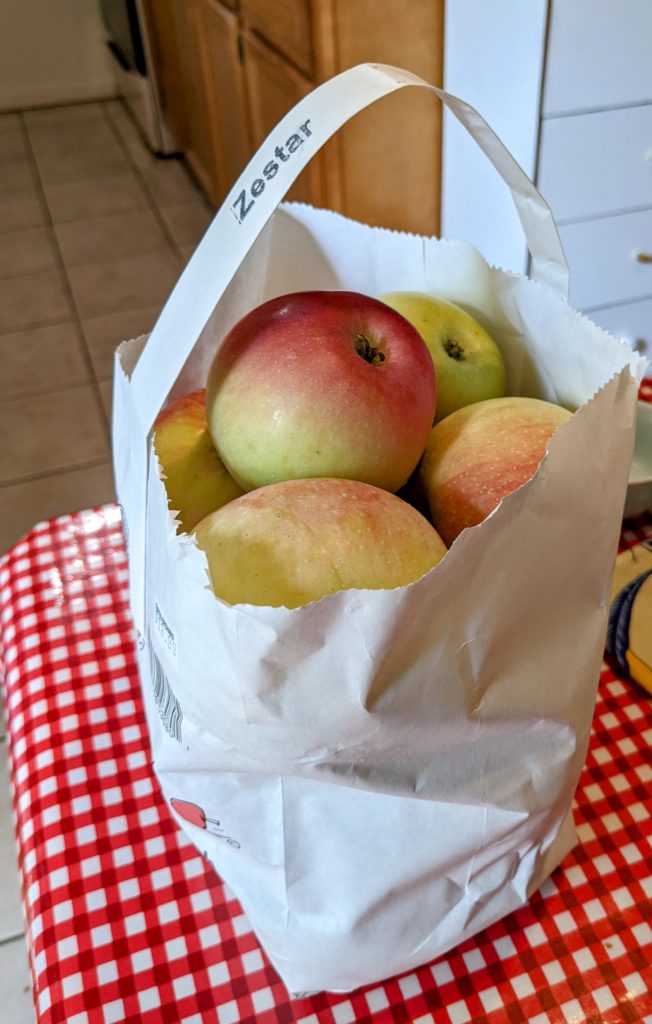
Went to #CurtisOrchard with @jackieLbrewer and got a half peck of Zestar apples. I’ve not tried this variety before, but @limako speaks highly of them.
Very nice. They taste more like I remember apples tasting in my youth than modern varieties like Honey Crisp, Cosmic Crisp, or even Pink Lady.
According to some site that @jackieLbrewer checked, the day the ragweed pollen count gets high isn’t for two more days. According to my nose, today is that day.
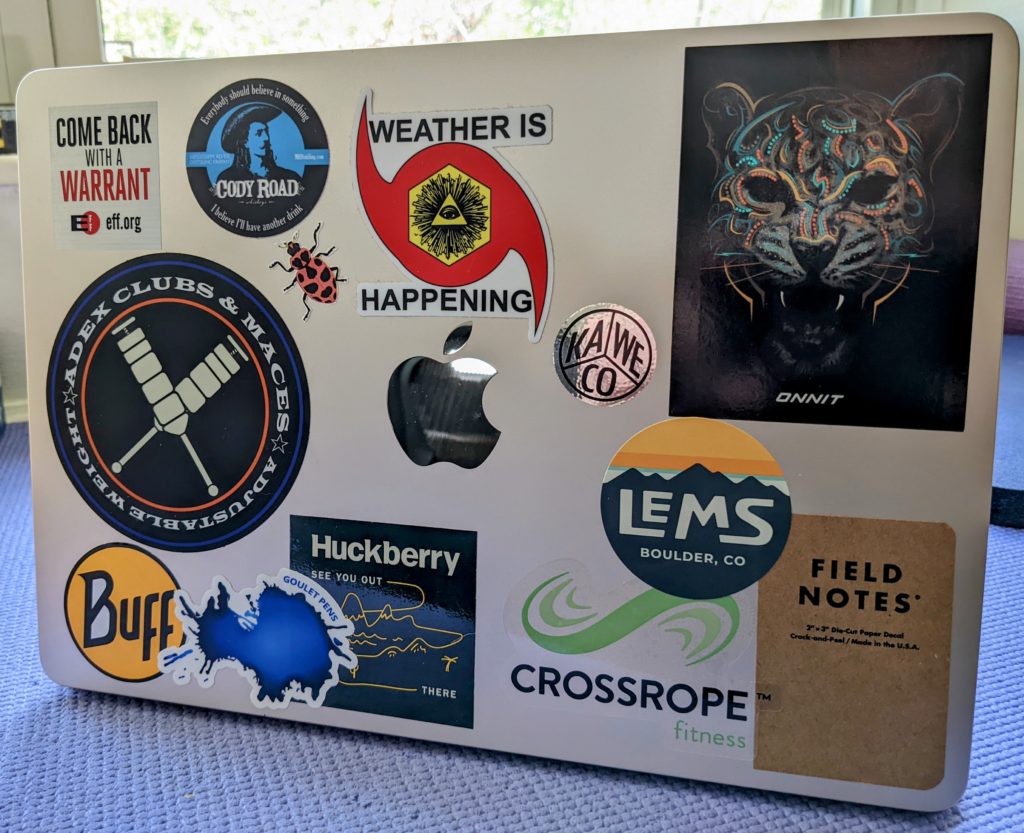
A few days ago I got a new MacBook Air. I got the one with the fancy new M2 chip, making it just incredibly faster than my old, old (ten-year old!) MacBook Air.
Having decided that I’m definitely pleased with it, I have taken the step of covering it with stickers:
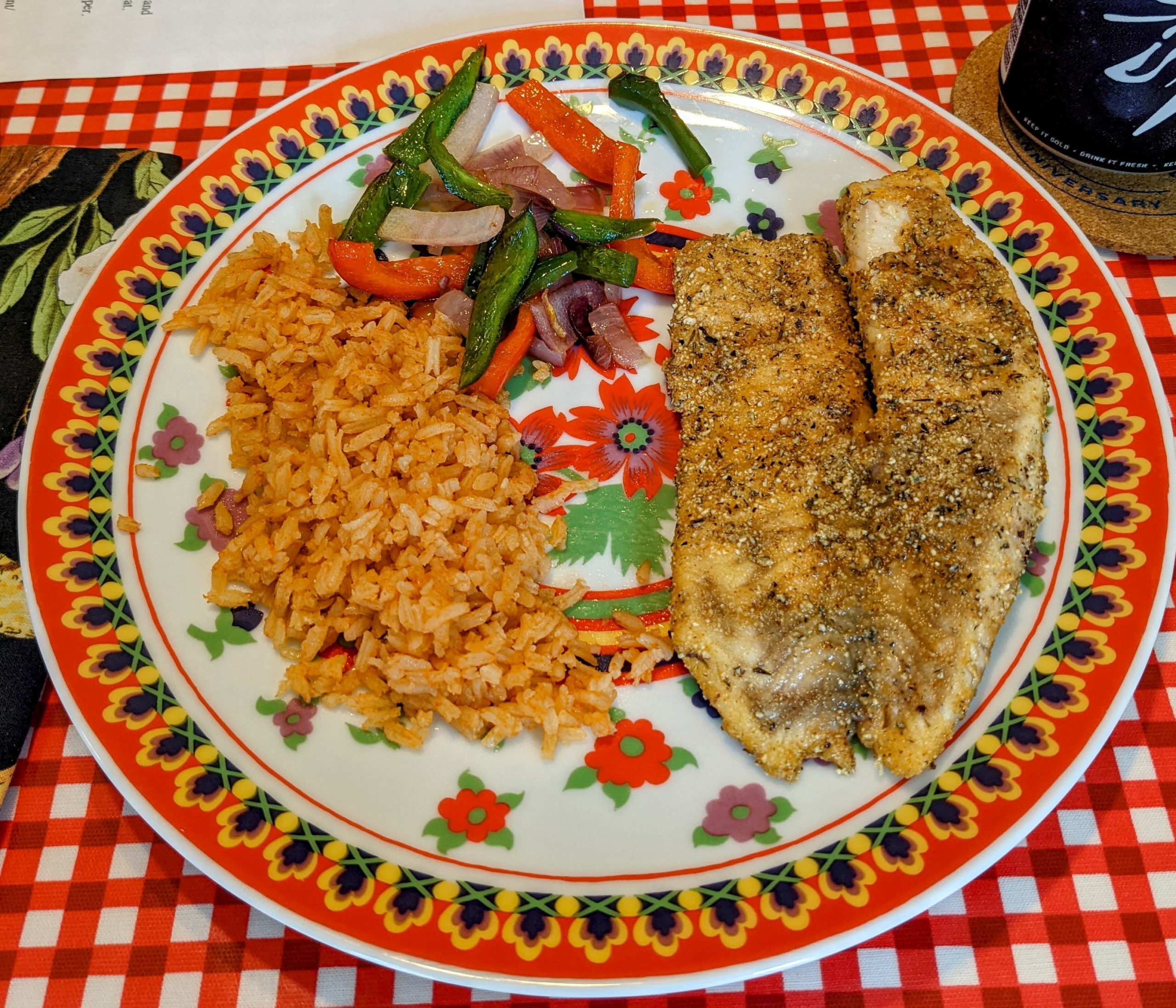
Tilapia from the farmers market, in a spicy cornmeal batter, fried in coconut oil. Served with onion and peppers sauteed in olive oil and some Mexican rice left over from Thursday’s takeout meal. @jackieLbrewer seemed to like it.
I’m generally unimpressed with Krysten Sinema, whose failure to support Democratic initiatives has generally been harmful. However, I kinda like the tax changes she’s forced into the climate package.
Fundamentally, I like dividends and I hate stock buybacks. So a tax on stock buybacks—even a small one—makes things better.
Now, most economists would have you believe that the two are equivalent. This is false.
Economists can gin up a model that suggests that owning a slightly larger share of a slightly smaller company is “equivalent” to getting paid a share of the company’s profits. Or that getting cashed out completely (by taking the buyback), and then finding a place to invest almost all of that cash in some new company is somehow equivalent. I don’t think either of those things is true even in an economic sense, but I think both are clearly false in a larger societal sense.
New York Stock Exchange
The way things used to work was that a company earned a profit, reinvested an appropriate amount of that profit in growing the business, and then paid out the balance to shareholders to do with as they pleased. (They could reinvest the money by buying more stock, they could spend it on luxuries—or necessities, they could invest it in some other company, they could donate it to charity—the possibilities are literally endless.)
This situation produces a sort of virtuous circle. A company that earns a reliable profit—and shares it with its stockholders—becomes more valuable, because people will pay more for a company that pays a reliable dividend. It’s good for the owners (their stock is worth more), it’s good for the employees (both line workers and managers), it’s good for the community (a profitable company pays taxes, their employees have money to spend, their shareholders have money to spend, etc.).
The non-dividend situation lacks all these dynamics. Instead of wanting to produce a profit, the company has all sorts of weird incentives—to maximize “growth” or “revenue” or “earnings” according to whatever weird metric appeals to Wall Street that week. Owners don’t get cash that they can spend. Instead they get the option to cash out at random intervals. The weird incentive structure encourages companies to make weird decisions regarding investing in growth (or dumping cash into buybacks). Shareholders who would otherwise be living on dividends are constantly having to make difficult decisions about selling small amounts of shares in this or that company for money to live on.
Maybe there’s some technical economic sense in which buybacks and dividends are equivalent, but they are very much not equivalent in a societal sense, producing very different results for ordinary investors and their communities.
The only reason any ordinary person would think a stock buyback was even close to equivalent is because capital gains have been tax-advantaged over dividends. So, something that reduces that tax advantage is all to the good.
I have long made it a general practice not to blame my age for any declines or limitations in my capabilities. It’s not that I don’t think my age matters. It’s just that I can’t do anything about my age, so blaming it doesn’t seem useful.
I now realize that I’ve been enabled in this by the fact that I spent my 20s, 30s, and 40s as a sedentary office worker. I did “exercise” some, but not a lot, and not very effectively.
The result of that was that when I finally started making exercise a priority in 2008, I was improving my fitness from a pretty low level. That meant that all through my 50s I was able to report, pretty much every year, that I was in the best shape of my life. (It was in 2014, when I was about 55, that I initially reported that I was getting enough exercise. A year and a half later I wrote this somewhat smug post on the myth of age-related illnesses of middle age. (I tried pretty hard not to be too smug about becoming fitter all through my 50s. Smugness is never very attractive, and it definitely doesn’t age well. I think that post holds up okay as being not so excessively smug.)
Looking back on it, I think my conclusions were the result of having a pretty skewed picture of what sorts of improvements in physical capability can be expected in an “older” person, based on have started from such a low base. Based on my experience these last two years, I’m beginning to think that I’ve made about as much progress as I can expect to make.
Me doing shoulder-taps.
That’s not definitely true. I continue to exercise. I continue to seek out new modalities of exercise. Maybe one of those will yet do great things for my physical capabilities. And it’s still true that I’m in the best shape of my life. But for the first time in a decade, I’m not in better shape than I was a year ago.
Still, I think I’ll hold off on blaming my age, at least for a while yet.
Some days it takes some motivation to get out and get my steps. Today’s motivation was a fresh donut with vanilla icing and Illini sprinkles. Now coffee and donut on the patio with my sweetie.