For some time now I’ve been groping toward more “functional” workouts, focused on developing actual useful capabilities—walking & running, crawling, lifting & carrying, balancing, climbing, jumping, throwing, catching, etc. (This in contrast to workouts that focus on capabilities that enable those things, such as pull-ups and dips which help enable climbing.)
This introduces certain complexities into my workouts. Skills-based activities need to be practiced at the start of a workout, when I’m fresh enough to do them with the sort of attention that lets me improve my skills. Likewise, any exercise that involves heavy weights, and any exercise that involves complex multi-joint motions, also needs to be done at the start, to minimize the risk of injury. That’s all well and good, but you can only put so much of a workout at the start before you inevitably find yourself in the middle. And then, what do you put at the end?
Well, one thing you can fairly safely put at the end is MetCon (metabolic conditioning) activity. Today I tried out such a MetCon circuit, with an eye toward doing something similar after my more skills-based workouts.
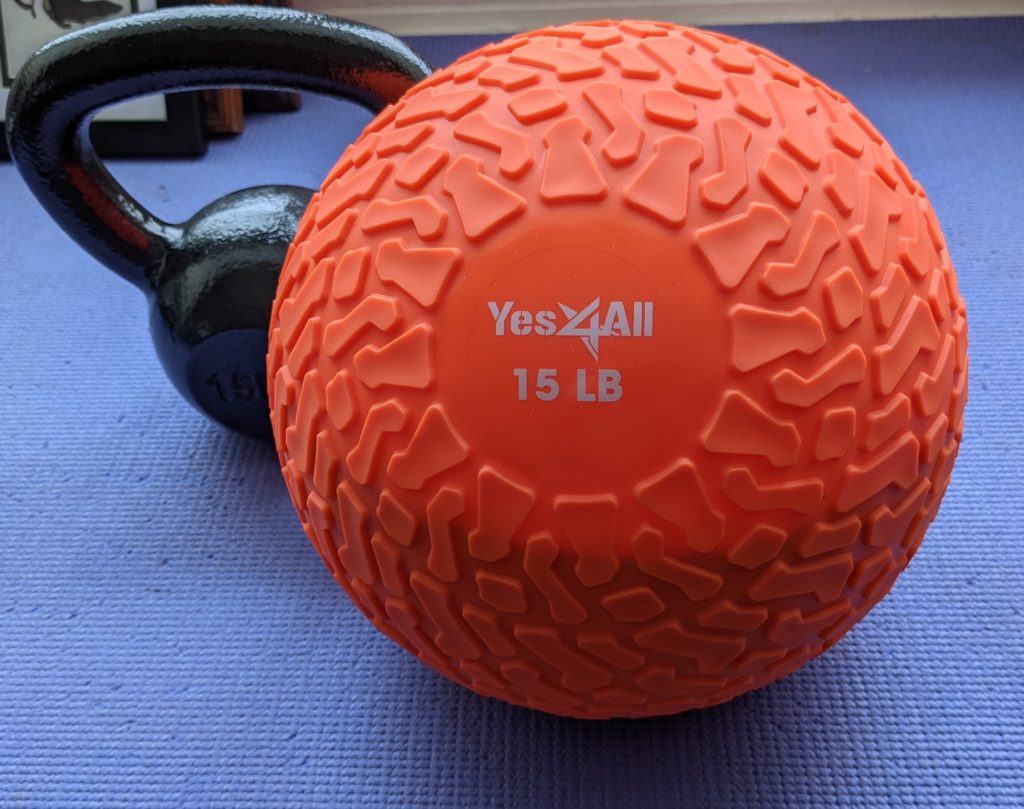
Kettlebell, jump rope, slamball
The workout was circuits of:
Kettlebell swings (53 lb) x 25 swings
Weighted jump rope (½ lb) x 60 jumps
Slamball slams (15 lb) x 15 slams
I’ve done something similar in the past with 45″ work followed by 15″ rest (and then 2–3 minutes rest between rounds). Today I didn’t feel like fiddling with the timer; I picked those rep counts to hit about the same 45″ duration for each set.
I repeated that circuit for 4 rounds, which took just over 22 minutes. I followed it up with a short suitcase carry of the kettlebell—just one circuit of my patio slab with the kettlebell on one side, and then again with the kettlebell on the other side.
It was a good workout.
Now the question is, can I first do a more skills-based workout and then follow it up with a MetCon circuit, without exhausting myself? If I can make that work, I’ll be a little closer to designing the functional training program that I’m working on.
I just wrote a post about “superhero” workouts, mentioning Anthony Arvanitakis’s Superhero Bodyweight Workout which I did last year. I plan to do it again this year, and this post is about a handful of specific issues I had with the plan last year, and how I’m planning to rejigger things to deal with them this year.
There were a few exercises that I couldn’t quite do—not because I lacked strength or endurance, but just because there was a skill component that I couldn’t master quickly enough to go full-power through the 8-week training program. Here are the specific exercises I identified as ones I had trouble with:
Prone angels with weights: I’d never done this exercise, and found it quite challenging. Now though, I’ve spent the winter doing it without weights as part of my morning exercises, and I’ve just in the past couple of weeks started adding in weights. I think I’ve got this one sorted.
Superhero (i.e. one-armed) planks: Similarly, I’d just never done one-armed planks, so I needed to develop a bit more core strength for anti-rotation to be able to 30-second holds on each side. (This one I haven’t been practicing all winter, but I’ve just now checked and managed 20-second holds on each side. I’m sure I can get to 30 seconds in short order.)
Pike push-ups: Another novel exercise for me, where most of the issue was just not knowing how to do it. I started doing it about once a week along about mid-winter, and I think I can do it okay now (although I should probably get Jackie to do a video of me doing it so I can look and make sure I’m doing it right).
Jumping lunges: This one I can’t do at all. For some reason, lunges were just not one of the moves I learned as a child. (Maybe my Phys Ed teacher thought they were bad for your knees or something.) Anyway, I’ve been trying to learn how to do lunges literally for years now, and have just barely gotten to where I can sort of do a wobbly lunge. I tried last week to do a jumping lunge (where you drop into a lunge and then jump into the air and switch your legs around so that you land in a lunge position with the opposite feet forward and back). It wasn’t as bad as a near-death experience, but it was not a success either. Fortunately, this exercise is always offered as an alternative to uphill sprints (preferred), box jumps, or burpees, so I can just pick one of those.
Besides those specific exercises, there are two other issues I had trouble with last time:
Supersets of pull ups and inverted rows. There’s a logistical complexity here because (if you’re doing them with rings) you have to adjust the ring height very quickly. (Otherwise it won’t be a superset, but just two regular sets.) I’m trying to come up with a plan to address that either by getting more practiced at quickly adjusting the ring height, or else by finding a workout location with a bar at either pull-up or inverted-row height (so I can just set up my rings at the right height for the other exercise and switch between stations).
Pyramids (both dip/push up and pull up/row). The first few times I do a pyramid (or ladder) workout, I find it pretty easy to misjudge where I’m going to reach failure, and the exercise is more effective if you don’t unexpectedly hit failure halfway through an early set—something that happened to me several times. This year before I start I want to do enough sets of these to get a good sense of what the right rep count is going to be, so that I know what I need to do to hit failure only during the last set.
Last year I started in late May (when Anthony released his latest version for the program and led the program). That was fine, but this year I think I’d like to start earlier in the spring—just as soon as we get reliably nice-enough weather for me to have some confidence I can put my rings up nearly every day.
It’s an eight-week program, so it would be nice to start around the first or second week of April. Then I’ll have my superhero body by the beginning of June.
There are two, or maybe three, genres of “superhero” workout. There’s the aesthetic workout plan, which aims to make you look like a superhero, and then there’s the practical workout plan, which aims to enable you to function like a superhero.
Photo by Jackie Brewer
The latter category is not at all common, because everybody knows it’s impossible—superheros are fictional characters—but The Bioneer still comes up with these sorts of plans because he’s all about producing a highly functional mind and body, and even if actual superhero-level performance is impossible, it’s still something he wants to strive toward. I respect that.
The former category can be divided into two parts, which is why I say “maybe three” genres. Most of the category is filled with workout plans supposedly followed by this or that actor getting into shape to look like a superhero for a role in a movie—except most of those are not actually a plan at all, just a single workout that some celebrity trainer came up with that includes some elements of what the actor did to produce the aesthetics that were wanted for the film. (Some years ago, Nerd Fitness wrote a great takedown of these sorts of “plans,” pointing out that what you really needed to do was choose your parents well to get the genes that would enable the physique you want, and then have a job that provided both lots of free time (for exercising) and lots of money (for hiring trainers, chefs, etc.).)
What I prefer, and what I found a specific useful instance of, is an actual workout plan (not just an individual workout) for producing the physique of a superhero, while allowing for your body type, and starting with your current physique: Anthony Arvanitakis’s Superhero Bodyweight Workout.
I followed that workout plan last year, and am planning to do it again this year (although then I’ll proceed directly to a Bioneer-style superfunctional workout plan). My success last year was limited by a few specific issues, and my next post is about my plan for addressing them this year.
I have always resisted driving places to get exercise. I do it, to spend time at cool outdoor (and even indoor) places, but each time I have to get over thinking, “But I could just run/walk/whatever right here and not have to drive at all!”
I think I’m over it. Post-pandemic I’m going to be a lot more willing to drive someplace just to walk or run on a trail.
Fasting is very much in the forefront of the kooky part of the health/wellness/fitness world that has me snake-fascinated. I’m convinced by the basic logic that our physiology functions best when we alternate between fed and fasted states, and functions poorly when we are always in a fed state.
As I write this, I’m approaching the end of a three-day fast. I did similar fasts in 2018 and 2019. This is actually my 2020 fast, slipped to early 2021 because I’d hesitated to do a fast during a pandemic. The pandemic isn’t over, but with 11 months of experience at dealing with it, I knew I could just arrange my schedule such that I had virtually no contact with other people for these three days.
Kinds of fasting
There are a lot of ways to do a fast, differing primarily in how long one fasts, and also in what one consumes during the fast.
At one end of the spectrum there’s just not eating for the period between supper and breakfast, which pretty easily stretches to 12 hours for anyone who can forego a bedtime or midnight snack. That period can be extended moderately—there are people who chose to fast for 13 to 16 hours per day—or it can be extended by somewhat more—some people choose to fast for a whole day. At the other end of the spectrum there’s prolonged fasting, where people fast for multiple days.
There are names for these various protocols. Some people practice what’s called 16:8 fasting, where they fast for 16 hours out of the day and consume all the food they eat within an 8 hour window (perhaps 8:00 AM to 4:00 PM, or noon to 8:00 PM). Another is called 5:2 fasting, where people fast on two days out of a week, eating as they like on the other five.
People seem to use the term “time-restricted eating” (or time-restricted feeding, if you’re talking about lab animals) to refer to fasting protocols where the fasting/eating windows are measured in hours. There is also the term “intermittent fasting” which some people just use as a generic term to refer to fasting protocols where the fasting window is not much more than a full day. (If you fast on alternate days you’ll typically end up with 36-hour fasts, assuming that you start your fast after supper on day 1, fast on day 2, and then break your fast with breakfast on day 3.)
Beyond the numerous periods of intermittent fasting, there’s the broad category of “prolonged fasting,” which can be anything from 48 hours out to 30 days or more, although fasting for longer than a week is rarely done for health reasons, except for people who are morbidly obese.
Autophagy
I’ve become convinced that some amount of fasting is not only healthy, it is important for health. Very briefly, there’s a finely balanced system inside of each cell that monitors available energy and available amino acids. If those things are present, the cell switches into a growth pathway, and starts making proteins and organelles (whatever the cell needs at the time). If the cell is short of either energy or amino acids, it switches over into what’s called autophagy, and instead of making proteins starts breaking them down.
For many people in the modern world it has become ordinary to eat frequently enough that one rarely goes even as long as 12 hours without eating. In that circumstance, cells rarely ever switch out of the growth pathway. Autophagy never happens, and old proteins never get broken down. This leads to all sorts of problems. Clearing out those damaged proteins (and damaged organelles) is important—they’re implicated in virtually all the diseases of aging from cancer to Alzheimer’s.
The cell seems to preferentially break down damaged, mis-folded proteins and damaged organelles. (See Selective degradation of mitochondria by mitophagy.) In any case, it’s going to replace them with whatever proteins and organelles you need most at the current moment. The process will end up improving both the quality and appropriateness of your cellular machinery.
My fasting
I do a version of intermittent fasting all the time. Jackie and I eat breakfast fairly early in the morning, but then we just have one main meal of the day, usually around 2:00 PM. We got started on that because I found that eating close to bedtime was interfering with my sleep, and Jackie got frustrated that moving supper as early as I wanted meant that there was barely enough time between lunch and supper to clean up the kitchen and then prepare another meal. My proposal to just combine the two meals was met with some initial skepticism, but it has turned out to suit us very well.
In one sense, I’m doing a version of a 16:8 fast, because I fast from 3:00 PM or so until 7:00 AM the next morning. It’s not a strict fast though. I typically have cocktail hour at 4:00 PM, and I nearly always have cream in my coffee first thing when I get up in the morning. That shrinks the window in which I’m strictly fasting, but probably does it in a way that doesn’t much reduce the benefits of the fast. (For details see Fast This Way, by Dave Asprey the guy who invented Bulletproof coffee.)
Once a year though, I do a prolonged fast of at least three days. Although the research is preliminary, there’s some evidence that after three days the body goes beyond just autophagy, and starts clearing out senescent cells. That’s great, if it’s true; there’s very good evidence that clearing out senescent cells substantially improves healthspan and lifespan.
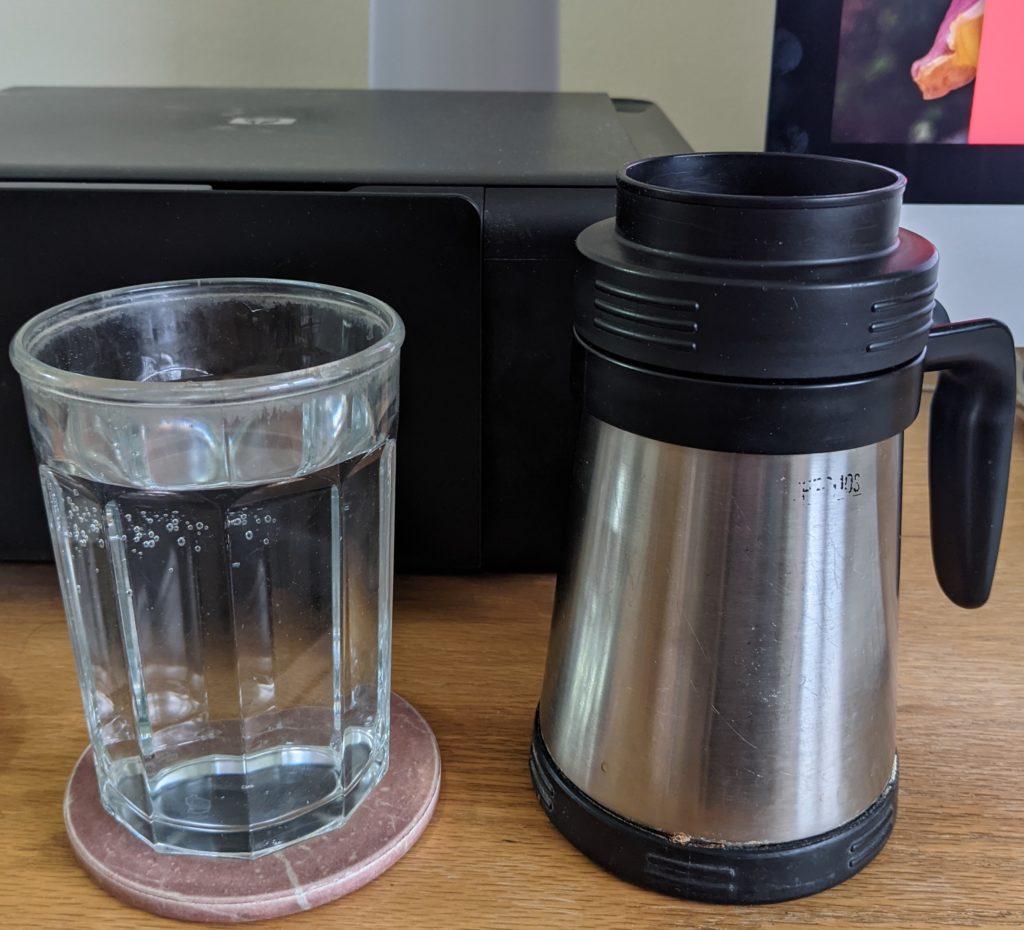
Glass of water, big cup of green tea
Except that I have a big cup of green tea in the morning (mainly to support my caffeine habit, also because green tea boosts autophagy and ketone production), I’m doing a water-only fast.
It hasn’t been hard. I was a little hungry the first day, felt great the second, and am now rather looking forward to breaking my fast in a few hours. But if there were some reason to extend my fast I could do it easily enough.
Slamball and kettlebell
I made a point of getting in a hard lifting session on day two, just to let my body know that I was most definitely using those muscles, and that those proteins should be used to repair muscle and not be metabolized for energy.
Every time you have a hugely inappropriate and harmful stress response and don’t die, you train your limbic system that an overblown stress response is the right thing. Because the only thing your limbic system cares about is not dying.
Last year I used my consumerist impulses to motivate myself to get out for runs—I’d buy running gear, and then feel like I had to go for runs to justify the purchase. 🏃🏻♂️ This year I’m running anyway. But that doesn’t mean I can’t buy new running gear. This handsome top is perfect for runs when it’s just about freezing.
I’ve long struggled to program my training, a task that is difficult because I want to get better at everything. I want to be stronger and faster. I want to have more endurance for running and more endurance for walking (which turn out not to carry over perfectly from one to the other). I want to maintain and deepen my taiji practice and my parkour practice. I want to learn rock climbing and fencing.
This isn’t a new problem for me. As just one example, back in 2013 I was considering programming training not organized by the week but perhaps in 9-day training cycles.
There are at least two problems that I’m trying to address. One is just fitting in training for each capability I want to get better at. The other is how to not break down under that training load (which involves at least fitting in enough recovery time, but other stuff as well).
During the pandemic I’ve done okay, by focusing on exercise. Although I tweak things pretty often, very roughly I’ve organized each week to include:
3 strength training workouts
2 runs (a “long” run and a “fast” run)
1 HIIT workout
2 rest days
That looks pretty good until you do the math and see that it only works for 8-day weeks.
Besides that, note that this excludes my taiji practice (which amounted to more than 5 hours a week back in pre-pandemic days, because besides teaching I was engaging in my own practice). It also excludes my long, slow warmups (which I’ve started calling my “morning exercises,” since I do them pretty much every morning before proceeding with my “workout” for the day).
The way I’ve been making it sort-of work is by doubling up how I think about some of the workouts. A “fast” run with sprint intervals is a HIIT workout, and a HIIT workout with kettlebell swings is a strength-training session.
Still, there’s no hope to make something like this work if I want to add in parkour, rock climbing, and fencing. Likewise, I know from experience that I need a full day to recover from a very long (14-mile or longer) walk, so doing one of those requires devoting two days out of the week to just one training session.
So, I’m left in a quandary. How can I get better at all the things I already do and add in some additional activities as well? (Just before the pandemic I’d started taking an aikido class; I’m sure I’d enjoy finding a local group that plays Ultimate Frisbee….)
Happily for me, Adam Sinicki (aka The Bioneer) has written a book that addresses exactly this issue. The book is Functional Training and Beyond: Building the Ultimate Superfunctional Body and Mind. It starts out talking about “functional training,” and about the history of “getting in shape” i.e. “physical culture.” Then it runs though all the most common training modalities (bodybuilding, powerlifting, kettlebells, crossfit, etc.), before proceeding to talk specifically about how to take the best from each one, and then how to program it all into a workout plan.
His thinking on programming is pretty straightforward: You don’t just add everything together. Rather, you look through all the exercises you might do and pick the ones with the most cross-over benefit relevant to your goals, and then build an exercise program out of those (and you sequence them correctly to maximize your gains in terms of strength, mobility, flexibility, skills acquisition, speed, power, hypertrophy, etc.).
I’m going to spend some time (and some blog posts here) thinking over just how I want to do that.
A fascinating article! For a movement geek like me, a veritable rabbit warren of links to follow.
“the origins of today’s self-care industry are deeply embedded in the Black Power movement of the 1960s and ’70s, in underserved communities across the country.”