It used to be that I was pretty casual about warming up before exercise. If the weather was nice, I’d go for a 20-minute walk. If the weather was crappy, I’d spend 5 minutes on the treadmill or an exercise bike. I’d do just enough to get my heart rate a little bit elevated, and raise my body temperature a degree or two.

That worked okay for years, but at some point I started having injury problems. I’d hurt my feet when I ran. I’d hurt my wrists when I tried to do pushups. I’d hurt my shoulders when I tried to do pull-ups. Each new injury taught me to warm up that body part a little more carefully.

As I’ve gotten older, I’ve found that it is very much worth the time and effort to do a long, slow warm-up.

I wrote a little while ago about taking some time to check-in with my body and with my exercise venue, but I didn’t talk much about specific warm-up activities. This post is an attempt to capture my current somewhat maximalist warm-up, primarily as a checklist to use myself. (Without one I tend to forget activities, and then only remember them later, when some body part twinges. “Oh, yeah, I forgot to do the shank rotations!”)

Just as a note: If I don’t mention some other rep count, I do most of these for 12 reps. If it’s a bilateral motion, I often do just 6–8 on each side.

Feet and ankles

I used to start with the neck and work my way down, but I’ve switched to do my feet and ankles up front (because it’s there that I’ve had the most persistent injuries), and then go back to the neck. Here’s what I do:

  1. Roll my feet on a ball. I’ve got a hard rubber ball, like kids used to bounce. I just roll each foot on it, back and forth across my foot, then up and down along the length of my foot, trying to find and linger on each of the numerous joints within the foot, to mobilize them.
  2. Walk on the edges of my feet. I walk the length of my house (not very far, about 15 or 20 steps) first on the outside edges of my feet, then the inside edges, then on my heels, and then on the balls of my feet.
  3. Toes and heels. I shift my weight forward toward my toes, and then back toward my heels. Once that’s comfortable, I go ahead and rise up onto the balls of my feet and then balance briefly on my heels.
  4. Calf raises. Finally, I head to the bottom step of our staircase and do some calf raises, pushing up as high as I can on the balls of my feet and then lowering my heels as far as I can for a good Achilles tendon stretch.

I don’t do any of those as strengthening exercises, I do them as range-of-motion exercises. At the end of the warm-up (or the end of the workout) I sometimes come back to the calf raises and do a few sets of one-footed calf raises, which can be intense enough to be a calf-strengthening exercise.

Neck

The thing I do not do for my neck is head circles. I tell my taiji students that you should never let your head loll around at the end of your neck. (Exception: If you are the heroine in a romance novel and have fainted into the arms of the bare-chested hero. Then your head can loll around at the end of your neck.)

What I do instead is this, an exercise I call “motivated looking”:

  • Look down and then up. I look down, as if to see if there’s something on the floor near my feet, and then I look up, as if to see a bird in a tree or something on a high shelf.
  • Tip my head to the side. I tip my head to the side, as if to look around the edge of a corner, or to read the spine of a book on a shelf. Then I tip my head to the other side.
  • Look left and then right. Turning just my head, I look as far as I comfortably can to the left, and then to the right. After I do that a few times, I repeat it a few more times, except at the far end of the turn I look down, as if trying to peek into my shirt pocket, or look at the floor just outside first one foot and then the other.

I don’t do any of these as a stretch; I keep within my comfortable range of motion at all times. I also don’t close my eyes; the point here is to actually look in those directions, as if to see what’s there. That’s why I call it motivated looking.

I just do about 4 of these in each direction.

Shoulders

Since the pandemic started I’ve been largely focusing on upper-body strength, mostly exercises with gymnastic rings, which hit the shoulders pretty hard. I have found that spending several minutes just warming up my shoulders helps a lot.

  • Candy wrapper. I hold my arms up at shoulder level, one palm up and one palm down, and then turn them to reverse which palm is up. After I do a dozen or so of these, I take it a step farther: I rotate the shoulder that’s turning palm-down all the way forward, while turning my head to look down the length of my other arm. I just do 3 or 4 of those on each side.
  • Open and close the chest. This is one of my qi gong exercises. I’ve embedded a video of some of the us demonstrating it below.
  • Shoulder circles. With my arms relaxed at my sides, I rotate each shoulder forward a few times and then back a few times. I do the shoulders one at a time (trying to keep the other shoulder completely relaxed), and then I do them together, both forward a few times and then both back a few times.
  • W Stretch. I lift my hands to about head high and make a W shape with my arms (elbows in, hands out) with my thumbs pointed straight backward. Then I squeeze my shoulder blades together (which draws my hands backwards, in the direction my thumbs are pointed), and then spread my shoulder blades apart (which pushes my hands outward—I emphasize that by straightening my elbows and pushing my hands out). I’ve embedded a video of the Tapp brothers demonstrating this one below.
  • Elbow drills. On my hands and knees, with my elbows slightly bent, I rotate my arms.
Open and close the chest
W Stretch

Back, hips, and legs

I like to go straight from elbow drills to rhomboid pushups to squat prep , because they all start from about the same position.

  • Rhomboid pushups. Still on my hands and knees, but now with my elbows straight, I turn my arms so that my elbow pits are as close to forward as I can get them, and then I lower my torso between my shoulders, going as low as I can while keeping my elbows straight. Then I push my torso up. The lowering move brings my shoulder blades together, the rising up move pushes them apart.
  • Squat prep . I start my hip exercises from the end of my rhomboid pushups. If I’m not already on my toes (as well as hands and knees), I fix that. Then I push my hips straight back. This gets me into essentially the same position as a squat. I explore my comfortable range of motion here, paying attention to where my hips start to tuck if I push them back any further. Sometimes I start by getting into an anterior pelvic tilt at the start, and then push back until the tucking brings me into a neutral hip position.
  • Perfect squat. Standing with my feet hip-width apart and pointed straight forward, I push my hips back and sink toward a squat while keeping my shins vertical. When I reach the point where I can’t get any lower without my knees coming forward, I stop and explore that position just a bit. I just do a couple of these—they’re an informational exercise, so I can perceive what my current physical state is, not an exercise to get better at something.
  • Regular squat. I shift my feet to a slightly wider stance and turn them out just a little, and then sink down into a deep squat. With this one I let my knees come as far forward as my toes.
  • Knee rolls. Lying face up with my knees bent and feet on the ground, I twist to one side, letting my knee on that side touch the ground, keeping my shoulder blades on the ground. Then I twist to the other side and touch that knee.
  • Hip bridge. Still lying face up with my knees bent and feet on the ground, I lift my hips, trying to make a straight line from my knees to my shoulders.
  • Prone Angels. Lying face down with my arms stretched past my head palm down, I left my lower legs and knees, and my head and chest. Then I bring my arms arms back and turn them palm up as they approach my hips, and then return them to the starting point. (I sometimes do this with water bottles in my hands as weights as a back-strengthening exercise, but for warm-ups I do it empty-handed.)
  • Hip circles. I stand with my feet about shoulder width apart and move my hips forward, to one side, back, and then to the other side. After a few circles, I reverse the direction. Sometimes I’ll precede that with a more linear prep motion, starting by tucking and then un-tucking my pelvis, and then shifting it to one side and then back again.
  • Shank rotations. I stand on one foot and left the other leg until my thigh is horizontal. Then I turn my shank to the left and right. This points the foot left and right, but if you focus on that it’s easy to imagine that you’re turning your shank when actually all you’re turning is your ankle. To check for that I usually put my hands on my upper shank, feeling for the front of my tibia just below the knee, so I can detect that I’m actually turning the whole shank and not just the ankle.
  • Dynamic hamstring stretches. I sit on the ground with my legs spread as wide as comfortable, and then reach toward one foot and then the other. I don’t do this as a static stretch.
  • Side sit reverses. I sit on the ground with my legs bent to one side, and then reverse which way my legs point. While I’m on each side, I turn to look over each shoulder as far as is comfortable. I do about 4 reps on each side. I’ve embedded a video with the reverses (but not the looking over each shoulder) below.
Side sit reverse

Wrists

I usually do my wrist exercises in the middle of my shoulder exercises, typically right after my shoulder circles, but there’s a bunch of them, so I wanted to pull them out into their own section.

  • Wrist circles. Sometimes I do these with my hands in front of me (ether crossed or not), but usually I plant my wrists over my hips and use the friction with my sides to provide some resistance as I rotate my hands one way and then the other.
  • Aikido wrist exercises. There are three wrist stretches that I learned in a long-ago Aikido class. They’re kind of hard to describe. Basically, you use your other hand to twist your hand one way, then the other way, then into flexion. Repeat a few times on one side and then the other. As best I can recall, the Aikido exercises didn’t include a stretch into extension, but I throw that in anyway (to get ready for pushups).

Fitting it in

Let me take just a moment to acknowledge that this is insane. On days that I do a full workout (which was running 4–5 days a week over the summer), I do very nearly this entire set of warm-up exercises. (Up to now I’ve often forgotten several, since until now I haven’t had a list to follow.)

This can easily take me 40 minutes, which is a pretty large chunk of the day to dedicate just to warming up.

Even then I’m not done—I go ahead and do “straight-elbow” versions of push-ups, pull-ups, or inverted rows (to match the full version of any of those exercises that are in my plan for the workout).

I also do a subset of this warm-up even on days that I’m not going to exercise.

The reason I do all this is simply that I feel better when I do. It’s not just my workouts that go better when I’ve gotten in a proper warm-up. Everyday activities go better as well—bending over to pick something up off the floor, standing up from having sat down on the floor, getting something down off a high shelf, etc. Everything I do for the rest of the day is easier and more comfortable, once I’ve gotten properly warmed up.

So, there you go. Feel free to take any or all of these activities to include in your own warm-up routines. If there’s one that isn’t clear, let me know—I could tweak the text, take a photo or even make a video, if that would make it clearer.

For some time now I’ve been aiming to do my endurance training at my MAF heart rate. MAF stands for Maximum Aerobic Function, and it’s the heart rate where you’re producing the maximum output without having to use anaerobic systems. Although the MAF formula just produces an estimate, there’s quite a bit of data to back it up.

If you do almost all your training at MAF, you’ll get better (run faster) at that heart rate. The idea is that you first do that, and only when your performance plateaus do you need to start doing any sort of speed work (and then not much of it).

As I say, for some time I’ve been aiming to train at my MAF heart rate, but it’s a low enough level of intensity that I’ve persistently had trouble not running too fast. I have a heart rate monitor, but it’s not very useful during a run, because my heart rate is displayed on my phone, and I don’t want to run around carrying my phone where I can see the screen. The upshot has been that I’ve inadvertently done a great deal of my training somewhat above my MAF heart rate, which rather defeats the purpose.

To get a better grip on my MAF training, I finally broke down and bought another heart rate monitor, which displays my heart rate on my wrist so I can check it while I’m running. It also has an alert function, so I can set it to vibrate if my heart rate goes above some value. After looking around a bit, I settled on the Mi Band 4 (which is available for cheap because the Mi Band 5 is now out). It does the thing I want well enough. (It also does a bunch of other stuff that I don’t care about, and some things that I do care about (sleep tracking), but that I do some other way, such as with my Oura ring.)

After a shakedown run a few days ago, where I spent a lot of time trying to figure out how to use the device the way I wanted, today I went out for a run where I tried to use it for some proper MAF training, and I think I was very successful. I probably only spent two or three minutes (out of a 51-minute run) with my heart rate above my target.

This very easy run was nice and gentle. Sitting here at my computer maybe an hour after I got home, my heart rate is already back down to just 64 bpm, which amounts to a surprisingly complete recover. After a run only a little bit faster, I’d expect to see my heart rate stuck in the 70s for several hours.

Now to see if regular training this way produces the speed gains it is reputed to.

I’ve been following a new workout plan by Anthony Arvanitakis (the latest iteration of his Superhero Workout), and one of the points that he makes is the importance of warming up. (“If you don’t have time to warm up, you don’t have time to work out.”)

Warming up is important, but as he’s made clear elsewhere, it’s actually the second step in the pre-workout process.

The first part is checking in.

Checking in

You want to check in with your body, but even before that, you want to check in with the venue.

I don’t have a good history with this step, which is a big part of the reason I’m writing this post: I’m documenting what I think I ought to be doing as part of the “warming up, but first checking in” procedure, in the hope that it’ll help me remember to do it.

Check in with the venue

Look around to see who else is there. Is anybody doing anything that might interfere with your workout?

Yesterday the folks mowing the lawn arrived in the courtyard where I’d set up my rings just as I was just starting my workout, and I ended up needing to take my rings down and move elsewhere. That was okay—but if I’d done a better job of checking in with the venue in advance, maybe I’d have been able to find a spot where I could have finished my workout without having to move.

Is there anybody doing anything that you might interfere with as you do your workout? I would have been in the way of the lawn mowing people. Other times I’ve gone someplace where people were setting up to do a family reunion picnic or something similar, and I’d have been in the way.

Especially in these times, there are other things to think about in terms of other people. Is there any chance that police or security guards might take issue with what you’re doing? Any chance that the people you interact with might themselves be malefactors of some sort? Best to avoid them, if you can.

I tend to do my workouts fairly early in the morning, but long enough after dawn that I don’t tend to have to worry much about such things. That doesn’t mean they can be entirely ignored.

Besides other people, look at the space itself. This is especially important for parkour, where you need to look for all kinds of hazards.

If you’re going to do parkour vaults, but also plyometrics, make sure the thing you’re going to put weight on is strong enough. Make sure it won’t tip over, or collapse under your weight, and also make sure that your planned activity won’t damage it.

Make sure that the zone where you’re going to land is free of any slipping or tripping hazards (water, ice, grease, sand). Is there anything that might roll? Is there anything with a point or a sharp edge?

Is there enough room for you to safely execute whatever move you have planned?

Check in with yourself

This can be before your worm-up, or combined with it. The key is to pay attention.

Are your tendons, ligaments, and joints free of pain? Do you have access to your entire normal range of motion? Does anything catch or click or grind as you begin to move? Are your muscles sore from recent workouts?

Are you focused? Are you confident that you know whether you can go all-out, or need to limit yourself in some way to stay safe?

None of these things would necessarily make you abandon a workout, but (depending on the extent to which they ease up as you begin your warm up), they might prompt you to modify your planned workout.

Anthony has a warm-up video here:

As I say, I’m not especially good at this. I tend to arrive at the venue with a workout in mind, and immediately jump into it.

I’ve gotten a bit better at getting my warm-up in. I have too many body parts (wrists and feet especially, but also ankles, shoulders, hips, and knees) that act up if I try to stress them before they’re warmed up. I’ve learned not to skip this part.

My qi gong practice does a very good job of warming up most of these parts. I also go ahead and do Anthony’s warm up routine as well (very similar exercises), and then throw in specific activities that I know I need in particular due to my own movement and injury history. (I use some wrist warm-ups from my long-ago aikido practice, for example. I use a ball to mobilize the joints in my feet.)

As I say, I’ve about gotten the warm-up part under control. It’s the check-in process that I’m particularly prone to skimp on. Hopefully, writing this post will remind me not to forget this part of a workout.

Looking over Anthony’s older videos, I came upon this one, which talks about a procedure for doing a check-in procedure ahead of the warming up:

It’s pretty good.

I actually knew this already, having seen an article about the work, originally serialized in the weekly journal the New York Atlas under the pseudonym Mose Velsor, when it was collected and republished as a PDF (Manly Health and Training) in 2016. But I hadn’t read through the whole thing until this month.

I’ve read a lot of fitness books over the years, and one thing I find interesting is how much they are all the same—including Walt Whitman’s. Of course, every fitness book has its own peculiarities—more or less focus on functional fitness, flexibility, muscle size, body fat, strength, quickness, power, control, aerobic capacity, aesthetics, etc. But the levers available to affect these things don’t really change: sleep, diet, resistance exercise, endurance training, and stretching just about cover the gamut. Aside from the details of the diet, it’s primarily a matter of selection, focus, and combining of exercises.

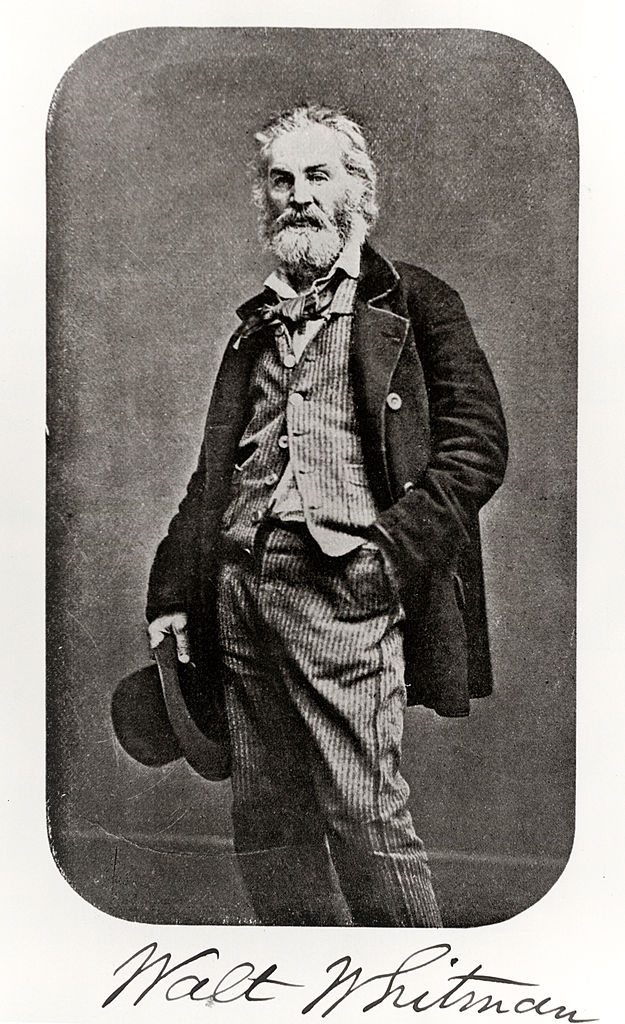
Walt Whitman from about the time his training book was being written and serialized. Photo by J. W. Black of Black and Batchelder / Public domain

Walt Whitman’s fitness manual offers a nice little selection of exercises, none of which would seem out-of-place in any modern fitness book:

  • Rowing: “a noble and manly exercise; it developes the whole of the body.”
  • Toe-touches: “The ordinary exercise of bending forward and touching the toes with the tips of the fingers, keeping the knees straight meanwhile, is a very good one, and may be kept on with, in moderation at a time, for years and years.”
  • Lunges: “The simple exercise of standing on one foot and lowering so as to touch the bent knee of the other leg to the ground, and then rising again on the first foot, is also a good one.”
  • Dancing: “The art of the dancing-master may also be called in play, for the development of the legs, and their graceful and supple movement.”
  • Swimming: “being relieved of all the clothes, and supported in the water, allows of bringing nearly all the muscles of the body into easy and pleasant action.”
  • Walking: “A pretty long walk may also be taken, commencing at an ordinary pace, and increasing the rapidity of the step till it takes the power of locomotion pretty well, and then keeping it up at that gait, as it can be well endured—not to the extent of fatigue, however.”

Walt Whitman wants his readers to be exemplars of manly beauty. In fact, based on how he talks about it, you have to assume that increasing the amount of manly beauty around is really the most important thing he hopes to achieve with his book—but that’s a fair thing to do, because:

As regards human beings, in an important sense, Beauty is simply health and a sound physique. We can hardly conceive of a man, at any age of life, who is in perfect health, and keeps his person clean and neatly attired, who has not some claims to this much-prized attribute.

Related to this, he is clearly keen to normalize men caring about aesthetics:

Nor is there anything to be ashamed of in the ambition of a man to have a handsome physique, a fine body, clear complexion, nimble movements, and be full of manly vigor. Ashamed of! Why, we think it ought to be one of the first lessons taught to the boy, when he begins to be taught at all. It is of quite as much importance as any grammar, geography, or arithmetic— indeed, we should say it was of unrivalled importance.

Of course, some things are desirable for more than just their aesthetic benefits:

The beard is a great sanitary protection to the throat—for purposes of health it should always be worn, just as much as the hair of the head should be. Think what would be the result if the hair of the head should be carefully scraped off three or four times a week with the razor! Of course, the additional aches, neuralgias, colds, &c., would be immense. Well, it is just as bad with removing the natural protection of the neck; for nature indicates the necessity of that covering there, for full and sufficient reasons.

An aside, because it touches on both dancing and aesthetics: A few years ago I read a fitness book titled something like How to Have a Dancer’s Body, which I read hoping to get some suggestions for improving strength and flexibility, only to be sadly disappointed. Its advice in those areas, after a brief treatment of stretching and posture, was that the student should find a good dance class and workout under a teacher. (Most of the book seemed to be about normalizing having an eating disorder—which, admittedly, is probably essential if you want to have the body of a prima ballerina.)

Dance’s attractiveness comes, I think, from the way it both provides actual (often astonishing) physical capability along with an aesthetic that I and many other people find attractive. Walt agreed on both counts, although seemed to take issue with the dance fashions of the times:

As originally intended, dancing was meant to give harmonious movements to the whole body, from the legs, by keeping time to music. In that sense, it was a beautiful art, and one of the noblest of gymnastic exercises. Modern arrangements have made it something quite different.

We would be glad to see some manly genius arise among the dancing teachers, who, out of such hints as we have hastily written, would assist the objects of the trainer and gymnast.

As I said, all fitness books are pretty much the same, so I am not really surprised to find things here that read exactly like something I might find in some entirely modern source of fitness advice.

For example, his rant on shoes and feet sounds exactly like what you might expect if Walt Whitman wrote some copy for Katy Bowman’s Nutritious Movement shoe page or Steven Sashen’s Xero Shoes.

Probably, in civilized life, half the men have more or less deformed feet, from the tight and wretchedly made boots generally worn.

In one of the feet there are thirty-six bones, and the same number of joints, continually playing in locomotion, and needing always a free and loose action. Yet they are always squeezed into boots not modeled from them, nor allowing the play and ease they require. For the modern boot is formed on a dandified idea of beauty, as it is understood at Paris and London, and not as it is exemplified by nature.

If you want to see the feet in their natural and beautiful proportions, you must get a view of the casts of the remains of ancient sculpture, representing the human form, doubtless from the best specimens afforded by the public games and training exercises of the Greek and Roman arenas. They exhibit what the foot is when allowed to grow up, with its free, uncramped, undeformed action. There have been no artificial coverings or compressions; and we know that the gait therefrom must have been firm and elastic. We can understand how the Macedonian phalanx, or the Roman legion, performed its long day’s march. We can see the ten thousand Greeks pursuing their daily wearying course through the destroying climate of Asia, marching firmly, manfully, across the arid sand, the mountain pass, or the flinty plain. It is a truthful lesson we may learn, not for the soldier only, but for the civilian.

Probably there is no way to have good and easy boots or shoes, except to have lasts modeled exactly to the shape of the feet. This is well worth doing. Hundreds of times the cost of it are yearly spent in idle gratifications—while this, rightly looked upon, is indispensable to comfort and health.

Simlarly, his principle workout plan sounds exactly like a MovNat combo:

In truth, however, a man who is disposed to attend to the matter of strengthening and developing his muscular power, will be continually finding some means to further that object, and will do so in the simplest manner, as well as any. To toss a stone in the air from one hand and catch it in the other as you walk along, for half an hour or an hour at a stretch—to push and roll over, a similar length of time, some small rock with the foot, thus developing the strength of the knees and the ankles and muscles of the calf—to throw forward the arms, with vigorous motion, and then extend them or lift them upward—to pummel some imaginary foe, with stroke after stroke from the doubled fists, given with a will—to place the body in position occasionally, for a moment, with all the sinews of the arms and legs strained to their utmost tension—to take very long strides rapidly forward, and then, more slowly and carefully, backward—to clap the palms of the hands on the hips and simply jump straight up, two or three minutes at a time—to stand on a hill or shore and throw stones, sometimes horizontally, sometimes perpendicularly— to spring over a fence, and then back again, and then again and again—to climb trees in the woods, or gripe the low branches with your hands and swing backward and forward—to run, or rapidly walk, or skip or leap along—these, and dozens more of simple contrivances, are at hand for every one—all good, all conducive to manly health, dexterity, and development, and, for many, preferable to the organized gymnasium, because they are not restricted to place or time. Nor let the reader be afraid of these because they are simple, but form the daily habit of some of them, without making himself uneasy “how it will look” to outsiders, or what they will say.

The book especially addresses people who are in school, telling them to be “also a student of the body,” but wants to be sure that the reader knows that not only students are the intended audience:

To you, clerk, literary man, sedentary person, man of fortune, idler, the same advice. Up! The world (perhaps you now look upon it with pallid and disgusted eyes) is full of zest and beauty for you, if you approach it in the right spirit! Out in the morning! Give our advice a thorough trial—not for a few days or weeks, but for months. Early rising, early to bed, exercise, plain food, thorough and persevering continuance in gently-commenced training, the cultivation with resolute will of a cheerful temper, the society of friends and a certain number of hours spent every day in regular employment.

I am pleased to find myself so particularly represented! I’m really not a clerk, but I will claim to be a literary man, and will own up to being also a sedentary person, an idler, and arguably even a man of fortune.

There are many reasons to read a good fitness book, but very few reasons to read another after that. Walt Whitman’s fitness book isn’t really an exception. Still, if you are, like me, a connoisseur of fitness books, it’s worth including this one—for his unique prose style, for his place in American literary history, and for his perspective on manly beauty.

A year ago I could do 3 pushups. (Except that when I tried there was a pretty good chance I’d hurt my shoulders or my wrists.)

Last summer, focusing mostly on running rather than lifting, I made no progress on strength gains at all. (Admittedly, my data isn’t directly comparable: To reduce injuries, I switched to bench pushups.)

I did various amounts of bench pushups all summer and fall. When I manged to put together a week or two of consistent lifting I could briefly work up to 3×8 bench pushups. (That is, 3 sets of 8 bench pushups.) I did that a couple of times.

By the time the stay-at-home order went into effect, and I lost access to our little fitness room, I’d finally gotten pretty consistent with my workouts, and had just recently graduated to real pushups, doing as many as 4×5.

Yesterday, probably for the first time in my life, I did 4×10 pushups. (And they were good pushups too: no sagging hips, no thrusting my hips up, no chicken-winging my arms out.)

I don’t think I’ve ever done that many before, not when I was taking a self-defense class in college and we worked up to 10 pushups, nor when I was in elementary school and we pretty often did 1×10 pushups in PhysEd class, and I may well have done as many as 1×20 as part of the Presidential Physical Fitness Test.

I’ve made some progress with my squats and my rows as well, but not to the same extent.

The squats are hard because I don’t have an appropriately heavy weight. I’m doing goblet squats with my 15 lb kettlebell, because it’s the only kettlebell I’ve got, but even 4×15 isn’t really enough to see much gains. Maybe 4×20? Hopefully I’ll be able to get a heavier kettlebell one of these days.

I was doing okay with the rows while I could put my rings up at the basketball court (I could do 3×6 or thereabouts), but since the kids were refusing to respect social distancing rules, Winfield Village closed the basketball courts. Without the rings I’m reduced to doing bent rows with that same 15 lb kettlebell, and even 4×20 isn’t really enough to challenge my back muscles. Maybe 4×25?

It sounds like we’re on track to significantly reduce the lockdown restrictions as early as two weeks from now. Maybe I’ll be able to get my rings back up, and maybe it will someday be possible to buy a kettlebell!

In any case, I can’t really complain: I did 40 pushups yesterday!

It’s a little hard for me to settle on a start date for my personal social distancing. The formal stay-at-home order from the governor didn’t go into effect until March 21st, but the last thing I did that was really inconstant with proper distancing was on March 12th when I attended an aikido class (you really can’t remain distant and practice aikido). So, I’m calling it a month-ish of distancing.

I think of myself as semi-retired (because I am still writing and was still teaching my taiji class), but as a practical matter, I’m really actually retired. I’ve been drawing my pension for something like 5 years now, and Jackie has started drawing her social security.

So our financial circumstances as far as income goes are pretty much just as they were. (It may be that I won’t get paid for the last session of teaching taiji, since I only taught two of the planned eight weeks, but the actual dollar amount in question is pretty small.)

I assume my stock investments got crushed in the early reaction to the pandemic and have since recovered some, but to be honest I’ve not paid much attention. I had lightened up on stocks a couple of times in the past couple of years, and am pretty comfortable with my asset allocation. (I actually checked with Wise Bread to see if they wanted me to pitch them an article on “Investing in Plague Time,” but they said they’d completely shut down commissioning articles due to how the pandemic was hitting their income. I’ll recast the article as a blog post and put it up here pretty soon.)

As far as spending goes, we’re spending quite a bit less. We’re still trying to support local businesses—we’ve been buying groceries during geezer hour at Schnucks, and we restocked our liquor cabinet at Friar Tuck’s, taking advantage of their curb-side pickup scheme—but I’ve stuck to my new policy of only buying prepared food or drinks from businesses that provide paid sick time to everyone who might come into contact with my food, and so far I haven’t heard of any local restaurants or bars that do that. (If you know of any, let me know!) The upshot is that 100% of the food we’ve eaten this month has been prepared by Jackie or by me, which means it’s been both delicious and healthy.

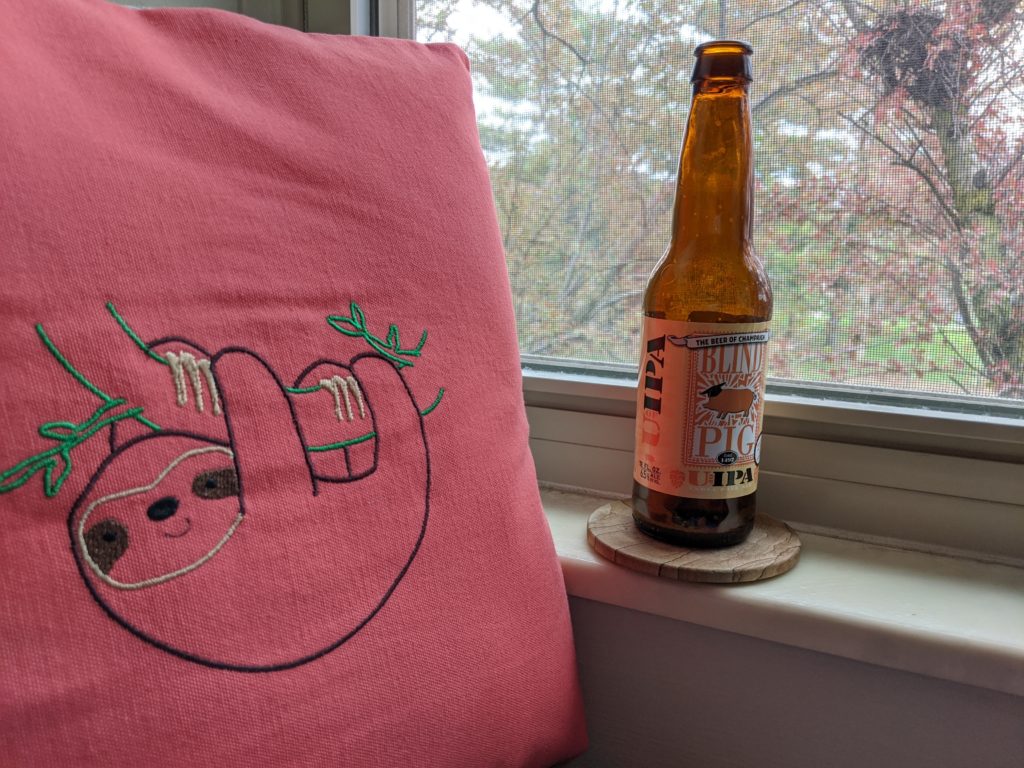
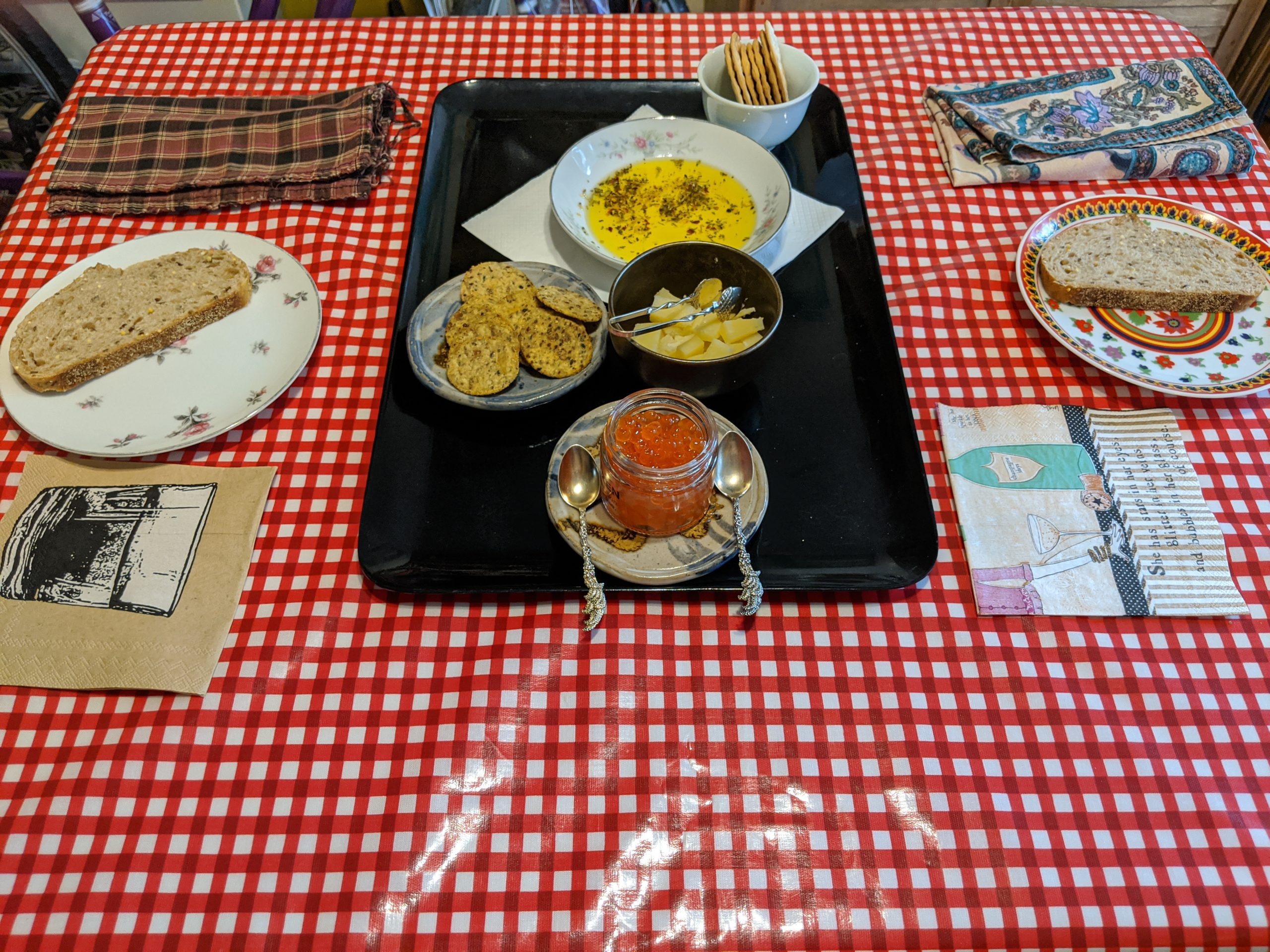
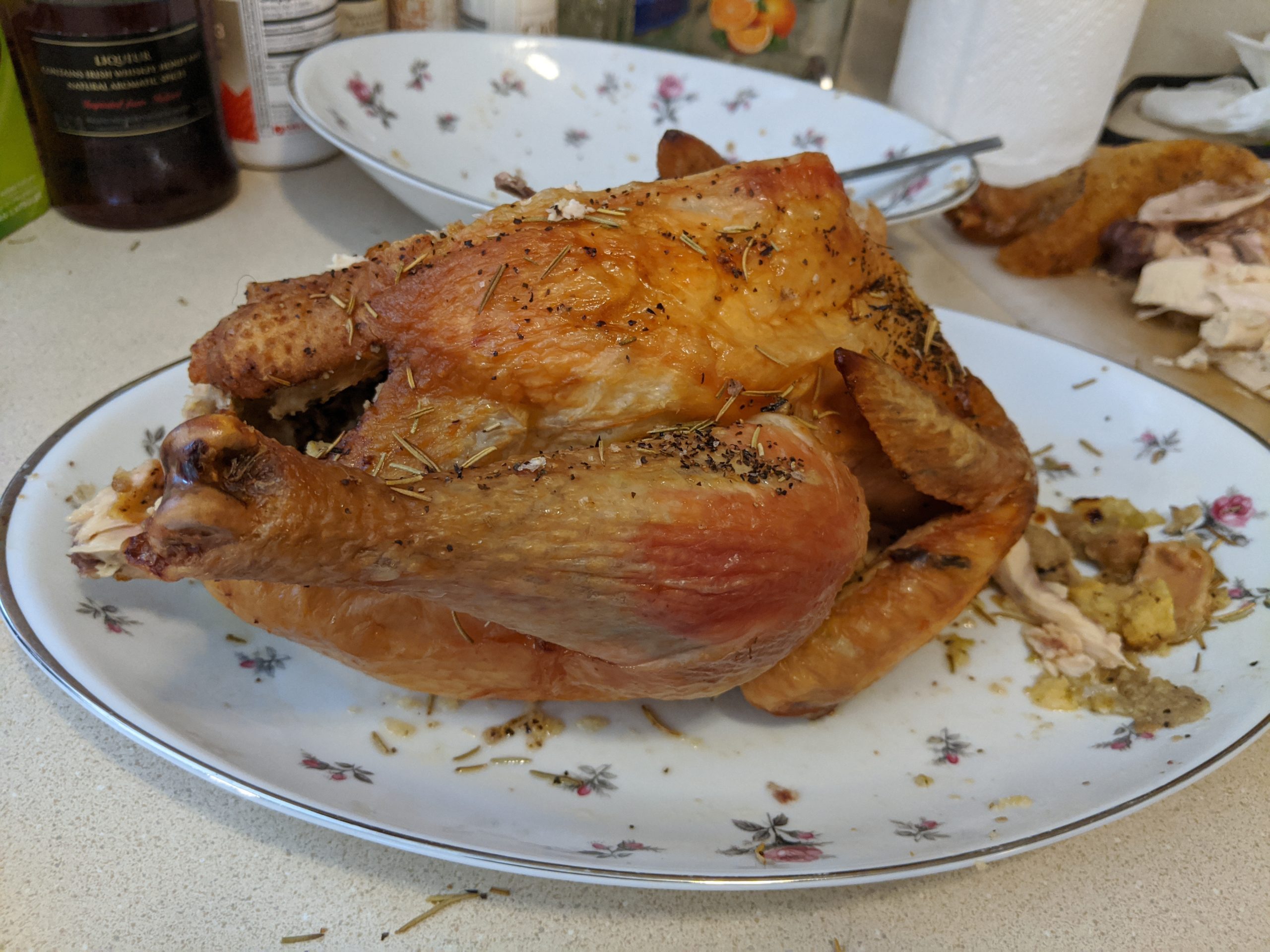
I don’t have many pictures of the great dishes that Jackie has cooked—most recently khema made with grass-fed beef and served with chapatis—and it seems that I failed to get a picture of the lingcod seasoned after the fashion of Kerala roadside chicken (garlic, ginger, fennel, garam masala, turmeric) that I fried in coconut oil in my big cast iron skillet. However, here’s a few recent dishes:

Besides all the great food, we’re also enjoying (perhaps a little too much) our daily cocktail hour—often on-line with my brother and our mom. The folks I meet for coffee on Tuesday morning have been keeping things going by doing that on-line as well.

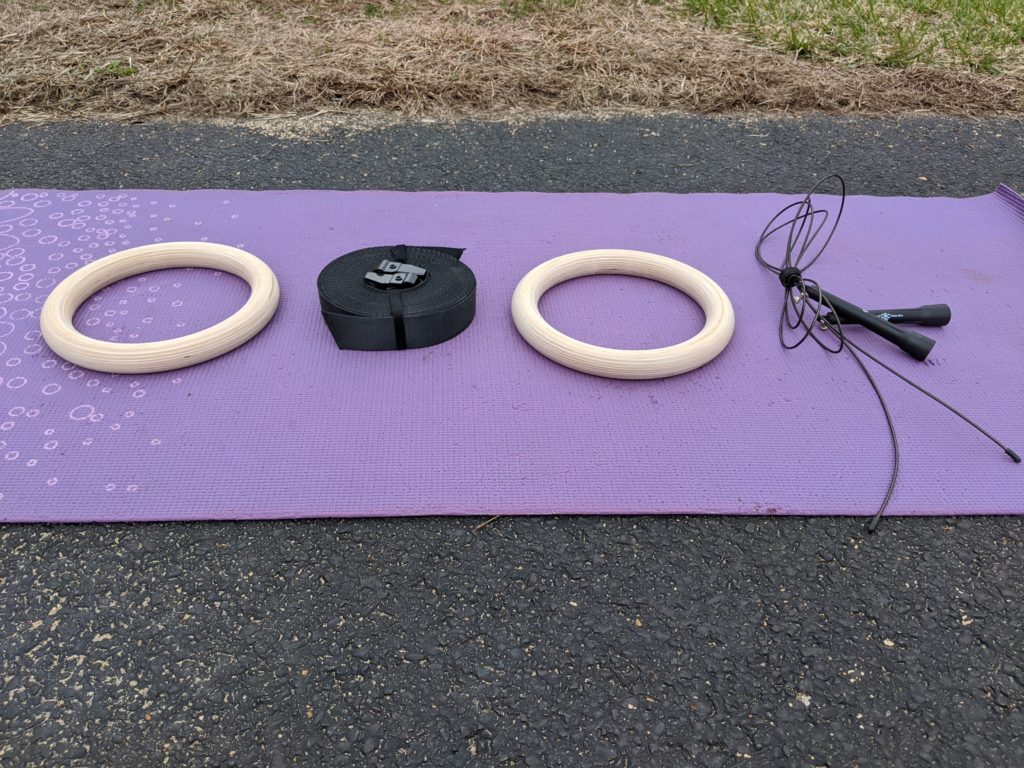
I’ve been very pleased with my success at maintaining my workout regimen, despite the closure of the fitness room. I’ve been making use of my kettlebell and my jump rope. I’ve been getting my runs in. I’ve been using my new gymnastic rings:

I do my workouts outdoors to the greatest extent possible—runs around the neighborhood, setting the rings up in Winfield Village’s basketball court, jumping rope and swinging the kettlebell in our little patio. Our neighbors all seem to be pretty good about respecting proper distancing practices, so it’s working okay so far.

While I’m on the subject of exercise, I wanted to mention in passing this hilarious tweet:

Just to say that, although getting ripped is perhaps not in the cards, I’m having a great time making the attempt.

Finally, I’m meaning to get back to getting some writing done, and to that end I spent all morning tidying up my desk:

At this moment (a couple of hours later), it is still just about that tidy, and I’ve used it to write this blog post. This afternoon I’ll use it to write a letter to my congressman and senators, urging them to support the post office. And then, I’ll see if I can’t get to work on some fiction.

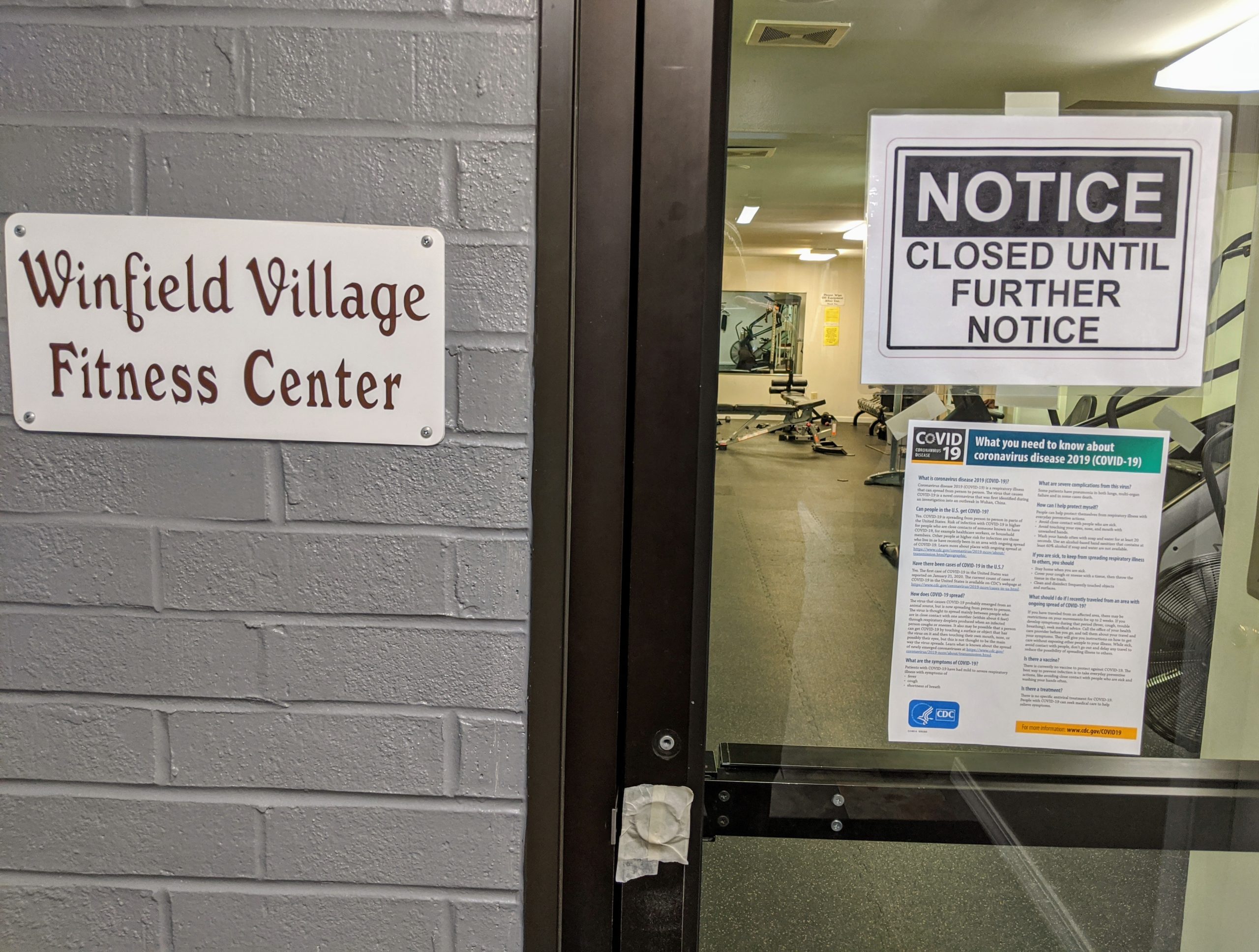
Like everyplace else, Winfield Village has closed down all the “non-essential” places people might congregate, including our fitness room.

“Notice: Closed until further notice”

Losing access to the fitness room is particularly annoying to me because I’ve just recently—starting about seven weeks ago—gotten my act together about lifting, and been getting to the fitness room at least three times a week.

Determined not to lose this momentum, I’m trying to cobble together an adequate workout routine that I can do with just equipment I own.

Great collection of dumbbells, no longer accessible because they’re in the fitness room

I had already been including quite a bit of bodyweight exercise, but since the dumbbells were right there, I’d often use them (for dumbbell rows and for goblet squats, in particular). I also used the 45 lb kettlebell in the fitness room all the time for my HIIT workouts.

The other thing that I’m really missing is the pull-up bar. To replace that, I’ve ordered a pair of gymnastic rings that should arrive Tuesday.

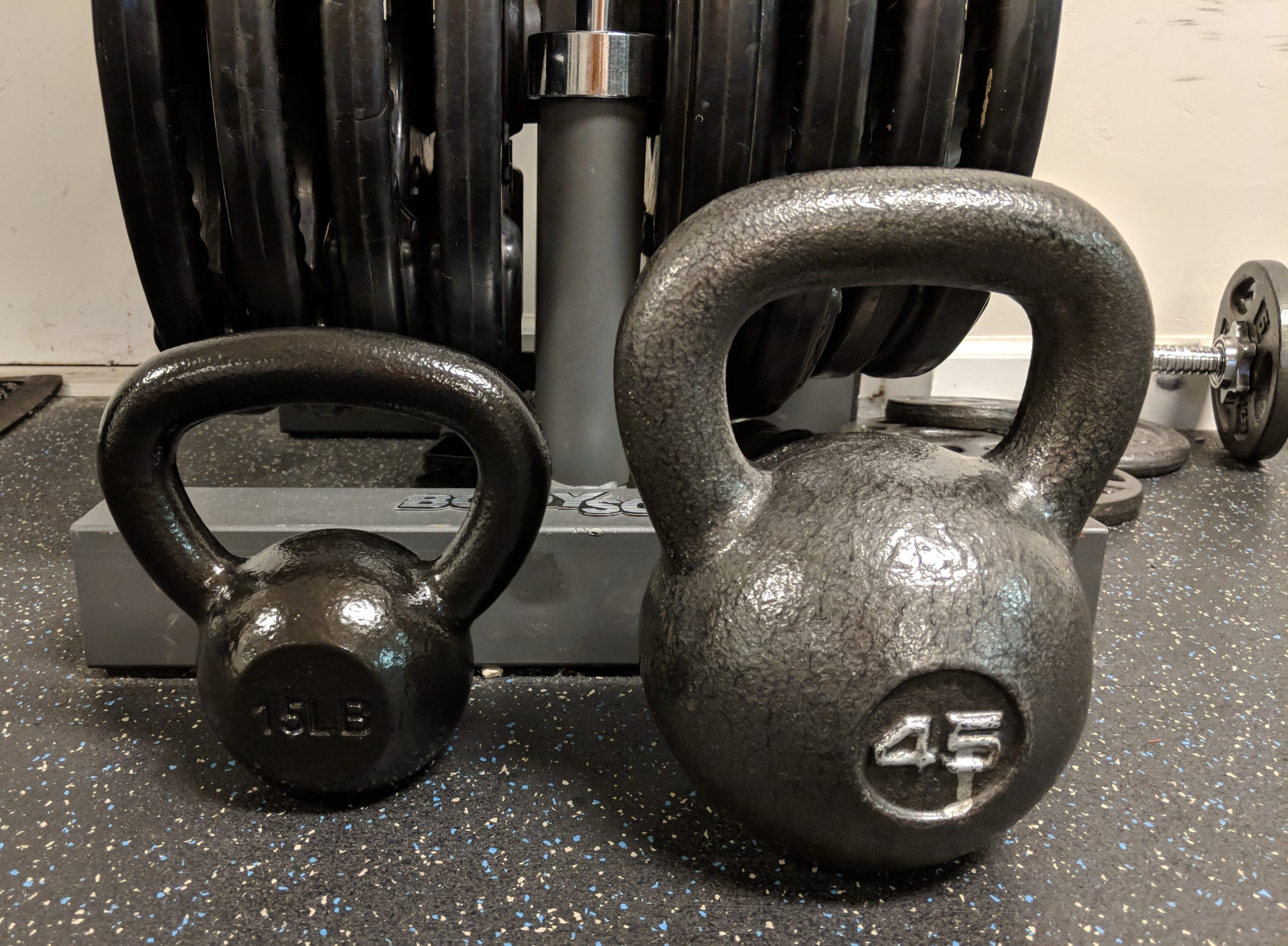
About all I’ve got that I own to replace the dumbbells and the kettlebell is a 15 lb kettlebell that I purchased so Jackie could join me in my workouts if she wanted.

My 15 lb kettlebell with its big brother

With the kettlebell (even in advance of the arrival of the rings) after about a week of social distancing, I’ve started to put together a routine that feels like I’m getting in a good workout.

For the core of the routine I’m doing hindu squats, hindu pushups, and goblet squats with the kettlebell. I’ve heard claims that just hindu squats and hindup pushups combine to form a pretty good, almost full-body workout. I’m adding in the goblet squats because the hindu squats seemed very focused on the anterior part of the legs, and I don’t want to lose the gains I’ve been making on the posterior parts.

My opportunities for “pulling” exercises are kind of limited until I get my gymnastic rings. I’m making do with the kettlebell to replace the dumbbells for rows. At 15 lbs, the kettlebell is kind of light for that, but on a temporary basis I can just do more of them. (The same logic applies to the hindu squats and the goblet squats: What I’m not getting in intensity I can largely replace with quantity.)

Once the rings get here I should be able to do hangs and inverted rows, and attempt to do pullups. That’ll cover my “pulling” exercises very well. I’ll also be able to attempt to do dips, which is another exercise that I haven’t found a good equipment-free bodyweight solution for.

One other piece of exercise equipment I have is a jump rope. I got it five years ago, after reading about how jumping rope is great training for running because it develops the springiness in your ankles and calves.

I haven’t made much use of my jump rope though. One year back in junior high or high school the phys ed class did one of its very few units that wasn’t focused around some team sport, and jumping rope was one included activity. I very much enjoyed the non-team aspect of it, put in the practice, and got quite good at jumping rope. Sadly, it turns out that you can’t let something like that go for 45 years and expect to just pick it back up again.

However, I figure this is a perfect circumstance for regaining my ability to jump rope. The weather is kinda crappy for running, but not so terrible that I can’t go outside at all. Yesterday I spent six minutes jumping rope, which was about as long as I wanted to spend outdoors in the cold, but also a good amount of practice for recovering the skill. I figure if I do the same every other day, by the time we start getting some nice weather I’ll be as good at jumping rope as I ever was.

I’ll use the jump rope for a HIIT workout. My HIIT workouts with the 45 lb kettlebell are off the table, and with just the 15 lb kettlebell I won’t be able to achieve the level of intensity I’m used to for my two-handed kettlebell swings. Besides the jump rope, I’m thinking I’ll do one-handed kettlebell swings with the 15 lb kettlebell. Less intensity, but the asymmetrical nature of the exercise will add a nice core workout aspect to the whole thing.

It’s come together pretty well, except that I’m not quite there with the hindu pushups yet. I need to develop both my strength and my flexibility, if I’m going to make those a key part of my workout routine. I’m close though. We’ll see.