I’m watching a video on how chronic stress reduces your adaptation to things like exercise. It’s down on passive coping strategies, such as “seeking out alcohol, watching TV, procrastinating, talking to friends, [and] moaning about the problem.” Instead the video recommends “active coping strategies, such as “actually deal[ing] with the problem,” and recommends such things as “if you have a problem with somebody, talk to them.”
And I’m like, “Okay, that’s a big nope.”
I mean, it’s not wrong… “This is what the stress energizes you to do. So you want to take advantage of that fight-or-flight mode? Seek out what the root cause of your problem is, what it is that is giving you stress, and then tackle the problem head on.”
Except I do not want to take advantage of that fight-or-flight mode, except that I do want to flee if at all possible.
And those passive coping strategies? I’m all-in. I mean, moaning about the problem is like 90% of my whole personality.
Ashley, on the other hand, is totally down with both fight and flight responses:
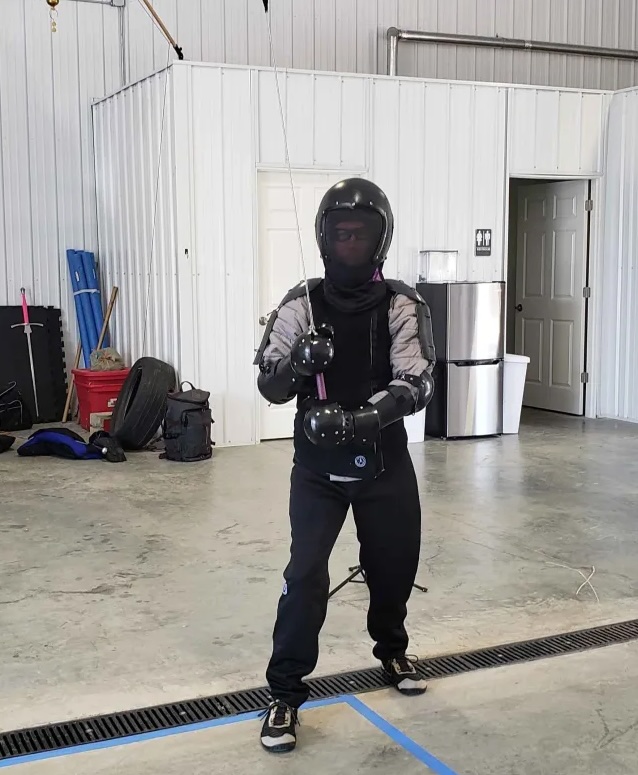
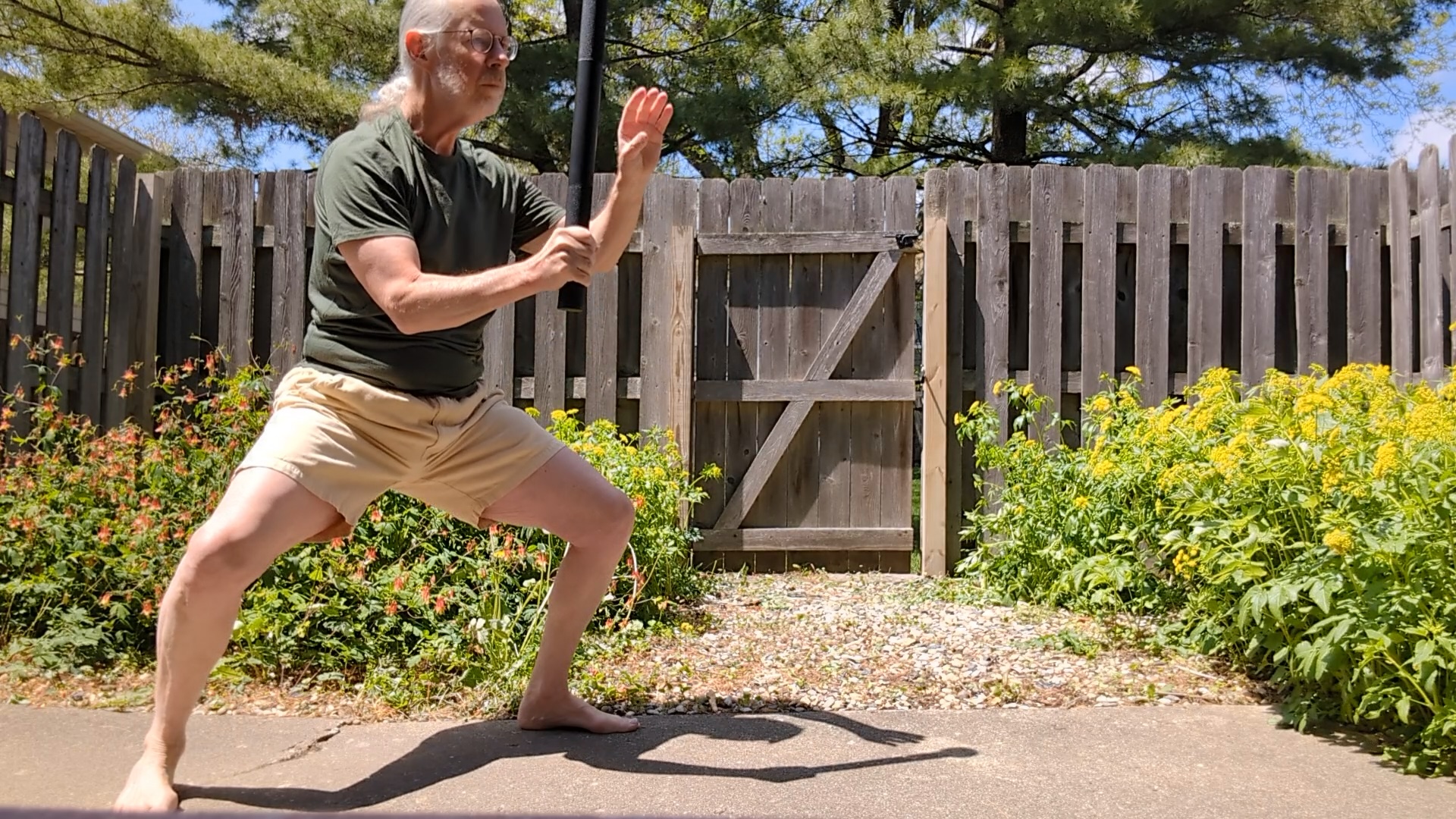
I wanted a workout to practice my Meyer fencing stance—a workout more interesting than just standing in the stance for a minute or two.
Mark Wildman, in one of his a live Q&A videos, suggested the mace drop swing as a useful exercise for someone doing longsword. (It was in response to a question I asked about improving arm strength and endurance for holding your arms forward and overhead at full extension for extended periods, as one does in longsword.) He had suggested doing it in Warrior 2, but specifically mentioned that you could do it in whatever stance went with your longsword style; it just got harder as your stance got wider.
Besides being boring, just standing in a Meyer stance for a minute or two seemed like a missed opportunity; even a modest challenge to your stability in the stance seemed like it might pay off in strength, flexibility, and control of your stance.
So here’s the workout I came up with:
Get in your best Meyer stance, with your mace in your front hand. Execute 5 drop swings, checking your stance after each rep. Shift the mace to your rear hand and repeat. Take one passing step forward. (Your mace will now be in your front hand.) Repeat five swings with the front hand and five swings with the back hand.
That’s one set.
Here it is as a video:
My plan is to gradually add sets until I can comfortably stay in the Meyer stance for 5 or 10 minutes, to build the habit and capability of keeping a good stance while it is challenged by a shifting weight.
I think my stance is okay here. Of course, there isn’t just one Meyer stance. This image from Meyer’s treatise show the range pretty well:
The front two figures are both in what I think of as a basic Meyer stance. The two figures behind them are also in Meyer stances, the one on the right in something of a lunge, the one on the left in a more upright stance.
My drop swings clearly need a lot of work (do not copy mine!), but that basically comes along for free as I do the stance workouts. (I wrote a post called Fitness training for longsword, Mark Wildman style that embeds two Mark Wildman videos of the Warrior 2 stance mace drop swing, if you want to see someone doing it better.)
I’m doing the swings with my 5 lb mace. I have a 10 lb mace that I’ll want to move up to, once I have the drop swings a bit more under control.
Went for a 3.3 mile run yesterday, with a time much too slow for me to be willing to mention it here. (I don’t know how much of the slowness was the previous day’s sword fighting training and how much of it was yesterday’s extreme heat, but boy was it slow.)
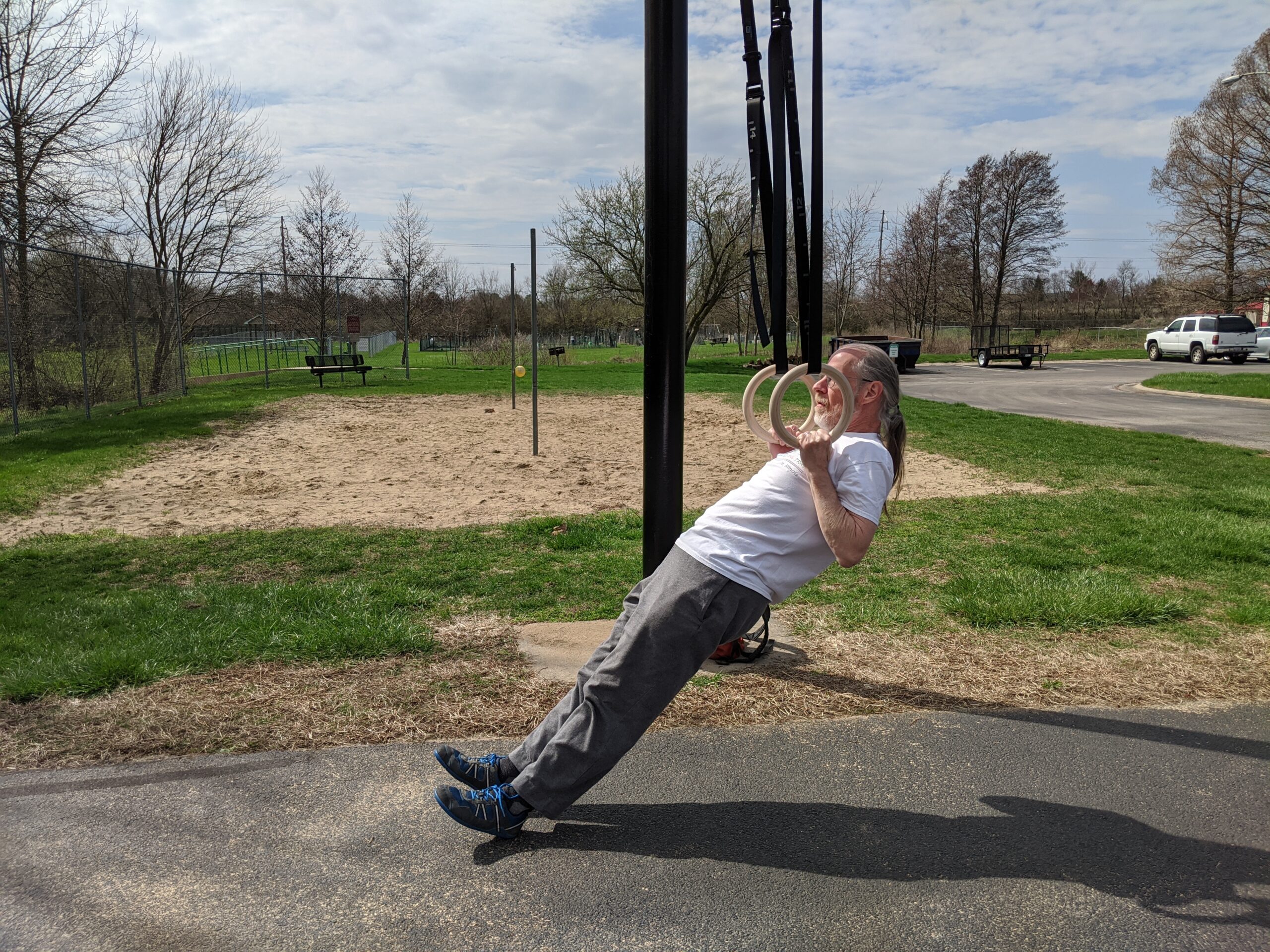
Early in the pandemic I bought a set of gymnastic rings, started training with them, and got great results. They have a few downsides, though: Since I hang them up outdoors it’s no fun to us them when its cold or wet or windy. Also, the easiest place to hang them up (the basketball court) is kind of out in public. I don’t really mind people watching me workout, but occasionally it’s a little awkward.
I neglected to get a photo today, but this is pretty much what I looked like.
Especially during the winter, I’ve largely switched to steel club exercises. I can do them in my study, and they’re a similarly good workout. Besides that, they add an element of rotation which I find useful to support my fencing.
One downside of club (and kettlebell) exercises is that they’re really not practical to do to failure.
Exercise machines are great to do to failure. With little or no risk of injury, you can know that you’ve gotten the maximum stimulus to strength and hypertrophy. With kettlebells or clubs, training to failure means that a big steel weight goes flying out of your hands and into whatever happens to be in the vicinity—a terrible idea.
The rings are closer to weight machines. I use them almost exclusively for three different exercises: inverted rows, dips, and pull ups. Do any of them to failure and all that happens is you don’t finish a rep. I suppose actual gymnasts do various sorts of inversions and such, where it might be dangerous to fail a rep. That’s not an issue for me.
Anyway, this morning I got my rings out, put them up at the basketball court, and did a version of the same circuit I did many times over the past five years. I did three rounds of:
Jump rope
This was mainly just to get/keep me warmed up for the rest of the round. I did sets of 100 jumps, and was pleased to find that I could still do them with just one or two misses in a set.
Inverted rows
These are a way to work the lats. I’ll hope I can do pull ups again soon, but even then I’ll probably stick to inverted rows for half my lat exercises. I did sets of 8 rows to failure, which is exactly what I was going for.
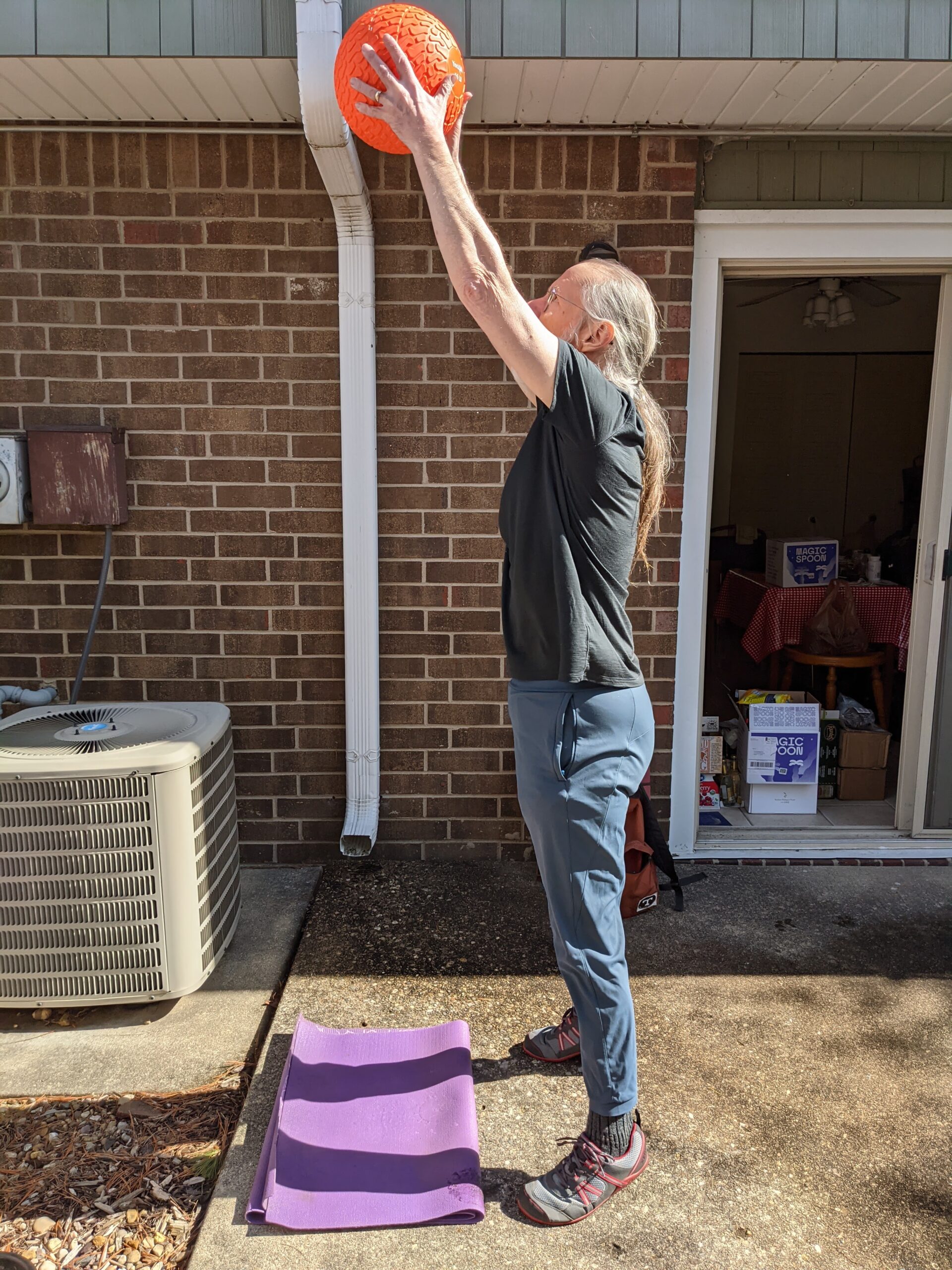
Slamball hunter squats
This exercise comes from Mark Wildman’s slamball program. You powerclean a slamball, do a double-pivot to turn 90 degrees to one side, which leaves you in a stagger stance. Then you drop down to a hunter squat (about mid-way between a squat and a lunge), holding the slamball in front of you. Then you stand back up, double-pivot again to face forward, and drop the slamball. Then you repeat, pivoting the opposite direction.
I was doing it with a 15 lb slamball, which isn’t terribly heavy, but I was too lazy to carry my heavier slamball out to the basketball court.
I did sets of 6 to 8 reps (3 or 4 each direction), which isn’t enough to reach failure on my legs. I either need to do more reps or else bite the bullet and bring out the 30 lb slamball.
Dips
Somewhat to my surprise, I actually managed to do 1 dip! That was all I managed though, so I satisfied myself with doing negative dips for the rest of my reps. But if I can do 1 dip, being able to do sets of 3 or even 4 is not far off.
Hollowbody hold
This was easier than I’d expected, I guess due to the Mark Wildman ab exercise program I’d been doing for a few months now. I did a 45-second hold each round.
I did a total of three rounds, which is what I did for most of my rings workouts in years past. It felt like a legit good workout.
I’m thinking two of those workouts per week, plus two club workouts per week, plus two runs per week (a long run and a fast run), would add up to a great, well-rounded exercise routine. Of course, I’ll also want to do a fencing class as well, adding up to seven workouts per week, which is perhaps a bit more than would be wise, but I don’t see any alternative.
For years I worried a lot about daily routines. (Just click on the tag for “daily routine” and you can find literally dozens of posts on the topic.) Of late, that seems to no longer be the case. It’s been years since I posted on the topic.
A few days ago though, my brother mentioned me in a toot on daily routines, which prompted me to wonder what my current daily routine actually looks like. Turns out, I do have a daily routine, that I stick to pretty well (with minor adjustments for errands, medical appointments, etc.).
Unsurprisingly, it’s rather sun-aligned.
(6:00 AM) I get up around dawn, which is at different times at different parts of the year, but is around 6:00 AM right now. I drink a (ginormous) mug of coffee (or two). I spend some time dicking around on the internet, check my social media feeds, chat on-line with my brother, and get an update on our mom (who lives with him). I also check my Oura ring, to see how well I slept. (That’s a joke. Of course I know how well I slept. But the information my Oura ring provides is nevertheless sometimes valuable.) We usually do the Jumble via chat during this time as well.
(6:40 AM) Around sunrise I take the dog for her first walk of the day. That’s been around 6:45 lately, but is getting earlier every day just now.
(7:00 AM) After first-walk I might have a third cup of coffee, but I proceed to fixing and then eating breakfast.
(8:00 AM) After breakfast it’s time for the dog’s second walk. This is the long walk of the day. In bad weather it might also be just 20 minutes, but is usually at least 40 minutes, and in really nice weather might be an 90 minutes or longer.)
(9:00 AM) Once I get home from second walk, I proceed to my morning exercises, which I ought to be able to do in 20 minutes or so, but which often stretches out to twice that long. I’m working to shorten it, so I have some hope of getting something else done during the day.
(9:30 AM) After morning exercises (which is really a stretching/flexibility/mobility routine), I proceed to my workout, unless it’s a rest day. That takes 40 minutes to an hour.
Since I started drafting this post three or four days ago, I’ve been tracking the start and end times of my morning exercises and my workouts, with an eye toward collapsing the total time for this stuff down to the 60–80 minutes that it should be. If I can do that, I should be able to finish no later than 10:30, which should give me most of three hours available to get work done, before I need to break for the main meal of the day.
(10:30 AM) Get work done!
(1:00 PM) Jackie and I have moved our main meal of the day to 1:00 PM or 2:00 PM, which provides just a bit more flexibility for getting work done in the morning (although that time gets used up if I need to run an errand, or if I’m fixing lunch that day). Ashley usually gets her third walk of the day either right before or right after lunch.
I generally don’t even try to get anything useful done after that. I might take a nap. I might read. I might spend some more time dicking around on the internet. Just lately, I’ve been trying to get a backup server configured so that my brother and I can backup our backups to each other’s servers, meaning that we’ll have off-site backups.
(4:15 PM) At 4:15 PM we have our cocktail hour call with Steven and my mom. We’ve all cut back on alcohol consumption, so we usually drink water rather than a cocktail, but we’re sticking with the call. It means I get to talk to my mom nearly every day.
(4:45 PM) After cocktail hour I take Ashley for her fourth (and now, finally, last) walk of the day. When she was a puppy I had to take her for eight walks a day (to keep her from peeing in the floor). That ramped down pretty quickly to seven and then six, but it took a long time to get her down to five and then four. But this is actually much more convenient for me, as well as being enough walking for both of us. (I average over 12,000 steps a day, even in the winter. In the summer it’s more like 15,000.)
(5:30 PM) After fourth-walk I usually sit down to watch some video entertainment with Jackie, or else read some more.
Jackie goes to bed quite early most days, a remnant from her days working at the bakery (when she had to get up at 4:00 AM).
I generally like to go to bed a couple of hours after sunset, although not that early in mid-winter nor that late in high summer. Just lately I’ve been aiming to take Ashley out of the patio for one last peeing opportunity in time for me to get to bed around 9:00 PM.
There’s some variability, of course. Mondays I do Esperanto in the early evening. Wednesdays there’s (just recently) a gentlemen’s lunch. Thursdays there lunch with some former coworkers, that’s been going on in some form or another for decades now. Sunday afternoons (and when I’m feeling fit enough, Tuesday and Thursday evenings) there’s sword fighting.
As I said above, the main value of this post to me seems to be around how I might get my warmup and workout done more compactly. I think I’ll write about that soon, and if I do, I’ll link to it here.
Some months ago my elbow started hurting. (The little bump on the inside of my elbow joint was where it hurt.) I don’t think it was a sword-fighting injury; I think it was a dog-walking injury—but the sword fighting seemed to aggravate it.
So I did less sword fighting. I switched from three times a week to just twice, and then just once, and then I quit going altogether. Then last week I traveled to Amherst to visit my brother and my mom, and just about didn’t exercise at all while I was on that trip. My elbow got steadily better, so that for about a week now, it hasn’t hurt at all.
So yesterday I went back for a sword-fighting class!
The class was kind of abbreviated. At the beginning of class we did a bearpit for a member’s birthday, so I got to do three passes at longsword. Then we did an actual class on rapier fencing. Then we were going to switch to longsword, but there was a tornado warning, and we all stopped to stare at our phones, looking at weather radar and texts with friends and relations in the area, making sure we were all okay.
Turns out that’s just a well. My elbow seemed to hold up fine during class, but today it’s a bit twingey again, so I’m glad I didn’t aggravate it more.
This pretty clearly means I’m not ready to go back to three-times-a-week training, but maybe it doesn’t rule out once-a-week training.
I’ll see how my elbow feels over the next few days.
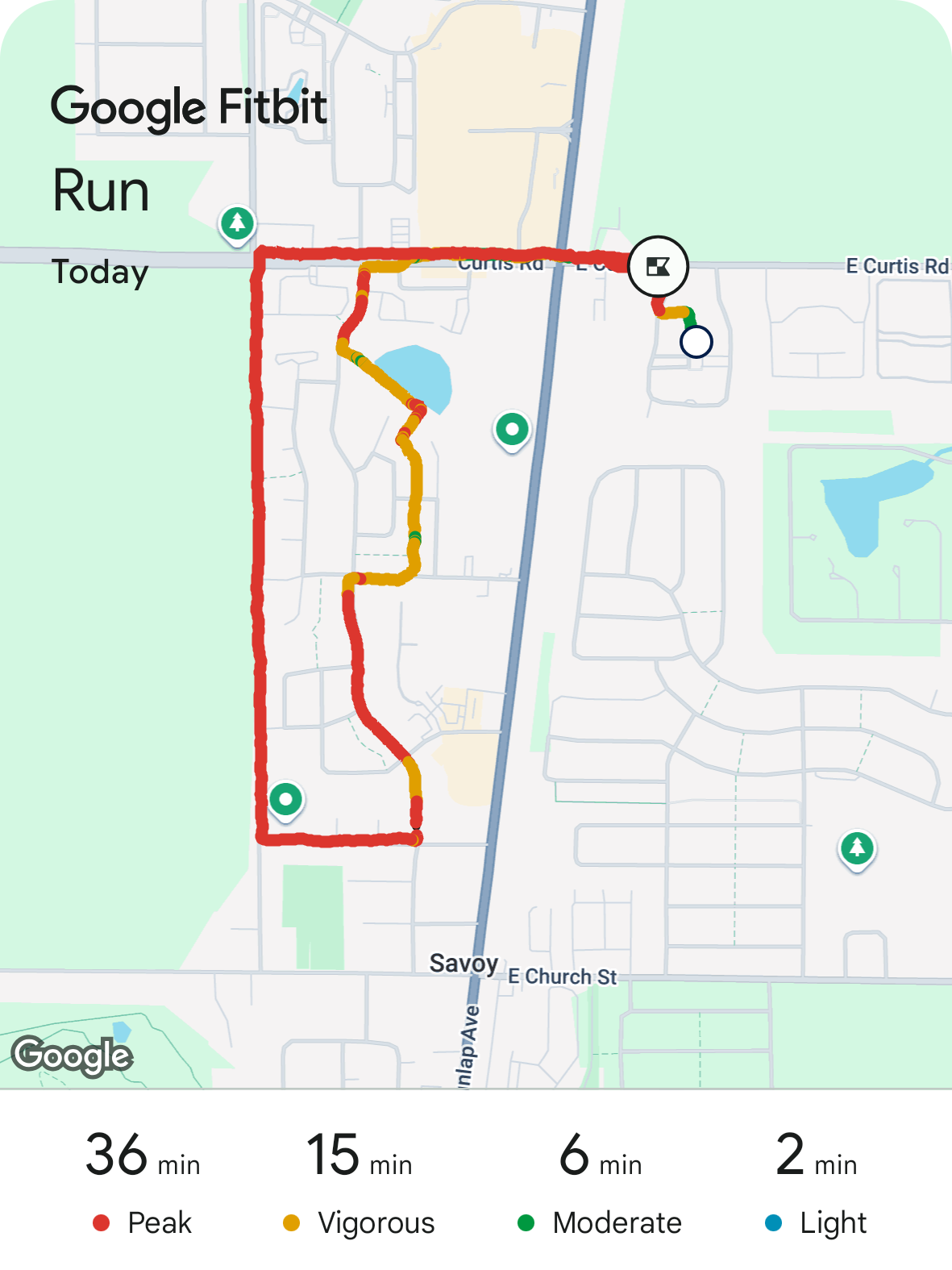
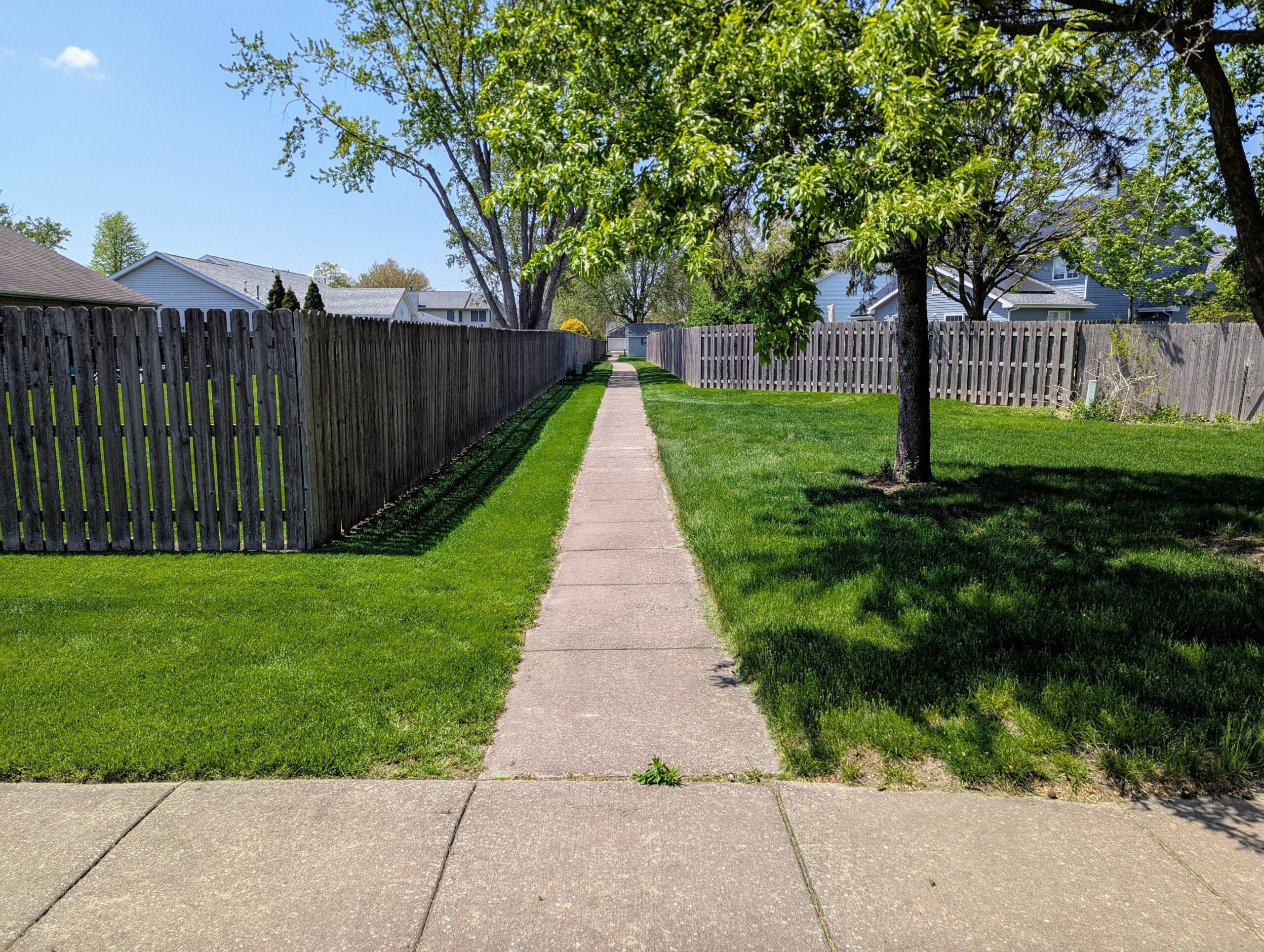
Got in a very nice run today with Ashley, going 2.46 miles in (despite what the image says) 33:41. Ashley was a Very Good Dog on the run, despite just a little bit of grabbing the leash in her jaws after we turned back toward home. 🐕 🏃🏻♂️
For most of my adult life, trying to use “intuition” to decide on rest days would have been a terrible idea. If I’d let myself say, “Hmm. I don’t really feel like a workout today,” I’d scarcely have worked out at all. Instead, I came up with a schedule, and stuck to it, either well or poorly.
When I stuck to it well, I’d see progress. When I stuck to it poorly, I wouldn’t.
Starting around 5 years ago or so, something changed in my brain: I started really enjoying my workouts.
Partially, it was that they were working well, which is just satisfying. But it was more than that. First, I noticed that I felt better after a workout. Then I started feeling better during a workout. Instead of it being hard to motivate myself to work out, I craved workouts.
People who knew me were mildly disturbed by this. It was unlike me. It was certainly unlike them. I would not be surprised if they began to suspect that I was some sort of pod-person.
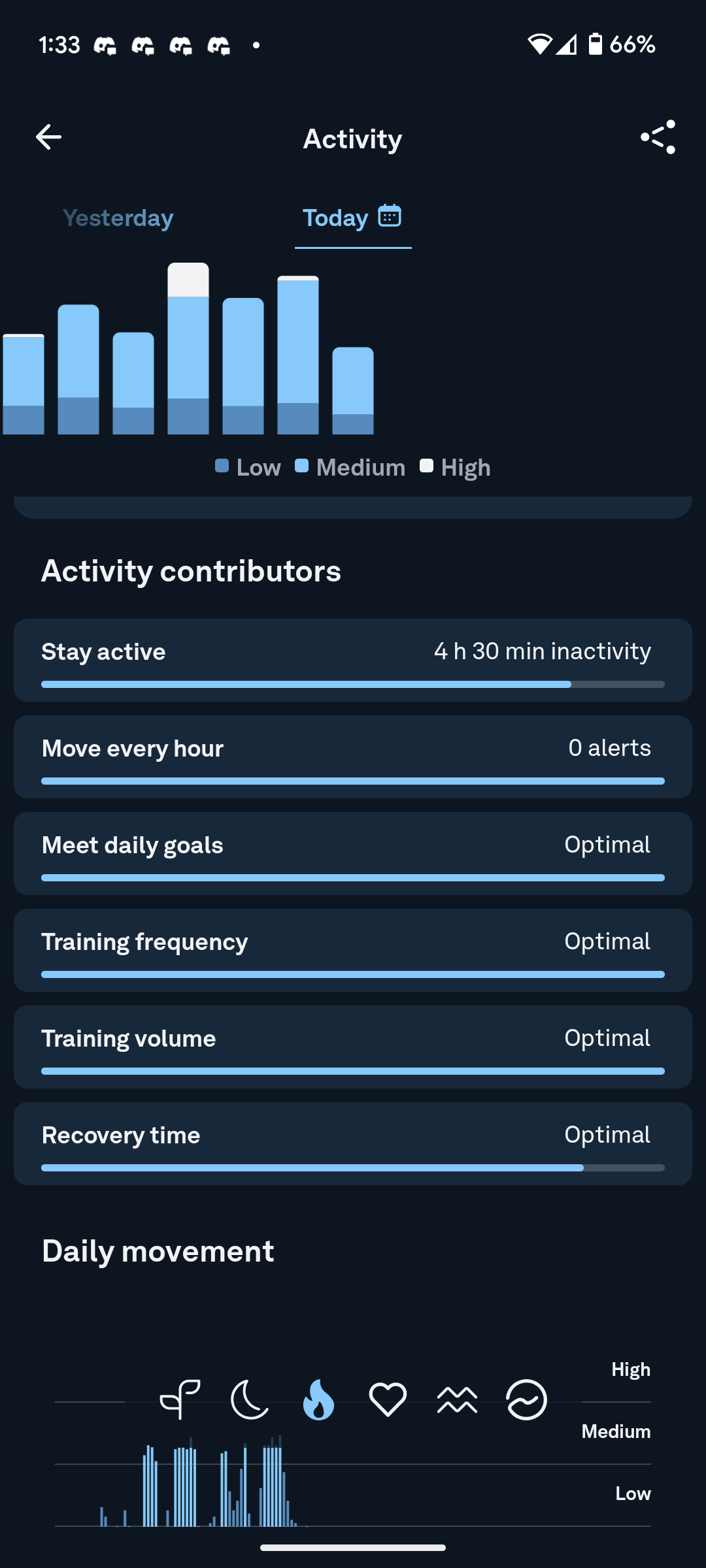
Because I wanted to work out nearly every day, I would sometimes wonder if I was over-training (or under-recovering), but that’s not trivially easy to determine in the moment.
I’ve long tracked my workouts, but not really in a consistent way—I’d just write down what I did that day. Sometimes I could look back and say, “Wow. That looks like a serious workout,” and other times I’d look back and say, “Was that really a workout?” But often times it wasn’t clear either way.
Just lately though, I’ve been doing the Mark Wildman workout programs that I mentioned a few weeks ago. That gives me a pretty consistent metric. I’m doing three different programs, each of which has 4 to 7 different levels, each of which can be done with an almost infinite range of weights, but they all have a consistency in design: start with a light weight, work up in complexity, then bump up the weight but go back down in complexity. If you’re consciously attempting to make progress, then it’s pretty easy to make each workout “count” as a workout, while avoiding overdoing it in any particular workout.
But while avoiding overdoing it in any particular workout is good, it is possible to do that, and yet get over-trained, simply by doing too many workouts with inadequate recovery.
So, today I went back over my past 3 months’ training log entries. For my first cut at this, I’m just counting rest days. I figure that I want to work out either 5 or 6 days a week, which makes any week where I have either 1 or 2 rest days a “good” week.
In the past 13 weeks I’ve had 1 week with 0 rest days, 1 week with 3 rest days, and 1 week with 4 rest days. All the rest were “good” weeks with either 1 or 2 rest days.
That’s just about perfect. The usual advice is to take a “deload” week every 4 to 6 weeks, so 2 weeks out of 13 being weeks with extra rest just about hits the nail on the head. The one week with 0 rest days was probably just an artifact of rest days falling outside of one calendar week—not a big deal, as long as it’s rare.
Anyway, the intuitive rest days seem to be working well. I’m getting in my workouts, and I’m getting in adequate rest. I guess I can stick with it for a while.
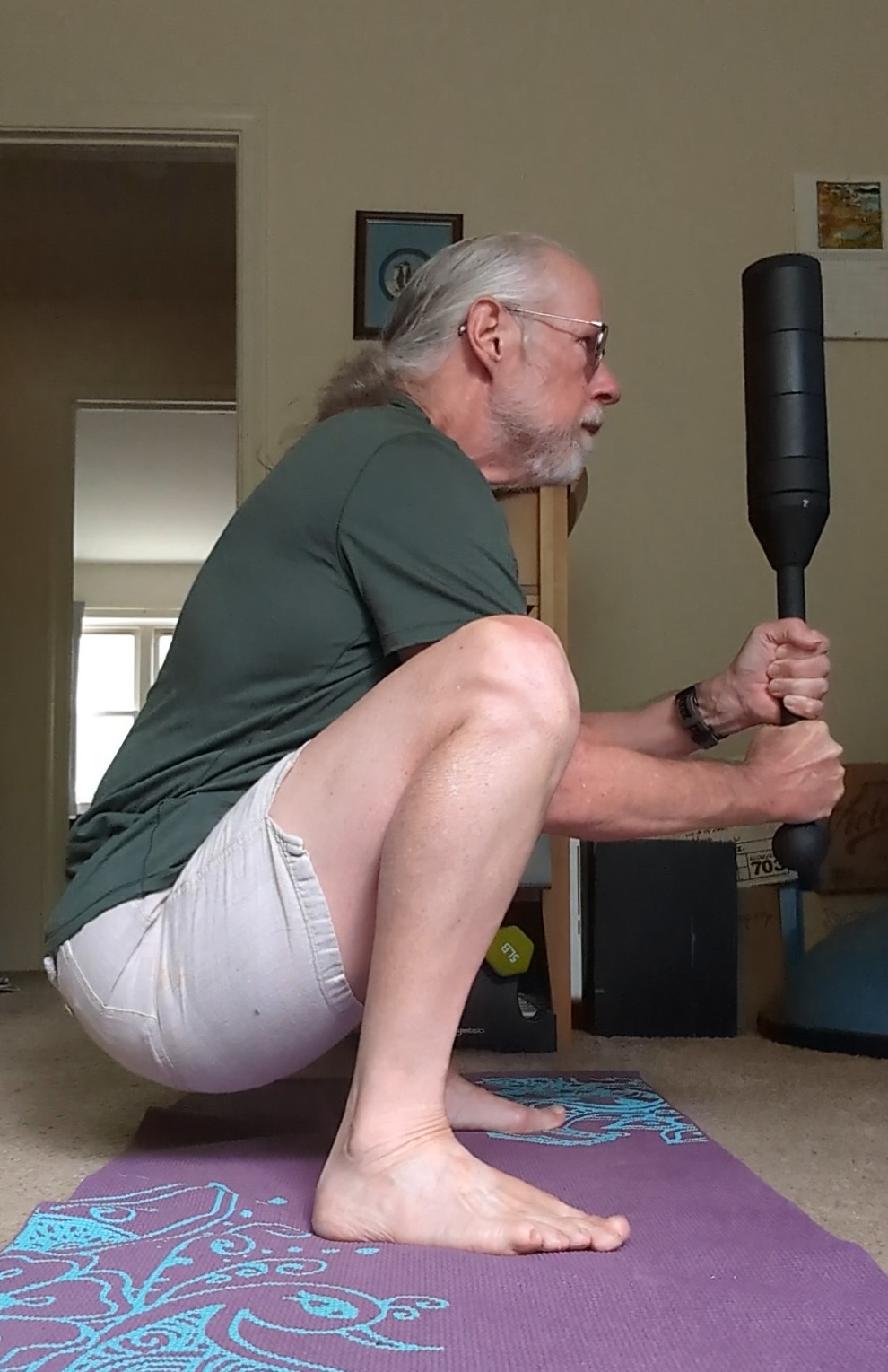
Today’s workout was 2-handed club swinging followed by abs.
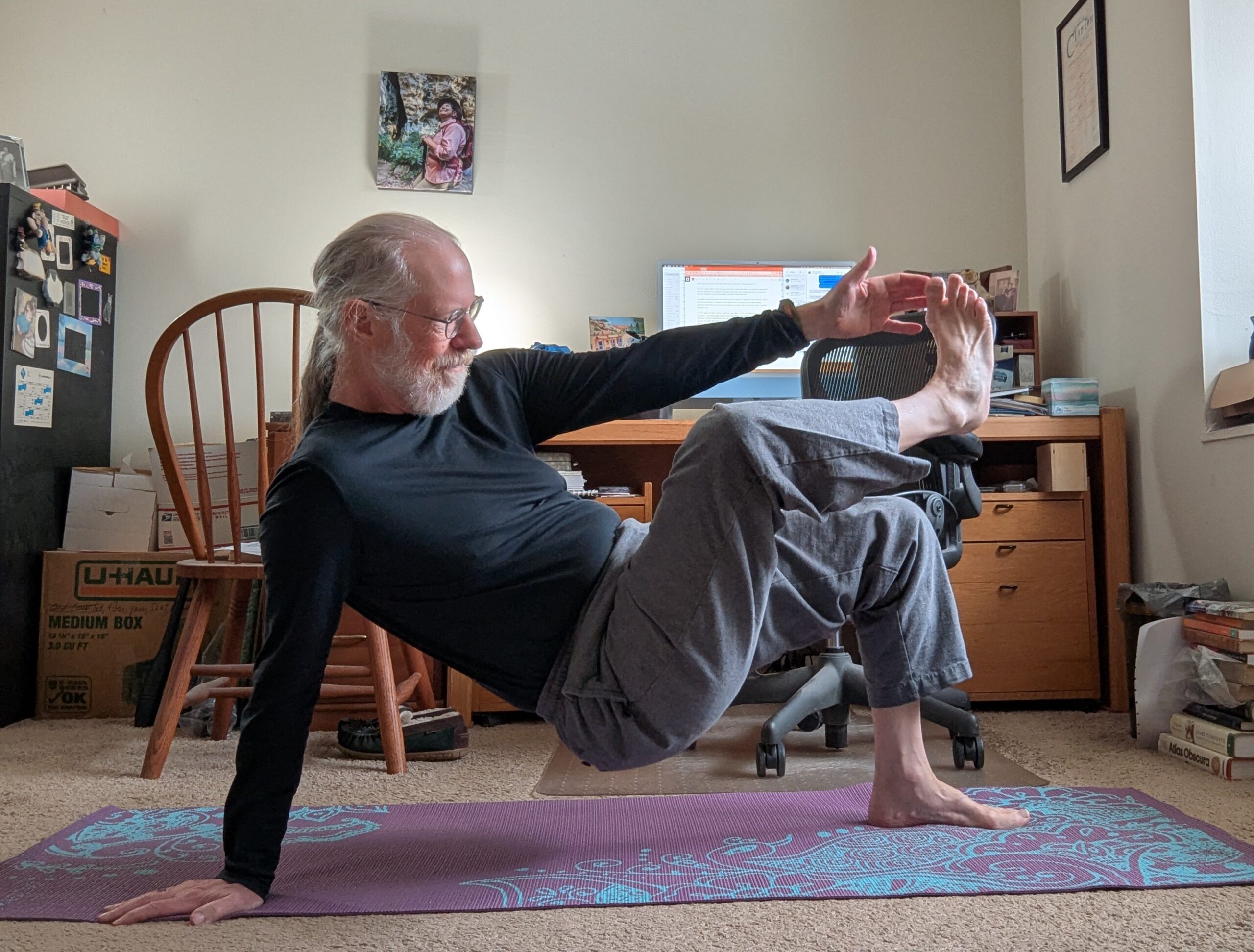
The main workout went fine, but when I started the ab workout, Ashley had come upstairs. She found the postures of my workout (hollow-body, plank, etc.) to be very provocative, inspiring her to want to help.