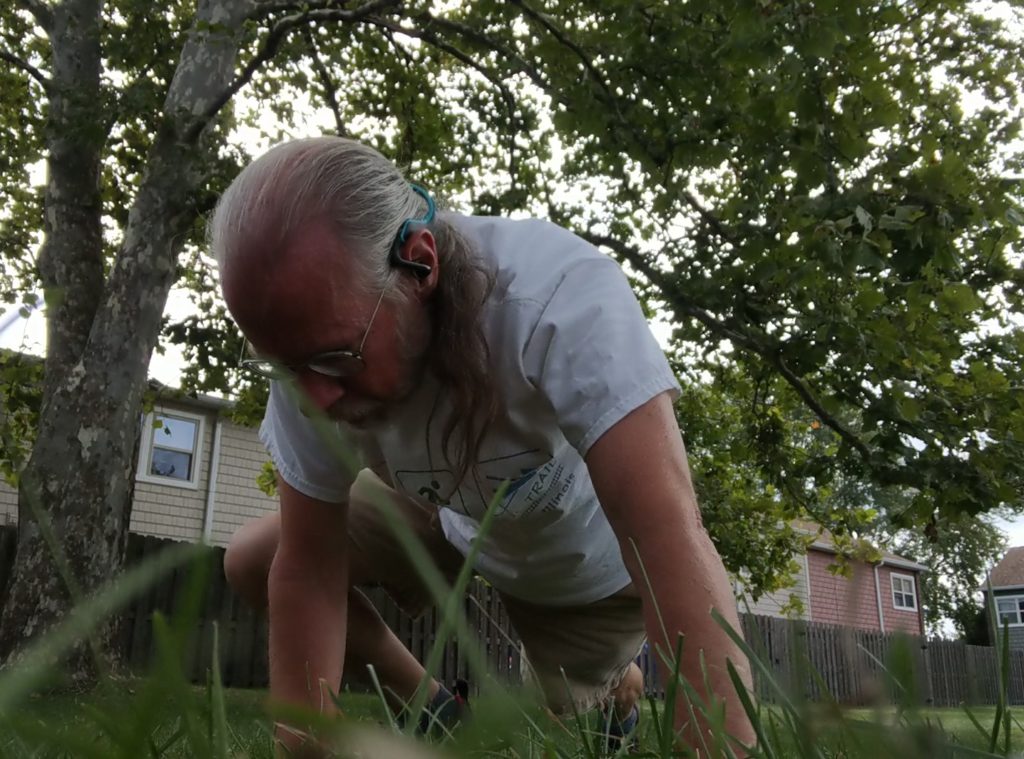
Jackie was fixing blue-corn pancakes with maple syrup for breakfast, and eating that many carbs first thing in the morning can be a problem for me. However, I have come up with a strategy for dealing with it: Getting in a pre-breakfast fasted workout. My theory is that by doing this I deplete my muscle glycogen, so that my muscles are primed to soak up all the carbs I eat, minimizing the degree to which the glucose spikes my blood sugar.

I have no data to show that this works, but anecdotally I can report that it seems to help.

I’ve been wanting to go for a run. I had planned to go for a run yesterday, but it ended up being rainy enough that I decided to postpone the run for a day. So I might have gone for a run for my pre-breakfast workout, but Jackie was hungry early, and I didn’t want to delay breakfast by an extra hour.

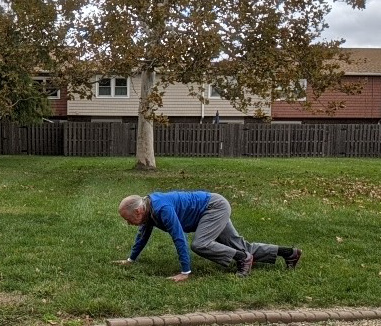
So, I did what’s becoming my standard HIIT workout: I warm up with 3×25 Hindu squats, and then I do 3×25 kettlebell swings with my 53 lb kettlebell. It’s a quick workout—it’s all done in 20 minutes, including some amount of pre-workout warmup—and it’s of high enough intensity to burn off plenty of glucose.

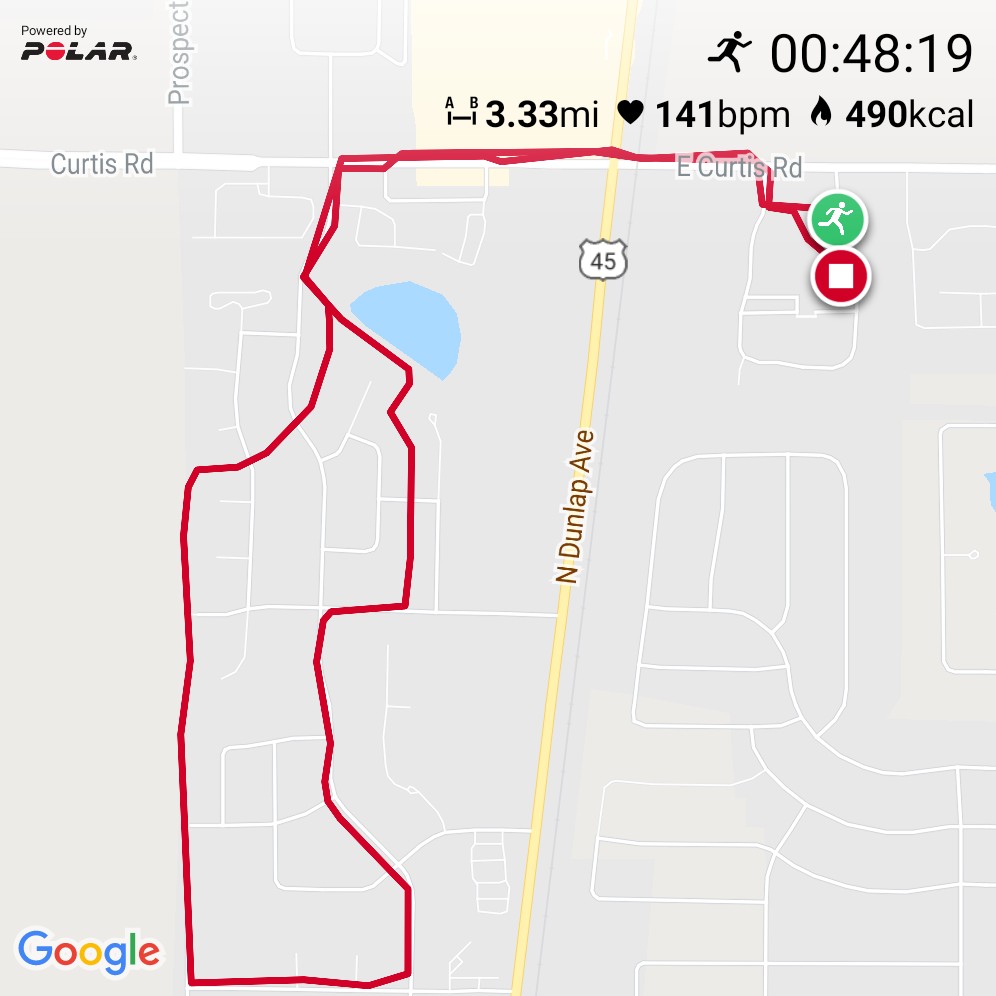
After breakfast (and a bit of digesting) I went ahead and got out for my planned run. After the persistently sore foot I’ve been dealing with for months now simply refused to get better, I had taken a full month off from running to see if all I needed was plenty of rest to fully recover, and that may have done the trick—I went out for a 3.33-mile run, and I had no foot pain whatsoever.

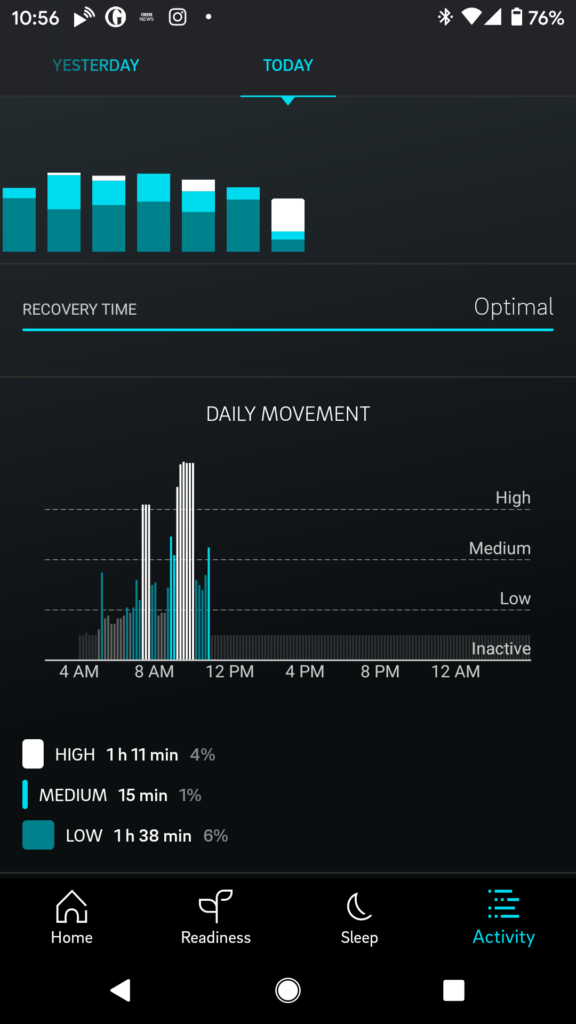
I don’t wear my Oura ring for the kettlebell workouts (or other workouts where I have to grip something, because handles, bars, and (gymnastic) rings don’t play well with the Oura ring). However, my Polar heart rate monitor will tell Google Fit about my workout, and the phone app for the Oura ring will read that data and give me credit for what I did while the ring was off:

My peak heart rate during the kettlebell swings would have seen me to much higher activity levels than the just-barely “High” levels shown, but that’s because it’s an interval workout. A set of 25 swings takes me just about 50 seconds, and then it takes about 3 minutes for my HR to drop low enough that I can do another set. The software is averaging those periods together. Unless I’m doing sprints (which I didn’t today) a run is just a steady-state effort. I try to keep my HR down in the MAF range, but didn’t manage it today (because of the prior HIIT workout).

One thing I’ve started doing (without really thinking about it until just today) has definitely improved my life: I’ve changed my attitude about “saving” energy for later.

It used to be that I’d consciously do less, if I expected to need that energy later. (And not just with energy. I’d ration all kinds of things that I had in limited supply. When I was suffering from plantar fasciitis, I’d ration my time spent standing or walking.)

I do much less of that now. It’s not that I have boundless energy, but I’m consciously refraining from setting boundaries in advance: I treat my energy as if it were boundless—and then, only when I find that I’ve become very tired, do I go ahead and quit spending energy with reckless abandon, and prioritize recovery.

One key here is having come to understand how important that second step is. I deplete myself, and then I recover. The more I do both of these things, the better I feel.

Children are like this—boundless energy and then none. (It was somebody pointing this out that prompted me to recognize that I’d shifted in this direction myself.) Broadly speaking, natural systems often work this way. A grassland that is intensively grazed and then allowed to fully recover tends to be healthier, more productive, and more diverse than one that is perpetually grazed, or one that goes ungrazed for long periods of time.

I recognize that I have some privilege here. I’m in a position where, if I tire myself out, I can just decide to stop whatever I’m doing. Someone working on a chain gang (or in an Amazon warehouse) doesn’t have that same option. If you’re not in control of when you stop, acting like you had boundless energy could get you into real trouble.

I finally got my new kettlebell!

Kettlebells have been completely unavailable since March, when all of a sudden nobody could just share the kettlebells at their fitness center, so everybody who used them went out to buy their own. I’d been looking around on-line every few days all through April, May, and June, checking at WalMart, and Dick’s Sporting Goods, and Amazon, and Onnit, all of which were perpetually sold out. But back on July 1st, I found a place via Amazon that had the size of kettlebell I wanted (53 lbs = 24 KG = 1.5 pood). It was expensive, but after waiting for months I was ready to pay up.

And yet, that was not the end of my story of woe. The package went to FedEx which said it would be delivered the next day. It made it as far as Ellenwood, GA, at which point they said it would be delivered in two days. But it never departed Ellenwood. On the day it was supposed to be delivered they claimed it would be delivered by the end of the day until it was the end of the day, at which point its expected delivery date changed to “Pending.” After two more weeks I contacted the vendor who said, “Oops, looks like FedEx lost it. We’ll send another.” And then exactly the same thing happened: It made it as far as Ellenwood, GA changed from “next day” to “two days” to “pending” and then stayed there.

But this time it didn’t vanish forever. FedEx eventually found it, and yesterday the FedEx guy muscled my 53 lb package up to my doorstep!

I’d been working out with kettlebells for maybe 4 years before the pandemic started, using the one kettlebell in the fitness room (the only one I had access to), which was 45 lb (= 20 kg = 1.25 pood). Over the first few weeks I’d worked up to doing 3×25 swings, which is probably enough to be a good workout for the posterior chain. Then I’d experimented with doing it as a HIIT workout and tried various alternative workout plans. For a while I was doing 30 seconds of work followed by 30 seconds of rest for (eventually) 10 rounds. Then I switched back to doing them in sets of 25 and had just worked my way up to 5×25 when we had to go into quarantine, and I lost access to the kettlebell.

After 4 months of not doing them, I was inclined to be quite careful about swinging this one, especially since this kettlebell is 8 lbs heavier. Yesterday by the time it’d arrived, I’d already had a beer, and I decided not to even try to swing my new kettlebell while even slightly under the influence.

Today though I got it out and did 6×10 swings, which was a pretty good workout.

I’m sure I’ll be able to work up to sets of 25 swings pretty quickly once again. Or maybe I’ll stick with 30-second intervals and go back to doing them as HIIT workouts.

Whatever I do, I’m delighted to have my new, heavier kettlebell!

Looking at my “readiness” score for today I’m perhaps slightly less ready than I was five days ago, when I let my Oura ring mislead me into postponing a rest day in favor of some hill sprints.

In fact, I felt enormously better today, and my performance shows that. Today’s run was a bare one minute longer than my run at the beginning of the week, but I ran a full mile further:

[sgpx gpx=”/wp-content/uploads/gpx/Philip_Brewer_2020-07-31_08-49-32.GPX”]

I’m not sure there’s anything to learn from this. Maybe “don’t skip rest days” would be a good start. I’m sure “listen to your body” is always good advice. Whatever lame platitude you want to go with is fine with me. As for me, I’m just glad I got in a good run.

In other news, the replacement kettlebell for the one I ordered on July 1st, but which vanished into some black hole at FedEx’s Ellenwood, GA location, only to vanish itself in exactly the same way, seems to have been discovered, and is now supposed to be delivered next week! We shall see.

View from a run

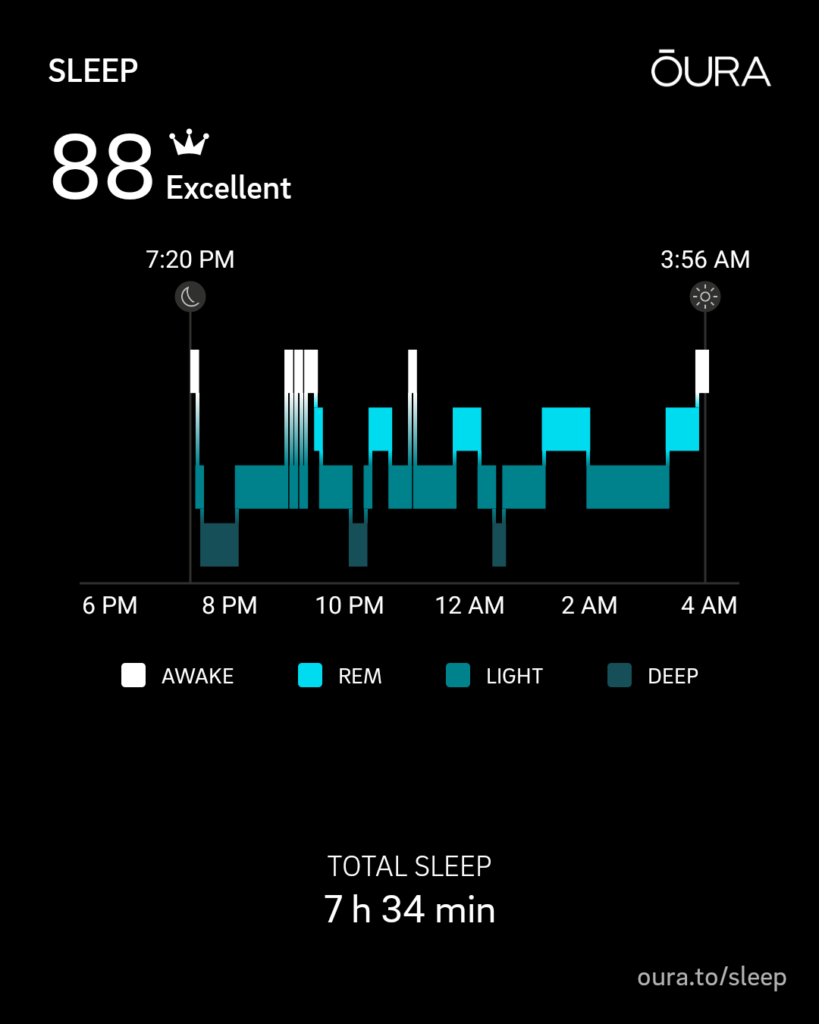
My Oura ring produces a “readiness” score each day, and I’ve found it to be a pretty good indication as to whether or not I’m up for a long run or a hard workout. The times I’ve ignored it when it said I needed to take it easy, I’ve often found it was right and I was wrong. Today was a rare instance of the reverse.

According to my plan, today should have been a rest day. But I wanted to go for a run.

The ring gave me a readiness score of 88 (out of a possible 100), which is rather above my average (my average this month has been 80), and I took that as a license to go for the run I wanted, instead of taking the rest day my plan suggested.

Turns out—this time—my plan was right and my ring was wrong. I went for my run, but I felt tired and sluggish throughout.

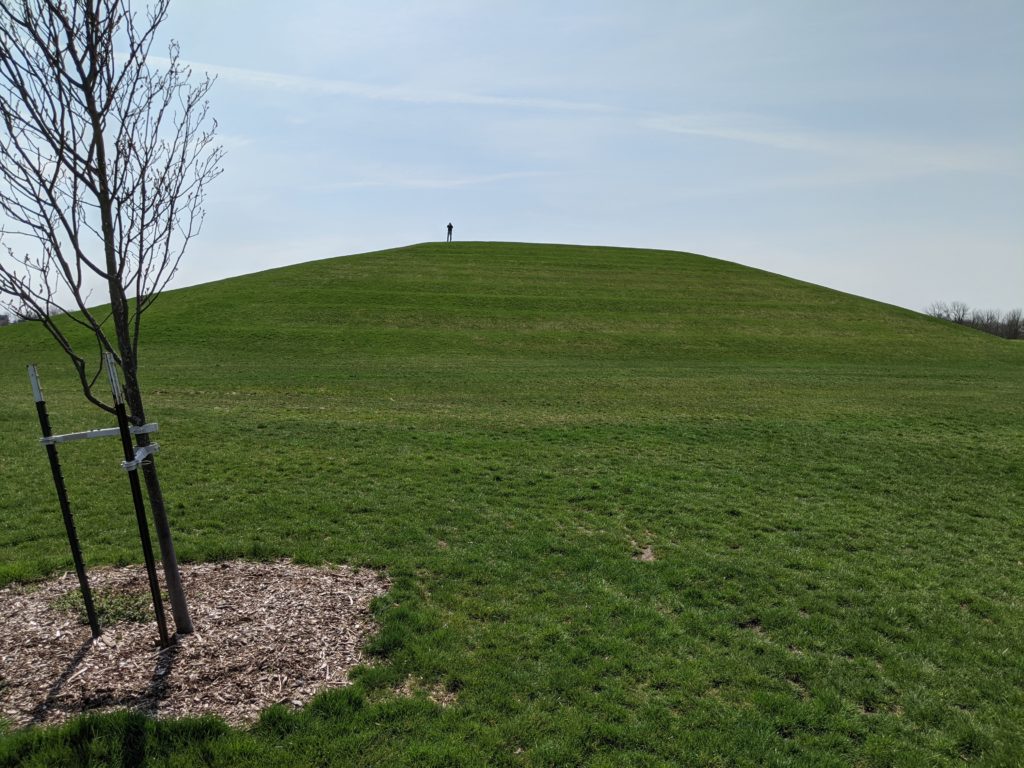
It wasn’t a catastrophe. I didn’t hurt myself. I just don’t think I did myself much good. I ran to Colbert Park, did three hill sprints (in actuality, feeble jogs), and then ran home again. But I didn’t have any oomph behind the sprints, so I don’t expect they’ll have done their job in terms of boosting leg strength or aerobic capacity.

The Oura ring’s readiness score has been a very reliable indicator for me—which is why it helped me fool myself this time. So this is a good reminder to me to interrogate all of the factors that go into making a workout decision—my plan, my intuition, my ring, etc.

So one thing I’m doing is looking back at the factors that feed into the score, looking to see if there’s one that looked better than it really was.

Nothing really jumps out at me. Given the same information, I’d also figure that I was ready for a hard workout. (In fact, I had that information, plus my own sense that I felt ready for a hard workout. That’s exactly how I overrode my plan and went out for a tired, tiresome run.)

Oh, well. Insert your own pithy “live and learn” aphorism here.

I’ve been working on dips for a while, but not with great consistency until just the past three or four months.

For a long time I was doing bench dips (where you put your hands behind you on a bench, stretch your legs out in front of you with your heels on the floor, and then push with your hands to raise your hips up to the level of the bench), to try to get my triceps strong enough to do real dips. In the fitness room there are some bars that can be put on the squat rack so you can do bar dips. I wasn’t really strong enough to do a good bar dip, but I’d sometimes do partials or negatives.

For parkour, you want to do wall dips, but I don’t know of any good chest-high walls in Savoy, so I haven’t practiced those in a long time.

Since I got my gymnastic rings around the end of March, I’ve been working pretty steadily on ring dips. (Which are much harder, because while pushing yourself up you also have to be able to stabilize your body.)

I’ve been following pretty much the usual progression—working on just a ring support (where you hold yourself in the top position for a dip), on negative dips (where you just lower yourself), and on partial dips (where you lower yourself only part of the way down, and then back up).

I’ve been gradually increasing the range of my partials, and a few days ago I thought I was doing a full, proper dip. I wasn’t really sure though—there aren’t any mirrors out under the sycamore tree where I hang my rings. So today I got Jackie to come and video me, so I could watch what I was doing:

I think those first two—especially the second—are legit dips. (The third, of course, is just a negative.)

I’d heard this, but I’m not sure I really believed it.

I’ve been running in “barefoot” shoes for a good 5 years now. The improvement in my gait was dramatic and immediate. But serious barefoot advocates are very firm about the point that it’s only when you run with actual bare feet that you acquire the huge upside that comes with barefoot running.

Reduced injury rates (due to the improved gait) are one of those upsides. Increased running efficiency (due to the improved gait, but also due to not having to carry the weight of a shoe on each foot) is another upside.

But there are alleged to be further sources of improved efficiency that come from barefoot running. When you’re actually barefoot, you’re going to hit the ground much more gently (because without cushioning it would hurt to hit the ground hard). Your foot is going to hit the ground with zero forward velocity (because if your bare foot slides along the concrete, the friction will cause blisters almost immediately).

In both cases—not slamming your foot into the ground, and not grinding your foot into the ground—the upshot is improved efficiency.

But it’s one thing to hear that “improved efficiency” is a thing, and another to actually see it. Check out this comparison of a run from one month ago, versus a run today.

Here’s the first three-quarters of mile of a run from one month ago, wearing minimalist shoes:

I left off the first few tens of seconds because it took until then for my heart rate monitor to stabilize on my actual heart rate. Then I went on for about three-quarters of a mile (out of a longer run) to match the distance that I ran today.

The things to note are that I ran at a 14:20 min/mil pace (very slow), that my heart rate averaged 117 bpm, and that the majority of my run was spent in zone 3.

Now check out my graph from today’s run, run with actual bare feet:

I’ve matched the distances (the former is the first part of a much longer run, the latter my entire barefoot run today). Today’s run was at a considerably faster pace (37 seconds per mile faster), while at the same time keeping my heart rate considerably lower (averaging 109 bpm, entirely in zone 2).

I have to say, this is very promising for future endeavors. I need to boost my confidence a bit, so I feel comfortable going for longer runs barefoot. I also need to get a bit more familiar with pacing—my MAF heart rate is probably more like 124. I need to figure out what it feels like when I run that pace barefoot. Because: who knows how fast I can run at that heart rate barefoot?

(The shortcode below won’t work until I get an updated version of the plugin for displaying GPX maps.)

[sgpx gpx=”/wp-content/uploads/gpx/Philip_Brewer_2020-06-27_08-46-36.GPX”]