
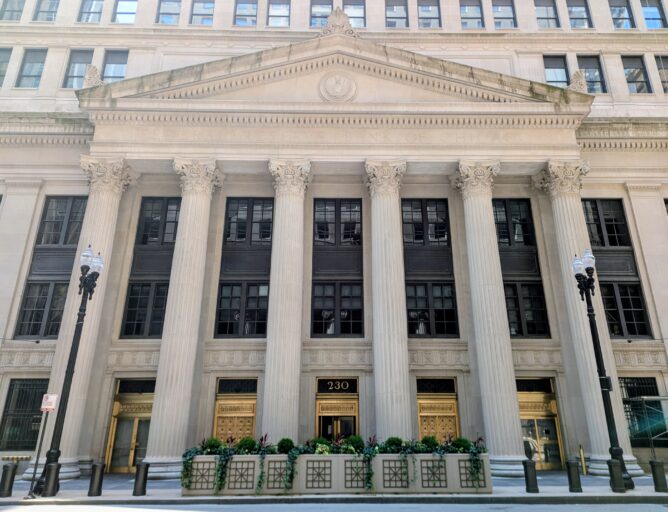
The main entrance of the Federal Reserve Bank of Chicago

I don’t usually worry much about investment bubbles. There have been a lot of them over the past few hundred years, and most of them (railroads, telegraph, dotcom…) were expensive disasters largely only for the people who invested in them. Some though, such as the Great Financial Crisis of 2007–2009, were expensive disasters for lots of other people as well. So it’s worth thinking a bit about whether the current AI bubble is of the former sort or the latter—and how to protect your finances in either case.

Bad just for investors

One big difference between bubbles that are going to be wretched for everybody when they pop and those that’ll end up mostly okay except for the foolish investor’s portfolio, is whether the excess investment got spent on something of enduring value.

For example, railroad lines got enormously overbuilt in the 1840s in the UK and in the 1880s in the US, leading in both cases to a stock market bubble, followed by a stock market crash and a banking panic. But (and this is my point), the enormously overbuilt railroads were of some value. As the firms went bankrupt, the people who had over-invested lost a lot of money, but the railroad tracks, rights-of-way, and rolling stock all still existed. The new firms that got those assets, free of the excess debt, were often viable firms that went on to be successes—hiring workers, providing transportation, and eventually providing a return to the new investors. The people who got screwed were the old investors. (And not even all of them, as the original investors often saw the overbuilding happening early and sold out just as the clueless people who knew nothing about running a railroad, but just saw stocks soaring and wanted to get in on it, started piling in.)

Much the same was true of part of the dotcom bubble. A lot of money got spent on a lot of things. To the extent that it was spent on buying right-of-way and burying fiber, there was something of enduring value that ended up owned by somebody, making it one of the less-bad bubbles.

The key to avoiding catastrophe in bubbles of this sort is largely just a matter of not investing in the bubble yourself.

Bad for the economy

But some bubbles have produced horrible, wretched, prolonged difficulties for the whole economy. The other part of the dotcom bubble, besides the dark fiber build-out, was the bubble in companies with no profits and no prospect of ever having profits, whose stock prices went up 10x based on nothing but a story that sounded compelling until you thought about it for 10 seconds. As usual, that ended up being very bad for the people who invested in those companies, but it also was bad for the whole economy, because when those firms went bankrupt, they left behind nothing of enduring value.

The result was that the imagined wealth of those companies just vanished. The stock market went down, which was bad for (almost) everybody, and it produced a general economic malaise, because post-dotcom crash it became hard even for legit companies with real assets, a real profit, and a real business plan for growth, to raise money, which made actually producing that growth much harder.

Really bad for the economy

There is, however a step beyond just pouring a bunch of money into a bubble that doesn’t actually produce anything of enduring value, like a fiber optic network or a railroad. That’s when the money is raised with leverage (i.e. debt).

The 1929 stock market crash was a rather drastic example. People invested in stocks not because there was an underlying business that was worth what the investors were paying for it, but purely because the stocks were going up. That might have been okay in other times, but stock brokers had recently started allowing ordinary people (as opposed to just rich people) to buy on margin—where you just put up a fraction of the price of the stock you want to buy, and the broker lends you the rest.

In the 1920s you could buy on 90% margin, where you only put down 10% of the price of the shares. That meant that, if the stock price went down by just 10% your whole investment was wiped out, and the broker would sell you out to raise money to pay off (most of) the loan. And of course, all those sales into a falling market produced more losses, leading to the crash.

Since the 1930s you could only buy stocks on 50% margin, making it much less likely that your broker will sell you out into the teeth of a general stock market crash—although it can still happen.

Bubbles with leverage

A great example of a bubble with leverage is the Great Financial Crises of 2007. (Most people date it from 2008, because that’s when Lehman Brothers collapsed. I date it from 2007 because that’s when my former employer closed the site where I worked and I ended up retiring rather earlier than I’d planned.)

That was a particularly bad bubble. A whole lot of money was raised, with leverage, to buy housing. But very little of the money ended up being spent to build more housing (which would have been something of enduring value that would have lasted through the subsequent collapse). Instead, the money was spent bidding up the prices of existing housing, which then fell in value after the bubble popped.

So we had two of the classic producers of bad bubbles: Nothing of enduring value created, and leverage. The whole things was made even worse by the structure of the leverage in question.

This is getting rather far from my main point, so I won’t go into much details, but to raise the large amount of money that was going into houses, the rules on housing market leverage were being eased over a period of time. It used to be that you had to put 20% down on a house. Then you still had to put 20% down, but only half of it had to be cash, with the other half being funded with a second mortgage on the property (at a higher interest rate). Then they started letting people put just 3% down. Then they started letting people with good credit put nothing down. Then they started letting people with no credit put nothing down. At the same time, “structured finance” obscured just how risky all those mortgages were, meaning that when the bubble went pop lots of “mortgage-backed securities” ended up being worth zero.

Which kind is the AI bubble?

This brings us to the current AI bubble. A whole lot of money is pouring into building two things:

  • Data centers (buildings filled with computer chips of the sort used to train and run AI models)
  • Large language models (non-physical things that are basically just a bunch of numeric weights of a bunch of tokens which can be used to produce streams of plausible-sounding text)

Each of those may have some enduring value.

Data centers will have some. They will probably have a lot less than a network of fiber optic cables, which can be buried and will have value for decades with minimal cost or maintenance. Since newer, faster chips are coming out all the time, a data center is well behind the cutting edge as soon as it’s finished. Plus, training or running an AI model runs those chips hard, meaning that they probably only last a couple of years (due to thermal damage on top of regular aging).

Large language models probably have even less enduring value, because so many people are training new ones all the time. People are always trying to make them bigger (trained on more data) while also making them smaller (so they can run without a giant data center). All that means that your two-year-old LLM probably isn’t worth what you paid to build it, and a four-year-old LLM probably isn’t worth anything.

That’s how things looked a year or so ago—a perfect example of a bubble that would burn the people who sank money into it, but leave the broader economy untouched.

Sadly, that’s been changing.

First, the structure of the leverage has been changing. It used to be rich people and rich companies were building data centers and hiring software engineers to build LLMs. But lately that’s been getting screwy. Those large companies are raising off balance-sheet money with Special Purpose Vehicles (small companies that big companies create and provide some capital to, that then borrow a bunch of money to make something, with the loans collateralized by the things they’re making—but importantly, not an obligation of the big company that created them). Any particular SPV can blow up, if it turns out that the things it built don’t earn enough to pay the interest on the money the borrowed to build them. And large numbers of SPVs can blow up if financial conditions change to make it harder for all the SPVs to roll over their debts as they constantly have to keep their data centers running.

Second, they’re also engaging in weird circular investing and spending arrangements, where company A buys stock in company B which then turns around and pays all that money back to company A to buy chips, letting company A treat it as both income and an investment, while company B can pretend it got its chips for free.

Finally, there’s all the non-financial obstacles that may well throw a wrench into the whole thing. The fact that LLMs are all built on copyright violations. The fact that running data centers requires huge amounts of power and water (that has to be produced and paid for). The fact that producing that water and power brings with it horrible environmental impacts.

What to do

So, if AI is a bubble, and its one of the bad sort that will produce a panic and a recession when it pops, what should you do?

There are a lot of little things you can do that will help. I wrote an article with suggestions at Wise Bread called Are your finances fragile? It talks about what financial moves you can take to put yourself in a better position if there’s a general financial crisis. (If you’re interested in my writing about this stuff more broadly, I wrote a overview of my perspectives on personal finance and frugality called What I’ve been trying to say, that includes a bunch of links to other of my posts at Wise Bread.)

Besides that general advice, there are also a few things to strictly avoid. In particular, strictly avoid thinking that you can find some very clever investment strategy that lets you make money off the popping of the bubble. Yes, after the fact there will be some investments that make a lot of money, but no amount of keen insight will let you find and make those investments, as opposed to the thousands of very reasonable-seeming investments that will blow up just like all the rest.

Along about the end of the Great Financial Crisis I wrote an article called Investing for Collapse, which explains why any such effort is pointless. It holds up pretty well, I think.

Short version? Avoid debt. Keep your fixed expenses as low as possible. Build a diversified investment portfolio that limits your exposure to the most obviously stupid investments, but doesn’t do anything too weird or wacky in an effort to get them to zero—it’s pointless, and will probably do more harm than good.

Good luck when the AI bubble pops!
There’s a whole genre of collapse-oriented investment writing. I’m something of a connoisseur of the form. But one really needs to treat that sort of literature as pornography—interesting to read, if you’re into that sort of thing, but almost nothing in it is stuff you’d actually want to do.

There are two ways most collapse writers go wrong. One is to assume that keen insight into the nature of the problems we face will allow one to make a bunch of smart investment moves in advance—as if there were some advantage to being the richest guy standing in a post-apocalyptic world.

In his recent post Where Should I Put My Money Before Things Collapse? John Robb avoids that trap pretty well. He understands that the systemic nature of the problem makes attempts to align your investments with the underlying trends pointless:

Looking for a safe asset class today, is like a Soviet bureaucrat in 1989, sensing trouble ahead, looking for the directorate with the safest job.

The other is to assume that there will be a collapse event. Those writers seem to suggest that you can spend your time until collapse behaving much as you do now (with some occasional time off to stock your shelter and practice your marksmanship), and then spend the end times hiding out in your shelter. That’s wrong, because there’s no reason to assume that there will be a collapse event. It’s at least as likely that things’ll go on much as they have been, with occasional points where a bunch of people lose their jobs, yet another class of investments suddenly becomes worthless, and various things (such as food or fuel) spike up in price.

John Robb does pretty well avoiding that trap as well. He understands that the only sensible response is to find a lifestyle that works now, and that will continue to work as collapse proceeds.

Just as he indicates, the right responses to problems like peak oil, peak debt, climate change, environmental degradation, habitat loss, and so forth are going to be community-level responses. With that in mind, he’s putting his money into supporting efforts to create that community response and those communities.

Having said all that, four decades of reading collapse literature have convinced me that collapse happens slowly. Very slowly. Slowly enough that we’re going to need to go on investing in ordinary investments for quite some time to come.

It seems like it would make sense to want those investments to be informed by the societal problems that we face, but my experience has been that an understanding of the sources of impending collapse doesn’t lead to useful investment insights.

There are a lot of reasons. First, as I said, collapse happens slowly, meaning that shorter-term trends will end up dominating. Second, a lot of governmental power will be brought to bear in support of pre-collapse norms, meaning the sort of large profits that might be produced if your investments do align with the large trends are prone to being seized or taxed away. Third, the situation is intractably complex, meaning that even a clear understanding of several of the problems may yield predictions that end up being trumped by other problems—no one can say whether peak debt or peak oil will influence the course of the economy more strongly or more suddenly.

The upshot is that investing for collapse is as pointless as Robb points out; I merely disagree with his analogy. Rather than being like a Soviet bureaucrat in 1989, I figure it’s more like being CEO of a department store chain in 1969. There are still opportunities to get ahead following the old arrangements, but all the most powerful forces of society, human nature, and nature itself are arrayed against you. You’d be much better off charting an entirely new course—and Robb’s suggestions are good ones.

I’ve already shared this on Google Reader (you can follow my shared items if you’re interested), but I wanted to blog it as well.

The always-interesting Dmitry Orlov is interviewed by Lindsay Curren in Transition Voice. As usual, Orlov is funny, but here he’s hitting on a lot of the same points that I like to hit on—that is, the points that I think are important—and is saying some really interesting stuff:

There’s this iron triangle of House-Car-Job, and the entire landscape is structured so you have to have all three or your life falls apart. People have to be creative in escaping from there.

He has a bit of advice (that I’m living right now): Retire immediately.

. . . make what ever adjustments are needed considering that you’re not going to have much of an income. Have a little bit of an income. But get rid of the mortgage, obviously. Get rid of the car.

He suggests that you shirk off for a couple of years and see where that takes you, then go back to work and earn enough to support the kind of lifestyle that you’ve already adjusted to.

A lot of people have, of necessity, already done this. But a lot have taken the opposite tack: they have abandoned any hope of every retiring. With their retirement savings destroyed and their kids unable to support themselves, they’re figuring that they’re going to have to keep working for years—maybe a decade or more—past what used to be retirement age. But that’s a crappy strategy. (For many reasons, but especially because it may well not be possible. There’s a good chance that your job will go away, even if it seems secure now. And there’s a good chance that your health won’t allow you to maintain your current pace, even if it’s holding up pretty well so far.) Orlov’s suggestion is a much better idea.

Check out the whole interview: No shirt, no shoes, no problem.

In 2008 I posted Ron’s paper on Peak Debt. He recently extended his work, in a new paper called Peak Debt and Income.

Once again, I’ve got a piece up at Wise Bread that provides an overview of paper:

Laszewski creates a simple model of the economy as a tool for investigating the question of how to get household balance sheets back in order after suffering the problems diagnosed in the earlier Peak Debt paper…

Really, though, you ought to read the paper. (The math in this one isn’t as tricky as the math in the original Peak Debt paper.)

Via Dmitry Orlov, I happened upon America: The Grim Truth, which I think is worth reading, even though I disagree with both the forecast and the prescription.

It’s worth reading because I think it’s actually pretty good descriptively—it nails the split between the reality of the current situation and the average American’s perception of it. I am persistently amazed at the things that Americans just accept.

On food:

Much of the beef you eat has been exposed to fecal matter in processing. Your chicken is contaminated with salmonella. Your stock animals and poultry are pumped full of growth hormones and antibiotics.

On education:

In most countries in the developed world, higher education is either free or heavily subsidized; in the United States, a university degree can set you back over US$100,000. Thus, you enter the working world with a crushing debt. Forget about taking a year off to travel the world and find yourself – you’ve got to start working or watch your credit rating plummet.

On wealth:

America has the illusion of great wealth because there’s a lot of “stuff” around, but who really owns it? In real terms, the average American is poorer than the poorest ghetto dweller in Manila, because at least they have no debts. If they want to pack up and leave, they can; if you want to leave, you can’t, because you’ve got debts to pay.

On freedom:

Why would anyone put up with this? Ask any American and you’ll get the same answer: because America is the freest country on earth. If you believe this, I’ve got some more bad news for you: America is actually among the least free countries on earth. Your piss is tested, your emails and phone calls are monitored, your medical records are gathered, and you are never more than one stray comment away from writhing on the ground with two Taser prongs in your ass.

Even though I agree with just about all of that, I disagree on the prospects for the future.

First of all, the current situation is still an improvement over most of US history. Through our whole first century and a half, the average American lived a life just as dangerous, just as precarious, and just as vulnerable as the one described above. And if the average American didn’t owe just as much money, it was only because he didn’t have access to that much credit.

My point is not that things are okay now, but rather that the fact that things got better serves as an existence proof that getting better is something that can happen.

Second, although the situation in the US is very bad for someone who has gotten caught in the wage-slave/debt-slave trap, it remains possible in the US to opt out. It’s actually pretty easy, as long as you avoid debt. And avoiding debt is pretty easy: just don’t let yourself be sucked into the consumer lifestyle. There’s an awful lot of crap for sale—don’t buy it. There are plenty of big houses for sale—don’t buy one. You can live in a bigger, nicer apartment if you’re willing to live an hour’s drive from where you work—but if you live where you can walk to work, you don’t have to buy a car. With the money you save, join the rentier class.

I think we ought to change things, and I think it would be great if we could get the government to set rules that would encourage those changes—require uncontaminated food, prohibit predatory lending, protect workers from abuse, etc. But individuals can actually make those changes in their own lives without needing the government to act.

So I don’t see a need to flee the country. But that doesn’t mean that I think things are okay—which is why I think that’s a post worth reading.

In his article Saving Yourself [Note: article is now behind a paywall] Daniel Akst buries at the end a particularly good statement of the central point I try to make in my personal finance writing:

Thrift is thus a way to redeem yourself not just from the unsexy bondage of indebtedness but also from subjugation to people and efforts that are meaningless to you, or worse. Debt means staying in a pointless job, failing to support needy people or worthwhile causes, accepting the strings that come with dependence, and gritting your teeth when your boss asks you to do something unethical instead of saying “drop dead”. Ultimately, thrift delivers not just freedom but salvation—which makes it a bargain even Jack Benny could love.

To get there, though, he takes you on a wonderful journey through the American history of thrift, from Jack Benny to the Puritans and back again, with a couple of side trips to Sexyland.

Ron has kindly let me host his fascinating peak debt paper on my site.

I take a quick look at the paper in my Wise Bread post on Peak Debt:

Is there a limit to how much Americans can spend?  Clearly there is:  All they earn, minus savings and service on their existing debt, plus new borrowing.  Since the Bureau of Economic Analysis puts numbers on those very items, it’s possible to see just how close we are to the edge.  In a fascinating paper, Ron Laszewski does exactly that.  The results are rather depressing.

Whether you read my Wise Bread piece or not, if you can follow the math, I urge you to read Ron’s paper itself: peak-debt-pd-020708.