I’ve known since before the inauguration that the economy was facing stagflation. The tax cuts would boost the deficit, raising interest rates. The tariffs would boost prices, producing inflation. Both those things, plus forcing out immigrants, would tank the economy, producing stagnation (at best), yielding stagflation.

I wrote about this more than a year ago, in Our new upcoming stagflation. We are now seeing it, even before the war started.

I’m actually a little surprised we didn’t see it sooner. I credit the delay to a few things. First, Biden had left the economy in really good shape. It took a lot to tank it. Second, even though it seemed to us that Trump was “moving fast and braking things,” it’s just hard to move that fast on things like tax cuts, imposing tariffs, and deporting migrants—even if you’re willing to break laws to do it faster, these things take time. Third, Trump always chickens out, so we didn’t get the threatened tariffs on schedule; we got watered down tariffs after a delay.

However, the stagflation is here. Check out this graph of Real GDP. As you can see, in Q4 it had fallen almost to zero. The economy wasn’t shrinking, but it was stagnating.

A graph of Real Domestic Product with the last data point showing a growth rate of barely above zero.

At the same time, inflation had quit coming down. Here’s a graph of Core PCE, the Fed’s preferred inflation index. After getting down almost to 2% (the Fed’s target) about 8 months ago, it reversed course and has been bumping along close to 3% since then.

A graph of Core PCE with the last data point only a little below 3%

I think all of these things were about to get worse. Even with the Supreme Court’s ruling that a major part of Trump’s tariffs were illegal, there were plenty of others that aren’t going away. The tax cuts are still in place. Immigration has virtually come to a halt, many immigrants have been detained or deported, and any sensible foreigners with skills that they can apply elsewhere are fleeing the country.

So: Stagflation was already here. But things are about to get much, much worse, because now there’s a war on.

That has already spiked up oil prices. Those won’t feed immediately into Core PCE (which excludes food and energy prices), but will feed in over time, because higher energy prices make everything we produce more expensive. And, of course, wars are fantastically expensive, meaning that the deficit will blow out way worse than it was already going to, which will lead to higher interest rates (soon) and higher taxes (later).

Oh, and don’t expect AI to save us. If you listen to the business news, you know that the only reason the economy isn’t in much worse shape is that businesses have been paying huge amounts on AI infrastructure. As I wrote in my AI bubble post, I think a large fraction of the data centers and model training that that money got paid for will turn out to be worth much less than was paid for it.

So, where are we? Well, about where I thought we’d be, as far as the economy goes—in a modest stagflation that could be fixed pretty quickly, at the cost of a substantial recession, if the Fed had the guts for that. Except that now we’re in a war too.

I can tell you how to arrange your finances to survive a stagflationary period, but I can’t tell you have to survive a war. Wars are very bad, much worse than recessions.

If you know how to survive a war, let me know. If not, good luck.

A pretty good recent episode of Gil Duran’s Nerd Reich podcast had an odd hole in it.

In the one I’m talking about, the one with Quinn Slobodian, Quinn explains that there’s a reason the many efforts to create a seastead, charter city, network state, and such never go anywhere: They’re unnecessary.

[Y]ou don’t actually need to create a new polity to have your own sense of entitlement and privilege reinforced in every imaginable way, and to have your own economic comfort facilitated by the institutional arrangements of the state in almost every way. With some creative accounting and some use of offshore havens and trusts and so on, you can really game the whole thing very well already, right?

Having said that, they do talk a bit about why, given that there are already tools to protect your property and money (freeports, trust, special economic zones, and the like), anybody would work so hard and spend so much money to create an actual place that’s outside the control of any government. They don’t quite come around to answering that question, which I think is unfortunate, because I think they both know the answer.

The people pushing these efforts want serfs.

They don’t want workers who can join unions. They don’t want software engineers who hesitate to create autonomous munitions or tools for surveillance capitalism. They don’t want maids or pool boys who feel free to resist their advances.

They want the right to be mean to people, in a situation where the people have to just take it.

That’s what places like Próspera offer that you can’t get from a family company incorporated in a special economic zone.

Okay, this is really, really good. About writers and writing (via @doctorow).

Makes me want to write some proletarian literature.

Characters in proletarian literature are often misled into believing that their individual flaws account for their miserable conditions, but then encounter a union organizer or a wise old Wobbly who tells them the truth, setting fictional men and women on the revolutionary path.

Source: Go Left, Young Writers!

This is exactly right, and we’re all going to suffer for it (along with all the other things we’re going to suffer for because of Trump).

The best summary of Trump’s trade “philosophy” comes from Trashfuture’s November Kelly, who said that Trump is flipping over the table in a poker game that’s rigged in his favor because he resents having to pretend to play the game at all.

Source: Pluralistic: Trump and the unmighty dollar (26 Jan 2026) – Pluralistic: Daily links from Cory Doctorow

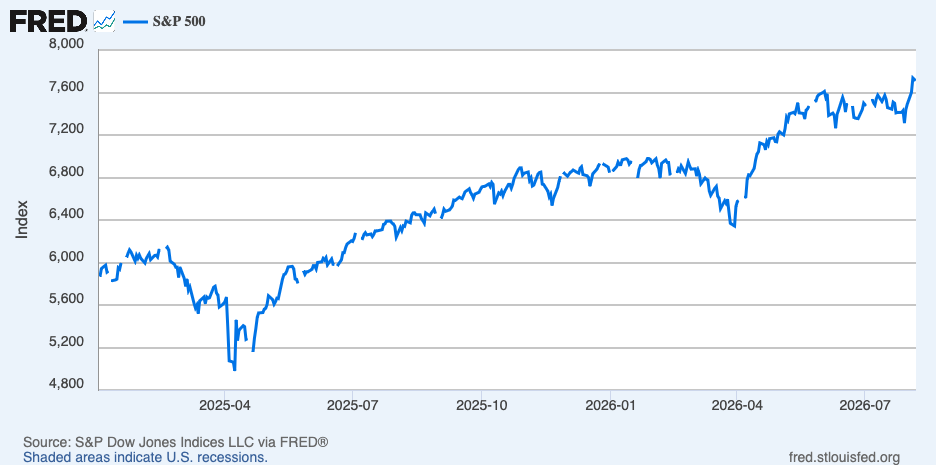
A graph showing a line that goes up to the right, with a big drop in April 2025 that is quickly reversed

There’s a broker offering a new product, that I’d have been all over 30 years ago. I think they’re calling it a “generated asset,” where they create a personal stock index just for you (based on a prompt to an AI), and then create an imaginary index fund for that imaginary index, and then (I assume) invest in the underlying stocks on your behalf.

Of course, you could do that yourself, but it would be awkward, probably expensive, and definitely fiddly, with a need to track the index over time.

So, instead of that (I assume), the company just promises to pay you the value of your index, and (I assume) hedges its promise by holding the underlying shares—and since this synthetic investment is a service, they can lump all these promises together and invest in all the underlying shares, and be generally sure that their hedge will be close enough that even very large stock moves won’t cost them more than investors are paying for access to this service.

As I said, I’d have been all over that 30 years ago. Now, not so much. I’ve gotten lazier and more conservative with my investments as I’ve gotten older.

But it did make me think what I’d want to invest in, if I were to create a synthetic index, and it occurred to me that the companies that are putting the least amount of money into AI crap will do much better over the next few years. So I asked confer.to if it could give me “a list of large corporations ordered by how much they talk about AI in their reports to investors.”

Sadly, the answer was no:

Based on the available data, I can’t provide a specific ranked list of large corporations ordered by how much they discuss AI in their earnings reports. While the information confirms that AI is a major topic in 2025 earnings calls across the S&P 500, the detailed company-by-company ranking you’re looking for isn’t publicly available in the sources I checked.

Here’s what we do know:

  • AI is a dominant topic: In Q3 2025, “AI” was cited on 306 S&P 500 earnings calls, the highest number in the past decade.
  • Significant increase: This is a large jump from the five-year average of 136 mentions and the 10-year average of 86.
  • Sector leaders: The Information Technology (95%) and Communication Services (95%) sectors have the highest percentage of companies mentioning AI.
  • Market impact: Companies that mentioned AI in their Q3 2025 calls saw a higher average stock price increase (13.9%) compared to those that didn’t (5.7%) since the end of 2024.

While sources like Yahoo Finance and MacroMicro track the overall trend and volume of AI mentions, they don’t publish a specific, ordered list of corporations ranked by the frequency or depth of their AI discussions in earnings reports.

This type of granular, ranked data is typically compiled by specialized financial data and analytics firms (like FactSet, which provided the data to Yahoo Finance) and is often part of a paid subscription service.

Perhaps the specialized AI tool that this broker uses to create its imaginary indices has access to the fine-grained data about AI mentions in earnings calls with investors. But I don’t care enough to go to the trouble of looking.

Poking around at the St. Louis Fed’s Fred graphing tool (to come up with a graphic to include for this post), though, led me to the graph at the top, which is of the “Nasdaq Global Artificial Intelligence and Big Data Index,” which “is designed to track the performance of companies engaged in the following themes: Deep Learning, NLP, Image Recognition, Speech Recognition & Chatbots, Cloud Computing, Cybersecurity and Big Data.”

So one option to get what I want would be to just go short on that index.

I don’t think I’ll do that either.

Turns out Cory Doctorow and I think a lot alike about the AI bubble, but he also has stuff to say about how to speed along the popping of the bubble, which would be a good thing. (Bubbles that pop sooner do less damage when they do.)

so I’m going to explain what I think about AI and how to be a good AI critic. By which I mean: “How to be a critic whose criticism inflicts maximum damage on the parts of AI that are doing the most harm.”

Source: The Guardian

This article, which had a really annoying headline, turns out to have some really great thinking.

In particular, the political perspective it is describing has more than a little overlap with the stuff I was writing about in my articles at Wise Bread.

An economic vision that … encompasses antimonopoly policies, right to repair and regulatory changes to smooth the path for people to start businesses, buy and work land, even build their own houses and invent things.

Source: NYT

Steven suggested that I should revisit my Wise Bread posts. There’s a lot of useful stuff there. It was stuff that had seemed a bit less relevant over the last few years (I started writing in June of 2007, right at the start of the Great Financial Crisis, and carried on for 10 years.) But with government having gone all-in on fascism, racism, and gangsterism this year, a lot of those themes are feeling much more on point than they had for a while.

So I think I’ll do that. A lot of my Wise Bread posts still feel just right. On a few, my perspective has changed a bit. I’ll write some new posts to talk about what’s changed.

Stay tuned.

Anybody who didn’t see this coming a decade ago hasn’t been paying attention.

“Payment systems are blocked for him, as US companies like American Express, Visa, and Mastercard have a virtual monopoly in Europe.”

https://www.heise.de/en/news/How-a-French-judge-was-digitally-cut-off-by-the-USA-11087561.html

Heavy-handed sanctions have mostly landed on people who deserve them, which has made them seem okay. But as I’ve been pointing out for years now, without proper rule-of-law, anybody can be crushed at the whim of a couple of people in the U.S. government.

The main entrance of the Federal Reserve Bank of Chicago

I don’t usually worry much about investment bubbles. There have been a lot of them over the past few hundred years, and most of them (railroads, telegraph, dotcom…) were expensive disasters largely only for the people who invested in them. Some though, such as the Great Financial Crisis of 2007–2009, were expensive disasters for lots of other people as well. So it’s worth thinking a bit about whether the current AI bubble is of the former sort or the latter—and how to protect your finances in either case.

Bad just for investors

One big difference between bubbles that are going to be wretched for everybody when they pop and those that’ll end up mostly okay except for the foolish investor’s portfolio, is whether the excess investment got spent on something of enduring value.

For example, railroad lines got enormously overbuilt in the 1840s in the UK and in the 1880s in the US, leading in both cases to a stock market bubble, followed by a stock market crash and a banking panic. But (and this is my point), the enormously overbuilt railroads were of some value. As the firms went bankrupt, the people who had over-invested lost a lot of money, but the railroad tracks, rights-of-way, and rolling stock all still existed. The new firms that got those assets, free of the excess debt, were often viable firms that went on to be successes—hiring workers, providing transportation, and eventually providing a return to the new investors. The people who got screwed were the old investors. (And not even all of them, as the original investors often saw the overbuilding happening early and sold out just as the clueless people who knew nothing about running a railroad, but just saw stocks soaring and wanted to get in on it, started piling in.)

Much the same was true of part of the dotcom bubble. A lot of money got spent on a lot of things. To the extent that it was spent on buying right-of-way and burying fiber, there was something of enduring value that ended up owned by somebody, making it one of the less-bad bubbles.

The key to avoiding catastrophe in bubbles of this sort is largely just a matter of not investing in the bubble yourself.

Bad for the economy

But some bubbles have produced horrible, wretched, prolonged difficulties for the whole economy. The other part of the dotcom bubble, besides the dark fiber build-out, was the bubble in companies with no profits and no prospect of ever having profits, whose stock prices went up 10x based on nothing but a story that sounded compelling until you thought about it for 10 seconds. As usual, that ended up being very bad for the people who invested in those companies, but it also was bad for the whole economy, because when those firms went bankrupt, they left behind nothing of enduring value.

The result was that the imagined wealth of those companies just vanished. The stock market went down, which was bad for (almost) everybody, and it produced a general economic malaise, because post-dotcom crash it became hard even for legit companies with real assets, a real profit, and a real business plan for growth, to raise money, which made actually producing that growth much harder.

Really bad for the economy

There is, however a step beyond just pouring a bunch of money into a bubble that doesn’t actually produce anything of enduring value, like a fiber optic network or a railroad. That’s when the money is raised with leverage (i.e. debt).

The 1929 stock market crash was a rather drastic example. People invested in stocks not because there was an underlying business that was worth what the investors were paying for it, but purely because the stocks were going up. That might have been okay in other times, but stock brokers had recently started allowing ordinary people (as opposed to just rich people) to buy on margin—where you just put up a fraction of the price of the stock you want to buy, and the broker lends you the rest.

In the 1920s you could buy on 90% margin, where you only put down 10% of the price of the shares. That meant that, if the stock price went down by just 10% your whole investment was wiped out, and the broker would sell you out to raise money to pay off (most of) the loan. And of course, all those sales into a falling market produced more losses, leading to the crash.

Since the 1930s you could only buy stocks on 50% margin, making it much less likely that your broker will sell you out into the teeth of a general stock market crash—although it can still happen.

Bubbles with leverage

A great example of a bubble with leverage is the Great Financial Crises of 2007. (Most people date it from 2008, because that’s when Lehman Brothers collapsed. I date it from 2007 because that’s when my former employer closed the site where I worked and I ended up retiring rather earlier than I’d planned.)

That was a particularly bad bubble. A whole lot of money was raised, with leverage, to buy housing. But very little of the money ended up being spent to build more housing (which would have been something of enduring value that would have lasted through the subsequent collapse). Instead, the money was spent bidding up the prices of existing housing, which then fell in value after the bubble popped.

So we had two of the classic producers of bad bubbles: Nothing of enduring value created, and leverage. The whole things was made even worse by the structure of the leverage in question.

This is getting rather far from my main point, so I won’t go into much details, but to raise the large amount of money that was going into houses, the rules on housing market leverage were being eased over a period of time. It used to be that you had to put 20% down on a house. Then you still had to put 20% down, but only half of it had to be cash, with the other half being funded with a second mortgage on the property (at a higher interest rate). Then they started letting people put just 3% down. Then they started letting people with good credit put nothing down. Then they started letting people with no credit put nothing down. At the same time, “structured finance” obscured just how risky all those mortgages were, meaning that when the bubble went pop lots of “mortgage-backed securities” ended up being worth zero.

Which kind is the AI bubble?

This brings us to the current AI bubble. A whole lot of money is pouring into building two things:

  • Data centers (buildings filled with computer chips of the sort used to train and run AI models)
  • Large language models (non-physical things that are basically just a bunch of numeric weights of a bunch of tokens which can be used to produce streams of plausible-sounding text)

Each of those may have some enduring value.

Data centers will have some. They will probably have a lot less than a network of fiber optic cables, which can be buried and will have value for decades with minimal cost or maintenance. Since newer, faster chips are coming out all the time, a data center is well behind the cutting edge as soon as it’s finished. Plus, training or running an AI model runs those chips hard, meaning that they probably only last a couple of years (due to thermal damage on top of regular aging).

Large language models probably have even less enduring value, because so many people are training new ones all the time. People are always trying to make them bigger (trained on more data) while also making them smaller (so they can run without a giant data center). All that means that your two-year-old LLM probably isn’t worth what you paid to build it, and a four-year-old LLM probably isn’t worth anything.

That’s how things looked a year or so ago—a perfect example of a bubble that would burn the people who sank money into it, but leave the broader economy untouched.

Sadly, that’s been changing.

First, the structure of the leverage has been changing. It used to be rich people and rich companies were building data centers and hiring software engineers to build LLMs. But lately that’s been getting screwy. Those large companies are raising off balance-sheet money with Special Purpose Vehicles (small companies that big companies create and provide some capital to, that then borrow a bunch of money to make something, with the loans collateralized by the things they’re making—but importantly, not an obligation of the big company that created them). Any particular SPV can blow up, if it turns out that the things it built don’t earn enough to pay the interest on the money the borrowed to build them. And large numbers of SPVs can blow up if financial conditions change to make it harder for all the SPVs to roll over their debts as they constantly have to keep their data centers running.

Second, they’re also engaging in weird circular investing and spending arrangements, where company A buys stock in company B which then turns around and pays all that money back to company A to buy chips, letting company A treat it as both income and an investment, while company B can pretend it got its chips for free.

Finally, there’s all the non-financial obstacles that may well throw a wrench into the whole thing. The fact that LLMs are all built on copyright violations. The fact that running data centers requires huge amounts of power and water (that has to be produced and paid for). The fact that producing that water and power brings with it horrible environmental impacts.

What to do

So, if AI is a bubble, and its one of the bad sort that will produce a panic and a recession when it pops, what should you do?

There are a lot of little things you can do that will help. I wrote an article with suggestions at Wise Bread called Are your finances fragile? It talks about what financial moves you can take to put yourself in a better position if there’s a general financial crisis. (If you’re interested in my writing about this stuff more broadly, I wrote a overview of my perspectives on personal finance and frugality called What I’ve been trying to say, that includes a bunch of links to other of my posts at Wise Bread.)

Besides that general advice, there are also a few things to strictly avoid. In particular, strictly avoid thinking that you can find some very clever investment strategy that lets you make money off the popping of the bubble. Yes, after the fact there will be some investments that make a lot of money, but no amount of keen insight will let you find and make those investments, as opposed to the thousands of very reasonable-seeming investments that will blow up just like all the rest.

Along about the end of the Great Financial Crisis I wrote an article called Investing for Collapse, which explains why any such effort is pointless. It holds up pretty well, I think.

Short version? Avoid debt. Keep your fixed expenses as low as possible. Build a diversified investment portfolio that limits your exposure to the most obviously stupid investments, but doesn’t do anything too weird or wacky in an effort to get them to zero—it’s pointless, and will probably do more harm than good.

Good luck when the AI bubble pops!