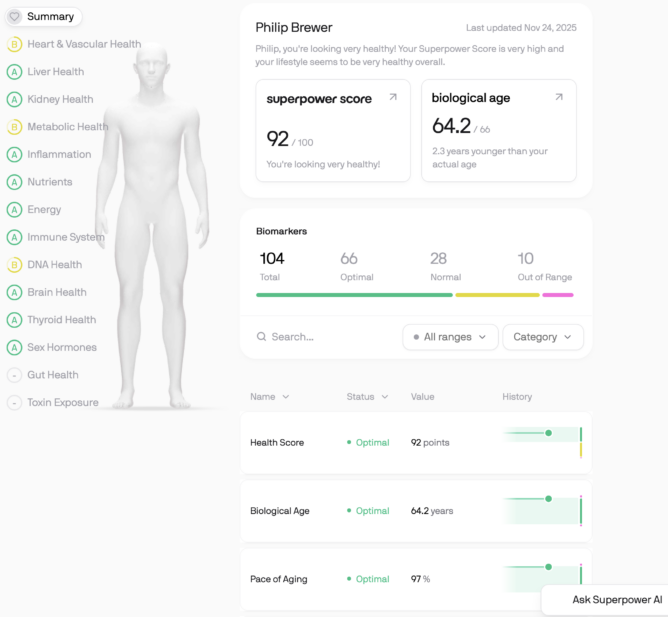
Overview of my results from Superpower.com

If you’ve been following me for any length of time, you know I’m big on metrics. It’s why I own both an Oura Ring and a Pixel watch. I am similarly interested in the annual blood work I get from my doctor’s office. That last though is often not quite as much or as often as I want, so I was very interested when Superpower reached out to offer me an extensive panel of blood work, if I’d post a review of their service.

This offer came at a particularly opportune time, as I’d been thinking of trying to get at least one specific test run ahead of my next physical. (I’d gotten a result that was slightly out-of-range on my creatinine test. This is common if you’re taking creatine, which I had been, but I still wanted to verify that it wasn’t indicative of a kidney problem. So, I’d gone off creatine, and wanted to re-run the test and be sure that my values had returned to normal.)

Getting a physical scheduled these days takes a ridiculous lead time, so it was going to be months before I got that blood work done. As I said, this made me want some other path to getting that test.

Enter Superpower, which is a way to get a vast suite of blood work done, but it’s much more than that. They have an AI trained on all these tests, with access to your results, that can integrate them together and answer questions about them. The answers are probably very similar to what your doctor could provide, except your doctor isn’t likely to have a couple of hours to go through your results line-by-line, the way I did last night with the Superpower AI.

You could get a reasonable read on any one of these markers just by googling the test name, but the Superpower AI has all your other results at its fingertips as well, so it can relate one value to another. For example, one of the blood tests measured my cortisol levels, and Superpower had this to say:

“Your cortisol level of 11.1 mcg/dL sits comfortably in the optimal physiologic range (10–18 mcg/dL), which suggests your adrenal function and stress response are well balanced.”

That’s roughly what you could get just by doing a google search on cortisol test and looking at the reference range. (Superpower is slightly better, because you won’t have to slog through the high values, the low values, the normal values, or the difference between the reference range and the optimal value.) But Superpower can do even better, because it has all your other data. For example, for me it goes on to say

  • This level indicates your hypothalamic–pituitary–adrenal (HPA) axis is functioning normally—not underactive (as in adrenal fatigue or insufficiency) and not overproducing cortisol (as with chronic stress, inflammation, or metabolic strain).
  • Given your low hs‑CRP (0.9 mg/L), balanced glucose (A1c 5.4%), and strong energy habits, your body is managing everyday physiological stressors efficiently.
  • You also show good DHEA‑S (88 mcg/dL), suggesting adrenal reserve is intact and age‑appropriate. The cortisol‑to‑DHEA‑S ratio is within the healthy range, a good sign of adaptive—not excessive—stress output.

I knew nothing about DHEA‑S, so reading what the Superpower AI said about it was instructive.

There were dozens of other tests (I think 160 in the basic panel), so the part of my brain that wants all the metrics was very happy indeed. If you’re like me, and just want the metrics, Superpower seems great: Lots of metrics and a very useful AI tool to tell you what they mean.

If you’re not like me, and you’re just interested in improving your health and performance, the value of Superpower isn’t quite as clear, but I think there is some value:

  • Every result that’s in the “optimal” range is one more thing to not worry about, and that’s useful.
  • Every value that’s in the “good” range (normal but not optimal) is a thing you could work on to improve your health or performance, and the AI will make some suggestions for how you could work to optimize all your blood work.
  • Every value that’s out of the reference range is, maybe, something you ought to talk to your doctor about.

That last is a bit uncertain. The doctors I’ve talked to over the years are pretty down on the idea of taking every test and then worrying about every value that’s out of the reference range. There are a few values (blood sugar, LDL cholesterol), where it’s both a clear sign that there’s something wrong that’s likely to lead to specific harms and there are practical treatments available that can reduce those harms. But just because a number is out of range isn’t much of a reason to do anything, unless there’s some symptom that’s plausibly related.

You almost certainly know what you ought to be doing to optimize your health. Eat food. Move a lot. Sleep well. (If not, read my post I’ve spent too much time thinking about longevity, which gives you a very slightly longer version of that same overview.)

Given that you know those things already, what would paying Superpower to run a bunch of blood tests do for your health and performance? That is: who is Superpower for?

First of all, it’s for people like me: People who just like having a bunch of metrics.

Second, it’s for people like me: People with a specific question to ask, like my question about creatinine levels.

Third, it’s for people who have trouble getting their doctor to go through all their test results with them. Of course any doctor who won’t go over any out-of-range results with you needs to be replaced. But ordinary blood work won’t even mention which of your results are in the reference range but outside the optimal range, and even a good doctor isn’t going to have time to go through those results and help you figure out how to improve them. The Superpower AI is a great tool for going through the normal-but-not-optimal results and coming up with a plan for optimizing your health.

Fourth, it’s for people who like the reassurance of being able to say, “Okay, I’ve got that one covered,” when one of the metrics is optimal, while being able to say, “Ah, but this other one could use a little more effort,” when one of the metrics is a little off. And, of course, there’s always the possibility that it’ll clue you in to something serious that you ought to take to your doctor.

So, how did I use it? Well, my creatinine levels had come back normal, so I’ve restarted creatine. My blood lipids are still a little off, even though I started a drug for that, so I have another thing to talk to my doctor about. Other than that, pretty much everything is normal, and most values are optimal, so I’m in that comfortable zone of feeling like I don’t have much to worry about.

How about the future? I just got the basic suite of blood work, and there are several options if I want to pay more money, and some of them are attractive.

For example, I’d be very interested to know about my magnesium levels. (Magnesium is very important in many cellular processes.) It’s not impossible to get enough magnesium from your diet—lots of foods have some magnesium in them—but there’s no one or two foods where you can just say, “Eat a couple of servings of this or that,” and you can be confident that you’ve got that base covered.

As another example, there are several B vitamins that need to be methylated to be turned into their active form, and people have a diversity of enzymes to do that, some of which are better than others. There are genetic tests to see if you have the gene for one of the good enzymes or one of the bad ones, but there are also tests to see if the vitamins in your blood are properly methylated, offered in the Methylation Specialty Panel. That’s another one that appeals to me.

I’ll consider those. If I decide to spring for them, I’ll follow up here in the future.

In the meantime, I’m pretty pleased with what I got: Something just for me.

Whether I’m trying to “get enough exercise” (as I tried to do for years), or trying to “fill my days with movement” (which I’ve realized is a much better way to think about my physical activity), training has been a constant. As someone who has only rarely trained as part of a group, or had a teacher or coach, a lot of my training has been solo training.

Often my focus was on endurance training: preparing for very long walks, foot races, or a 100-mile bike ride. I also did strength training. And my training often included skill training—Tai Chi, parkour, tennis (long ago), even fencing (one brief term in college).

Training by yourself is hard. It’s hard to motivate yourself to go out and do it, and it’s hard to push yourself enough to make good progress (and if you’re good at pushing yourself, it’s hard to know when to take time to recover instead). For skills-based training, it’s hard to learn those skills without a teacher or coach. And for activities with any sort of competitive element, such as tennis or fencing, it’s especially hard to train without a partner. This has been particularly acute during the pandemic, but really it’s always true.

And here is where Guy Windor’s new book The Windsor Method: The Principles of Solo Training comes in.

A lot of the specific information in the book is stuff I’ve figured out myself over the years: Some training is just about impossible to do without a teacher (learning your first Tai Chi form) or a partner (practicing return of serve in tennis). But for most activities, that fraction of the training will be much less than half of your training. Much of the rest of your training is either easy to do by yourself (strength and endurance training), or at least possible to do by yourself once you’ve learned the skill well enough to be able to evaluate your own performance (practicing a Tai Chi form, for example).

The key is to spend some time figuring out the entire scope of your training activities, and then think deeply about what category each activity falls into.

To the extent that your access to a teacher, coach, or partner is limited (as during a pandemic), emphasize the things that are easy to train solo (such as strength training and endurance training), then judiciously add those parts of the training that are advantaged by (or require) a teacher or partner as they are available.

What Guy Windsor adds to this sort of intuitive structuring of training is, as the title suggests, a method. He has systematized the structure in a way that makes the decision-making parts of the activity easier to do and easier to get right.

Perhaps even more important than that, he has taken a step back to talk about all the parts of training that aren’t just skills training for your particular activity. That other stuff—sleep, healthy eating, breathing, mobility, flexibility, strength training, endurance training, etc.—are actually more important than this or that skill, while at the same time being the bits that are easiest to train solo. If you’re stuck for a year with no partner, no teacher, and no coach, but you spend that year focusing on health and general physical preparedness, you’ll scarcely fall behind at all, and make yourself ready to jump into your skills training with both feet once that’s possible again.

I should mention that Guy Windsor’s book was written with practitioners of historical European martial arts especially in mind, but that scarcely matters. It is entirely applicable not only to practitioners of any other martial art, it is entirely relevant to literally anyone who trains in anything.

And, since many of my readers are fiction writers, I should also mention another of Guy Windsor’s books Swordfighting for Writers, Game Designers, and Martial Artists. When I signed up for his email list, he offered it as a free download for people who did so.

Being forced into purely solo training for 18 months has made me keenly aware of the many opportunities for non-solo training available here locally. There’s a local fencing club that I’ve had my eye on for some time, and our financial situation is such that now we could afford for me to join and buy fencing gear. Just today I searched for and found a local historical European martial arts club on campus—I’ve asked to be added to their Facebook group and joined their Discord. One of my Tai Chi students teaches an Aikido class with the Urbana Park District—I had started studying with him right as the pandemic began and got in two classes before everything was canceled. And, not sword-related, but cool and great training, is indoor rock climbing at Urbana Boulders.

Just as soon as the pandemic lets up for real, I’ll be doing some of those things.

In the meantime, I’m going over my solo training regimen, taking advantage of the insights that Guy Windsor provides in The Windsor Method: The Principles of Solo Training to figure out what adjustments I should make.

I’ve long struggled to program my training, a task that is difficult because I want to get better at everything. I want to be stronger and faster. I want to have more endurance for running and more endurance for walking (which turn out not to carry over perfectly from one to the other). I want to maintain and deepen my taiji practice and my parkour practice. I want to learn rock climbing and fencing.

This isn’t a new problem for me. As just one example, back in 2013 I was considering programming training not organized by the week but perhaps in 9-day training cycles.

There are at least two problems that I’m trying to address. One is just fitting in training for each capability I want to get better at. The other is how to not break down under that training load (which involves at least fitting in enough recovery time, but other stuff as well).

During the pandemic I’ve done okay, by focusing on exercise. Although I tweak things pretty often, very roughly I’ve organized each week to include:

  • 3 strength training workouts
  • 2 runs (a “long” run and a “fast” run)
  • 1 HIIT workout
  • 2 rest days

That looks pretty good until you do the math and see that it only works for 8-day weeks.

Besides that, note that this excludes my taiji practice (which amounted to more than 5 hours a week back in pre-pandemic days, because besides teaching I was engaging in my own practice). It also excludes my long, slow warmups (which I’ve started calling my “morning exercises,” since I do them pretty much every morning before proceeding with my “workout” for the day).

The way I’ve been making it sort-of work is by doubling up how I think about some of the workouts. A “fast” run with sprint intervals is a HIIT workout, and a HIIT workout with kettlebell swings is a strength-training session.

Still, there’s no hope to make something like this work if I want to add in parkour, rock climbing, and fencing. Likewise, I know from experience that I need a full day to recover from a very long (14-mile or longer) walk, so doing one of those requires devoting two days out of the week to just one training session.

So, I’m left in a quandary. How can I get better at all the things I already do and add in some additional activities as well? (Just before the pandemic I’d started taking an aikido class; I’m sure I’d enjoy finding a local group that plays Ultimate Frisbee….)

Happily for me, Adam Sinicki (aka The Bioneer) has written a book that addresses exactly this issue. The book is Functional Training and Beyond: Building the Ultimate Superfunctional Body and Mind. It starts out talking about “functional training,” and about the history of “getting in shape” i.e. “physical culture.” Then it runs though all the most common training modalities (bodybuilding, powerlifting, kettlebells, crossfit, etc.), before proceeding to talk specifically about how to take the best from each one, and then how to program it all into a workout plan.

His thinking on programming is pretty straightforward: You don’t just add everything together. Rather, you look through all the exercises you might do and pick the ones with the most cross-over benefit relevant to your goals, and then build an exercise program out of those (and you sequence them correctly to maximize your gains in terms of strength, mobility, flexibility, skills acquisition, speed, power, hypertrophy, etc.).

I’m going to spend some time (and some blog posts here) thinking over just how I want to do that.

Deep Work: Rules for Focused Success in a Distracted World by Cal Newport.

At some level, I’ve always understood deep work—the sort of work where you sit down and focus on your task for 20 or 60 or 90 minutes, long enough finish a difficult task, or make real headway on a big project.

Even when I was quite young I’d use it to get large amounts done on some big project I’d made for myself. Deep work let me create codes and ciphers for securely communicating with Richard Molenaar. It let me create maps of the wooded areas in our neighborhood where we’d play, and then assign fantasy or science-fictional elements to them. Once it let me write quite a bit of scripture for an imaginary religion. Deep work let me create maps and keys for D&D adventures I was going to be DM-ing.

I’ve never quit using deep work on my own projects. At Clarion writing a short story every week entailed a great deal of deep work. Writing an article for Wise Bread was best accomplished with an hour or so of deep work.

For other people’s work—in school, in college, and as an employee—I more often used it to enable procrastination: On any small or medium-sized project I knew I could sit down a couple of days before a task was due and crank through the whole thing in one or a few long sessions of focused work.

Given that it was such a useful capability, I’ve long thought it was kind of odd that I never really honed my capability for deep work. But through the lens of this book, I think I’m coming to understand it now.

I used to think it was because I was lazy. It was only when I quit working a regular job and started writing for Wise Bread that I came to understand that I was never particularly lazy. Rather, I just didn’t want to do stuff I didn’t want to do. Lacking that understanding I did a poor job of arranging my (work) life so that there was a lot of work I wanted to do and only a little that I didn’t want to do. Once I had work that I wanted to do, I jumped right into using deep work to get it done.

Although I take my full share of the blame for not doing a better job of maximizing the work that I wanted to do, my various former employers also deserve plenty of blame. They routinely deprived me and (most of) my coworkers the opportunity to engage in deep work.

First, they tended not to assign people a single top-priority task, but rather a set of tasks of shifting priority. (I don’t think they did it in order to be able to blame the worker when they focused on the tasks that turned out in retrospect not to be the right tasks, although that was a common result. Rather, they were just abdicating their responsibility to do their jobs as managers.)

Second, they were (especially during the last few years I was working a regular job) constantly interrupting people to ask for status updates. (One randomly timed query along the lines of “Are you going to have that bug fixed by Thursday?” which from the manager’s point of view only interrupted me for 20 seconds could easily undo 60 or even 90 minutes of stack backtrace analysis.)

At some level it was clear that the managers understood this, because there were always a few privileged engineers whose time for deep work was protected. The rest of us resorted to generating our own time for deep work by coming in early or staying late or finding a place to hide or working off-site—all strategies that worked, but not as well as just being able to close the door of our office and focus.

It wasn’t all bad management though. There were times when there was no external obstacle to doing deep work, and yet I’d not be highly productive. It’s only in retrospect that I’ve come to understand what was going on here: When I suffer from seasonal depression I find it very hard to do deep work. As a coping mechanism—as a way to keep my job when I couldn’t do the deep work they’d hired me to do—I started seeking out shallow work that I could manage to be productive on.

It’s from that perspective that I found Deep Work even more interesting than the book that lead me to Cal Newport’s work, his more recent Digital Minimalism (that I talked about briefly in my recent post on social media).

The first part of the book is about what deep work is and makes the case that it’s valuable—things that, as I said, I understood. The rest of the book is largely devoted to teaching you how to arrange your life to maximize your opportunities for bringing deep work to bear on the work you want to get done. That part, in bits and pieces, helped me understand myself in a way that I really hadn’t before.

Deep work is the way to get a big or difficult task done, but everybody has some small or easy tasks that also need to get done, so there is plenty of opportunity to make effective use of shallow work as well. Newport lays out the distinction well and provides some clear guidelines as to when and how to use shallow work to do those things where it makes sense, and in a way that protects time for deep work. He also talks about the appeal of shallow work—it’s quick, it’s easy, it’s “productive” in the sense that a large number of micro-tasks can be quickly ticked off the list.

It’s been very good for me to be reminded of all these things, because it’s easy to fall out of the habit of using deep work to do big or difficult things. The sort of rapid-fire “productivity” of shallow work has its own seductive appeal, especially in the moment. It’s only after a week or a month of shallow work, when I look back and realize that I haven’t really gotten anything done, that I tend to remember the distinction—and then pointlessly feel bad that I haven’t made any progress on the big things I want to get done.

Deep Work by Cal Newport is a great book for anyone who wants to do big or difficult things. (Also for people who manage such workers, although I don’t expect they’ll want to hear the message.)

I just finished Ultralearning: Master Hard Skills, Outsmart the Competition, and Accelerate Your Career by Scott H. Young.

It’s a good book. I think it would be particularly interesting to my brother, who of course won’t read it because he imagines that its implicit pedagogical underpinnings would not accord with his own. In fact, to the extent that I understand either one, I think it accords almost perfectly. (In particular, that learning is an activity of the learner.)

Even if he were to spend five minutes looking at the table of contents, he’d still be inclined to reject the book, because three of the nine principles are about drilling, testing, and memory retention. Since he won’t read past that he’ll never see the nuanced discussion on these topics.

What kinds of things should you invest the time in to remember in the first place? Retrieval may take less time than review to get the same learning impact, but not learning something is faster still . . . .

One way to answer this question is simply to do direct practice. Directness sidesteps this question by forcing you to retrieve the things that come up often in the course of using the skill. If you’re learning a language and need to recall a word, you’ll practice it. If you never need a word, you won’t memorize it. . . . Things that are rarely used or that are easier to look up than to memorize won’t be retrieved.

Young, Scott H. Ultralearning, pp. 127–128.

Still, it’s an excellent book for anyone who is interested in undertaking any sort of learning project. There are good, practical tips how to start such a project (how to decide what to learn, how to decide how to learn it and find resources, how to manage the project once you get going).

The book works especially to normalize the behavior of undertaking a learning project that might be considered extreme in terms of its size, scope or speed.

Ultralearning: Master Hard Skills, Outsmart the Competition, and Accelerate Your Career by Scott H. Young. Highly recommended.

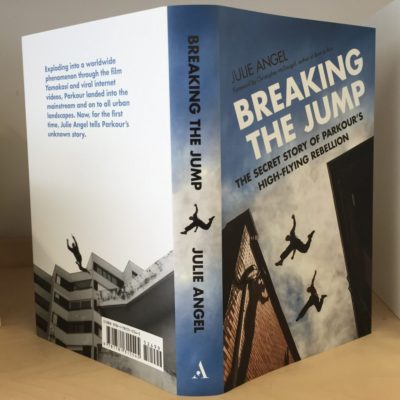
breaking-the-jump-coverI’m not sure exactly when I discovered parkour. Its first mention here in my blog is in May 2014 when I talk about starting to practice precisions and shoulder rolls.

By then, Julie Angel had already finished a PhD and created a large body of photos and videos on parkour.

I came across her work fairly early, and immediately appreciated its strength, so I was delighted to learn that she was writing a book. I bought a copy as soon as it came out, and spent last week reading it.

I’d read some about the early history of parkour, so I knew about David Belle as an individual and the Yamakasi as a group, but this was largely my first exposure to the other early practitioners as individuals—and a bunch of interesting individuals they are.

Early in the book Angel takes a stab at tweezing out the many threads that went into making parkour something that appeared in this place at this time: The urban planning that produced the built infrastructure in Lisses and that also drew in the immigrant population that lived there. The life- and family- histories of the handful of young men who became the Yamakasi. The kinds of men they were. Angel never really pins down exactly why these young men produced parkour when no one else had done so, but it’s a credible effort at answering a question that’s probably unanswerable.

Because on the one hand, many other groups of young men could have created parkour. Most of the key traits of these young men—a certain facility with movement; a willingness to train very, very hard; a tendency to push one another to ever greater efforts (and to let themselves be pushed)—are not that rare. Although many young men are clumsy or lazy, you need only look among the national-level competitors in any boys or junior individual sport, or even at any good high school sports team, to find both movement skill and the capacity for hard training.

More important than those things—which are, as I say, fairly common among young men—was an ethos that leaned against that willingness to push and be pushed. It’s an ethos exemplified in some of their sayings—things like “Start together, finish together,” and “Be strong to be useful.” Everyone was pushed outside their comfort zone, but no one was pushed to attempt anything that he didn’t know he could succeed at. It is surely the reason that early parkour practitioners had such an incredibly low rate of training injuries whether from accidents or from overtraining. (Would that runners were as durable.)

New to me—and a perfect example of that ethos—is the picture Julie Angel gradually paints of Williams Belle. Younger than the others, he was someone I hadn’t even been aware of until I read the book. Williams is portrayed as having all the movement skill and all the willingness to train very, very hard as any of the other pioneers, but lacking the ego of David Belle, and possessing teaching methods that seem uniquely gentle.

She has Stéphane Vigroux saying this about Williams:

On the surface it was the same training school, but somehow the energy and feel when observing Williams was different. . . . From the first jump . . . Williams had known that the discipline should be about helping and sharing with others.

It makes Williams sound like someone I’d like to get to know.

Angel includes a good look at the prehistory of parkour—Georges Hébert and others—and a look at contemporaries who created things that overlap—people like Erwan Le Corre—but it’s not really about them. Most of the book is about the early practitioners. But only most of the book. A little bit—maybe ten or fifteen percent—is kind of a memoir of Julie Angel’s own experiences beginning with parkour. Her stories of her struggles to break her own jumps, learn to balance on a rail, or simply to attend her first class are very effective at illuminating the journey of the founders.

Maybe she used every such story she had—at least, that’s the only good reason I can think of for including so few, because frankly, those bits are some of the best bits in the book. If she wrote a longer memoir of her own journey learning parkour, I’d buy it.

If you’re interested in the history of parkour, and especially if you’re interested in understanding what it meant to those early folks—what it meant to work together, to train very hard, to confront their fears and overcome them together—this is an outstanding book

Breaking the Jump: The secret story of parkour’s high-flying rebellion by Julie Angel.

DJST-coverI no longer remember the precise path through which I came to Katy Bowman’s work, but it must have gone something like this: Parkour to Georges Hébert to Erwan Le Corre to Katy Bowman.

Once I found her Katy Says blog, I stuck around for a while—binge-reading the trove of posts I found there, watching the related videos, and listening to back episodes of her podcast. That material, together with what I found in her then-newest book Move Your DNA, went into a piece I wrote for Wise Bread that suggested natural movement as a way to get fit that was doubly frugal—no cost for the gym, plus you get to do some of your exercise while you’re working.

Unbeknownst to me, Katy was on the verge of publishing a book on just that topic and when I shared my article with her, she offered to send me a review copy of Don’t Just Sit There.

Katy’s thesis in brief is that your body responds to the forces applied to it by adapting itself: moving toward the most optimal form for dealing with those forces. The forces it experiences are wildly diverse—gravity, the continually changing pressures caused by clothing and by breathing, the stretching and compressing of all parts of your body as you move them, the activity of your intestinal biome, etc. Your body as it is now includes a lifetime of accumulated adaptations.

If you had spent your life moving as humans moved during the period in which the human form evolved, your body would have adapted itself most excellently. But you probably haven’t. You’ve probably spent your life sitting in chairs, wearing shoes, riding in cars, and doing a hundred other things that no one had ever done until just the last few hundred years—things that have produced a relatively novel set of forces, resulting in a set of adaptations that are probably not ideal.

Among those adaptations are many things that are considered diseases—osteoarthritis and osteoporosis being two of the ones most obviously related to the history of forces applied to your body. But most “lifestyle” diseases like high blood pressure, coronary artery disease, type-2 diabetes, allergies, and asthma also have their roots in adaptations to the lifetime history of forces applied your body.

It is these adaptations—and the resulting disease processes—that explain why sitting all day is an independent risk factor for all-cause mortality, even for people who exercise regularly.

And that is the starting point Katy has chosen for this book. Sitting all day is clearly bad for you, but what should one do instead? Using the model that Katy provides, it is easy to understand that simply replacing sitting all day with standing all day is not an improvement. The problem is not any particular posture; it is maintaining a static posture for hours each day. Specifically, it’s the forces produced by maintaining a static posture for hours each day.

What’s good about this insight—that many disease processes are deeply related to your body’s response to the forces applied to it—is that it is very easy to apply different forces, and thereby produce different adaptations: Adaptations that make your body stronger, more functional, and more healthy. These different forces can be produced by engaging in natural movement.

It is, of course, no easy thing to overcome the results of a lifetime’s movement history. You probably can’t even think of many of the things that all humans did daily for millennia, and without a lifetime of practice, you wouldn’t be able to do them well. If you tried, you’d surely hurt yourself—your adaptations have produced a body that can no longer do certain things.

Happily, Katy’s book provides exactly what you need: a program for safely achieving the capability of filling your day with natural movement—without hurting yourself, and without hurting your productivity. (I was going to say “and without losing your job,” but it’s more than that. Katy is endlessly productive, and clearly cares deeply about your ability to be productive as well, whether you have a job or are simply doing work you think is important.)

This provides the core of the book. There’s a chapter on how to stand (because your lifetime movement history has probably produced habits—and a body—that don’t make it automatic to stand in proper alignment). There’s a chapter on how to sit (for the same reason, plus you probably have a chair that encourages poor posture). There’s a chapter on the small movements that don’t even need to interrupt your work. There’s a chapter on the larger movements that probably do interrupt your work, but only for a minute or two.

All that is preceded by a chapter on building a workspace that doesn’t lock you into one or a few static postures, and then followed by a short group of chapters that use all the preceding information to build a specific program with exercises that build toward filling your workday with natural movement.

What I like best about the book is that it constructs a model for how to think about all these issues. Instead of finishing the book wishing that you could ask the author the right way to deal with this or that particular workplace situation, you can figure it out on your own by applying the principles presented.

If the book has a flaw, it is only that some of its recommendations are based on specific research, while others are simply Katy’s well-informed gut-instinct about what would be better—and the distinction is not always well-marked. For example, there’s an excellent reference to research on the health effects of light pollution to justify suggestions for dealing with lighting and screen time. The related suggestions for engaging in “distance eye-gazing”—that one take “a quick glance every five minutes, and more extended gazes every 30 minutes”—don’t include a reference. I suspect this is because there has not yet been any research to quantify whether those specific time periods are frequent enough and long enough to significantly improve outcomes, but the book doesn’t say.

If you do work—whether for a living, or simply because you’re trying to accomplish something—this is a great book. It’s filled with actionable tips for adapting your workspace to allow you to fill your time with natural movement, and it provides a program for doing so. Most important, it constructs a model for understanding the underlying problem, meaning that you can adapt the program to your own situation.

The paper book is the text portion of a multi-media program with audio and video as well as an ebook. I haven’t seen it, but having heard and seen audio and video created by Katy, I don’t doubt that it is also excellent.

You can buy the paper book Don’t Just Sit There by Katy Bowman from Amazon. (That’s an Amazon affiliate link.) Or you can buy either the paper book or the multimedia program directly from the publisher.

As a bonus, here’s video of Katy filling an hour of work with exercise and natural movement, run at high speed so you can watch the whole hour in just a couple of minutes.