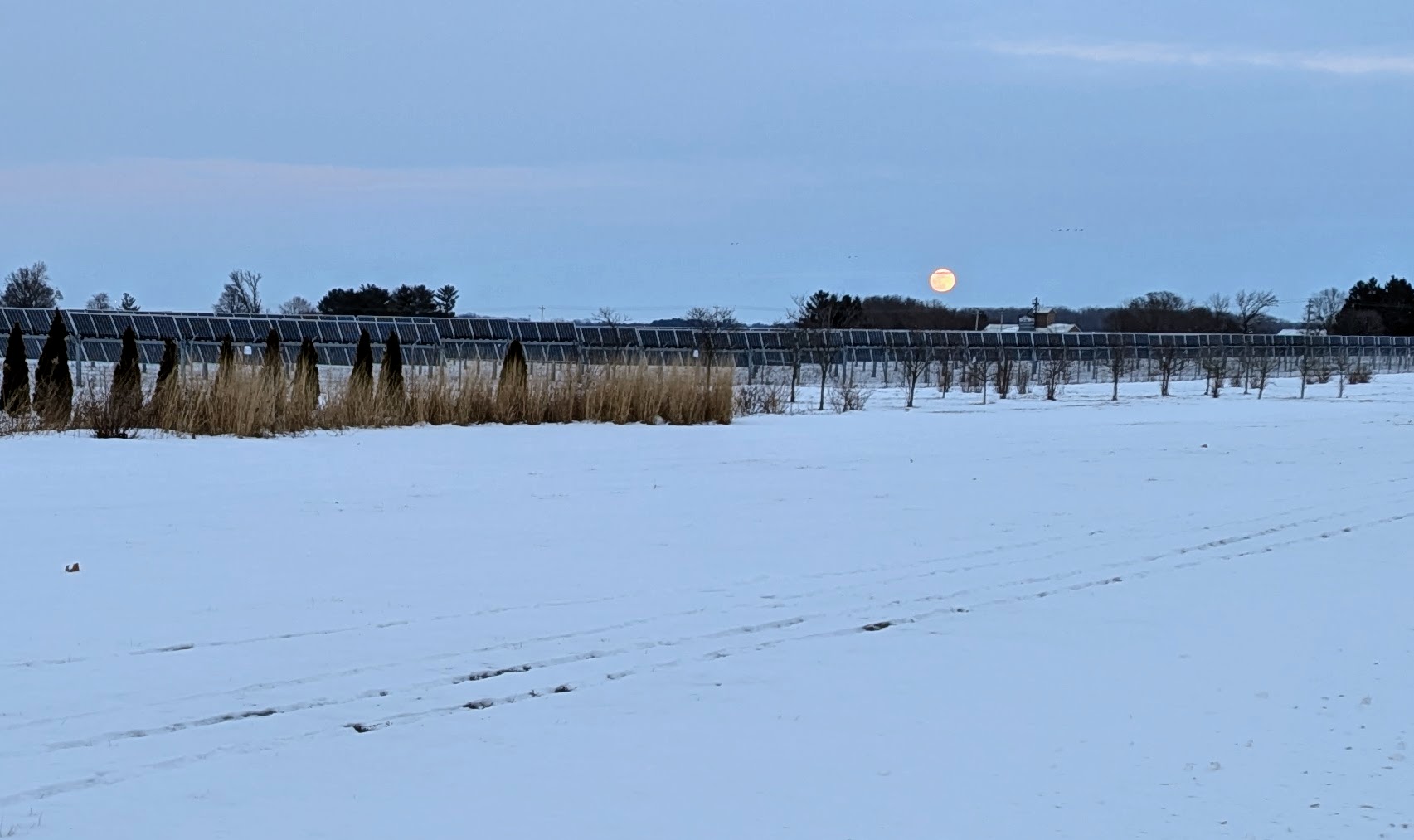
Weather conditions at Willard Airport, with a temperature of -14℉ and a wind chill of -32℉

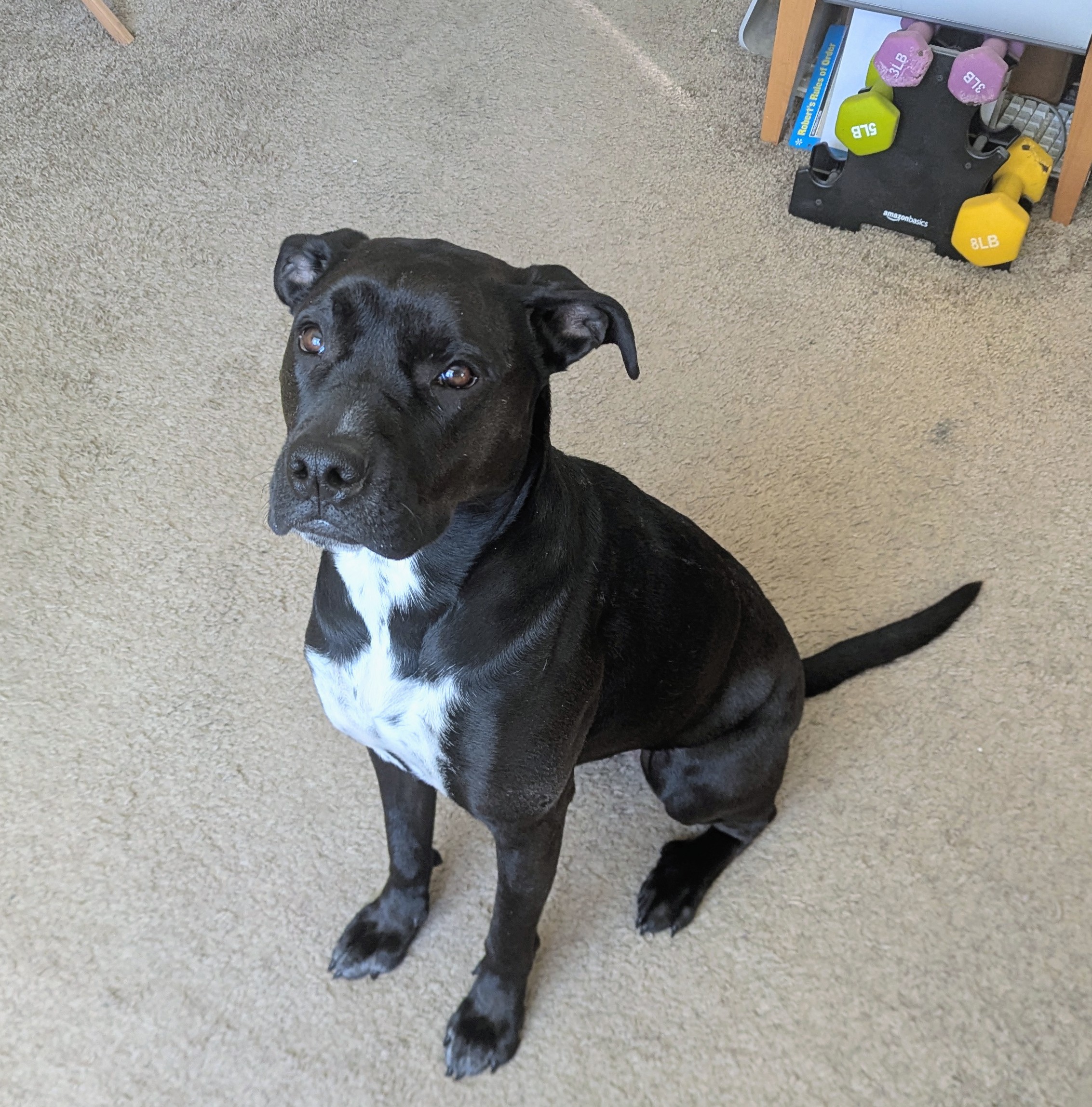
It was way too cold to try to get a picture of Ashley in her jacket. But I did want to report that she was a Very Good dog, and did the needful when I took her out in the bitter, bitter cold.

Since I was wearing a silk base layer, a mock-T, and my heavy Dale of Norway sweater under my Alaska pipeline coat, I was warm enough to stay outside for an extra three minutes, and shovel our little sidewalk.

I didn’t bother salting after. And these temperatures, what’d be the point?

I made a shopping trip to Arthur, Illinois (a largely Amish community) last week. Among other things, I bought three pounds of chicken backs, which I roasted for an hour and then put in the Instant Pot with an onion and some celery tops and pressure cooked on the “broth” setting for 2 hours and 45 minutes. Then I strained the broth and put it in the fridge.

Today I spooned out about half a mug of (super gelatinous) broth, added 16 tsp of salt, and poured boiling water to top up the mug and behold: a nice mug of warm drinking broth. Delicious, warming, and very healthy!

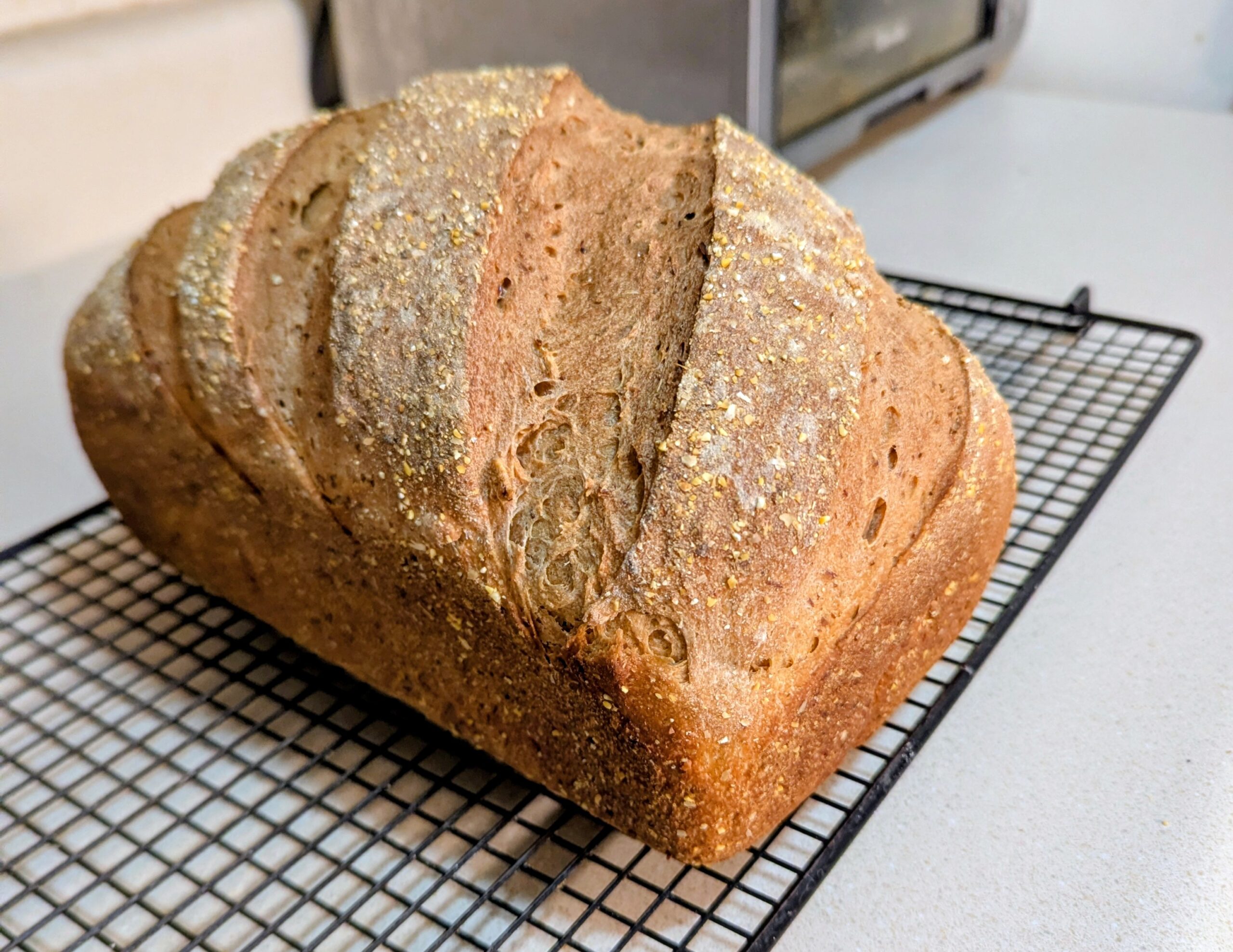
A mug mostly full of chicken broth

Do you know what insurance is? Insurance is a mechanism to protect yourself from financial catastrophe caused by a very rare event (a house fire, let’s say).

Only when you restructure insurance, the way we have with medical insurance, to turn it into something like a pre-paid service plan, does something like a Health Savings Account start to make sense.

It’d be like fire insurance starting to cover fixing the plumbing, and then coming along with a “House Saving Account” that you could use to pay for sidewalk shoveling (but was also supposed to cover a new giant deductible when your house did burn down).

Health Saving Account, one of those movement-conservative notions based on the premise that everyone should have the “freedom” to be driven into bankruptcy by unforeseen circumstances.

Source: The Senate Only Just Realized That We’re in a Health-Care Crisis

Overview of my results from Superpower.com

If you’ve been following me for any length of time, you know I’m big on metrics. It’s why I own both an Oura Ring and a Pixel watch. I am similarly interested in the annual blood work I get from my doctor’s office. That last though is often not quite as much or as often as I want, so I was very interested when Superpower reached out to offer me an extensive panel of blood work, if I’d post a review of their service.

This offer came at a particularly opportune time, as I’d been thinking of trying to get at least one specific test run ahead of my next physical. (I’d gotten a result that was slightly out-of-range on my creatinine test. This is common if you’re taking creatine, which I had been, but I still wanted to verify that it wasn’t indicative of a kidney problem. So, I’d gone off creatine, and wanted to re-run the test and be sure that my values had returned to normal.)

Getting a physical scheduled these days takes a ridiculous lead time, so it was going to be months before I got that blood work done. As I said, this made me want some other path to getting that test.

Enter Superpower, which is a way to get a vast suite of blood work done, but it’s much more than that. They have an AI trained on all these tests, with access to your results, that can integrate them together and answer questions about them. The answers are probably very similar to what your doctor could provide, except your doctor isn’t likely to have a couple of hours to go through your results line-by-line, the way I did last night with the Superpower AI.

You could get a reasonable read on any one of these markers just by googling the test name, but the Superpower AI has all your other results at its fingertips as well, so it can relate one value to another. For example, one of the blood tests measured my cortisol levels, and Superpower had this to say:

“Your cortisol level of 11.1 mcg/dL sits comfortably in the optimal physiologic range (10–18 mcg/dL), which suggests your adrenal function and stress response are well balanced.”

That’s roughly what you could get just by doing a google search on cortisol test and looking at the reference range. (Superpower is slightly better, because you won’t have to slog through the high values, the low values, the normal values, or the difference between the reference range and the optimal value.) But Superpower can do even better, because it has all your other data. For example, for me it goes on to say

  • This level indicates your hypothalamic–pituitary–adrenal (HPA) axis is functioning normally—not underactive (as in adrenal fatigue or insufficiency) and not overproducing cortisol (as with chronic stress, inflammation, or metabolic strain).
  • Given your low hs‑CRP (0.9 mg/L), balanced glucose (A1c 5.4%), and strong energy habits, your body is managing everyday physiological stressors efficiently.
  • You also show good DHEA‑S (88 mcg/dL), suggesting adrenal reserve is intact and age‑appropriate. The cortisol‑to‑DHEA‑S ratio is within the healthy range, a good sign of adaptive—not excessive—stress output.

I knew nothing about DHEA‑S, so reading what the Superpower AI said about it was instructive.

There were dozens of other tests (I think 160 in the basic panel), so the part of my brain that wants all the metrics was very happy indeed. If you’re like me, and just want the metrics, Superpower seems great: Lots of metrics and a very useful AI tool to tell you what they mean.

If you’re not like me, and you’re just interested in improving your health and performance, the value of Superpower isn’t quite as clear, but I think there is some value:

  • Every result that’s in the “optimal” range is one more thing to not worry about, and that’s useful.
  • Every value that’s in the “good” range (normal but not optimal) is a thing you could work on to improve your health or performance, and the AI will make some suggestions for how you could work to optimize all your blood work.
  • Every value that’s out of the reference range is, maybe, something you ought to talk to your doctor about.

That last is a bit uncertain. The doctors I’ve talked to over the years are pretty down on the idea of taking every test and then worrying about every value that’s out of the reference range. There are a few values (blood sugar, LDL cholesterol), where it’s both a clear sign that there’s something wrong that’s likely to lead to specific harms and there are practical treatments available that can reduce those harms. But just because a number is out of range isn’t much of a reason to do anything, unless there’s some symptom that’s plausibly related.

You almost certainly know what you ought to be doing to optimize your health. Eat food. Move a lot. Sleep well. (If not, read my post I’ve spent too much time thinking about longevity, which gives you a very slightly longer version of that same overview.)

Given that you know those things already, what would paying Superpower to run a bunch of blood tests do for your health and performance? That is: who is Superpower for?

First of all, it’s for people like me: People who just like having a bunch of metrics.

Second, it’s for people like me: People with a specific question to ask, like my question about creatinine levels.

Third, it’s for people who have trouble getting their doctor to go through all their test results with them. Of course any doctor who won’t go over any out-of-range results with you needs to be replaced. But ordinary blood work won’t even mention which of your results are in the reference range but outside the optimal range, and even a good doctor isn’t going to have time to go through those results and help you figure out how to improve them. The Superpower AI is a great tool for going through the normal-but-not-optimal results and coming up with a plan for optimizing your health.

Fourth, it’s for people who like the reassurance of being able to say, “Okay, I’ve got that one covered,” when one of the metrics is optimal, while being able to say, “Ah, but this other one could use a little more effort,” when one of the metrics is a little off. And, of course, there’s always the possibility that it’ll clue you in to something serious that you ought to take to your doctor.

So, how did I use it? Well, my creatinine levels had come back normal, so I’ve restarted creatine. My blood lipids are still a little off, even though I started a drug for that, so I have another thing to talk to my doctor about. Other than that, pretty much everything is normal, and most values are optimal, so I’m in that comfortable zone of feeling like I don’t have much to worry about.

How about the future? I just got the basic suite of blood work, and there are several options if I want to pay more money, and some of them are attractive.

For example, I’d be very interested to know about my magnesium levels. (Magnesium is very important in many cellular processes.) It’s not impossible to get enough magnesium from your diet—lots of foods have some magnesium in them—but there’s no one or two foods where you can just say, “Eat a couple of servings of this or that,” and you can be confident that you’ve got that base covered.

As another example, there are several B vitamins that need to be methylated to be turned into their active form, and people have a diversity of enzymes to do that, some of which are better than others. There are genetic tests to see if you have the gene for one of the good enzymes or one of the bad ones, but there are also tests to see if the vitamins in your blood are properly methylated, offered in the Methylation Specialty Panel. That’s another one that appeals to me.

I’ll consider those. If I decide to spring for them, I’ll follow up here in the future.

In the meantime, I’m pretty pleased with what I got: Something just for me.

A rather blank-faced snowman, standing next to the sidewalk, with snow and some trees beyond, and a creek beyond that.

Simply because they occur together in the winter, I tend to lump the cold in with the dark, as things I dislik about winter. But they are not really the same at all.

The dark is a trigger for my Seasonal Affective Disorder, a legitimate pathology—happily in remission this past decade or so.

By comparison, the cold is really no big deal at all. In fact, it’s not even that I particularly dislike the cold so much as that I like the heat. I’m rarely happier than when I’m out being active in the sun, wearing as little clothing as is socially acceptable.

As much by luck as by design, as the weather turned cold this year I thought to turn back to my blog posts tagged cold from the past few years. I vaguely remembered I’d had some thoughts on Getting my mind right with the cold, and I was right. And some of those thoughts were very useful as the weather turned cold the past few days. In particular, I was reminded that the body’s reactions to cold are all movements, and I’m all about getting in movement.

In the right doses, cold is a hormetic stressor, producing adaptation beyond whatever is necessary to recover from the stress itself. With that in mind, it is perhaps valuable to dress one level less warmly than the level for maximum comfort, and I try to do that sometimes. Other times, when I feel like I need maximum coziness, I don’t hesitate to put on precisely the right layers to achieve that.

Since I have to go out in the cold at least four times a day, just to walk the dog, I have many opportunities to get that right (or wrong). And having a bit of resilience as far as the cold goes is pretty handy.

And I do have a bit of resilience.

I’m okay with the cold.

Suits of armor in a display case

I have long had mixed feelings about gameification, where you use the structures that underlie games (like points, achievements, badges, etc.) to motivate yourself to do the things you already know you want to do. I’m dubious about it, but at the same time, I do find myself motivated by such structures, which makes it very tempting to use them. (For exercise in particular, but really everything.)

Just lately, I’ve started thinking about a modest alternative: storyfication, where you use the structures of fiction to motivate yourself to do whatever it is you want to do.

Essentially, you tell yourself a story about what you’re doing, rather than making a game out of it.

Plenty of people do related things. There are several popular YouTube fitness channels that are all about using anime stories and situations, or superhero stories and situations, as inspiration for working out. (See for example JaxBlade, The Bioneer, or Kevin Zhang.) Some of them are primarily about aiming for the aesthetics of anime characters, but some reach into the story lines of specific anime. And some—the most interesting ones—use the underlying structure of anime or comic-book type stories as workout inspiration.

I’ll rough up an example here. Any story structure might be worth trying, but I’m inclined to start with the Hero’s Journey story structure. I’m assuming that we’re talking about doing exercises to get fit, but the basic storyfication thing could work for anything where you need to engage in repeated actions to get better at something—learning to paint, say, or learning to play the violin.

You begin with the Call to Adventure. If we’re talking about exercise, it would be a desire to get fit. Of course, the hero always initially resists the call. (Getting fit is a lot of work that’s hard and sometimes uncomfortable.) But finally the hero (you) chooses to accept the call.

The bulk of what you’d be doing would be “traveling on the road of trials, gathering powers and allies.” (That is, consistently doing your workouts.)

Dividing things up into separate books or seasons makes good sense. It can be very useful to grind away on one or a few things (building strength, say, or building endurance, or explosiveness) for a few weeks or a few months, but you need to include occasional breaks. You might consider each week of workouts a chapter or an episode. Put six or eight or ten together, then take a break. And then, of course, return for the next volume or the next season, perhaps with a new focus.

In the Hero’s Journey structure, the next thing would be to confront evil and be defeated, leading to a dark night of the soul. I don’t see much value in writing this into your plan, but there may be value in keeping the idea in your pocket for when things go awry. And, of course, things will go awry. A major project at work or at home may take so much time you can’t fit in all your workouts. An injury or illness may derail your workouts for a time. Maybe you’ll just hit a plateau in your fitness journey.

When something like that happens, well, you can view it as confronting evil. Remember, after being defeated, you face the dark night of the soul. One thing you might do at this point is think deeply about what obstacle might be blocking your progress. In fitness there are many possibilities: insufficient volume of exercise, insufficient intensity, insufficient recovery, poor exercise selection, poor nutrition . . . . The possibilities are nearly endless, and it is often hard to know which is the real culprit.

For that reason, the next step in the hero’s journey is especially appropriate: You take a leap of faith. Even though you can’t know what’s the best choice, you make a choice anyway. Maybe you ease up on intensity and focus on recovery. Maybe you double-down on exercise volume. Maybe you focus on your diet.

Whatever you choose, you can think of it as confronting evil again. And in a proper hero’s journey, this time are victorious.

Go ahead and write this part into your plan.

The final stage of the Hero’s Journey is that the student becomes the master. Again, there’s no need to write that into your plan. But it is entirely possible that having some success with storyfication will make you feel like sharing your insights with others, which is really what being a master of something is.

I generally view both gameifcation and storyfication as essentially neutral—neither good nor bad, except to the extent that the thing being motivated is good or bad.

Perhaps related to this is a word I’ve just learned:

“hyperstition.” The term, coined by “accelerationist” writer Nick Land, describes the belief that one can manifest future realities by telling compelling stories, and that prophecies become self-fulfilling through repetition and virality.

https://www.thenerdreich.com/silicon-valley-apocalypse-capitalism/

Telling yourself a compelling story can definitely help you put in the time and effort to achieve your goals, just like the structures that underlie games can do the same.

Is anybody else out there interested in using story structure to motivate themselves to exercise (or do something else)? Anybody already doing so, and able to provide some first-hand experience?

Let me know! (See my Contact page for many ways to contact me.)