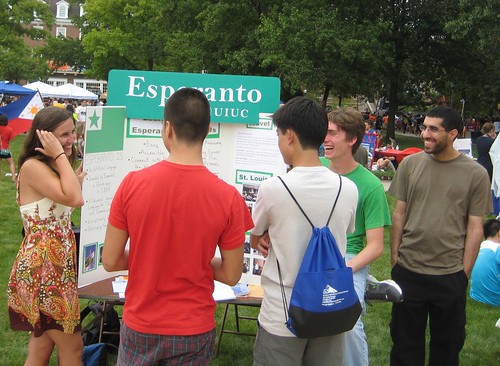
I was really pleased with this picture of Darcy, Dan, and Omar telling a couple of undergrads how much fun it is to learn Esperanto as a member of our group.
Of course, I didn’t want to actually run with bare feet. That seems stupid (although I suppose it’s another capability that might be worth developing, just in case circumstances arise where I might really need to run in bare feet).
No, what I wanted to do—like many people who have read Christopher McDougall‘s book Born to Run—was try running with the stride that one would use if one were barefoot.
The natural running stride, it turns out, is quite different from the walking stride. In walking, you land on your heel, then rock forward and push off with your toes. If you wear cushiony, padded running shoes, you can run like that too, but it’s not the natural way to run.
The natural running stride is easy to experience—just run in place for a few seconds. You’ll land on your forefoot, absorb the impact with the muscles of your calf and thigh, and then launch yourself off again with those same muscles.
I’ve been trying to run with more of a forefoot strike since I started running again this spring, but it’s hard to do if you’re wearing ordinary running shoes. The heel is not only all cushiony, it’s thick. That means that, unless you exaggerate your forefoot strike, you’re still going to land on your heel.
So, I went to the shoe store, meaning to try out one of the many new “minimalist” running shoes with thinner heels and less cushioning that are now on the market.
Happily, we have a great running shoe store in town called Body and Sole. After trying on three pairs of shoes with progressively less padding and structure, I tried on a really minimalist pair, which felt wonderful. I tested them in the concrete parking lot, taking a turn around the outside of the building, and then a second turn, and then a third. I told the salesman, “That first pair was fine, and I would have bought them. But this pair was the pair that made me want to keep running laps around the building.”
So, now I need to adjust to this new stride. It demands a bit more strength and endurance in the calf muscles (and no doubt in the muscles that keep the bones of the foot correctly arranged as well).
The shoes I ended up, a style called the Road Glove, are made by Merrell, which also provides an extensive website on barefoot running. They feel just like you’re barefoot, except that there’s a sole to protect your feet from sharp/hard/abrasive road hazards.
Following their advice, I just ran half a mile yesterday. I certainly feel it in my calves today. They don’t feel bad, though. Just tired and sore like I got a good workout yesterday. And my tendons and joints don’t feel sore at all.
The timing is perfect for doing a few low-mileage days. On Sunday I ran 5.25 miles for my long run (in my old shoes), so Monday and Tuesday would have been light running days anyway.
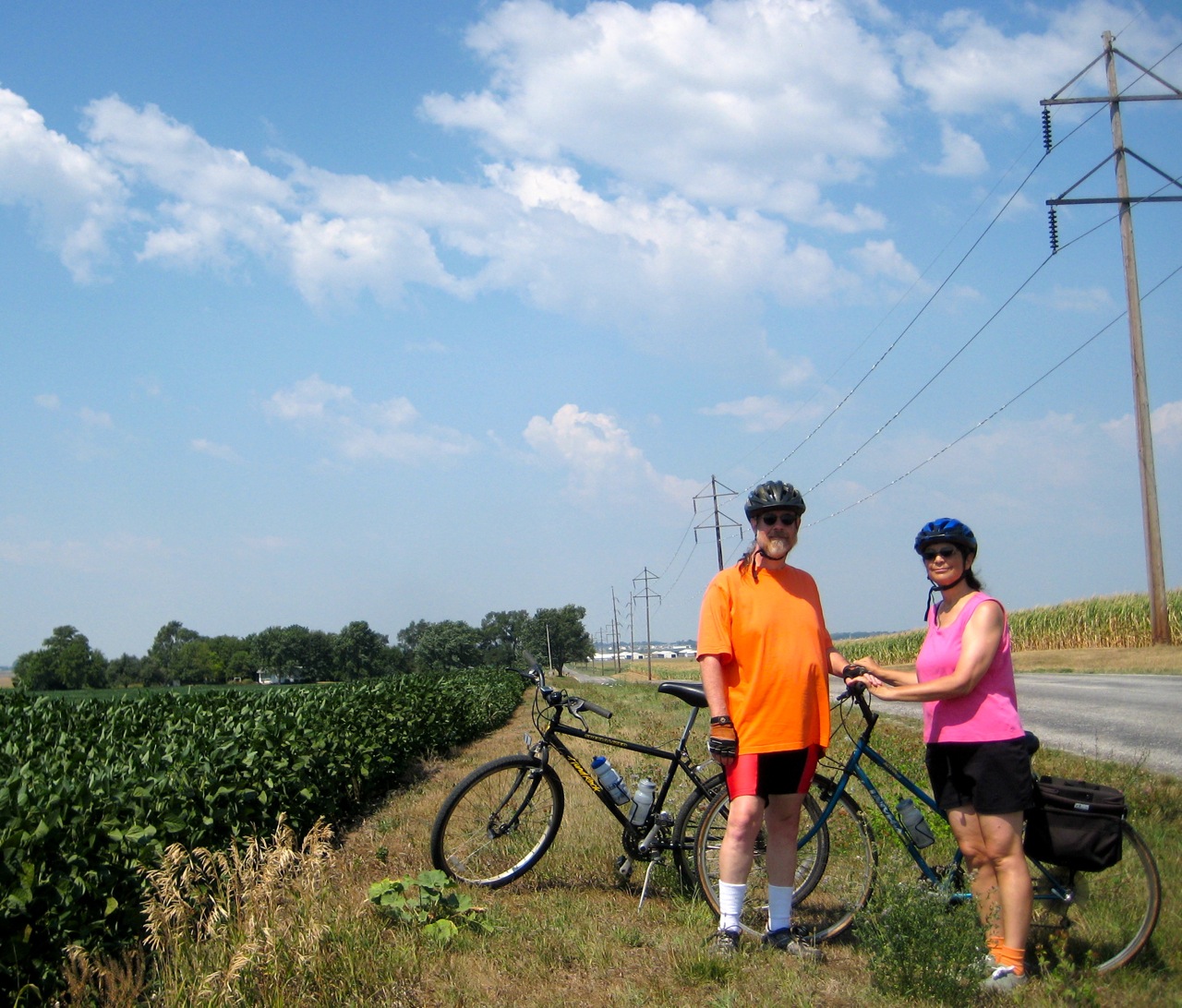
Plus, on Tuesday we went for a long bike ride. We rode to Philo and met some friends for lunch at the Philo Tavern. That’s a 28-mile round trip, which we did in an even three hours. (I wrote about an earlier bike ride to Philo in my old Clarion journal.)
Here’s us, on the road to Philo:
Me and Jackie on the road to Philo
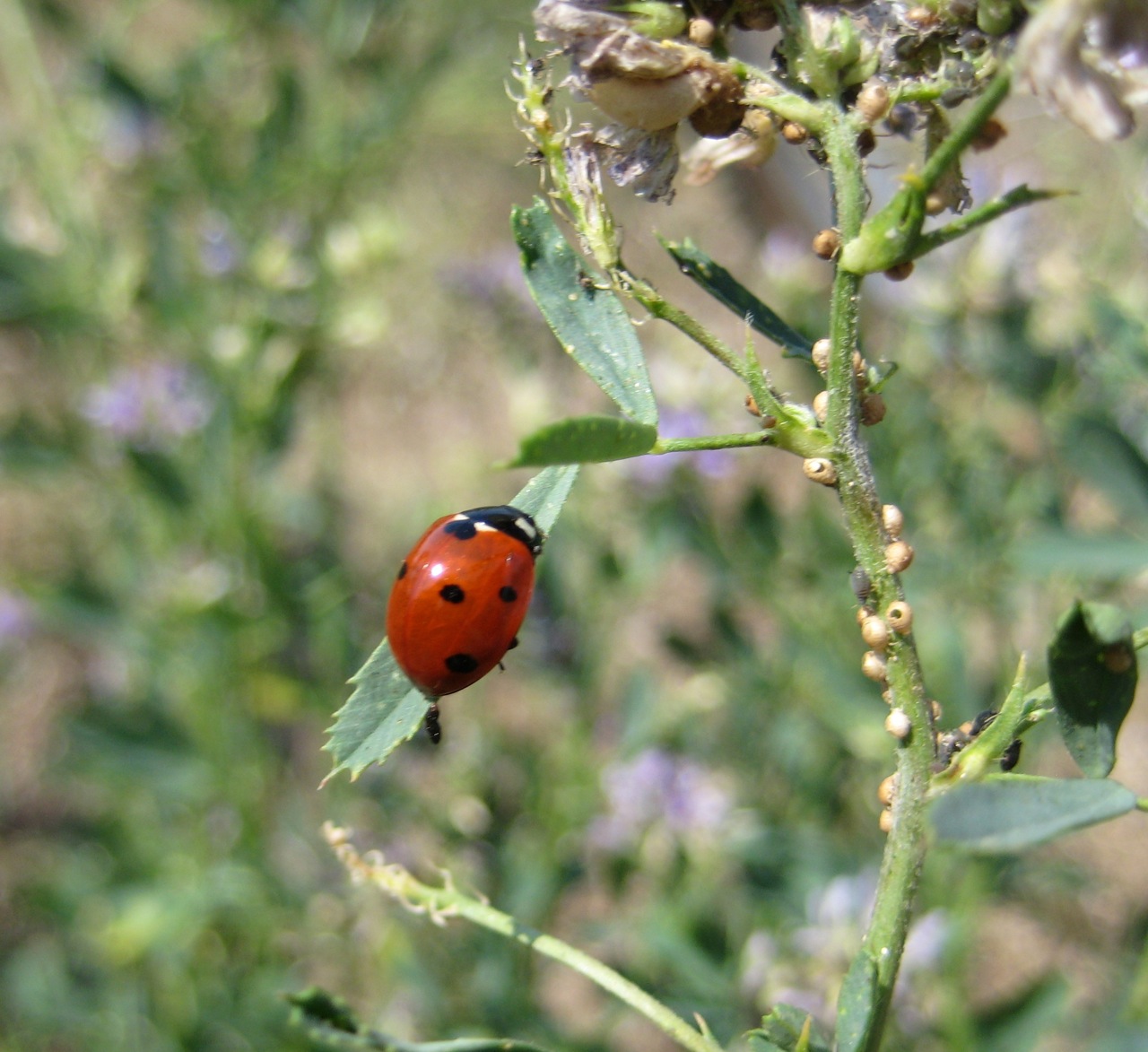
And here’s a pretty ladybug that I noticed while we were paused to get that picture:
Roadside Ladybug
I’ve already sent that picture to the Lost Ladybug Project, which is trying to gather data on the native ladybugs, whose distribution is changing due to the importation of non-native ladybugs and climate change.
We went to the garden early, to harvest and water. (Right now, anything you want to do has to be done early, because of the heat.)
We took a lot of sunflowers—and these are on top of the flowers we got two days ago, and the ones from a couple days before that. We’d given away a bouquet to a woman with a garden plot near ours, and two bouquets to Jackie’s mom (one for a neighbor of hers), but we still had so many flowers that Jackie had to be quite inventive to find enough containers to use as vases, and enough places to put the vases.
So, I thought I’d take a picture of each bouquet, and then take a spin at using the blog’s ability to display galleries of images, and show off the many sunflowers currently decorating every room in our apartment. They’re not the best photographs ever, but with such a pretty subject as sunflowers, it’s possible to get nice pictures anyway. Click an image to embiggenize it.
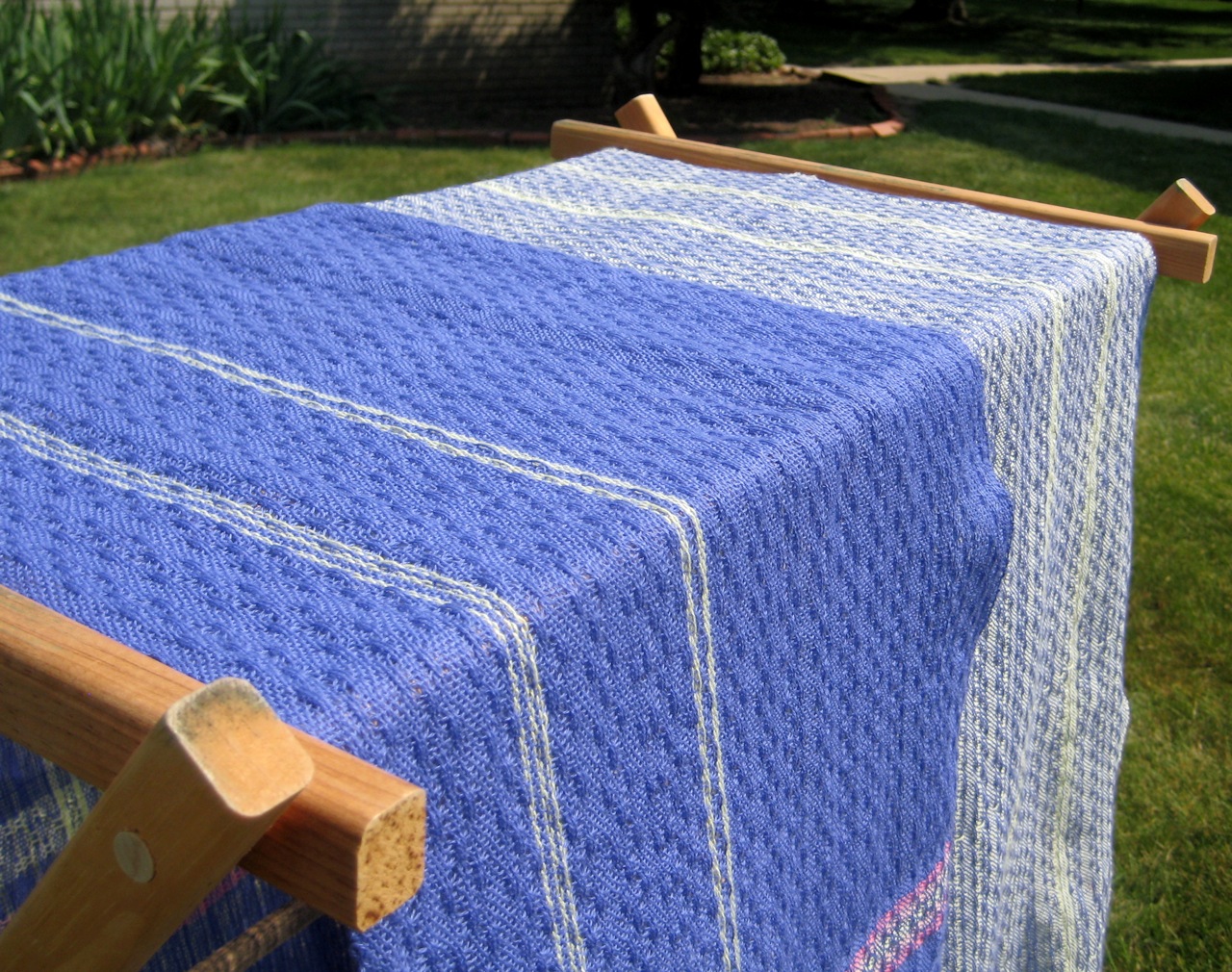
I did a photo-shoot for Jackie this morning, taking some pictures of her new fabric fresh off the loom.
I rather liked this picture, which I think captures the texture of the fabric rather nicely. (Click the photo for a larger image.)
As I type this, she’s preparing to wind a warp for another piece of fabric to go with this one.
As I understand it, she’s making three difference pieces of fabric with three different weave structures, but all three made out of the same cotton yarn. Then she’s planning to use the fabric to make a blouse.
I expect Jackie will be posting on her new fabric shortly, with additional photos. So if you’re interested, keep an eye on her blog.
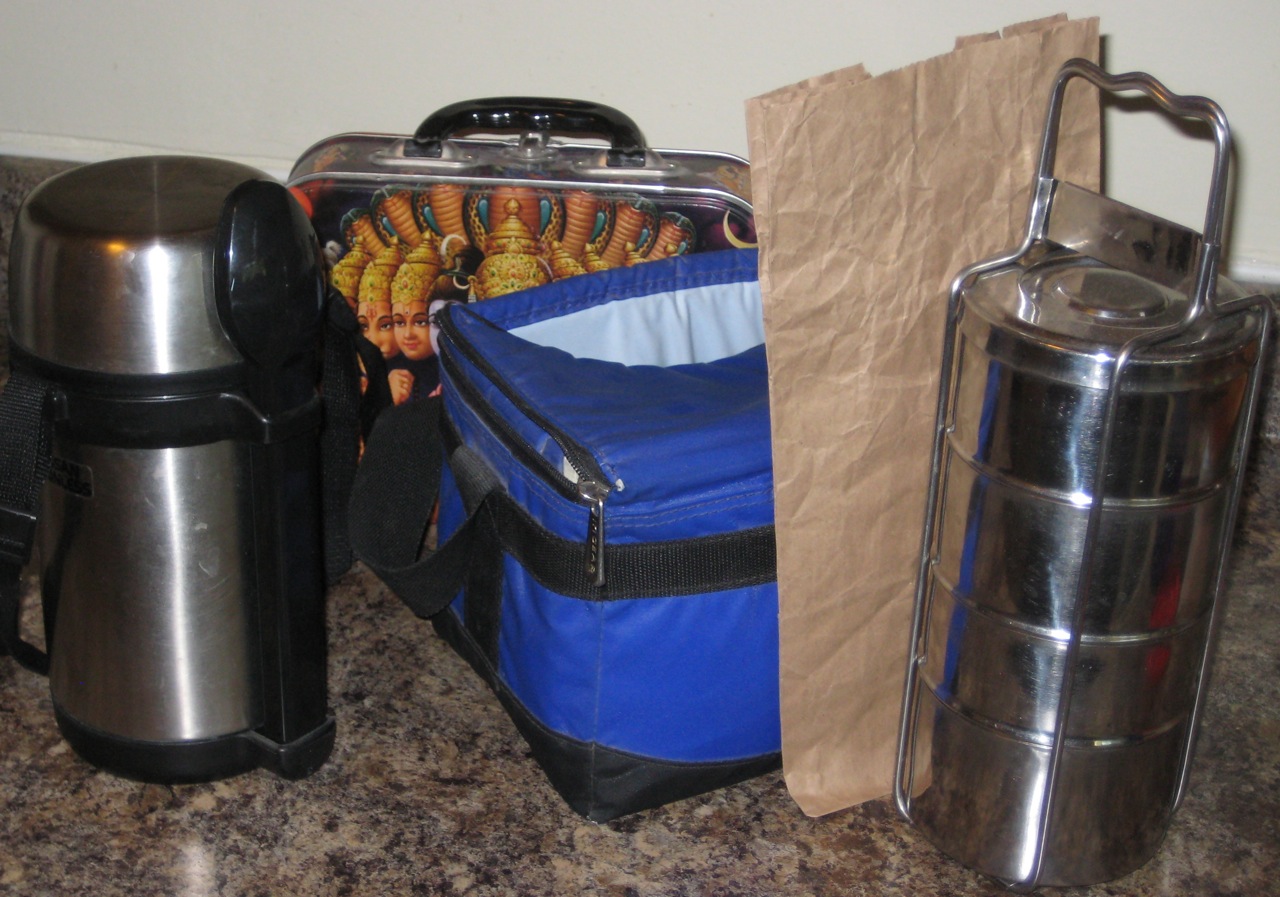
Photo of lunch boxes originally taken for Wise Bread.
I took this photo specifically to illustrate my latest Wise Bread post, which uses lunch boxes as an example in a discussion about how to choose between buying disposable versus buying to last. The editor ended up going with a different image, but I kind of liked this one, so I figured I’d use it here.
Turns out I have a lot of containers for carrying lunch.
The right-most one is Jackie’s tiffin carrier. Some places in India, wives produce fresh hot lunches for their husbands in the late morning and use a delivery system to have the lunches delivered at lunch time in carriers like this. We sometimes bring it to restaurants so we don’t need to ask for a box when we want to bring leftovers home.
Next to that is a brown paper bag, which I contend is a perfectly reasonable choice for brown-bag lunches: paper is cheap, made from renewable resources without requiring large amounts of energy, and is bio-degradable.
The blue container next to that is the lunch container I actually used to bring my lunch to the office for years. It’s insulated, so food from the fridge would stay cold enough to remain fresh, and then I’d heat it up in the office microwave.
Behind that is a metal lunch box printed with a Hindu pantheon. (The other side has a rather terrifying picture of Kali.) As best I can recall, we’ve never used it to carry a lunch. I think Jackie stores some sort of textile-related tools in it.
At the far left is an awesome thermos-brand lunch carrier that’s basically a big thermos bottle. I won it in a raffle at a Motorola company picnic. (It’s got a Motorola logo printed on it, although it was made by Nissan which I gather bought Thermos some years ago.) It’s a very clever contraption. Clearly someone put a lot of thought into it. There are four stackable containers inside. The bottom one is made for soup, and has gasketed lid to keep liquids in together with a little valve that lets pressure equalize as the soup cools. The next one up is a big container for the main dish—rice, pasta, whatever. The lid of that container is insulated. The next container up is supposed to be used for salad (kept from getting hot by the insulated lid below it), and the top container is for desert. I don’t think I ever used it as intended, to carry both hot and cold dishes, but it worked great as an alternative to my blue insulated carrier to carry cold dishes that I could heat up in the microwave. (And I might yet use it as intended, if I ever want to carry a hot lunch someplace that doesn’t have a microwave.)
As I was setting up for the photo shoot, I kept thinking of more lunch containers that we own. We actually have at least two that didn’t make it into the picture.
Some years ago, my dad gave us a picnic backpack. It’s for rather higher-class affairs than lunch at the office. It came with a tablecloth and place settings for two, together with a cutting board for serving bread and cheese, and a corkscrew. There’s a sleeve suitable for a carrying a bottle of wine. The pack has two compartments, one for the implements and then another insulated compartment for the food. (I think it’s this one: Picnic Backpack at REI.) I never brought that into work for lunch, but Jackie a couple of times packed up food for two and came to join me at the office for lunch.
The last is my “rack trunk” for my bicycle. It’s sized to fit on top of the bicycle’s rear rack, and is basically a big plastic tub lined with insulation, and then covered with nylon. It’s just the right size to hold a six-pack of soda (turned sideways), with enough room left over to hold a sandwich, along with a couple of granola bars, Reese’s peanut butter cups, or what have you. Jackie packed my lunch in that pretty often as well, during summer bicycling season. (If you don’t try to fit in a six-pack, there’s plenty of room for a proper meal.) They don’t make this sort of rack trunk any more. The new ones lack the rigid plastic tub, and just get their shape from the structure of the fabric—they’re not nearly as nice as mine.
I’d had no idea I had so many lunch boxes, until I started gathering them up for that photo shoot.
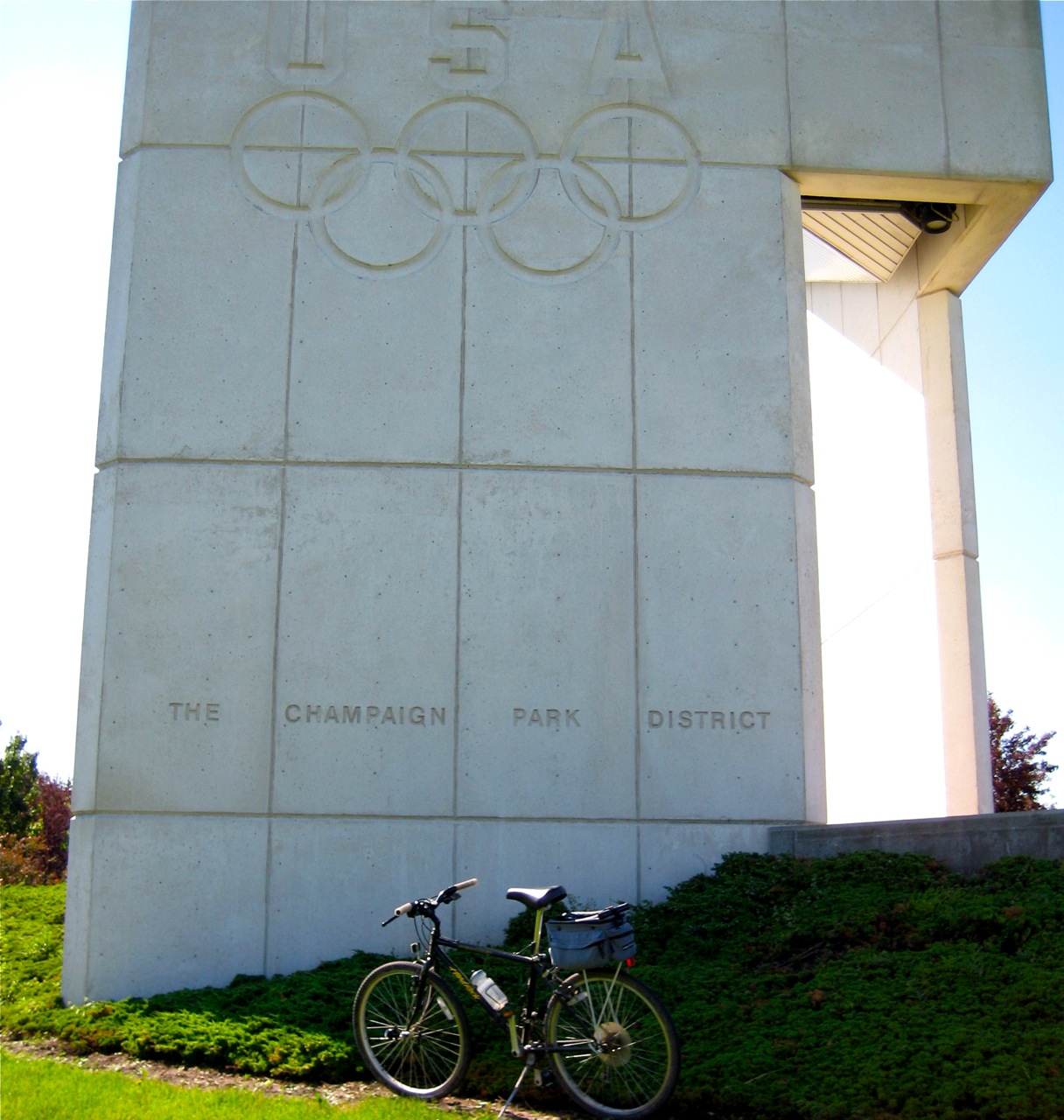
Jackie and I went for our first bike ride of the year. We followed our traditional first-ride route, around Kaufman Lake, past the Olympic Monument, around Parkland College, and then back. This year we went 6.27 miles.
I’d been hearing cardinals for several days, but out on this ride we got definitive expressions of bird spring. The robins are back, as are the red-winged blackbirds. I saw a crow fly up out of Copper Slough with a huge wad of nesting material in its beak.
The ride itself went fine as well. No mechanical problems. No problems with Jackie’s wrist. There had been a couple of previous days when it would have been warm enough to ride, but those days were very windy. It was nice to just wait for today and not have to deal with the headwinds.
I think we’re all set now, to be able to ride whenever we want. In particular, if there’s a day when it’s nice enough to ride first thing in the morning, we could ride to the Fitness Center and then to taiji. (That’s a bit long and complex of a ride to try to combine it with our first “shakedown” ride of the year.)
Spotted these decorative brassicas by the front walk of a house near campus, and liked them—a seasonally appropriate floral alternative for December.
Not the best picture ever—my phone had a pretty good camera for its day, but the lens has been riding around in my pocket for 5 years now.
I was near campus to meet some former co-workers for lunch, and took the opportunity to walk over to a Chinese grocery store near University and 5th, where I’d gotten a box of Ceylon tea last summer. That box of tea is just about empty, and I thought I’d look and see if they still carried it—which they do. (I’d checked on the internet, and found that Amazon was selling the same tea for $17 a box. The Chinese grocery store had it for $3.)
I don’t hate shopping. I sometimes say I do, but it’s an inaccurate shorthand. What I hate are a cluster of things inextricably intertwined with shopping. I hate driving from store to store. I hate the mall. I hate agonizing about the tradeoffs between choice A and choice B, especially under time pressure, and especially under conditions of imperfect information.
I’m a lot happier buying stuff on-line. But not boots. I never buy shoes or boots without trying them on.
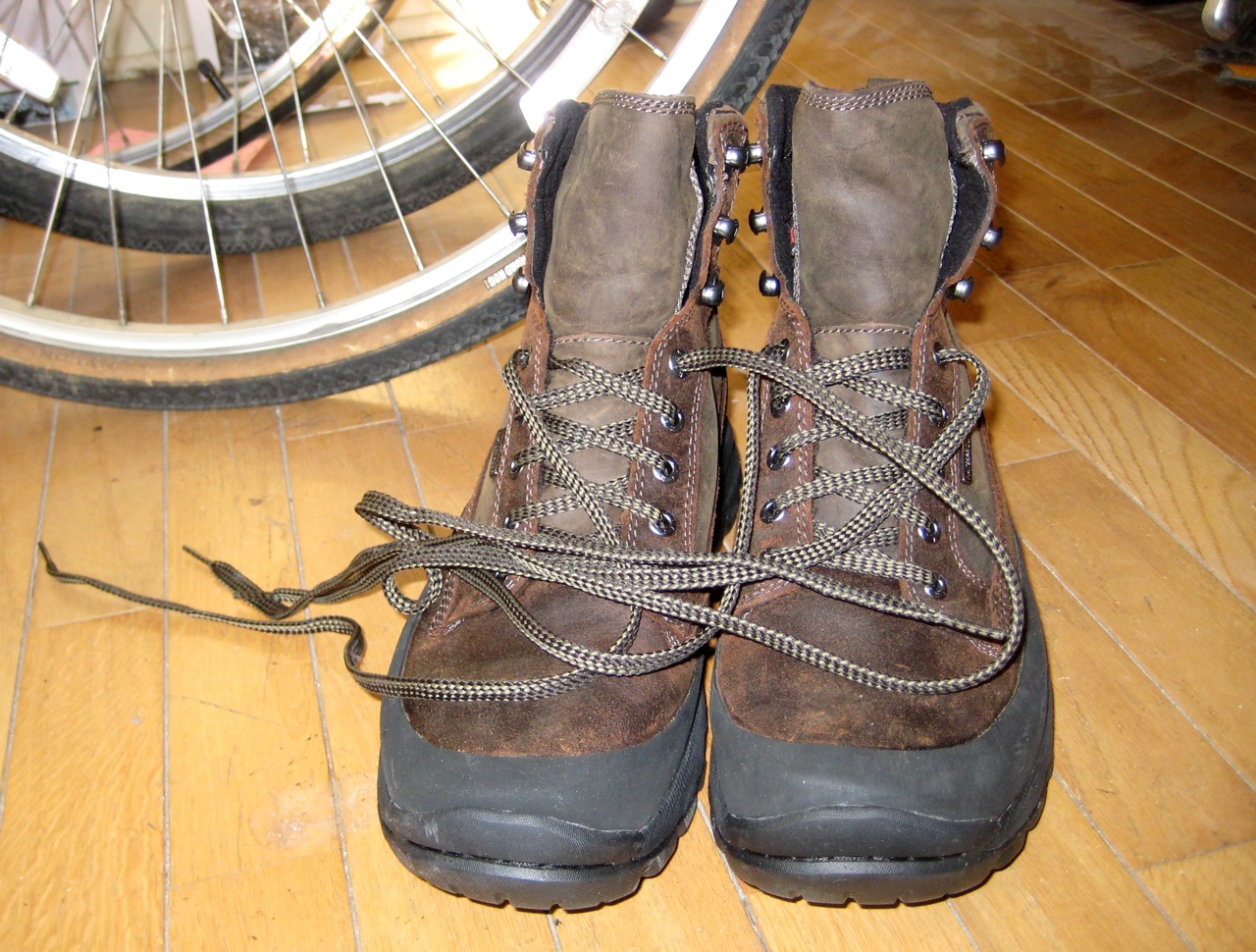
I also dislike spending money, especially spending largish sums of money, such as the $168 (including tax) that I just spent for a pair of boots.
I think I like the boots. I wanted a pair of waterproof, lightly insulated, hiking boots. This pair is all those things, plus they fit well and feel good on my feet. I’d had in my mind that I’d get GoreTex waterproofing and that the degree of insulation I wanted would probably be 200 gm Thinsulate, and I didn’t end up getting either of those. These are just “waterproof,” which probably means that the leather was treated with some sort of sealant—probably adequate for my purposes. And they’re insulated with 200 gm Primaloft, which is also probably at least as good as Thinsulate.
I decided that I needed these boots, because last year I found myself staying indoors too much during the winter, because I didn’t have adequate footwear for cold and wet. (We get a lot of cold and wet in Central Illinois—slush, snow, rain changing to snow, melting snow, cold rain falling on snow or ice, freezing rain, freezing mist. If you can think of weather that’s cold and wet, we have it here.)
With the right boots, I’m hoping I’ll be able to get myself out to walk, even in inclement conditions. Plus, there’s the slight extra boost that comes from the novelty factor of new boots.
And, with that in mind, I’m heading out now to walk a mile or two, to start breaking them in.