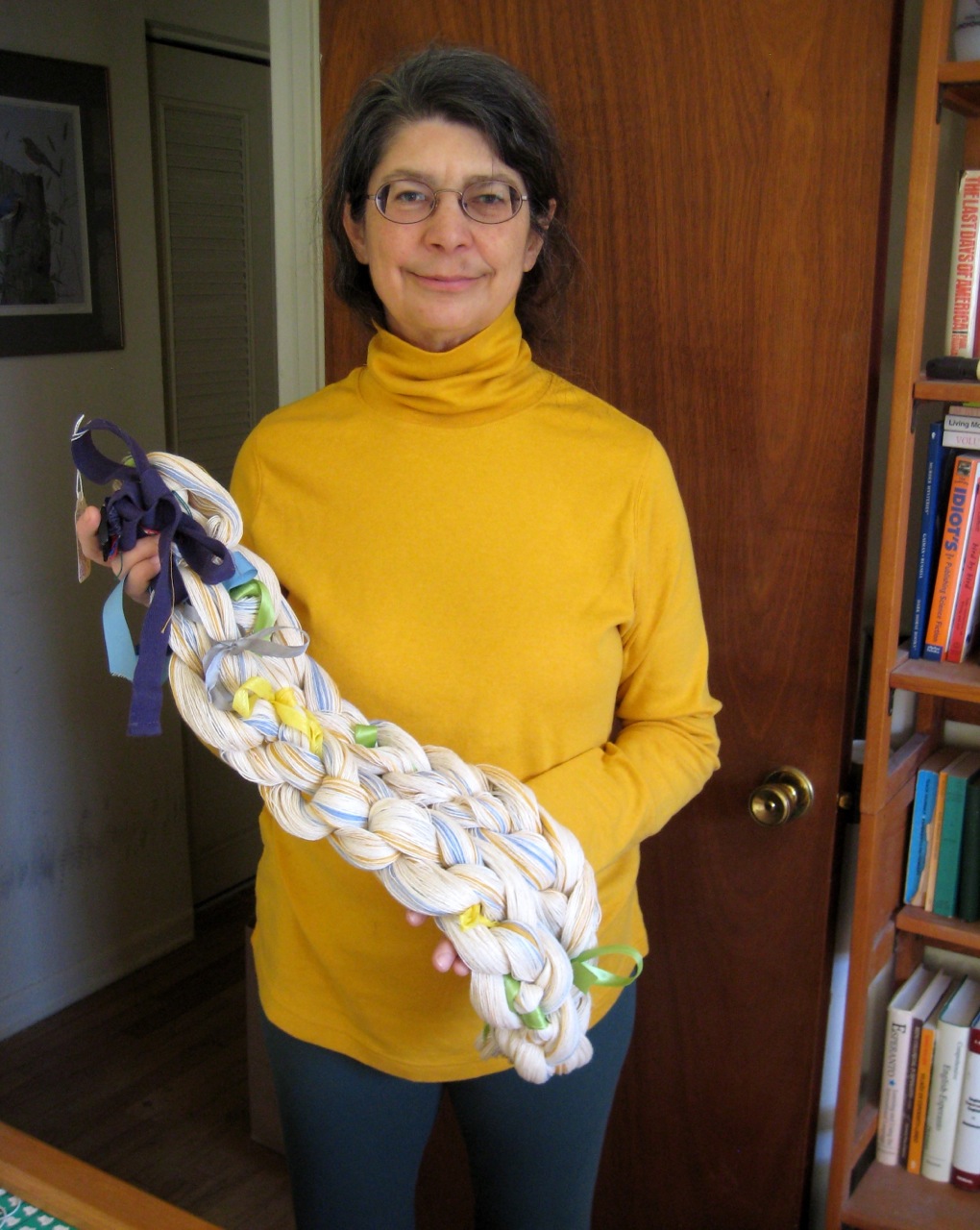
I did a photo-shoot for Jackie this morning, taking some pictures of her new fabric fresh off the loom.

I rather liked this picture, which I think captures the texture of the fabric rather nicely. (Click the photo for a larger image.)

As I type this, she’s preparing to wind a warp for another piece of fabric to go with this one.

As I understand it, she’s making three difference pieces of fabric with three different weave structures, but all three made out of the same cotton yarn. Then she’s planning to use the fabric to make a blouse.

I expect Jackie will be posting on her new fabric shortly, with additional photos. So if you’re interested, keep an eye on her blog.

Various containers for carrying lunches
Photo of lunch boxes originally taken for Wise Bread.

I took this photo specifically to illustrate my latest Wise Bread post, which uses lunch boxes as an example in a discussion about how to choose between buying disposable versus buying to last. The editor ended up going with a different image, but I kind of liked this one, so I figured I’d use it here.

Turns out I have a lot of containers for carrying lunch.

The right-most one is Jackie’s tiffin carrier. Some places in India, wives produce fresh hot lunches for their husbands in the late morning and use a delivery system to have the lunches delivered at lunch time in carriers like this. We sometimes bring it to restaurants so we don’t need to ask for a box when we want to bring leftovers home.

Next to that is a brown paper bag, which I contend is a perfectly reasonable choice for brown-bag lunches: paper is cheap, made from renewable resources without requiring large amounts of energy, and is bio-degradable.

The blue container next to that is the lunch container I actually used to bring my lunch to the office for years. It’s insulated, so food from the fridge would stay cold enough to remain fresh, and then I’d heat it up in the office microwave.

Behind that is a metal lunch box printed with a Hindu pantheon. (The other side has a rather terrifying picture of Kali.) As best I can recall, we’ve never used it to carry a lunch. I think Jackie stores some sort of textile-related tools in it.

At the far left is an awesome thermos-brand lunch carrier that’s basically a big thermos bottle. I won it in a raffle at a Motorola company picnic. (It’s got a Motorola logo printed on it, although it was made by Nissan which I gather bought Thermos some years ago.) It’s a very clever contraption. Clearly someone put a lot of thought into it. There are four stackable containers inside. The bottom one is made for soup, and has gasketed lid to keep liquids in together with a little valve that lets pressure equalize as the soup cools. The next one up is a big container for the main dish—rice, pasta, whatever. The lid of that container is insulated. The next container up is supposed to be used for salad (kept from getting hot by the insulated lid below it), and the top container is for desert. I don’t think I ever used it as intended, to carry both hot and cold dishes, but it worked great as an alternative to my blue insulated carrier to carry cold dishes that I could heat up in the microwave. (And I might yet use it as intended, if I ever want to carry a hot lunch someplace that doesn’t have a microwave.)

As I was setting up for the photo shoot, I kept thinking of more lunch containers that we own. We actually have at least two that didn’t make it into the picture.

Some years ago, my dad gave us a picnic backpack. It’s for rather higher-class affairs than lunch at the office. It came with a tablecloth and place settings for two, together with a cutting board for serving bread and cheese, and a corkscrew. There’s a sleeve suitable for a carrying a bottle of wine. The pack has two compartments, one for the implements and then another insulated compartment for the food.  (I think it’s this one: Picnic Backpack at REI.) I never brought that into work for lunch, but Jackie a couple of times packed up food for two and came to join me at the office for lunch.

The last is my “rack trunk” for my bicycle. It’s sized to fit on top of the bicycle’s rear rack, and is basically a big plastic tub lined with insulation, and then covered with nylon. It’s just the right size to hold a six-pack of soda (turned sideways), with enough room left over to hold a sandwich, along with a couple of granola bars, Reese’s peanut butter cups, or what have you. Jackie packed my lunch in that pretty often as well, during summer bicycling season. (If you don’t try to fit in a six-pack, there’s plenty of room for a proper meal.) They don’t make this sort of rack trunk any more. The new ones lack the rigid plastic tub, and just get their shape from the structure of the fabric—they’re not nearly as nice as mine.

I’d had no idea I had so many lunch boxes, until I started gathering them up for that photo shoot.

Jackie has an update about her latest project, in which she’s weaving something called Huck Lace.

I mostly wanted to draw attention to the third picture, in which I captured Rapunzel “helping.” In this case, she’s helping by poking her face up through the warp.

Pure luck that I got that picture—her head wasn’t even headed that way when I pressed the button, but there it was in the captured image.

Jackie and I went for our first bike ride of the year. We followed our traditional first-ride route, around Kaufman Lake, past the Olympic Monument, around Parkland College, and then back. This year we went 6.27 miles.

I’d been hearing cardinals for several days, but out on this ride we got definitive expressions of bird spring. The robins are back, as are the red-winged blackbirds. I saw a crow fly up out of Copper Slough with a huge wad of nesting material in its beak.

The ride itself went fine as well. No mechanical problems. No problems with Jackie’s wrist. There had been a couple of previous days when it would have been warm enough to ride, but those days were very windy. It was nice to just wait for today and not have to deal with the headwinds.

I think we’re all set now, to be able to ride whenever we want. In particular, if there’s a day when it’s nice enough to ride first thing in the morning, we could ride to the Fitness Center and then to taiji. (That’s a bit long and complex of a ride to try to combine it with our first “shakedown” ride of the year.)

Plaque commemerating a lecture by Susan B. Anthony

Plaque commemorating a lecture by Susan B. AnthonyI’ve long been peeved by how little credit people give to the power of their vote.

So many people seem to think that a vote isn’t effective unless it holds the balance of power, as if their vote only counted when the other voters were equally split, so that their vote would sway the election one way or the other.

This isn’t true for individuals, and it most especially is not true for groups.

Back in the run-up to the 2008 election, I heard a  story on NPR that provided a good counterexample. An Indian tribe in (I think) New Mexico was getting attention from state and national candidates of both parties, because they had started voting. Pretty much all of a sudden, after their voting turnout had shot up, their issues became important to politicians at all levels. And their issues weren’t just important when there was a close election and their votes might make the difference: Because they voted in every election, every politician needed to pay attention to their issues all the time.

If you’re a member of a group that votes, your group’s issues will be taken seriously. You don’t need to be a majority. You don’t even need to vote as a block. (In fact, it’s probably better if you don’t: You want politicians thinking that each individual vote is up for grabs, if they institute the right policies.)

The image at the top of this post is of a plaque in downtown Champaign, commemorating a lecture on “Work, Wages, and the Ballot,” that Susan B. Anthony gave here back in 1870. I’ve seen the plaque many times, but couple of days ago, I thought to take a picture of the plaque, and that prompted me to do a proper search, which yielded some results.

This Project Gutenberg Book Susan B. Anthony: Rebel, Crusader, Humanitarian, by Alma Lutz is pretty good:

She had at hand a perfect example in the unsuccessful strike of Kate Mullaney’s strong, well-organized union of 500 collar laundry workers in Troy, New York. Aware that Kate blamed their defeat on the ruthless newspaper campaign, inspired and paid for by employers, Susan asked her, “If you had been 500 carpenters or 500 masons, do you not think you would have succeeded?”

“Certainly,” Kate Mullaney replied, adding that the striking bricklayers had won everything they demanded. Susan then reminded her that because the bricklayers were voters, newspapers respected them and would hesitate to arouse their displeasure, realizing that in the next election they would need the votes of all union men for their candidates. “If you collar women had been voters,” she told them, “you too would have held the balance of political power in that little city of Troy.”

I turned 18 shortly after the voting age in the US had been lowered to 18. The drinking age had been lowered along with it, so it was legal for me to drink. But a big jump in drunk driving accidents prompted many states to raise their drinking age.

In Michigan it turned out to be an oddly complex process. A state law was passed, raising the drinking age to 19, but grandfathering in people who were already old enough to have started drinking before the law went into effect. After that law was passed, but before it went into effect, a state constitutional amendment was put on the ballot, that would raise the drinking age to 21, without any grandfathering. That would create a whole cohort of people who’d been able to buy alcohol for a year or more, who would lose that right. And all of them could vote.

I voted against it, of course. But nobody else I knew who was going to be in the affected group bothered to vote. They didn’t much care about the issue—it was as easy for under-age drinkers to buy booze then as now—and they didn’t think their vote would count for much. And, as it turned out, they were right. But only because their peers didn’t vote. Not only could a solid voting block of 18-to-20 year olds have affected the outcome, I rather doubt if the issue would have even gone on the ballot, if 18-to-20 year olds voted at the rates that senior citizens do.

The way voting helps is not by winning individual elections (although that does happen and it’s nice when it does). The way voting helps is that if you’re a voter, politicians take your interests into account all the time.

Spotted these decorative brassicas by the front walk of a house near campus, and liked them—a seasonally appropriate floral alternative for December.

Not the best picture ever—my phone had a pretty good camera for its day, but the lens has been riding around in my pocket for 5 years now.

I was near campus to meet some former co-workers for lunch, and took the opportunity to walk over to a Chinese grocery store near University and 5th, where I’d gotten a box of Ceylon tea last summer. That box of tea is just about empty, and I thought I’d look and see if they still carried it—which they do. (I’d checked on the internet, and found that Amazon was selling the same tea for $17 a box. The Chinese grocery store had it for $3.)

Creative Commons License
Decorative Brassicas by Philip Brewer is licensed under a Creative Commons Attribution 3.0 Unported License.
Based on a work at www.philipbrewer.net.

I don’t hate shopping. I sometimes say I do, but it’s an inaccurate shorthand. What I hate are a cluster of things inextricably intertwined with shopping. I hate driving from store to store. I hate the mall. I hate agonizing about the tradeoffs between choice A and choice B, especially under time pressure, and especially under conditions of imperfect information.

I’m a lot happier buying stuff on-line. But not boots. I never buy shoes or boots without trying them on.

I also dislike spending money, especially spending largish sums of money, such as the $168 (including tax) that I just spent for a pair of boots.

I think I like the boots. I wanted a pair of waterproof, lightly insulated, hiking boots. This pair is all those things, plus they fit well and feel good on my feet. I’d had in my mind that I’d get GoreTex waterproofing and that the degree of insulation I wanted would probably be 200 gm Thinsulate, and I didn’t end up getting either of those. These are just “waterproof,” which probably means that the leather was treated with some sort of sealant—probably adequate for my purposes. And they’re insulated with 200 gm Primaloft, which is also probably at least as good as Thinsulate.

I decided that I needed these boots, because last year I found myself staying indoors too much during the winter, because I didn’t have adequate footwear for cold and wet. (We get a lot of cold and wet in Central Illinois—slush, snow, rain changing to snow, melting snow, cold rain falling on snow or ice, freezing rain, freezing mist. If you can think of weather that’s cold and wet, we have it here.)

With the right boots, I’m hoping I’ll be able to get myself out to walk, even in inclement conditions. Plus, there’s the slight extra boost that comes from the novelty factor of new boots.

And, with that in mind, I’m heading out now to walk a mile or two, to start breaking them in.

The crowd in West Side Park at the Occupy CU rally

I came out of college almost debt-free, because my parents paid for my education.

I got a job writing software. It was exactly what I wanted to do—the only thing I wanted to do as much as writing prose. I remember being glad that my manager didn’t know that I’d have worked for free, just to get access to the computers. (In 1981, computers were still expensive.)

I started my career right at the moment when software started to became important everywhere. Even though my degree was in economics, I had no trouble finding software jobs.

I got raises, because software went on becoming more important. Even when the companies I worked for fell on bad times, I found a new job without difficulty.

I saw things changing. After about 1990, jobs went away a lot quicker, and when they went away, they didn’t come back.

I was still okay, because software was still important.

I realized that software wasn’t going to remain special. I realized that millions of people around the world could write software just as well as I could. I realized that the ones in China and India could live a middle-class life on one-tenth the money I was earning. I realized that I couldn’t compete with them on price.

I figured I was safe for a while, but only because there were so many managers who were sure that an employee he couldn’t see working probably wasn’t working. But that wouldn’t last. Managers would adapt. And managers who couldn’t adapt would lose their jobs.

I started saving money. I could see that I wasn’t saving it fast enough, so I started living more frugally. That was a double win: Spending less left more money to save, and it also provided me with an existence proof that I could live on less.

I lost my job when Motorola closed its Champaign facility in August of 2007. By then, I had saved and invested a lot of money. Not enough to retire in any ordinary sense, but enough that I figured I could get by without a regular job.

I am a writer now. It’s exactly what I want to do.

I am very lucky. That’s not unusual; there are a lot of lucky people. What’s a little unusual is that I know just how lucky I’ve been.

I am the 99%.

Our 2011 harvest of peppers
Washing our pepper harvest

After Jackie broke her wrist, we quit going to the garden. She couldn’t do that sort of work at all, and I was so busy trying to do the bare minimum of my work plus the necessary fraction of the work she couldn’t do any more, anything extra had to be dropped. The garden was one thing we dropped.

Jackie’s nearly all better now. The splint has been off for several weeks. The hand therapist said she was doing well enough on her own and didn’t need formal physical therapy. (He gave her a bunch of exercises to do.) But we still didn’t go to the garden. It just seemed like it would be too depressing to see the remnants and imagine what our garden might have been.

And yet, we figured there’d probably be some stuff to harvest. We’d had a hot, dry summer, so we didn’t expect the tomatoes to have survived. And without us there to do the weeding, we figured the greens would have been overshadowed terribly by weeds. But the sage should have survived, and perhaps the peppers as well.

As it turns out, it wasn’t even quite that bad. Two of our cherry tomato plants did very well. And, as you see, the peppers produced in great profusion. We also got some sage, some swiss chard, and a some sunflowers.

Now I’m feeling a little silly that we didn’t get to the garden earlier. We’d certainly have gotten a lot more sunflowers—we could have had flowers steadily for all these weeks. We’d also have been able to eat the peppers steadily as they ripened, instead of getting a whole bunch at once that we’re going to have to preserve. But not very silly. We did about the best we could under the circumstances. To have gotten this much of a harvest despite doing no work since early July is kind of a bonus.