You know what integer posts are—the ones where the title starts with an integer. I scorn them when I’m reading, so I tend not to write them. I’ve ended up writing a few, though. Seriously—sometimes they just pop out.

I knew I’d written three, but looking back over my list of Wise Bread posts, I see that I’ve actually written six, a fact that I’m somewhat ashamed of:

These last two are sliders. For one thing, the integer is spelled out, not written as a digit. For another, the posts are organized as a logical sequence, rather than as a lame list. I don’t know if they count or not, but the title begins with an integer, so I’m including them.

This next list, though, don’t count. They’re posts that quite legitimately include a number in the title because it’s part of what the post is about:

Those I’m not ashamed of at all. I mean, 401(k) isn’t even an integer!

Oh, and I almost missed this shameful integer post, because I’d hidden the integer in the middle:

And what about this one?

Shameful? Or shameless?

Sadly, integer posts do seem to work, if by “work” you mean “get more reads.” Perhaps the title of this post should have been “7 Shameful Integer Posts”! Hmm?

Siam Dragon Peppers
Siam Dragon Peppers
We keep harvesting them, but every time we return to the garden a few more of our Siam Dragon Peppers are ripe.

I like to joke that I no longer multitask at more than one thing at a time.

Related to that, I recognized years ago that a certain amount of monomaniacal focus was really useful for successfully completing a large project (such as a novel), but that being able to focus on more than just one thing was important to being more broadly successful.

This is all the more true if you want to accomplish more than just one thing (if you want to, for example, write a series of Wise Bread posts, write an occasional short story, and become physically fit, in addition to writing a novel). And yet, each one of those things requires focus, if I’m to accomplish it.

Basically, I need to be able to be monomaniacal about three or four things at a time.

Like most people, I find that I get caught up in whatever I’m doing, both on a minute-to-minute basis and a day-to-day basis.

On a minute-to-minute basis, when I’m writing something, and especially when the writing is going well, I want to press on. I feel this way, even though I know from both things others have said and personal experience, that it’s always best to stop in the middle of things—to leave a ragged edge, so that I return to the work with a clear entry point, already knowing how the next bit goes. Convincing myself to do this routinely would really help with being monomaniacal about multiple things: I’d be quicker at ending the first thing so I could switch my focus to the second, and I’d be quicker at resuming the first thing when I came back to it.

Just lately, my day-to-day monomaniacal focus has been on running. I don’t run every single day, but I’ve had to make it the first thing I do on the days that I do it, because otherwise it’s too hot to run. It’s been working very well for building fitness, but doing it first has tended to result in it preempting my writing.

I’m not quite sure why. Partly it’s because a good workout leaves me feeling tired. Partly it’s because a good workout leaves me feeling like I’ve accomplished something (so I’m less driven to accomplish something more). Partly it’s just that I’m only at my best first thing in the day, so whatever I do first always ends up being the main thing I do that day.

Once there’s a break in the heat, I want to get back to writing first of all. If I can put that together with taking a fairly early break (leaving the work paused at a ragged edge) and then running (or walking or bicycling or lifting or doing taiji) and then returning for a second session of writing, I think I’ll be more productive at the writing without any loss of success at the fitness thing.

Exactly on topic for the above is Tobias Buckell’s latest meditations on designing a daily routine that provides both writing time and exercise time, while also allowing him to work on different aspects of his work at whatever time of day he’s most effective at that particular thing. Toby is a great writer, but he’s an absolute genius at measuring his productivity and then using that data to tweak his work habits.

I need to improve my own data collection. I already track my productivity at writing, but I need to get a bit more fine-grained about it and track productivity per work session (rather than per day). I’m sure I’m most productive in the first session of the day, but I don’t have any evidence, and I certainly don’t know how much less productive I am during the later sessions, nor to I know whether my productivity declines less if I work on non-fiction (or editing, or research).

The picture, by the way, has nothing to do with this post. I just thought the blog needed another picture, and I’d brought the camera to the garden today.

I just discovered another Champaign-Urbana area writers group for writers of speculative fiction, calling themselves All Writes Reserved. How did I not know this? In any case, it’s great to know that there’s another group of serious writers of speculative fiction in town.

Anyway, I’ve added five blogs to my feed reader—the individual blogs of the group’s members, plus that group blog, which I also added to the list of local writers groups on my Incognitos Writers Group page.

I’ll also try and get in touch with them and raise the possibility that we might do an occasional joint critique session or something. (Getting in touch with a group of people on the net is not as easy as it used to be, now that so many people insist on trying to hide their email address in a futile effort to stave off spammers. And, practicing what I preach, my email address is right there on my Contact page.)

I told Jackie, “I want to get a slug of fiction writing done, and then take a nap.”

She said, “Does fiction writing naturally come in units of slugs?”

And I said, “Yes. The slug is the natural unit of fiction writing.”

So she said, “Well then, you should be sure to bring along Sigurson.”

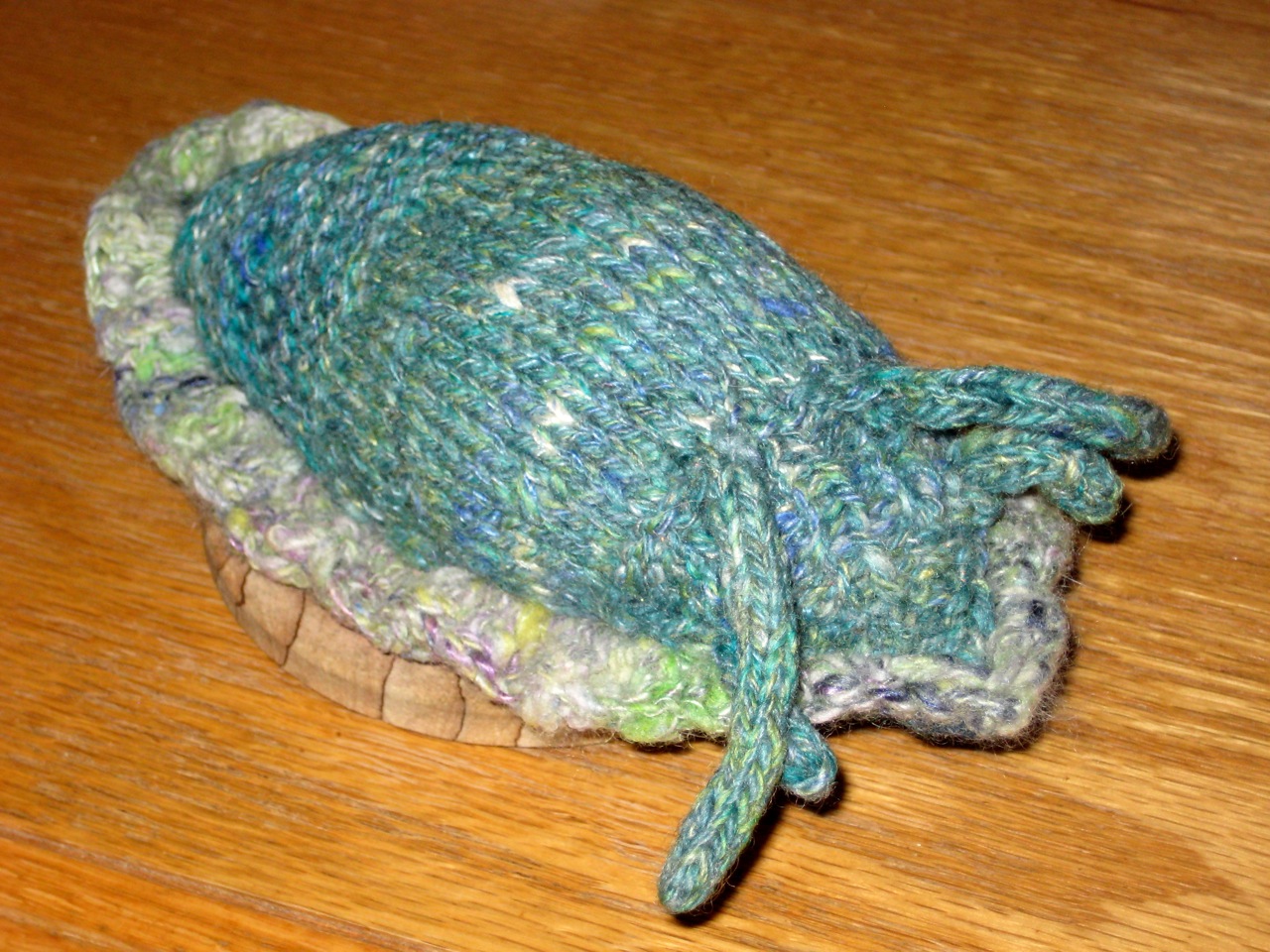
So I went and got Sigurson to sit with me while I work on the next bit of this story.

Here’s a picture of Sigurson, sitting on a spare coaster on my desk:

Update: I wrote 745 words. Didn’t get a nap, though.

I’m a student of daily routines. I like to imagine that I’m looking for good models for my own behavior, but that’s only true in an oblique way. By now I understand pretty well the structure of a productive routine; no new routine will be enough better than the routines I’ve already studied to justify the effort of examining them. The value in studying daily routines, for me, is as a reminder to follow my own routine.

For a while there was a great blog called Daily Routines that was very nearly pornography for this inclination of mine to ponder new models. It was there that I found the daily routine for Charles Darwin, which is probably the best model I’ve found so far.

And it is in part because of its similarity to Darwin’s model, that the daily routine of Vestricius Spurinna caught my eye:

At the second hour [after waking] he calls for his shoes and walks three miles, exercising mind as well as body. If he has friends with him the time is passed in conversation on the noblest of themes, otherwise a book is read aloud….

Then he sits down, and there is more reading aloud or more talk for preference; afterwards he enters his carriage [for more private conversation].

After riding seven miles he walks another mile, then he again resumes his seat or betakes himself to his room and his pen. For he composes, both in Latin and Greek, the most scholarly lyrics. They have a wonderful grace, wonderful sweetness, and wonderful humour, and the chastity of the writer enhances its charm.

When he is told that the bathing hour has come—which is the ninth hour in winter and the eighth in summer—he takes a walk naked in the sun, if there is no wind.

Then he plays at ball for a long spell, throwing himself heartily into the game, for it is by means of this kind of active exercise that he battles with old age.

After his bath he lies down and waits a little while before taking food, listening in the meantime to the reading of some light and pleasant book. All this time his friends are at perfect liberty to imitate his example or do anything else they prefer.

Then dinner is served…. The dinner is often relieved by actors of comedy, so that the pleasures of the table may have a seasoning of letters. Even in the summer the meal lasts well into the night, but no one finds it long, for it is kept up with such good humour and charm.

The consequence is that, though he has passed his seventy-seventh year, his hearing and eyesight are as good as ever, his body is still active and alert, and the only symptom of his age is his wisdom.

– (From a public-domain translation of the letters of Pliny the Younger.)

Of course, Spurinna was retired, so one writing session of just an hour or two is probably enough for him. His work when he was younger was as a magistrate and governor, and so probably took place in those conversation sessions that are now just for pleasure.

I think there’s a lot to emulate there. Three walks per day adding up to five miles seems just about right—as long as you include another hour or two of vigorous sport. Of course, he’s in his late seventies. Us younger folk should probably get in a little more than that.

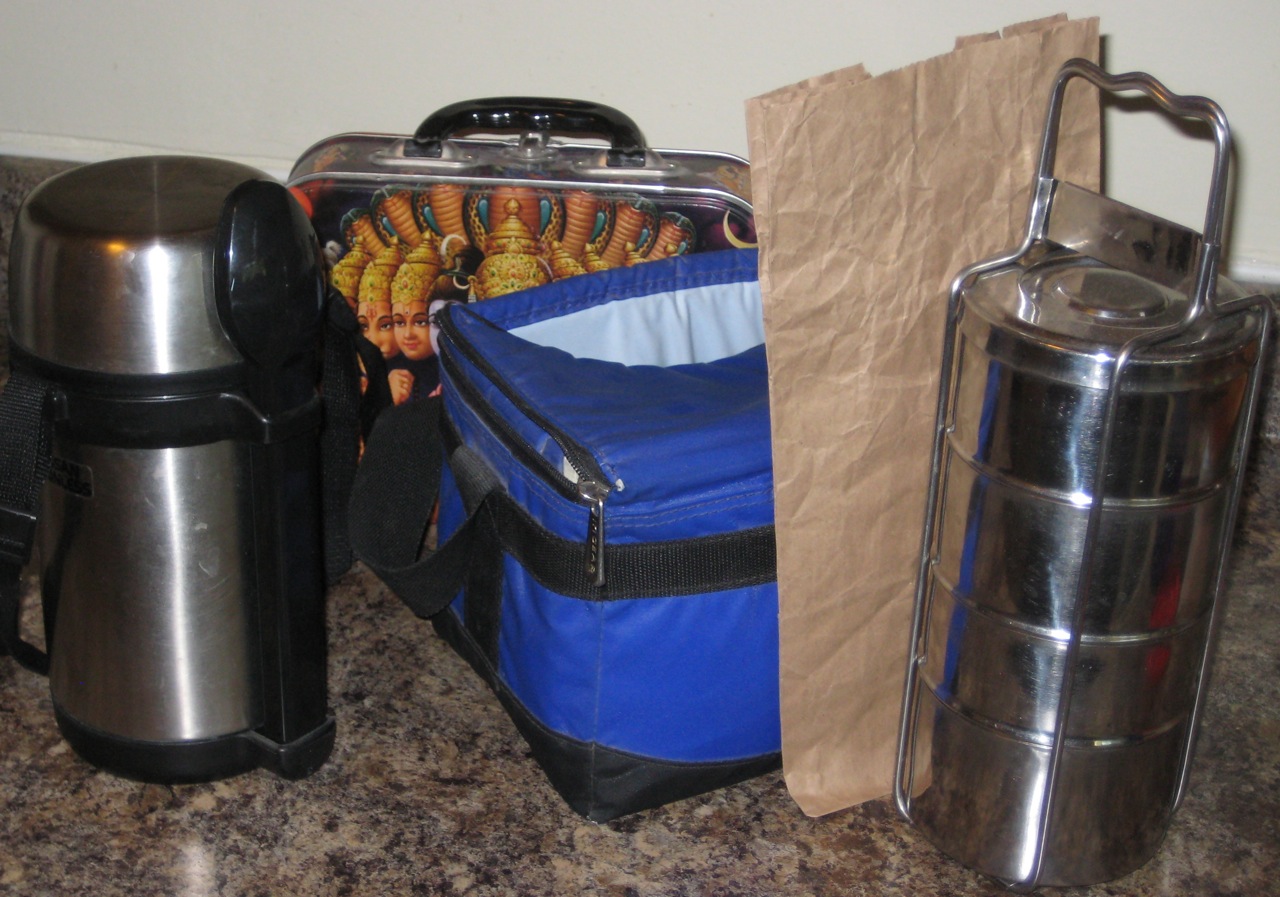
Various containers for carrying lunches
Photo of lunch boxes originally taken for Wise Bread.

I took this photo specifically to illustrate my latest Wise Bread post, which uses lunch boxes as an example in a discussion about how to choose between buying disposable versus buying to last. The editor ended up going with a different image, but I kind of liked this one, so I figured I’d use it here.

Turns out I have a lot of containers for carrying lunch.

The right-most one is Jackie’s tiffin carrier. Some places in India, wives produce fresh hot lunches for their husbands in the late morning and use a delivery system to have the lunches delivered at lunch time in carriers like this. We sometimes bring it to restaurants so we don’t need to ask for a box when we want to bring leftovers home.

Next to that is a brown paper bag, which I contend is a perfectly reasonable choice for brown-bag lunches: paper is cheap, made from renewable resources without requiring large amounts of energy, and is bio-degradable.

The blue container next to that is the lunch container I actually used to bring my lunch to the office for years. It’s insulated, so food from the fridge would stay cold enough to remain fresh, and then I’d heat it up in the office microwave.

Behind that is a metal lunch box printed with a Hindu pantheon. (The other side has a rather terrifying picture of Kali.) As best I can recall, we’ve never used it to carry a lunch. I think Jackie stores some sort of textile-related tools in it.

At the far left is an awesome thermos-brand lunch carrier that’s basically a big thermos bottle. I won it in a raffle at a Motorola company picnic. (It’s got a Motorola logo printed on it, although it was made by Nissan which I gather bought Thermos some years ago.) It’s a very clever contraption. Clearly someone put a lot of thought into it. There are four stackable containers inside. The bottom one is made for soup, and has gasketed lid to keep liquids in together with a little valve that lets pressure equalize as the soup cools. The next one up is a big container for the main dish—rice, pasta, whatever. The lid of that container is insulated. The next container up is supposed to be used for salad (kept from getting hot by the insulated lid below it), and the top container is for desert. I don’t think I ever used it as intended, to carry both hot and cold dishes, but it worked great as an alternative to my blue insulated carrier to carry cold dishes that I could heat up in the microwave. (And I might yet use it as intended, if I ever want to carry a hot lunch someplace that doesn’t have a microwave.)

As I was setting up for the photo shoot, I kept thinking of more lunch containers that we own. We actually have at least two that didn’t make it into the picture.

Some years ago, my dad gave us a picnic backpack. It’s for rather higher-class affairs than lunch at the office. It came with a tablecloth and place settings for two, together with a cutting board for serving bread and cheese, and a corkscrew. There’s a sleeve suitable for a carrying a bottle of wine. The pack has two compartments, one for the implements and then another insulated compartment for the food.  (I think it’s this one: Picnic Backpack at REI.) I never brought that into work for lunch, but Jackie a couple of times packed up food for two and came to join me at the office for lunch.

The last is my “rack trunk” for my bicycle. It’s sized to fit on top of the bicycle’s rear rack, and is basically a big plastic tub lined with insulation, and then covered with nylon. It’s just the right size to hold a six-pack of soda (turned sideways), with enough room left over to hold a sandwich, along with a couple of granola bars, Reese’s peanut butter cups, or what have you. Jackie packed my lunch in that pretty often as well, during summer bicycling season. (If you don’t try to fit in a six-pack, there’s plenty of room for a proper meal.) They don’t make this sort of rack trunk any more. The new ones lack the rigid plastic tub, and just get their shape from the structure of the fabric—they’re not nearly as nice as mine.

I’d had no idea I had so many lunch boxes, until I started gathering them up for that photo shoot.

I use a trick for getting into flow state.

Anybody who does creative work knows about flow state, where your surroundings vanish and for a timeless period you’re creating whatever is you create. If you’re a writer, the words just, well, flow.

Many writers have some sort of process for achieving flow state, such as a pre-writing ritual, or a specific place or specific set of tools that they reserve for their creative work.

I’ve seen working writers mock these techniques—making fun of the writer who needs the right kind of tea in the right special cup and the right ink in the right fountain pen before they can write. And I do see the mocking potential. But I find having such a process is highly effective in speeding the process of getting into flow state.

The key here is speeding. If your pre-writing ritual takes twenty minutes, it’s not likely to be faster than just starting to write. (Which is, after all, the only essential step.)

But some very short ritual, or some special place or object, if you start using it when you’re working, will become associated with entering flow state. And once it has become associated, just following it or having it or using it makes it easier and quicker to enter flow state.

In my case, it’s a vest that Jackie made me. I reserve it just for fiction writing. Having written a lot of fiction wearing that vest, just putting it on puts me in the frame of mind that I’m going to write fiction.

I can write without it. I probably write more without it than I do with it. But especially when I have only a short period of time to write, it’s worth the 30 seconds it takes to put my vest on when I sit down to write.

[Update: I just remembered that I’ve mentioned my writing vest before, in my Clarion journal, in reference to Steven Barnes talking about learning to enter flow state.]

I think of myself as a writer, not a “content creator,” so I find Drew Breunig’s warnings of doom to anyone whose business is built around “content” to be hopeful. Those same warnings ought to terrify the owners and managers of those businesses.

My writing for Wise Bread has given me a particular perspective on this. The Wise Bread admins have done a pretty good job of seeking out and paying for high-quality writing. They have fallen prey to the idea that winning in this niche is all about SEO and monetizing, but that’s not so bad.

The SEO thing tends tends to work in favor of a writer who wants his work to be read. A Google search for budget categories finds my article Refactor Your Budget Categories, despite a lot of other articles on budgeting. (I was going to say that I wouldn’t do so well if I just posted the article on my own blog, but when I tested that theory, I found a Google search for rich country finds my article How to Have a Rich Country just fine. Maybe I could do as well on my own site.) In any case, there’s nothing wrong with SEO, as long as it’s in service of good content—good writing.

The monetizing thing is more of a slippery slope. If you let your browser do so, it’ll run scripts from at least 15 other domains every time you load a page on Wise Bread. I haven’t looked at what they’re all for, but most of them either serve ads or provide some sort of analytics or tracking of who’s viewing what. As a reader, I don’t care about any of that stuff, so I generally don’t let my browser run those scripts. As a writer, I tolerate it as a way to make more money, but I don’t think it makes my posts look better. (Wise Bread does at least avoid the very worst of the interstitials and floating boxes that cover the page and so on.)

So, as I say, I hope Drew Breunig is right. I’d very much like to see the revenue potential of a content farm article fall to zero. Or, at least, low enough that there’s no point in paying some semi-literate buffoon a nickle to cobble together a few paragraphs that look like prose and are stuffed with keywords. Not that I begrudge the semi-literate buffoons their nickles; I’d just like to see the incentives in the system shift so as to make it pointless to hire writers who can’t write.

It would take a lot of those nickles to add up to a reasonable wage, but there are a lot of those nickels. A world in which we swapped 10,000 worthless articles for one worthwhile article—and paid one writer $500 instead of a thousand buffoons 50¢ each would be a better world.

I wrote the following for my teenaged nephew, who is also a writer:

I understand that you’re ready to move beyond just writing stories for yourself, and to start submitting them for publication. There are a lot of articles with advice on this topic. You could spend a few hours reading a bunch, but I can save you the time. Their advice boils down to this: “Read the submission guidelines. Follow them.”

In the time I’ve just saved you, I suggest that you do a little exercise. It will take a couple of hours, and it will teach three or four very useful lessons on what it’s like to be an editor—and once you know that, you’ll scarcely need any of those articles.

Set aside two hours during which you can focus, and do this:

  1. Go to ralan.com. It has lists of markets to which you might submit sf or fantasy stories, organized by how much they pay per word. The top two categories are of markets that pay 3¢ a word or more. These are the markets that you’ll soon be submitting to. But for this exercise, we’ll be focusing on the lower tiers: Pay, Token, and Expo.
  2. Click on each of those lists. Look for markets that publish stories in your genre, and that publish them on-line.
  3. Make a list of 10 or 20 such markets. Pick ones that look like they’ll have the sort of stories you’d like to read. In your list, include the URL that will take you to each market’s most recent stories.
  4. Read 50 stories from those markets, and pick the two best.
  5. Write two quick notes about why each of those stories is superior.
  6. If you have time, write another 48 notes for each of the stories that didn’t make the cut, explaining how they fall short.

That last step, of course, is a joke. Obviously you won’t have time. In fact, if you tried to read every story all the way through, you’ll have used up your two hours long before you were done.

Now you know a bunch of things from an editor’s perspective:

  • You’ll know they start each submission they read hoping it’ll be great. They want it to be awesome, because that’ll mean that they get to read an awesome story—and then they’ll be able to print an awesome story in their magazine!
  • You’ll know that they can usually tell in just a few paragraphs that a story isn’t going to make the cut. Oh, they’ll read a bit further—they’ll be hoping that you’ve hidden an awesome story behind a weak opening. But they only get to accept two stories, and if your story isn’t better than the best ones they’ve read today, it’s not going to make the cut.
  • You’ll know why they’re so picky about the format they want submissions in. Editors don’t want submission stories to look awesome. They want them to be awesome, but they want them to look all the same. (How much time did you waste, just getting through each new market’s front page to find the stories?)
  • You’ll know why you aren’t going to get any useful feedback from editors. (How many of those 48 rejected stories did you provide notes for?)

Hopefully, you’ll also know a few new things from a writer’s perspective. You’ll know that there are a lot of crappy stories out there (and those are the best crappy stories—the ones that got published). There’s some consolation in that, but not much. It’s not good enough for your story to be better than the crappy ones—it’s going to have to be better than the great stories, and there are some of those too.

I’m sure you’re going to figure that you can get most of the benefit just by thinking about this exercise, without actually doing it. This is not true. Do the exercise. It only takes a couple of hours, and you won’t believe the things you’ll learn.

I sold one new story in 2011: “Watch Bees” to Asimov’s Science Fiction. It appeared in the August 2011 issue.

“Watch Bees” also gave me my first reprint sale, first foreign sale, and first sale in translation: it should appear in the Russian sf magazine ESLI early in this new year.

A story I sold in 2010 was published in 2011: “Like a Hawk in its Gyre” appeared in the February 2011 issue of Redstone Science Fiction. (They also published an interview with me in the same issue.)

As far as writing new fiction goes, I had mixed results. I finished several first drafts and got them critiqued by the Incognitos, but late in the year I had an unproductive spell, and only one of those critiqued drafts has been transformed into a submission draft that I’m satisfied with. (I have a query out to an editor who had expressed an interest in that story. If he doesn’t want it, I’ll send it off to the regular magazine markets.)

The new year should be more productive, with several stories a short step from being submission-ready, and several new projects waiting to be begun.

I wrote “Four Steps to Managing Personal Debt” for American Public Media Marketplace‘s Makin’ Money blog.

I also wrote 29 articles for Wise Bread. I’ve bolded a few where I thought I managed to say just what I was trying to say: