

Picked up my race number and pinned it to my sweatshirt for tomorrow’s race.
Picked up my race number and pinned it to my sweatshirt for tomorrow’s race.
Scouted tomorrow’s Rattlesnake Master Run for the Prairie 10k race, including Jackie’s volunteer station. Walked the bit where it enters and leaves Yankee Ridge. Just inside the park spotted the tree where the vultures hang out!

I have always been an optimizer. I spend way, way too much time, energy, and attention optimizing things. Which is, you know, fine, even though my net benefit is small or zero, largely because I don’t focus my optimization efforts in places where I get the biggest payoff. (I’d say that I don’t optimize my optimization efforts, but I don’t want to tempt my brain into trying to do that. It would not end well.)
One place where my optimization efforts did end well has been in optimizing things for life under late-stage capitalism.
I was helped by a couple of lucky coincidences and a bit of lucky timing.
Purely because I enjoyed doing software, I became a software engineer at the dawn of the personal computer era, which gave me a chance to earn a good salary straight out of college, a salary that grew faster than my expenses for most of the next 25 years.
Whether because of my upbringing or my genes (my grandfather was a banker), I liked thinking about and playing with money, which meant that I was doing my best to save and invest during a period when ordinary people could easily earn outsized investment returns.
It worked out very well for me. I’m as well positioned as anyone who isn’t in the 1% to do okay in late-stage capitalism. (Frankly, better positioned than a lot of the 1%, who find it easy to imagine that they deserve the lifestyles of the 0.1%, and if they live like they imagine they should will quickly ruin their lives.)
This whole post was prompted by a great article that looks mainly at the efforts women make to optimize themselves under the overlapping constraints of health, fitness, appearance, and financial success in the modern economy. Highly recommended—insightful and daunting, but also funny:
It’s very easy, under conditions of artificial but continually escalating obligation, to find yourself organizing your life around practices you find ridiculous and possibly indefensible…. But today, in an economy defined by precarity, more of what was merely stupid and adaptive has turned stupid and compulsory.
Athleisure, barre and kale: the tyranny of the ideal woman by Jia Tolentino
One focus of that article is on “fitness.” I put fitness in quotes because of the way, especially for women, so much of fitness is actually about appearance. Perhaps because I’m not a woman—also perhaps because I’m already married, and because I’m older—my own perspective on fitness has gotten very literal: I want my body to be fit for purpose—fit for a set of purposes which I have chosen. I want to be able to do certain things because I have found the capability to be useful. (I also want to be able to do certain things that I can’t do, because I imagine that the capability would be useful, and much of the exercise I do now is intended to achieve those capabilities.)
In a sense, optimizing for fitness is really neither here nor there as far as optimizing for late-stage capitalism, which is mostly about money. And yet, really it is. My fitness suffered during the period I was working a regular job. Getting fit and staying fit takes time. To a modest extent, you can substitute money for time—you can pay up for the fancy gym where the equipment you want to use is more available, or take a job that doesn’t pay as much but allows you to squeeze in a midday run. But now we’re right where we started: optimizing for life in late-stage capitalism.
I should say that I’m delighted with how well my life has turned out. If I’d had any idea how little I could spend and still have everything I really want, or how early I’d have saved up enough money to support that modest lifestyle, perhaps I could have avoided a lot of anxiety and unhappiness along the way. But who among us has such luck? And more to the point, maybe some of that anxiety and unhappiness were crucial to my making the choices I did that got me to where I am.
I worry just a bit about my irresistible impulse to optimize, but like everything else about me, it got me to where I am. And, as I say, I’m delighted to be here.
Reading @ChrisMcDougall’s Running with Sherman and drinking the @BlindPigBrewery Dark Mild while I wait for my Esperanto group to arrive. Beer not bitter enough for @limako, but I like it. Book not bitter at all


I am a little too prone to use black humor to distance myself from the depressing effects of the long, cold darkness of winter, which sometimes leaves people worrying about me unnecessarily. So I thought I’d mention that despite a bit of anxiety over the inevitable turn of the seasons, my mood is currently pretty great.
Beyond just feeling good right now, I’m hopeful. Over the past decade I’ve been handling winters better and better.
The biggest factor, I think, is that I no longer have a job to lose, so I no longer get into the spiral where seasonal depression makes me less productive, making me anxious about losing my job, making me more depressed, making me even less productive. Sadly, advising others to take advantage of this strategy is not very useful (although I do and will continue to support and advocate for either a citizen wage or a guaranteed job).
Putting early retirement aside as impractical for most people, I thought I’d briefly summarize my other current practices—mostly ordinary coping strategies—both as a reference for myself any time I start to feel my brain chemicals coming on, and perhaps as a resource for other people. Here’s what’s working for me:
I have a few new possibilities up my sleeve:
That’s what I’ve got at the moment, but I’m always on the lookout for things to alleviate seasonal depression.
Not as much trouble as I’d expected from making a double red-cell donation as far as aerobic performance, but more than I’d expected as far as endurance: Quite tired after just 3 miles or so. Still a good run.
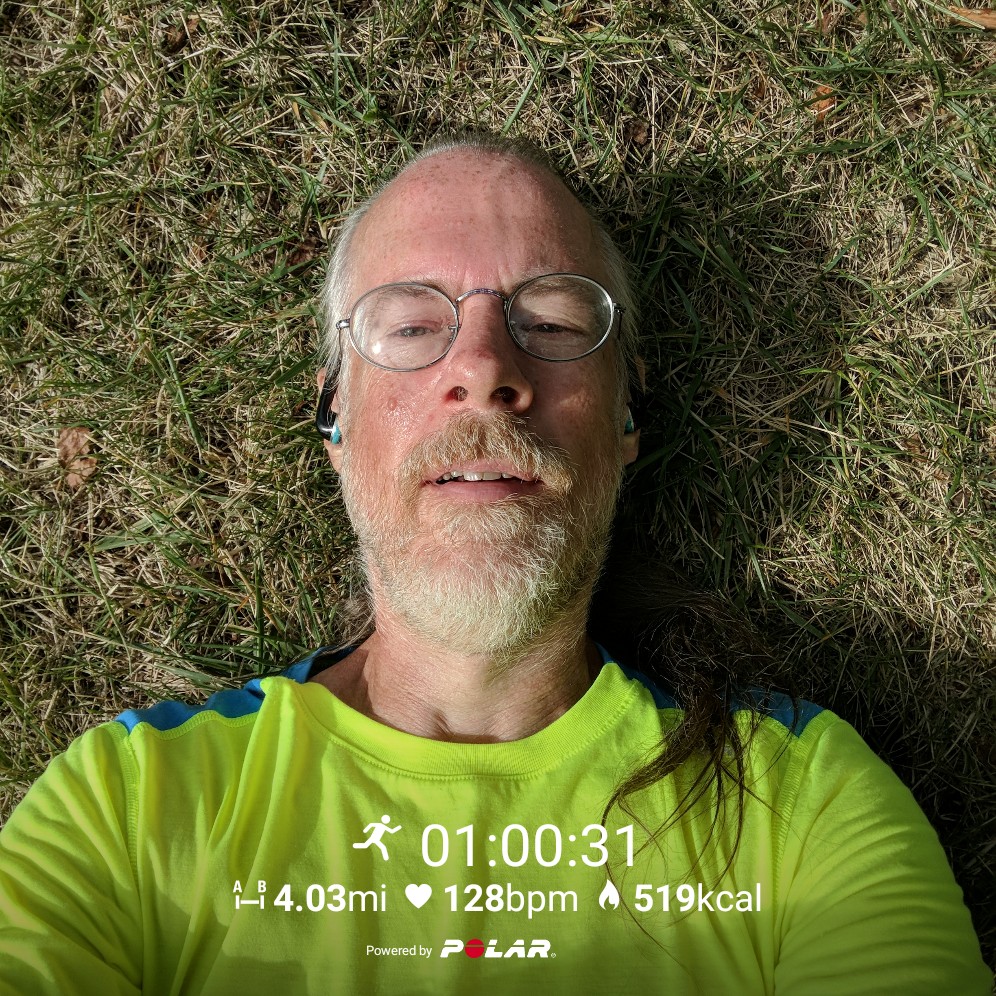
Went for a longish run at a nice easy pace. Felt good all the way through—good enough that I was going to add another half mile or so (by running around Dohme Park), only to have my knees abruptly say, “Nope. You have run the correct amount.” So I just stopped right there and came home. As I have started doing lately, I did this run in a fasted state (mumble mumble autophagy, mitophagy).
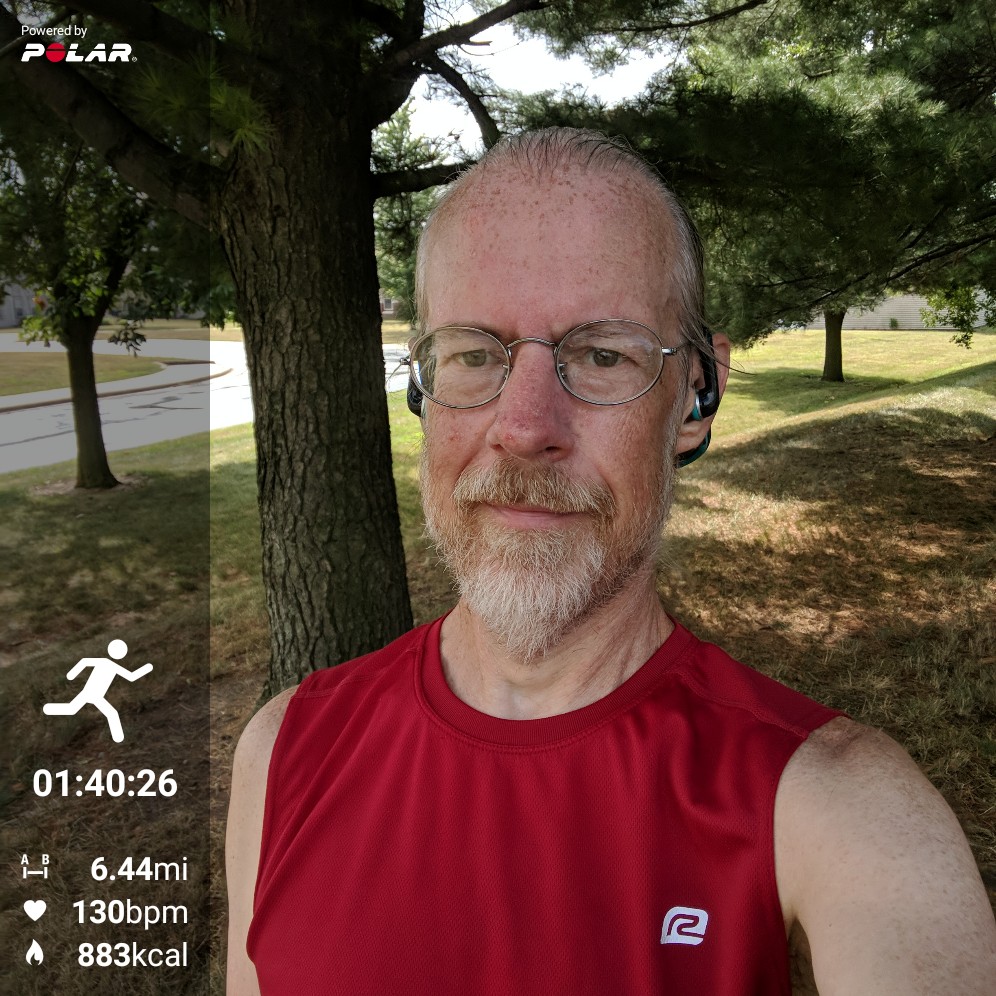
I occasionally choose to do hard things.
In the book Own the Day, Own Your Life Aubry Marcus suggests making your brain chemistry work for you by creating small successes, especially early in the day: Decide that you’re going to do something, and then do it. Even a small thing—deciding to mediate for 5 minutes and then doing so—gives you a little dopamine hit. That makes you feel better immediately, and possibly for the rest of the day. More to the point, repeatedly achieving small successes like this gradually boosts your capability: You can decide to do harder things (get in your workout, go for a run, write 5 pages of your novel) and then do them.
In an episode of her Move Your DNA podcast, Katy Bowman juxtaposes the feeling of satisfaction that you get when you set yourself to do something that you know will be hard and then carry through all the way to completion, with the feeling of being comfortable, saying:
What we’re trying to create through comfort is like the synthetic version of what you get when you pass through those hoops.
Katy Bowman
I think there’s a lot of truth to that. It’s very satisfying to decide to do something that’s hard and then do that thing. It feels good. I’m not sure it feels good in the same way that sitting in a comfy chair feels good, but I think there is a connection. Sitting down feels really good after a long run when your legs are tired; sitting in a really comfy chair kinda feels like that, without the need to go for the long run first.
I occasionally do physically hard things. I’ve run several footraces, at distances up to 7.1 miles. I did a century bicycle ride. Jackie and I day-hiked the 33.4-mile Kal-Haven trail. And it’s very true: choosing to do a hard thing knowing that it will be hard, and then doing the whole thing even though it is hard, is very satisfying.
However, there’s another entirely legitimate perspective:
A sentence I read today in an outdoors magazine: “You are in danger of living a life so comfortable and soft that you will die without ever realizing your true potential.” Danger? Like, that’s my life goal. 😬First world folk are… interesting.
zeynep tufekci (@zeynep) January 13, 2019
She says that—but she also apparently reads outdoor magazines, so I suspect even she sees the value in doing hard things.
For a week now, the forecast has been that yesterday would be the first really nice day of the season, and I had decided a week ago that I’d go for a long run.
I tried to set everything up for good readiness, with a medium run back on Monday (so it wouldn’t be too long between runs), and then ordinary amounts of walking on Tuesday through Friday.
However, it wasn’t to be. I felt weak and sluggish right from the start, and found that even just maintaining a slow pace required that I ramp up my heart rate as the run went along:
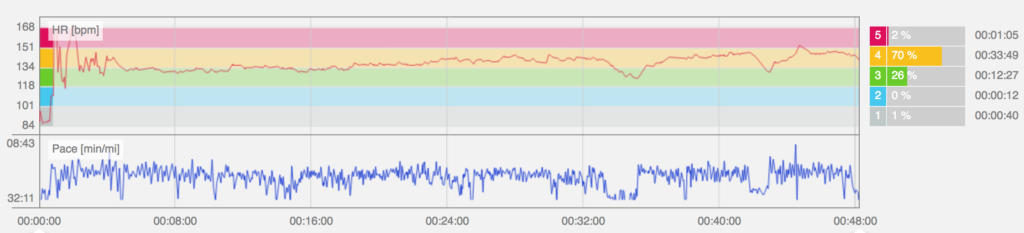
(All that stuff in the yellow is too high, which is basically the whole run. I kept it almost in the green for the first mile, but after that it was way too high the whole time. The tiny bit where it spiked up into the red at the end was when I was sprinting to the button to get a walk signal.)
I have to say that my Oura ring warned me that my readiness was only so-so yesterday:
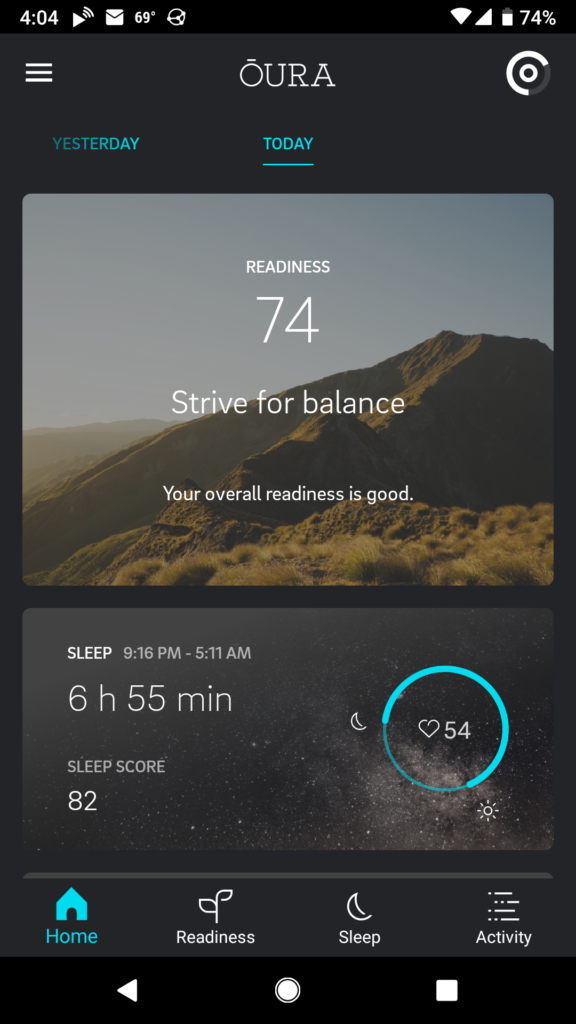
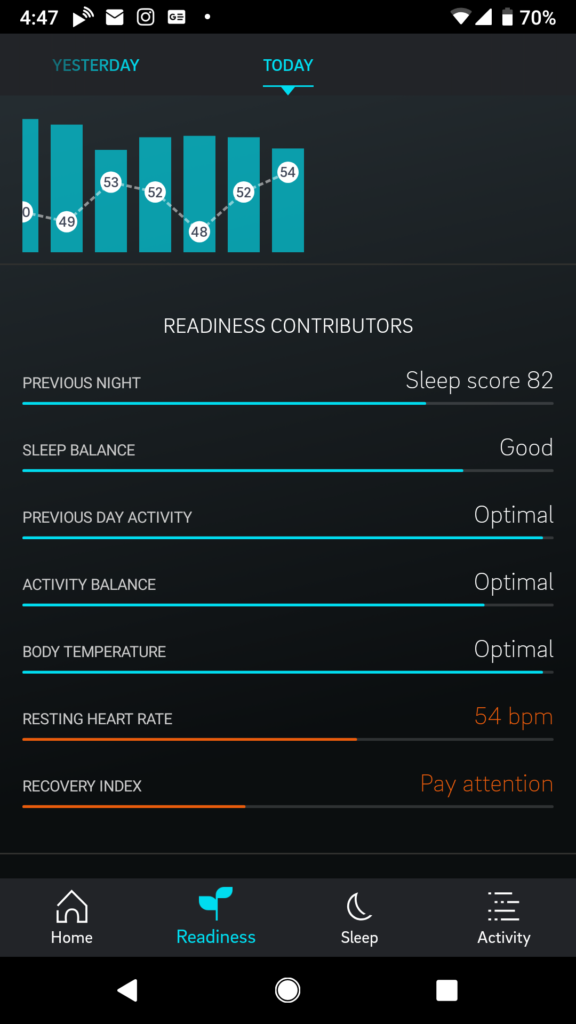
The main negative contributors, from the Oura ring’s perspective, were a mediocre night’s sleep, and a slightly elevated resting heart rate—and in particular, a resting heart rate that took most of the night even to settle down to that slightly elevated level (the “recovery index” part):
Last night my sleep was much better:
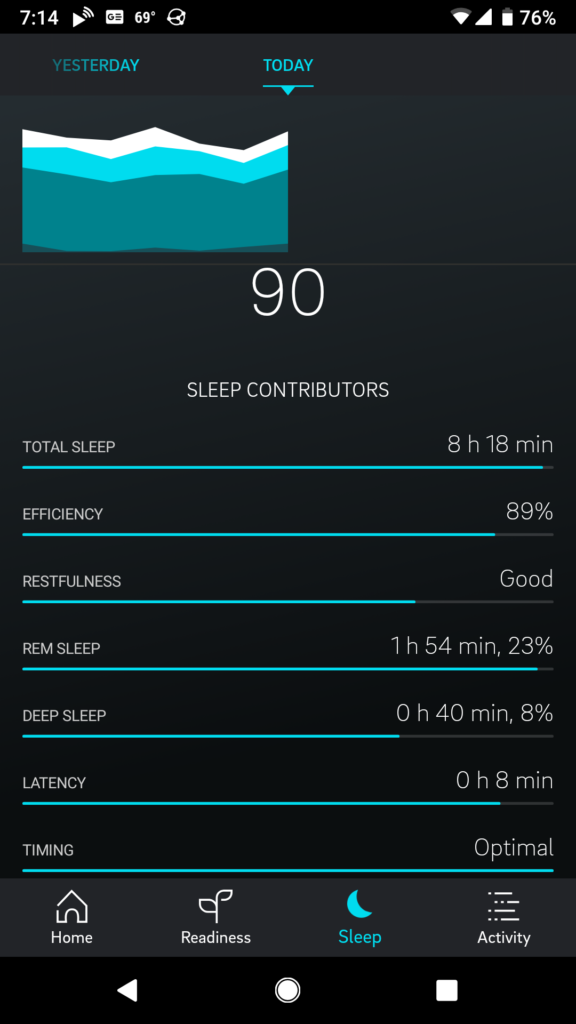
But it didn’t lead to a much higher readiness today, because yesterday’s run, even though it was a pretty feeble effort, was enough to mean that today I should at least somewhat take it easy:
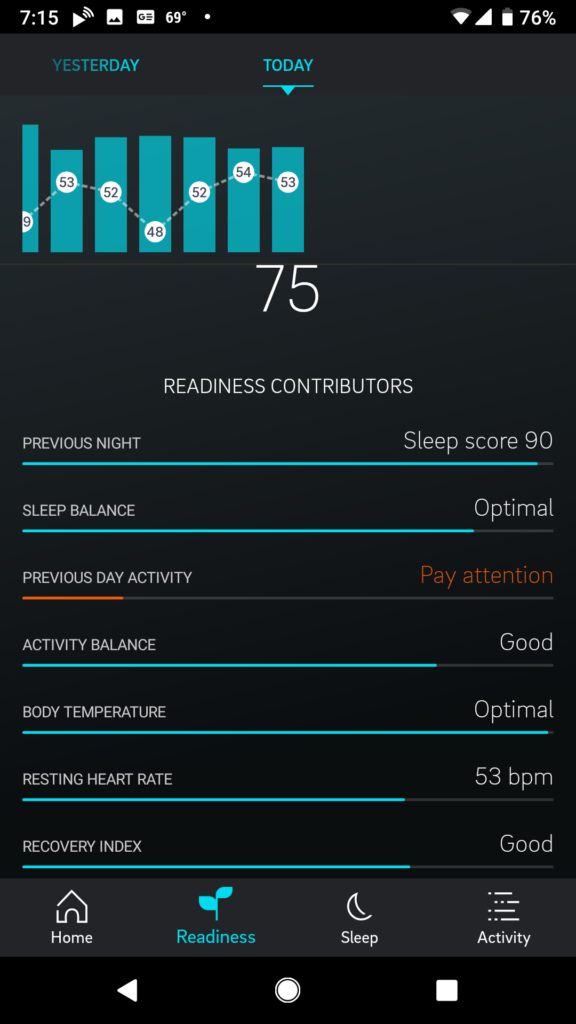
As it happens, I was pretty happy to do that. I got a reasonable amount of movement today, while nevertheless taking it pretty easy. Included in the day’s movement was the first bit of barefoot walking of the season. I also spent just a few minutes punching the heavy bag, mainly to get some photos for an Esperanto blog post on one aspect of my summer training plans.