Graph of the Dow, S&P 500 indexes, and the Apple stock price, all down dramatically

For the last 40 years, I’ve pretty much just enjoyed market declines. Especially in the early days I had very little invested, so even a huge percentage change was a pretty small amount of money to me. That made it easy to simply enjoy the drama—all the serious people running in circles, screaming and shouting.

I have been known many times to say, “If the weather can’t be good, it should at least be bad enough to be interesting.” Big market moves have historically engendered the same kind of feelings in me.

Even the last big decline, the Great Financial Crisis—which happened right after I’d retired, prompting a good measure of black humor (“I wouldn’t want to be someone who’d just retired, right before his stock market portfolio took a 40% hit!”)—didn’t keep me from being able to enjoy the journey.

Today’s decline is not different. At least, it’s not yet different.

Graph of today's Dow and S&P 500 index moves, and the price of Apple stock

A big part of why I could enjoy the early declines was that I had a regular income, with a tidy chunk going into the markets. To a person in that situation, a big decline in stock prices is a big sale. All the stocks just got cheaper to buy.

Now that I’m long retired, that is less true.

As I say, the main reason I’ve long been interested in big declines is that they’re interesting. This one is perhaps more interesting than most, because this could be the AI bubble popping.

Let me be clear that it is much too early to announce that this is the AI bubble popping. It is entirely possible that the markets will take this as a “brief correction” and then zoom off to even more absurd heights before the bubble pops. And it is also not certain that the bubble will pop in any kind of dramatic way. Sometimes these things just work themselves out, with the over-extended stocks pulling back gradually over a few years while other stocks go up, in a way that never produces a dramatic crash to point at.

One thing I do want to observe is this by Paul Krugman:

“… it’s increasingly difficult to see how the hyperscalers can realize their gargantuan investment plans unless someone is willing to take massive losses.”

And there will be massive loses. I mean, even if everybody went “You know, maybe we don’t want to spend so much on data centers,” and quit borrowing and spending, there’s quite a bit of debt that’s not going to get paid back. But if they go on borrowing and spending, there’s going to be a gargantuan amount of debt that isn’t going to get paid back.

Who loses all that money?

Well, to begin with, the people who lent the money to people who couldn’t pay it back. There are also people who guaranteed that debt in various ways; they should be on the hook as well. But we know from the great financial crisis that it won’t be only (or even primarily) the lenders. During the Great Financial Crisis, the banks (who made horrible, terrible, no good mortgage loans to people who had no hope of ever paying the money back) were protected. Instead, the home owners got absolutely screwed by the banks, by the governments, and by the courts.

And this time around, we won’t have home owners to put on the hook for it. The money has been borrowed by Special Purpose Vehicles—companies whose only purpose is to borrow money to fund some activity (such as building a data center), while keeping the borrowing off the books of the big companies who want to use the data centers to run AI models.

The special purpose vehicles will be screwed, which is exactly their purpose. Unfortunately, that doesn’t help, because the companies who loaned the money, and the companies who guaranteed the money (such as by promising to pay to run their models at the data center built by that SPV) are all kind of important to the economy. As I say, the whole purpose of the SPV was that it (and the people who loaned it money) get screwed. But that’s only okay if it’s just the random SPV here and there. If they all go down, then the whole AI sector goes down, and that’s half the stock market at this point.

That observation, along with Paul Krugman’s observation, got me wondering: Who might be stuck with the massive losses?

I mentioned the question to my brother, who suggested it’d be “Mom & Pop who bought mutual funds for their retirements.”

I think that’s exactly right. They’re going to try to stick it to the Boomers. That’s the only group that has the money to cover those losses. (Except for the billionaires, and the whole point is to make sure they don’t have to take it on the chin.)

That somewhat changes my perspective on big declines in the stock market.
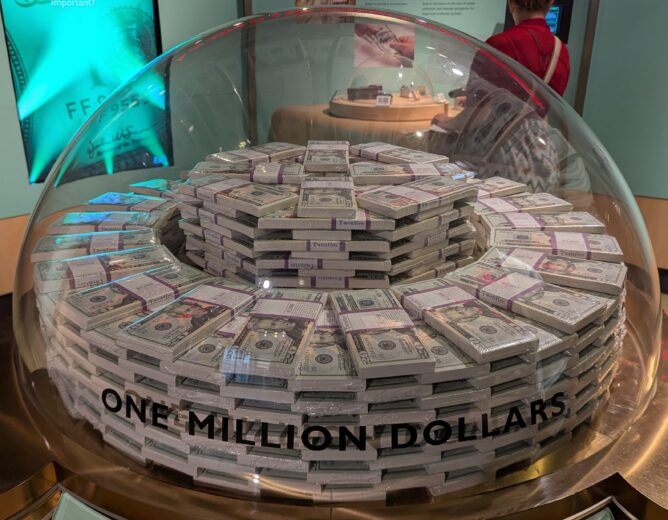
Museum exhibit at the Chicago Fed of $1 million in $20 bills

I’ve been warning about the current stagflation since the beginning of last year. It’s good to see others are catching up.

Stagflation, the Scourge of the 1970s, Is Back by Phillip Braun

One point the opinion piece makes is that the one bright spot in the economy—the stock market—is actually (in line with what I’ve been saying about how the markets and the business news have this all completely wrong) a “severe systemic risk.”

A graph of oil prices, showing the peak during the war, and the start of another peak now

A few weeks ago, back before the Iran war heated back up, The Economist wrote a mia culpa, explaining why they’d gotten it wrong about the war being an economic disaster. Briefly, while the MOU was holding up, I was tempted to write my own.

Like The Economist editors, I had thought back in April that Things are amazingly more bad than markets seem to think, but by the beginning of June, it was looking like maybe the risk of catastrophe had eased.

I didn’t write a mia culpa. To be fair, part of that was just laziness. But part of it was looking at things and thinking I was still right. Maybe between some demand destruction and some dribs and drabs of oil getting through the strait, world markets had found a new equilibrium that wasn’t nearly as bad as I’d expected. But I didn’t think so.

The Economist thought so. They thought they’d gotten it wrong for two reasons:

First, we thought that America and Iran would hold out against a deal to reopen the Strait of Hormuz: America because Mr Trump deludedly thought he held the whip hand, Iran because its regime knew its people could be made to endure more pain. In fact, facing the fury of American motorists, Mr Trump all but folded, preventing a disaster. Since the two parties struck a provisional deal in June, enough oil has been getting out of the Gulf to reassure markets that supply is coming back online, even if the future of the strait remains uncertain.

Our second oversight was, like others, not anticipating the staggering degree to which China would be able to slash its oil imports. Crude imports are 5m barrels a day lower than a year ago, despite the fall in prices. China has cut its demand and shored up supply. Its oil reserves are opaque—many barrels are hidden from satellites underground, and there is a blurred line between official reserves and corporate inventories. But they have been shown to be a powerful buffer.

I pretty much bought their second point. China had produced a truly fantastic amount of demand destruction, and had done it with minimal impact on their own economy, by largely shifting the impact onto people in other countries who had bought their oil distillates, before China prohibited exports. They could probably keep that up indefinitely, removing their demand from the world market.

That first point, though, I found doubtful. I mean, yes, Trump always chickens out, which is why we got the MOU and the briefly partially reopened strait. But I think they were wrong in thinking that Iran would go along with what Trump wanted, or that Trump could settle for what Iran would (obviously) want to do. They tried to paper over the cracks for a few weeks. I mean, I believe Trump settling for whatever Iran did and pretending it was a victory was a thing that could happen. But I’m not surprised it didn’t work out. Too many other people in the U.S. government were simply unwilling to let Trump leave the strait in Iran’s hands. And, although oil prices were coming back down, they were not on a trajectory that would improve the Republican’s chances in the midterms.

So, I think The Economist was right in the first place, and wrong to imagine that Trump and Iran could agree that “preventing a disaster” was something they could do.

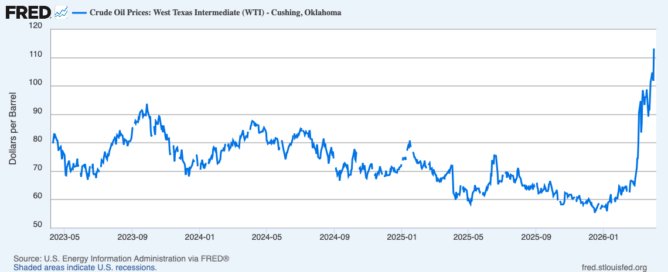
The oil price graphic above is already out of date. It shows yesterday’s closing price, and things have gotten worse already today. Brent crude is over $100 as I wrap up this post.

Graph of the spot price for West Texas Intermediate crude oil, showing the recent spike

For no reason I can understand, markets seem to think that (with the cease fire with Iran) things are going to return more or less to normal, more or less immediately. This is false. It is not just false, it is so far from the truth that I don’t understand why way more people aren’t panicking.

There are so many problems with oil supply delivery right now—so many more than just the Strait of Hormuz. A lot of oil and gas production infrastructure is gone. A lot of oil and gas distribution infrastructure is gone. Even where the production infrastructure is still there, since there’s no way to ship out what is produced, production is being shut in. Production that has been shut in will take weeks to get started again. And it won’t be started again until it can be delivered.

At the same time, shipments of oil and gas that came out through the Strait just before it was closed, are probably only now reaching their destinations—meaning that it is only now that refineries are finding themselves without their next input for refining. The refining facilities are going to have to shut down. And just like the production facilities, it will take weeks to get them started again. And they won’t be started again until the people who run them foresee reliable, steady deliveries of crude.

These effects are already obvious in the observed spread between spot prices (the cost of a barrel of crude to be delivered right now), which are high (although not as high as I think would make sense), and futures prices (the cost of a barrel of crude to be delivered in a month), which are also high (but not nearly as high as I think would make sense).

The same is true (with various differences in details) with helium, nitrogen for fertilizer, aluminum, and who knows how many other commodities that used to come though the Strait.

This all matters because the knock-on effects are going to be huge. Higher fuel prices—much higher, and for much longer than the markets are currently anticipating. Higher food prices, due to the shortage of fertilizer reducing food production, especially of corn—which is a major input to both meat production and to ethanol production, meaning another way it feeds-through the higher energy prices. Higher helium prices feed through to shortages of computer chips—which were already under strain due to AI-related data-center demand.

In the background of all these are Trump’s tariffs from a year ago, the impact of which was eased in many different ways (the pause, various rate cuts, firms stocking-up ahead of the imposition of the taxes, the supreme court decision ruling that the worst of them were illegal), all of which delayed the main impacts for months. For some reason, the markets seem to think that those impacts would quit showing up in comparison to the year-ago numbers (since the tariffs were announced one year ago), but in fact are probably only now fully showing up in reported numbers.

My take on all this is that every aspect of the economy is going start getting bad, and then going on getting worse. The getting-worse phase will go on at least for months and months, and very possibly for a year or two or three.

Inflation spiked up to 3.3% last month, but that is only the start. That’s just the energy-price spike. As soon as those effects feed through to other prices, they’ll all go up. And as soon as those high prices start forcing people to cut back on other spending, we’ll see at least a recession, and very possibly worse than that. And that’s all before actual shortages of fuel and food start impacting every aspect of people’s lives.

Oh, and as I’ve said before: Don’t imagine that having some idea about what things are going to be higher-priced or in short-supply gives you the sort of insight that will let you invest to make money off these circumstances. The real-world impact of these things are going to be chaotic enough that any particular investment could go very badly wrong, even if your understanding of the general direction of events is correct. And, of course, the government is going to trying to protect their supporters (oil companies and tech billionaires, mostly) so they may well be bailed out. Any investments that suppose that things will go badly for them in particular may well go spectacularly awry.

Poor Ms. Feuerstein. She just suffers and suffers. I bet she’s as tired as the rest of us of the Leopards-Eating-Faces jokes.

China has long relied on the U.S. for soybeans. But with new steep tariffs, it is likely to look even more to Brazil and Argentina.

Source: How Trump’s Tariffs Could Hurt US Farmers and Benefit Brazil – The New York Times

All through the 1990s I was waiting for the labor market to punish employers for their (then new) strategy of laying people off as soon as there was 15 minutes with no work to do, intending to hire them back (or hire somebody else) as soon as they had work again.

Capital markets forced employers to go that route. Any company that tried to resist—keeping on employees beyond the bare minimum—would see its stock price fall so much that it would be taken over in a leveraged buyout, and then the new owner would cut staff to the bone.

As I wrote for Wise Bread back in the day (in What’s an employee to do), it made me sad to watch. Surely, I thought, eventually the labor market would tighten up, and employers who had kept their employees on through a rough patch would have an advantage over employers who had to go out and recruit, hire, and train new employees.

But it never happened. Until, according to a recent article in the New York Times, now: Companies hording workers could be good news for the economy.

It’s a pretty good article.

Employers traumatized by not being able to hire enough people may not be quite so quick to lay them off:

“When the job market slows, employers will have recent, firsthand memories of how expensive it can be to recruit, and train, workers. Many employers may enter the slowdown still severely understaffed, particularly in industries like leisure and hospitality that have struggled to hire and retain workers since the start of the pandemic. Those factors may make them less likely to institute layoffs.”

Jeanna Smialek and Sydney Ember https://www.nytimes.com/2022/10/12/business/economy/companies-hoarding-workers.html

And, if employers do keep workers on as the economy slows, it will help the U.S. economy. As Federal Reserve Board Vice Chair Lael Brainard says:

“Slowing aggregate demand will lead to a smaller increase in unemployment than we have seen in previous recessions.”

https://www.federalreserve.gov/newsevents/speech/brainard20220907a.htm

Perhaps even more important than those things, it will make me happy.

After three decades in which the market was reinforcing exactly the wrong behavior, now maybe it will encourage the right behavior.

I’m generally unimpressed with Krysten Sinema, whose failure to support Democratic initiatives has generally been harmful. However, I kinda like the tax changes she’s forced into the climate package.

Fundamentally, I like dividends and I hate stock buybacks. So a tax on stock buybacks—even a small one—makes things better.

Now, most economists would have you believe that the two are equivalent. This is false.

Economists can gin up a model that suggests that owning a slightly larger share of a slightly smaller company is “equivalent” to getting paid a share of the company’s profits. Or that getting cashed out completely (by taking the buyback), and then finding a place to invest almost all of that cash in some new company is somehow equivalent. I don’t think either of those things is true even in an economic sense, but I think both are clearly false in a larger societal sense.

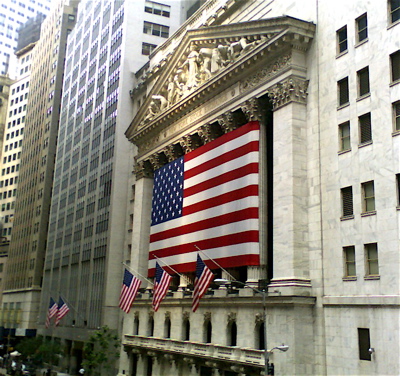
New York Stock Exchange

The way things used to work was that a company earned a profit, reinvested an appropriate amount of that profit in growing the business, and then paid out the balance to shareholders to do with as they pleased. (They could reinvest the money by buying more stock, they could spend it on luxuries—or necessities, they could invest it in some other company, they could donate it to charity—the possibilities are literally endless.)

This situation produces a sort of virtuous circle. A company that earns a reliable profit—and shares it with its stockholders—becomes more valuable, because people will pay more for a company that pays a reliable dividend. It’s good for the owners (their stock is worth more), it’s good for the employees (both line workers and managers), it’s good for the community (a profitable company pays taxes, their employees have money to spend, their shareholders have money to spend, etc.).

The non-dividend situation lacks all these dynamics. Instead of wanting to produce a profit, the company has all sorts of weird incentives—to maximize “growth” or “revenue” or “earnings” according to whatever weird metric appeals to Wall Street that week. Owners don’t get cash that they can spend. Instead they get the option to cash out at random intervals. The weird incentive structure encourages companies to make weird decisions regarding investing in growth (or dumping cash into buybacks). Shareholders who would otherwise be living on dividends are constantly having to make difficult decisions about selling small amounts of shares in this or that company for money to live on.

Maybe there’s some technical economic sense in which buybacks and dividends are equivalent, but they are very much not equivalent in a societal sense, producing very different results for ordinary investors and their communities.

The only reason any ordinary person would think a stock buyback was even close to equivalent is because capital gains have been tax-advantaged over dividends. So, something that reduces that tax advantage is all to the good.

Details: Krysten Sinema Agrees to Climate and Tax Deal – The New York Times

Cathy Reisenwitz is trying to reconcile her belief in the benefits of free enterprise with her growing realization that many industrial-produced edible substances are not healthy food. See: The processed food tribe.

Personally, I do not find those ideas at odds: Corporations operating in a free market will make maximizing their profits their only goal.

Producing food that’s cheap to make and tastes great is the obvious way to maximize profits. Negative health effects that don’t show up for years (and don’t kill the customer for decades) are entirely consistent with the profit-maximizing goal of a corporation.

The health of their customers will only be prioritized to the extent that poisoning their customers isn’t profitable. (Sometimes not even then: See the multiple scandals related to Chinese companies adulterating milk and baby formula with melamine.)

A free society would make a priority of allowing each individual to choose what to eat based on their own values. One would assume that being as healthy as possible would be a priority for most individuals, but there are many stumbling blocks. (One of the biggest is that getting accurate information is hard in a world where corporations fund studies designed to produce and publish inaccurate results about the harms of eating too much sugar. Another is that food scientifically designed to be hyper-palatable is in fact so tasty as to be hard to resist, especially for children—and the tastes one forms in childhood influence one’s tastes as an adult.)

Free markets are the best mechanism we’ve found for optimal allocation of resources. But the market only allocates resources to achieve one set of goals (maximum profits) and ignores other goals. Maximum public health is one of the goals that a free market does not concern itself with.

As to the topic of the term “processed” food, I have found it useful to include a category of “minimally processed” food when thinking about what’s likely to be healthy.

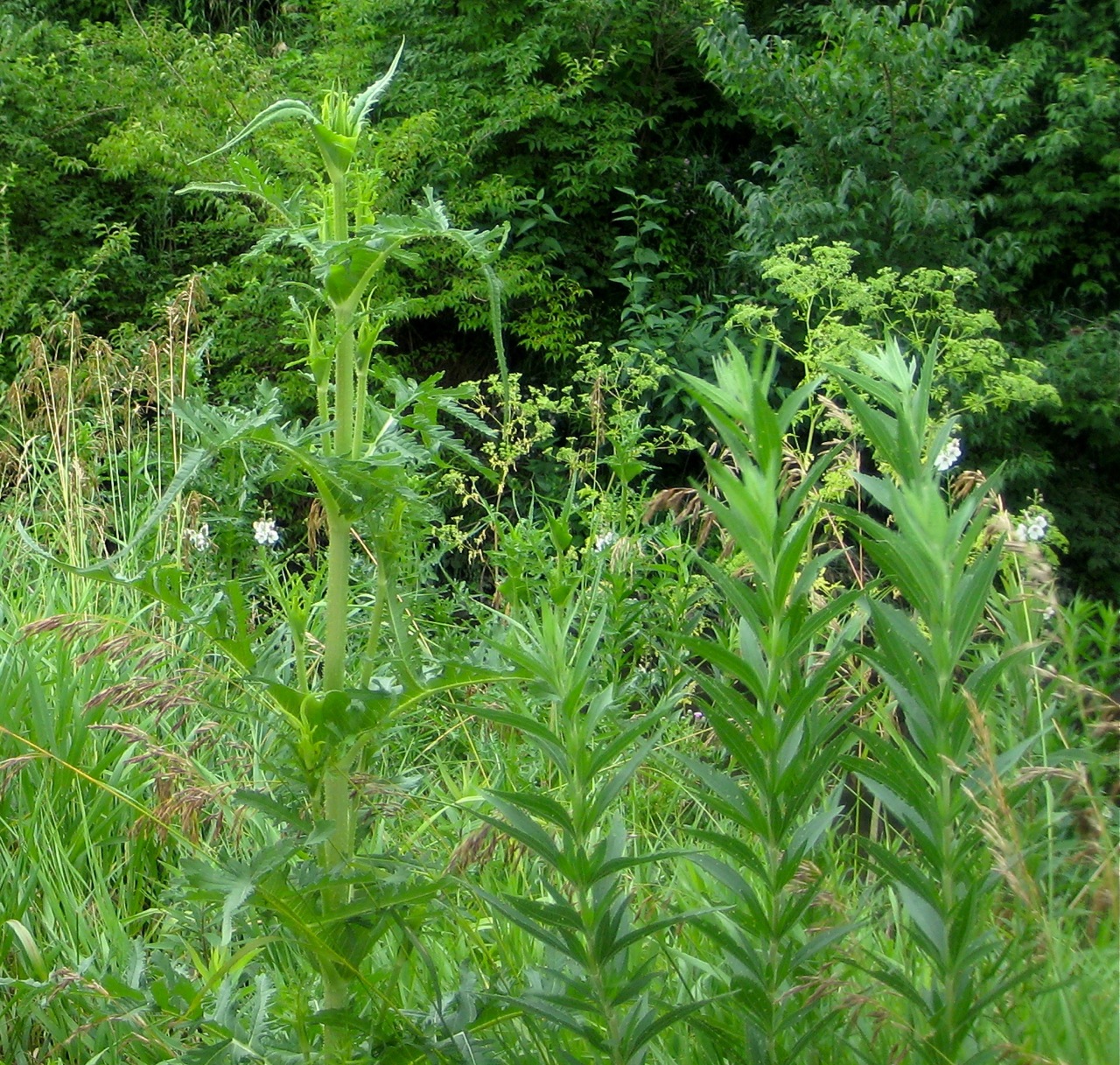
Prairie plants

Prairie plants
Prairie plants

One utterly predictable consequence of climate change is that the price of northern farmland will rise as growing regions shift north.

Tobias Buckell yesterday shared a report that just this sort of price shift is now occurring—interesting to me because this result is not merely predictable: I predicted it my own self, way back when I was in high school.

Global warming was still pretty speculative then (in the 1970s), but people were already talking about the greenhouse effect and trying to figure what the result would be. At the time, I was mainly thinking about the geopolitical implications of  shifting the growing regions north—how things would change if Canada and the (then) Soviet Union were suddenly way more productive of food, while places like the United States, China, and France suddenly less so.

What I discovered, though, was that those northern regions aren’t nearly as fertile as places like Illinois, where 8,000 years of tall grass prairie left an incredibly thick layer of rich soil.

No matter how perfect the climate is, Saskatchewan is not going to produce the bushels per acre of Illinois or Kansas. Their soil is not only less fertile, it’s also much more fragile than the soil of the tall grass prairies. The fertile layer isn’t as deep, so the land must be plowed with greater care, and it will in any case be more quickly depleted.

I’m sure there’s a lot more and better data available now than there was back then, but I doubt if it changes the fundamentals. Shifting growing regions means winners and losers, but it also means less total food production.