Anybody who didn’t see this coming a decade ago hasn’t been paying attention.

“Payment systems are blocked for him, as US companies like American Express, Visa, and Mastercard have a virtual monopoly in Europe.”

https://www.heise.de/en/news/How-a-French-judge-was-digitally-cut-off-by-the-USA-11087561.html

Heavy-handed sanctions have mostly landed on people who deserve them, which has made them seem okay. But as I’ve been pointing out for years now, without proper rule-of-law, anybody can be crushed at the whim of a couple of people in the U.S. government.

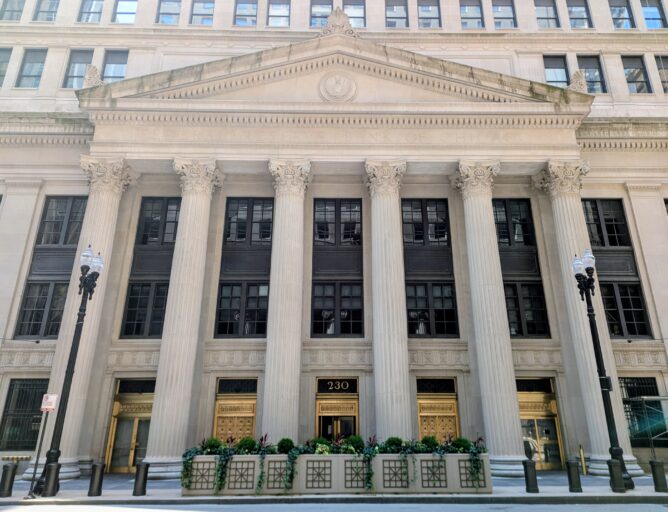
The main entrance of the Federal Reserve Bank of Chicago

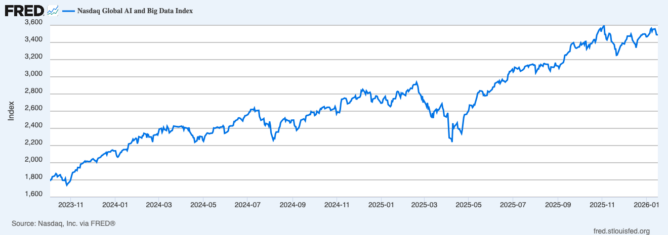
I don’t usually worry much about investment bubbles. There have been a lot of them over the past few hundred years, and most of them (railroads, telegraph, dotcom…) were expensive disasters largely only for the people who invested in them. Some though, such as the Great Financial Crisis of 2007–2009, were expensive disasters for lots of other people as well. So it’s worth thinking a bit about whether the current AI bubble is of the former sort or the latter—and how to protect your finances in either case.

Bad just for investors

One big difference between bubbles that are going to be wretched for everybody when they pop and those that’ll end up mostly okay except for the foolish investor’s portfolio, is whether the excess investment got spent on something of enduring value.

For example, railroad lines got enormously overbuilt in the 1840s in the UK and in the 1880s in the US, leading in both cases to a stock market bubble, followed by a stock market crash and a banking panic. But (and this is my point), the enormously overbuilt railroads were of some value. As the firms went bankrupt, the people who had over-invested lost a lot of money, but the railroad tracks, rights-of-way, and rolling stock all still existed. The new firms that got those assets, free of the excess debt, were often viable firms that went on to be successes—hiring workers, providing transportation, and eventually providing a return to the new investors. The people who got screwed were the old investors. (And not even all of them, as the original investors often saw the overbuilding happening early and sold out just as the clueless people who knew nothing about running a railroad, but just saw stocks soaring and wanted to get in on it, started piling in.)

Much the same was true of part of the dotcom bubble. A lot of money got spent on a lot of things. To the extent that it was spent on buying right-of-way and burying fiber, there was something of enduring value that ended up owned by somebody, making it one of the less-bad bubbles.

The key to avoiding catastrophe in bubbles of this sort is largely just a matter of not investing in the bubble yourself.

Bad for the economy

But some bubbles have produced horrible, wretched, prolonged difficulties for the whole economy. The other part of the dotcom bubble, besides the dark fiber build-out, was the bubble in companies with no profits and no prospect of ever having profits, whose stock prices went up 10x based on nothing but a story that sounded compelling until you thought about it for 10 seconds. As usual, that ended up being very bad for the people who invested in those companies, but it also was bad for the whole economy, because when those firms went bankrupt, they left behind nothing of enduring value.

The result was that the imagined wealth of those companies just vanished. The stock market went down, which was bad for (almost) everybody, and it produced a general economic malaise, because post-dotcom crash it became hard even for legit companies with real assets, a real profit, and a real business plan for growth, to raise money, which made actually producing that growth much harder.

Really bad for the economy

There is, however a step beyond just pouring a bunch of money into a bubble that doesn’t actually produce anything of enduring value, like a fiber optic network or a railroad. That’s when the money is raised with leverage (i.e. debt).

The 1929 stock market crash was a rather drastic example. People invested in stocks not because there was an underlying business that was worth what the investors were paying for it, but purely because the stocks were going up. That might have been okay in other times, but stock brokers had recently started allowing ordinary people (as opposed to just rich people) to buy on margin—where you just put up a fraction of the price of the stock you want to buy, and the broker lends you the rest.

In the 1920s you could buy on 90% margin, where you only put down 10% of the price of the shares. That meant that, if the stock price went down by just 10% your whole investment was wiped out, and the broker would sell you out to raise money to pay off (most of) the loan. And of course, all those sales into a falling market produced more losses, leading to the crash.

Since the 1930s you could only buy stocks on 50% margin, making it much less likely that your broker will sell you out into the teeth of a general stock market crash—although it can still happen.

Bubbles with leverage

A great example of a bubble with leverage is the Great Financial Crises of 2007. (Most people date it from 2008, because that’s when Lehman Brothers collapsed. I date it from 2007 because that’s when my former employer closed the site where I worked and I ended up retiring rather earlier than I’d planned.)

That was a particularly bad bubble. A whole lot of money was raised, with leverage, to buy housing. But very little of the money ended up being spent to build more housing (which would have been something of enduring value that would have lasted through the subsequent collapse). Instead, the money was spent bidding up the prices of existing housing, which then fell in value after the bubble popped.

So we had two of the classic producers of bad bubbles: Nothing of enduring value created, and leverage. The whole things was made even worse by the structure of the leverage in question.

This is getting rather far from my main point, so I won’t go into much details, but to raise the large amount of money that was going into houses, the rules on housing market leverage were being eased over a period of time. It used to be that you had to put 20% down on a house. Then you still had to put 20% down, but only half of it had to be cash, with the other half being funded with a second mortgage on the property (at a higher interest rate). Then they started letting people put just 3% down. Then they started letting people with good credit put nothing down. Then they started letting people with no credit put nothing down. At the same time, “structured finance” obscured just how risky all those mortgages were, meaning that when the bubble went pop lots of “mortgage-backed securities” ended up being worth zero.

Which kind is the AI bubble?

This brings us to the current AI bubble. A whole lot of money is pouring into building two things:

  • Data centers (buildings filled with computer chips of the sort used to train and run AI models)
  • Large language models (non-physical things that are basically just a bunch of numeric weights of a bunch of tokens which can be used to produce streams of plausible-sounding text)

Each of those may have some enduring value.

Data centers will have some. They will probably have a lot less than a network of fiber optic cables, which can be buried and will have value for decades with minimal cost or maintenance. Since newer, faster chips are coming out all the time, a data center is well behind the cutting edge as soon as it’s finished. Plus, training or running an AI model runs those chips hard, meaning that they probably only last a couple of years (due to thermal damage on top of regular aging).

Large language models probably have even less enduring value, because so many people are training new ones all the time. People are always trying to make them bigger (trained on more data) while also making them smaller (so they can run without a giant data center). All that means that your two-year-old LLM probably isn’t worth what you paid to build it, and a four-year-old LLM probably isn’t worth anything.

That’s how things looked a year or so ago—a perfect example of a bubble that would burn the people who sank money into it, but leave the broader economy untouched.

Sadly, that’s been changing.

First, the structure of the leverage has been changing. It used to be rich people and rich companies were building data centers and hiring software engineers to build LLMs. But lately that’s been getting screwy. Those large companies are raising off balance-sheet money with Special Purpose Vehicles (small companies that big companies create and provide some capital to, that then borrow a bunch of money to make something, with the loans collateralized by the things they’re making—but importantly, not an obligation of the big company that created them). Any particular SPV can blow up, if it turns out that the things it built don’t earn enough to pay the interest on the money the borrowed to build them. And large numbers of SPVs can blow up if financial conditions change to make it harder for all the SPVs to roll over their debts as they constantly have to keep their data centers running.

Second, they’re also engaging in weird circular investing and spending arrangements, where company A buys stock in company B which then turns around and pays all that money back to company A to buy chips, letting company A treat it as both income and an investment, while company B can pretend it got its chips for free.

Finally, there’s all the non-financial obstacles that may well throw a wrench into the whole thing. The fact that LLMs are all built on copyright violations. The fact that running data centers requires huge amounts of power and water (that has to be produced and paid for). The fact that producing that water and power brings with it horrible environmental impacts.

What to do

So, if AI is a bubble, and its one of the bad sort that will produce a panic and a recession when it pops, what should you do?

There are a lot of little things you can do that will help. I wrote an article with suggestions at Wise Bread called Are your finances fragile? It talks about what financial moves you can take to put yourself in a better position if there’s a general financial crisis. (If you’re interested in my writing about this stuff more broadly, I wrote a overview of my perspectives on personal finance and frugality called What I’ve been trying to say, that includes a bunch of links to other of my posts at Wise Bread.)

Besides that general advice, there are also a few things to strictly avoid. In particular, strictly avoid thinking that you can find some very clever investment strategy that lets you make money off the popping of the bubble. Yes, after the fact there will be some investments that make a lot of money, but no amount of keen insight will let you find and make those investments, as opposed to the thousands of very reasonable-seeming investments that will blow up just like all the rest.

Along about the end of the Great Financial Crisis I wrote an article called Investing for Collapse, which explains why any such effort is pointless. It holds up pretty well, I think.

Short version? Avoid debt. Keep your fixed expenses as low as possible. Build a diversified investment portfolio that limits your exposure to the most obviously stupid investments, but doesn’t do anything too weird or wacky in an effort to get them to zero—it’s pointless, and will probably do more harm than good.

Good luck when the AI bubble pops!

“… food delivery giant DoorDash announced a deal Thursday with buy-now, pay-later outfit Klarna, offering hungry consumers “the added convenience of Klarna’s seamlessly integrated, flexible payment options while shopping.”

Source: Almost Daily Grant’s Commentary

Of course. Who doesn’t think it’s a good idea to spread the cost of your lunch over a few weeks or months?

A group of friends and I agreed last week that the most likely result of the most likely policies coming out of this administration is stagflation.

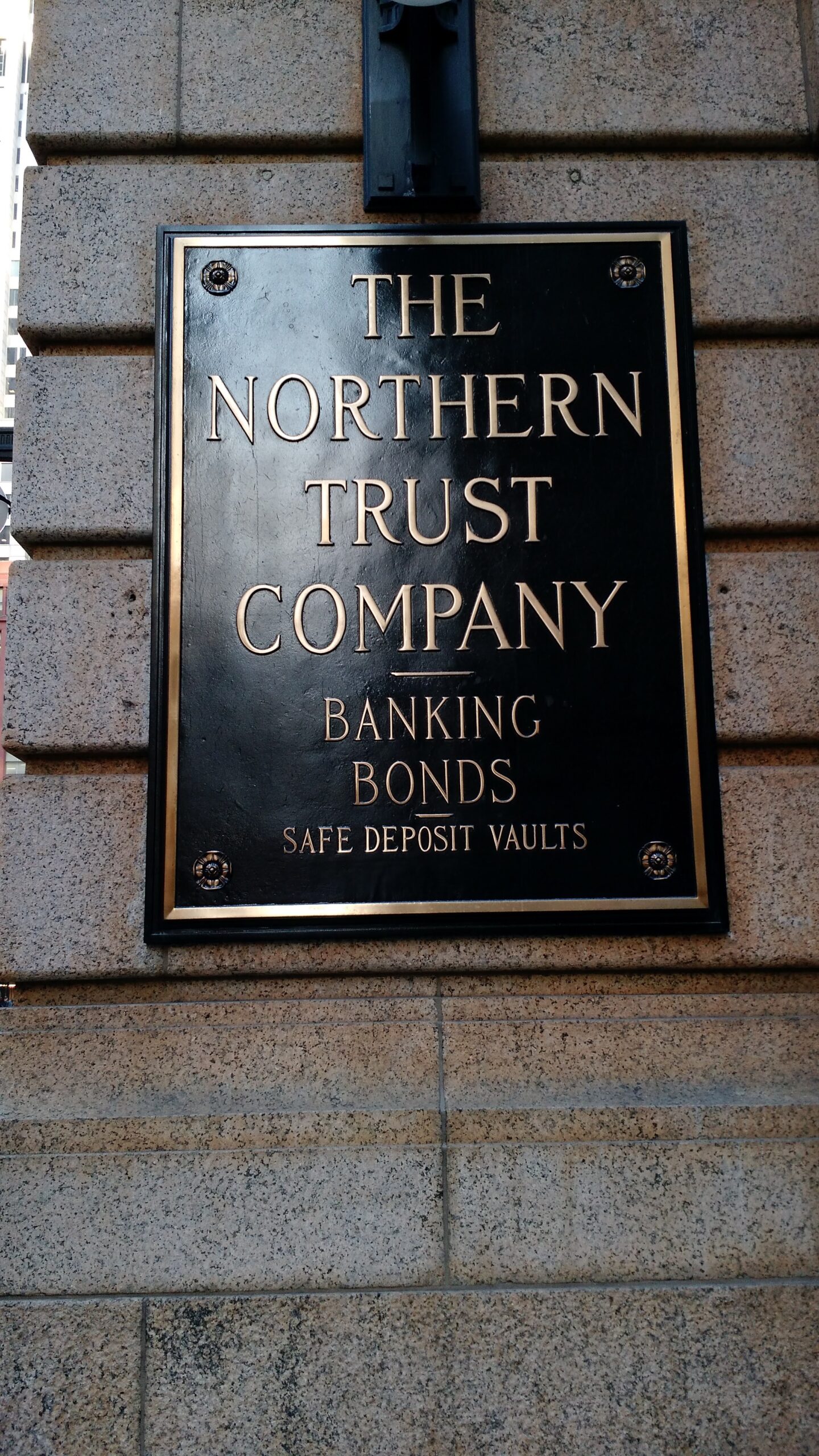
Plaque for the Northern Trust Company

Talking about it reminded me of the Wise Bread post I wrote All about stagflation, so I re-read that. I think has held up pretty well, even though circumstances (financial crisis followed by a pandemic) meant that things didn’t play out as I’d expected. Even so, I think the analysis of how to produce a stagflation is right on: raise interest rates to bring down inflation, but then panic when it’s clear that you’re in danger of producing a recession and cut rates before you’ve gotten inflation under control; repeat until you have high inflation and a recession.

That is, stagflation is usually the result of a timid Fed, that’s afraid to do its job.

The thing is, the policies that I see coming (tariffs and tax cuts) will produce stagflation even if the Fed does a great job. The tariffs directly raise prices, and the tax cuts (through increased deficits) raise interest rates, producing a recession.

In the Wise Bread article I warn that it’s tough to position your investments for stagflation. The reason is that inflation makes the money worth less (helping people with debts, but hurting people with money), while the recession hurts people with debts and people with investments.

Upon reflection though, I don’t think it’s quite that bad. In fact, it’s really just regular good financial advice:

  1. Avoid debt (you’ll get crushed by a recession faster than you’ll get rescued by inflation).
  2. To the extent that you have assets, move them into cash (initially you’ll get screwed by inflation, but pretty soon rising interest rates will save you).
  3. Limit your investments in stocks, and especially limit your investments in your own business (both much too likely to get crushed by recession).

Basically: live within your means and stay liquid.

Playboy magazine and Helen Gurley Brown. That’s what last week’s New York Times opinion piece, Barstool Conservatism, Revisited (on the weird agglomeration of libertarians, crypto- and tech- bros, and incels who ended up voting with social conservatives) made me think of.

My thoughts draw on a book I read about Hugh Hefner, Playboy, and Helen Gurley Brown. The basic thesis, as I recall it, was that Hefner wanted a society where young men could enjoy an extended youth. The best way to make that work, he thought, was for women to be able to support themselves—so that they’d be willing to sleep with men, rather than feeling that they had to hold out for a man who would marry them.

To that end, Playboy magazine was very active at promoting equal rights for women—so they could earn money, own property, etc. Because only when they were able to support themselves without needing to get married, would they be willing to sleep around. And women willing to sleep around, were what the Playboy demographic wanted.

That social experiment played out pretty much just the way Hefner wanted through most of the 1960s, 1970s, and 1980s. Women could earn enough to afford an apartment, food, clothing, and the other necessities, which meant that they didn’t have to get married just to survive.

However (and this was key, even though I don’t think Hefner really thought about it much) men earned more than women.

The result was perfect for men. They had enough money to buy fancy cars, fancy stereos, fancy watches, expensive liquor—all the sorts of products that advertised in Playboy—with enough left over that they could afford to take women out on nice dates and buy them little gifts. The women earned enough less that, although they could get by, they couldn’t have really nice things, except when men bought them.

Things began to change the 1990s, when women’s incomes grew to the point that they could afford nice things. That produced two changes. First, women that could afford not merely a tiny apartment, but their own house, weren’t so reliant on men to make them comfortable. Second, with so many women taking top jobs, there were fewer top jobs for men. That meant that more and more men found it tough to earn an income that let them improve a woman’s standard of living.

This situation is what has the incels so unhappy. For decades, even after women weren’t legally subservient to men, men generally had enough money that they had something very tangible to offer a woman. Now that’s only true for the top few percent of male wage earners.

Of course, any man with either ambition or good sense could work around this situation. Becoming one of the 1% is hard, but simply having enough ambition to get into, let’s say, the top 50%, means that you have enough of a surplus to be able to raise the standard of living of a woman. And good sense is all it takes to do a bit of an analysis and realize that following the strategies of the pick-up bros isn’t going to lead to what you want nearly as well as coming up with things to offer to women besides cash. (Different things for different women, but: getting fit, wearing nice clothes, learning about the arts or science or history—whatever any particular woman is interested in, paying attention to them when they talk, being supportive of their efforts, are all things that might work.)

But incels as a group don’t seem to want to make even that modicum of an effort. They’d rather blame women.

The other groups I mentioned are broadly similar. Even the rich, successful tech bros are often dysfunctional to the point that they have trouble attracting women. Libertarians are often attracted to the movement specifically because what they yearn for is a world where people have minimal legal protections from the wealthy (and for no good reason, they imagine that they’ll be wealthy enough to take advantage of that). Crypto bros are the same, except they have a specific (rather than vague) notion of where their money is going to come from, even if it’s a fantasy.

So I understand that article. I think that is why all those disparate groups came together, even when their actual interests are pretty disparate.

The big question is, will these groups hang together going forward? Or will the fact that they have nothing much in common except a fantasy of enjoying being on top, lead to infighting and failure?

I’m hoping for failure, but it’s still too soon to say.

Let me start by saying that, judging from his previous term, most of what the incoming president says has no particular bearing on what he’s going to do. But I think a few trends look likely enough that it’s worth thinking about the results on the dollar’s value.

The things I’m thinking of are tariffs and tax cuts, which I expect to lead to higher inflation and larger deficits, both of which will lead to higher interest rates.

Graph of inflation rate and 3-month t-bill rate going back to June of 1977 (when I graduated from high school
Blue is the historical Inflation rate (CPI vs one year earlier). Red is the historical 3-month T-bill rate (roughly what you could earn in a money market fund). Both are from June, 1977 (when I graduated from high school) through last month.

Tariffs

The president can impose tariffs on his own, with no need for congressional action. Whether we’ll get the proposed 60% tariffs on Chinese goods, or whether that’s just a bargaining chip, I have no idea. But I think some amount of tariff increase will be imposed, which will feed through directly to higher prices.

That’s not to say that tariffs are necessarily bad (although usually they are). But they do feed through to higher prices.

Tax cuts

Tax cuts need to get through Congress. If the Republicans get the House as well as the Senate, it’s highly likely that legislation will preserve the 2017 tax cuts set to expire next year, and probably some additional tax cuts, such as a much lower rate on corporate income. It’s also possible that we’ll see the proposals to cut tax rates on tip income and on overtime pay enacted, although I doubt it. (The incoming president only cares about his own taxes, not about those of random working-class folks.)

The main thing taxes cuts will do is dramatically increase the deficit. The tariffs will bring in some countervailing revenue, but not nearly enough to fill the gap.

Other things that raise inflation and cut revenue

There are all kinds of other proposals that were bandied about during the campaign, such as deporting millions of immigrants, that raise costs both for the government, leading to higher deficits (the labor and logistics both cost money, and not a little) and for employers (they’re employing the immigrants because their wages are lower), which they will try to offset with higher prices.

What this means for our money

Rising costs will feed directly into higher prices, which is going to look like inflation to the Fed, so I think we can expect short-term interest rates (the ones controlled by the Fed) to get stuck as a higher level than we’d otherwise have seen.

At the same time, lower taxes will mean lower government revenues, leading to larger deficits. For years now, the government has been able to get away with rising deficits, but I doubt if the next administration will have as much success in this area. (Why not deserves a post of its own.)

My expectation is that higher deficits will mean higher long-term interest rates, as Treasury buyers insist on higher rates to reward the risks that they’re taking.

So: Higher short rates and higher long rates, along with higher inflation.

What to do

I had already been expecting inflation rates to stick higher than the market has been expecting, so I’d been looking at investing in TIPS (treasury securities whose value is adjusted for inflation). I’m still planning on doing so, but not with as much money as I’d been thinking of, for two reasons.

First, I’d been assuming that money market rates would come down, as the Fed lowered short-term rates. Now that I think short-term rates won’t come down as much or as fast, I’m thinking I can just keep more money in cash, and still earn a reasonable return.

Second, I’d been assuming that treasury securities would definitely pay out—the U.S. has been good for its debts since Alexander Hamilton was the Treasury Secretary. But the incoming president has very odd ideas about bankruptcy. As near as I can tell, he figures the smart move is to borrow as much as possible, and then declare bankruptcy, and then do it again. It worked for him, over and over again. I’m betting that Congress won’t go along with making the United States do the same, but I’m not sure of it.

Of course, if the United States does do that, the whole economy will go down, and my TIPS not getting paid will be the least of my problems.

Looked at properly, inflation is the money getting less valuable, which shows up as rising prices. It’s opposite, deflation, is the money getting more valuable, leading to falling prices. Something that used to be very obvious, but has perhaps become less so, is that inflation sucks if you have money, whereas deflation sucks if you owe money.

TL;DR version: You can reverse inflation, as long as you’re willing to grind into the dust everyone who owes money, making them work more and more, to earn less and less, to pay back debts that get higher and higher (because the dollars it takes to pay them off are getting more and more valuable). Society has done that many times in the past. Sometimes it works out okay; other times it produces terrible impoverishment of ordinary people, leading to social unrest.

The rest of this post looks at this in a bit more detail. I was prompted to write it because recent polls have suggested that young folks—Millennials and Gen-Z—continue to be unhappy about inflation, even though the inflation rate is down a lot. When you talk to these people, it turns out what they’re unhappy about is not inflation but rather prices: They remember what things used to cost, and they cost more than that now, which they find annoying, even if the price has largely quit going up. (And of course prices change all the time, so some prices are always going up.)

Older folk—people who lived through the inflation of the late 1970s and early 1980s—have a different perspective on that, partially because their parents and grandparents lived through the Great Depression.

Basically, they remember what happens when you try to push prices back down to what they were before a period of inflation.

There’s a sense among the “hard money” types that inflation is impossible when the currency is backed by gold, but this is false. There is often inflation under a gold standard, but it (often) ended up getting undone, meaning that looked at from the perspective of a century, it looks like there wasn’t much inflation. And indeed there wasn’t much inflation on average.

This was especially true during the heyday of the gold standard, roughly the 18th and 19th centuries. In 1816 the pound sterling was defined as 113 grains of pure gold, where it remained until 1931. (Before that it was defined as 5,400 grains of silver—about a pound of silver, hence the name a pound sterling—but in terms of value it was a similar amount of purchasing power.)

A big part of the reason that people remember the gold standard fondly is that it worked pretty well, especially for people who had money. With stable prices, it was even possible to value land not at a market price (because who would sell land?) but at the income that land would produce—an income that would remain stable for generations at a time.

However, as I said, there was still inflation. Inflation came from many sources, but two important ones: new discoveries of gold, and war. When the quantity of gold increased—as during the 1840s and 1850s when large amounts of gold were found in California and Australia—the rising quantity of gold (i.e. money) would produce inflation just like rising quantities of money produce inflation now. The other common source of inflation was war, because paying for a big war without inflation is almost impossible.

For example, there was a big inflation in the U.S. during the Civil War, when the Federal Government printed “greenbacks” to pay for the costs of the war. (The Confederates did the same, but as they lost the war their Confederate dollars ended up being worthless.) Dollars, on the other hand, were gradually revalued, with greenbacks gradually being withdrawn from circulation producing a grinding deflation that went on for more than a decade.

Like always in economics, there were other things going on at the same time. Industrialization was going on at the same time, meaning that things produced by industrial firms were getting cheaper, leading to deflation, while gold discoveries were leading to an increase in the supply of gold (= money) leading to inflation.

On balance there was deflation, meaning that people who had money were getting richer, while people who owed money were getting poorer. As long as that happens only in a small way, and as long as people sense that it’s “fair”—that nobody is cheating the system to take unfair advantage—it’s kinda nice. If you don’t owe money (and most people didn’t, because there were no credit cards, and virtually no student loans), then whatever meager savings you had got gradually more and more valuable. At the same time, wages tended not to drop (for the same reasons that wages tend not to drop these days as well), so somebody with a job ended up gradually better and better off.

Of course rich people got vastly more well off, so they loved it. The main people who hated it were farmers and small businessmen, because they generally needed to borrow money (to buy seed or raw materials), so they were constantly screwed by the fact that the money they had to pay back was worth more than the money they’d borrowed.

I started this post meaning to suggest that “kids these days” just didn’t understand the dynamics of deflation, But upon reflection, I think there’s another layer to it. Kids these days (as opposed to the Gen-X kids who trusted their parents and guidance counselors, and borrowed as much money as necessary to go to the best school they could get into) don’t owe so much money, so they’re not in the position of being utterly screwed by deflation. Many of them may be in the position of ordinary people in the great post-Civil War deflation, who ended up doing pretty well, with their wages or salary rising in value, while industrialization and globalization helps hold down prices.

The fact is, though, that deflation can absolutely destroy a generation of ordinary people. After WW I, for example, Britain, having funded the war through inflation, decided to return to the pre-war gold parity, which required a grinding deflation that lasted until 1929—great for people with money, bad for people without, devastating for people with debts. France decided instead to revalue, punishing people with money, coddling people with debts (which has its own downsides in terms of social disruption). German, the loser of WW I, saddled with debts denominated in gold, made a valiant effort to pay them back, giving up and starting WW II only when that proved utterly impossible.

The lesson of that period, understood by pretty much everybody from the 1940s through the 2000s, was that the best thing to do after a period of inflation was to bring the inflation rate back down near zero, but accept the price increases that had already happened. (If the inflation rate is brought back down to, let’s say, 2%, prices will be generally stable. The slight remaining inflation will be barely noticeable, hidden amidst the ordinary rise and fall of prices due to changes in fashions, technological improvements in the means of production, depletion of resources, etc.)

It’s very interesting to see young folks returning to the instincts of the 18th and 19th century, thinking the prices should go back to what they were before the inflation. It goes very much against what I learned as an economics student, but who can say that what I learned was right and that their instincts are wrong?

Seems like a situation of “time will tell.”

Sources: