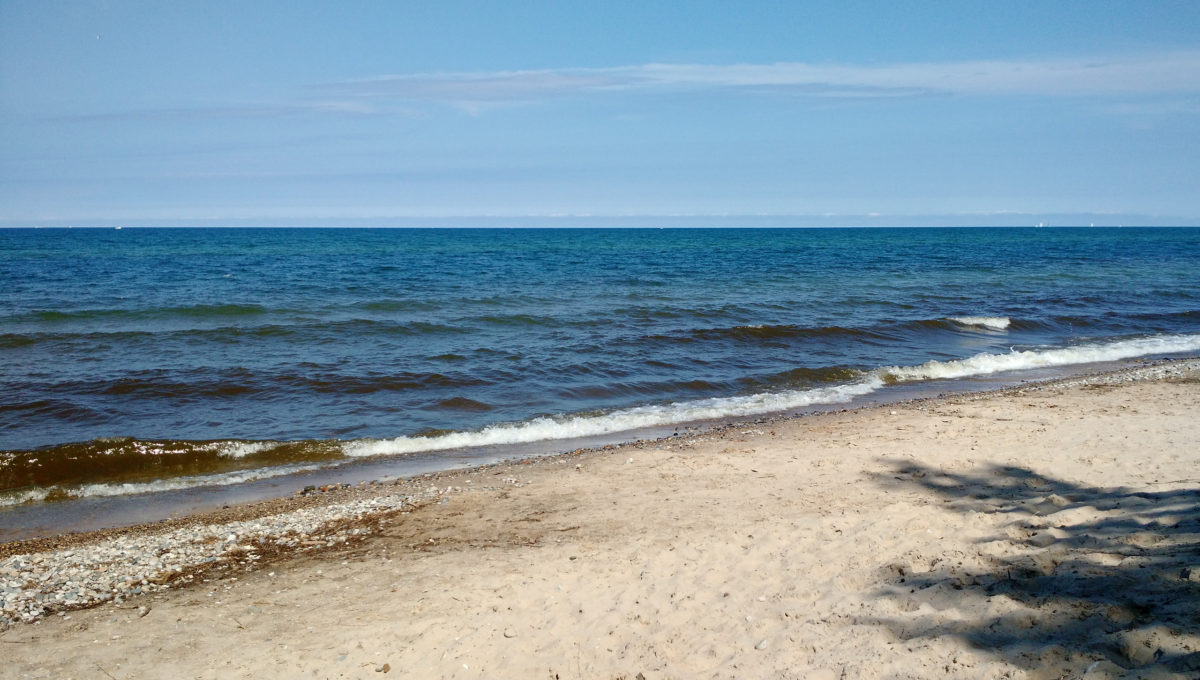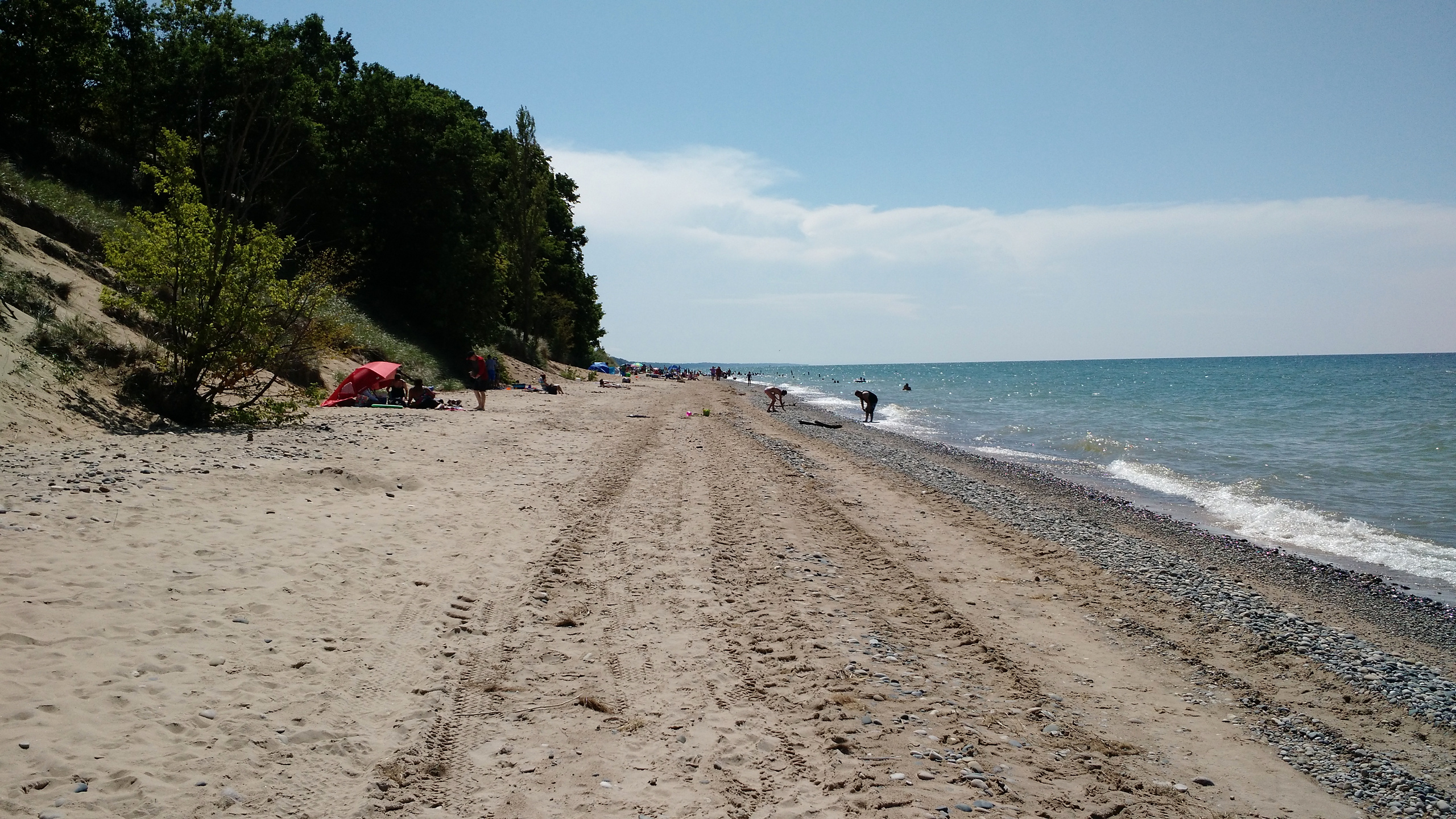
Lake Michigan isn’t great for swimming—the water is still pretty cold even in August, it’s kind of polluted, it lacks the extra buoyancy that comes from the salt in ocean water, and there’s no coral. But if what you want is a beach, Lake Michigan has a great one.

Eight years ago my brother convinced me to come to St. Croix for a family reunion sort of thing. We stayed at Cottages by the Sea. The meticulously kept grounds invited barefoot walking, and I was surprised to discover that a week walking barefoot in the grass and the sand cured my plantar fasciitis. (I’d been keeping it under control with Birkenstocks, supportive shoes, rationing the amount of standing I did on hard floors, and strictly limiting the amount of barefoot walking I did. Discovering that barefoot walking on natural surfaces helped rather than hurt was a key early step in my move toward natural movement.)

lake-michigan-beach-2_29188771842_oThe Lake Michigan beach has some rocks right down in the surf, but they’re not an obstacle to comfortable walking, because they’re resting on sand and push right down when you step on them (unlike the rocky beach in St. Croix, which seems to be exposed bedrock with a little sand on top). And anyway, just a few feet up the beach from the surf, it’s just sand.

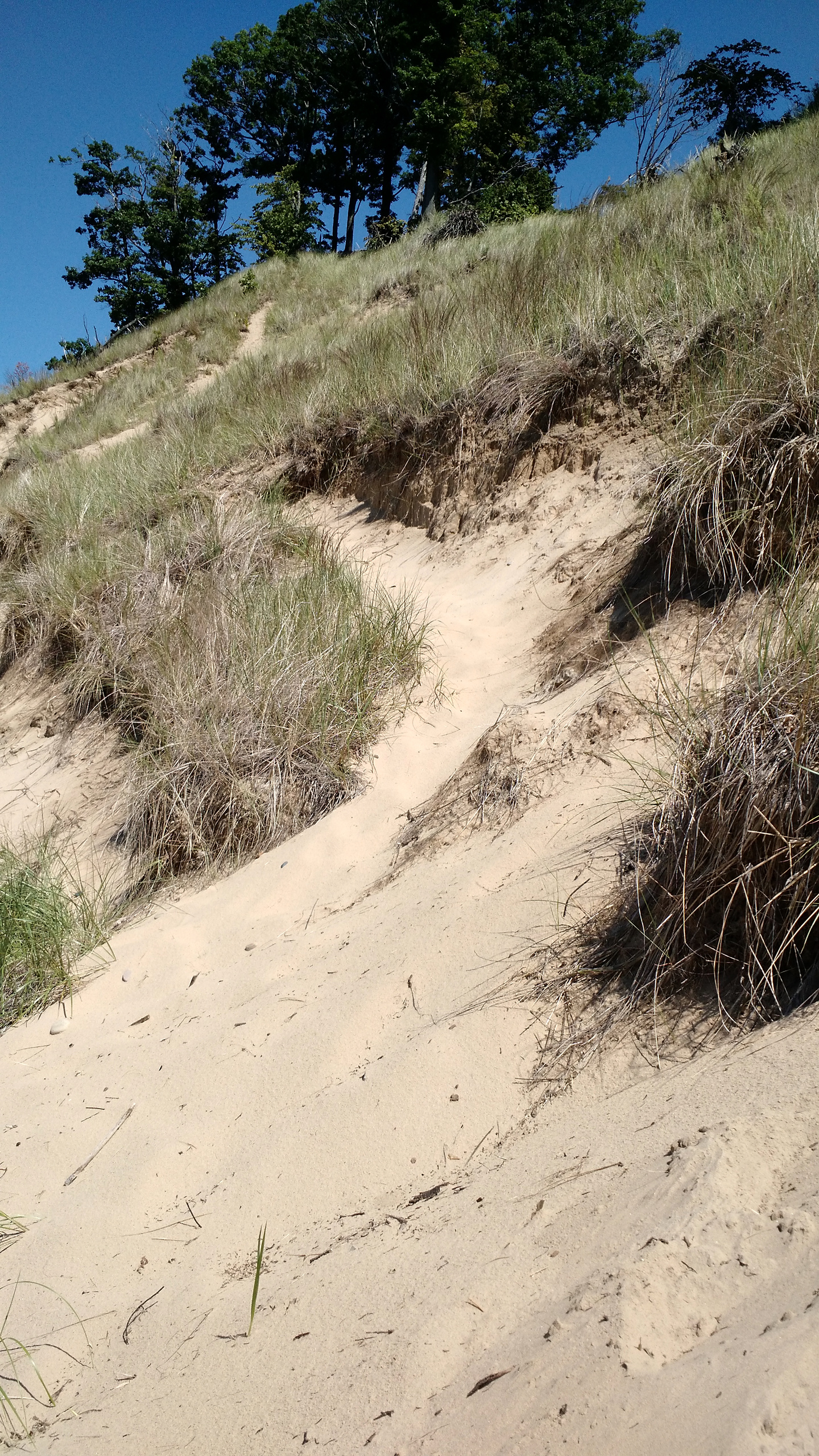
looking up a duneRather a lot of sand, actually. Whole dunes of it. It’s beautiful along the lake.

Champaign-Urbana is a great place to live, but it is lacking in beach, so I was glad to get a chance to visit the beach while visiting my dad last week. We drove to South Haven, visited a small nature preserve, and then went to the Van Buren State Park just south of the preserve. I did some beach walking both places.

I loved walking in the sand—soft, comfortable, hot (up where the sand is dry), cool (down by the water), and mildly abrasive. My feet enjoyed it even though my plantar fasciitis is long gone, cured by the taiji practice (standing meditation turns out to be a great way to learn how to stand), and by plenty of barefoot walking on natural surfaces.

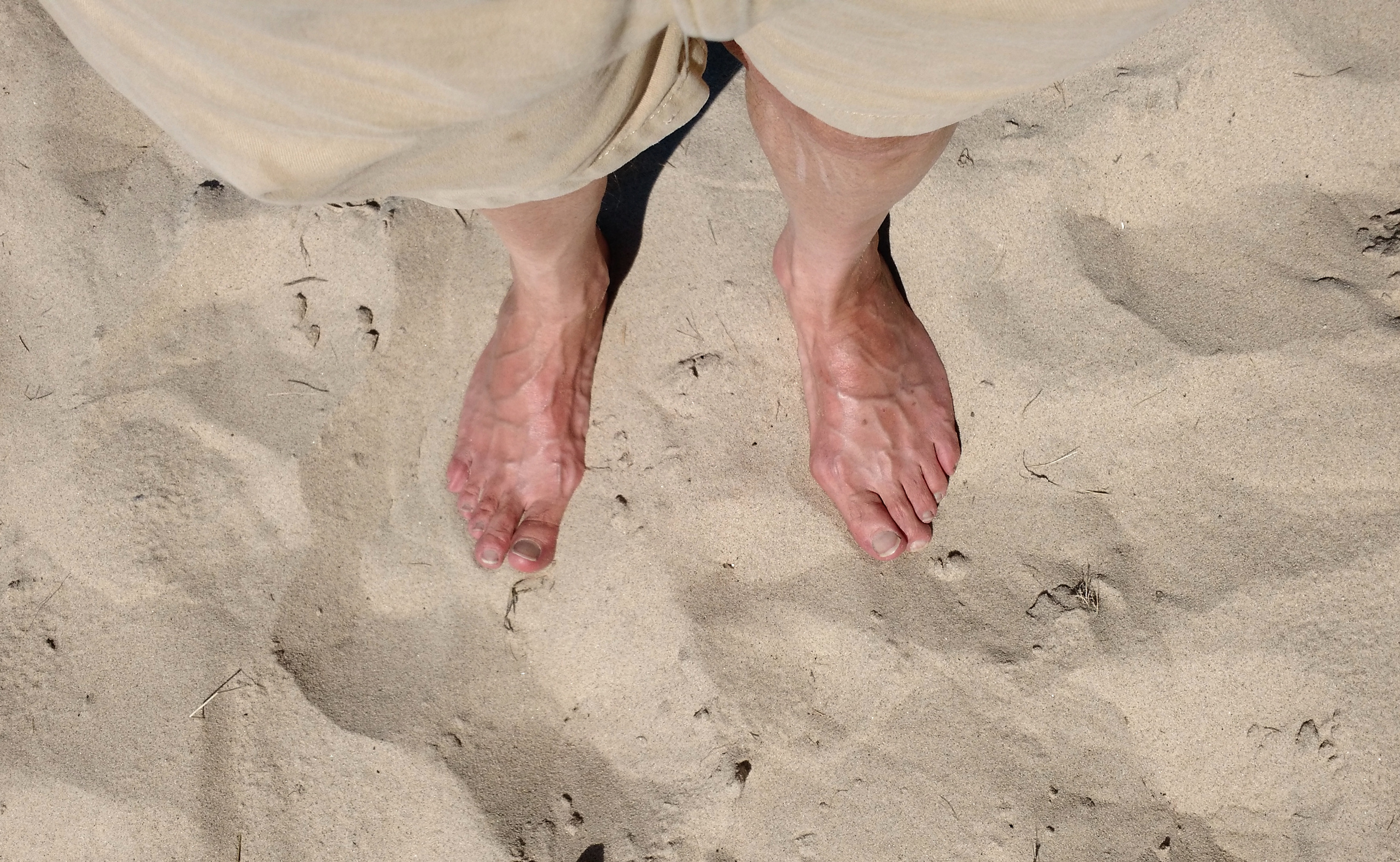
feet-in-the-sand_29219114001_oIt only occurred to me recently that my feet being shoe-shaped (rather than foot-shaped) was a bad thing. I’d some years ago started down the path of “barefoot” running (that is, running in minimalist running shoes), but I’d been focusing on improve my running gait, rather than the shape of my foot.

Once I started walking actually barefoot, I quickly developed an odd callus on the pad of my left index toe. And, looking at my feet, you can see why. Just the bit of barefoot walking I’ve done over the past couple of years has almost normalized my right big toe, which now comes out almost straight from my foot. My left big toe is still canted over at an angle so that it presses up against my left index toe. No wonder I use the toe oddly in a way that produces the odd callus.

Well, something to continue working on.

For going on two years now, I’ve been working on recovering the ability to squat. I’m not talking about the exercise called the squat, although I do that too. I’m talking about the ordinary human resting posture of lowering your butt down near your heels and relaxing there.

The reason I’ve been working on it for two years is that I haven’t been flexible enough to get into a proper squat. My flexibility has been improving pretty slowly, but it has been improving—I can now get down into a pretty good squat if I have a bit of heel support.

The change that’s been driving the improvement, but (as needing heel support shows) the area where I still need to improve, is ankle dorsiflexion. (Dorsiflexion is pulling your toes up toward your knees. It’s the opposite of plantarflexion, which is pointing your toes away from your knees.) To improve my ankle dorsiflexion I’ve been doing a variety of calf stretches with both straight and bent knees.

I don’t really have a before picture, but my ankle flexion used to be just about zero. That is, my ankle would bend 90° (as in standing up straight) no problem, but bending it up further simply didn’t happen. I used to think that was normal, and didn’t really try to stretch my calf to go beyond that range.

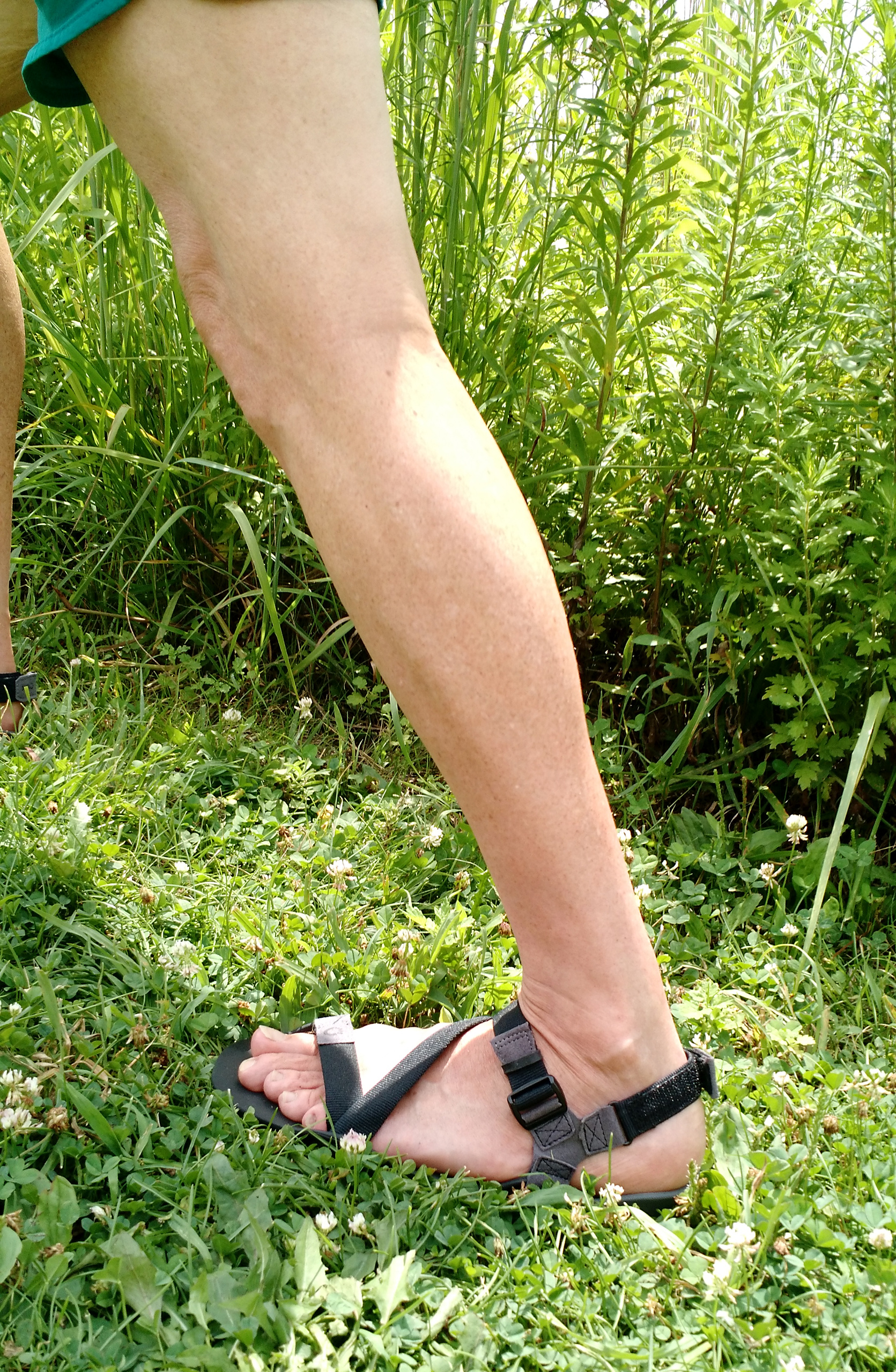
Now that I’ve been doing my stretches for a while, I can manage a bit of dorsiflexion:

Ankle dorsiflexion while walking uphill

The thing that prompted me to write this post, though, is not that I’m a few degrees closer to being able to squat, but that this added range of motion turns out to be useful for other stuff. In particular, as demonstrated in this picture, walking uphill.

There’s not a lot of call for walking uphill in east-central Illinois, but you can find places where it’s possible to go up a hill. Jackie and I visited one a couple of weeks ago, and I found myself putting my new range of motion to good use.

See, if you can dorsiflex your ankle, then the heel of your back foot can stay on the ground as you stride uphill. This lets you use your glutes to drive yourself forward and upward.

If you can’t dorsiflex your ankle, then your back heel comes off the ground as soon as your front foot goes forward. Now you’re stuck pushing yourself up with your relatively wimpy quads and calf muscles.

I’m not surprised, I just hadn’t though of it. This natural movement stuff turns out to have all kinds of side benefits.

Last summer we were doing lots of very long walks, getting ready for our day hike of the Kal-Haven Trail. This year, without that motivating event, we haven’t done nearly as many.

We’ve done plenty of walking, of course. We’ve even taken some long walks. But since our big hike last summer, we’d only done one very long walk, back in October last year. (A very long walk is one longer than 14 miles. That post includes the explanation of how I picked that distance.)

With this lack of very long walks in mind, a couple of days ago I suggested to Jackie that we should go for a 15-mile hike, and we agreed that Saturday looked like a good day for it.

Jackie has signed up to be a Master Naturalist, and because it’s an endeavor of the Urbana Park District (among other groups), she wanted to visit some Urbana parks. So, we made a point of hitting a few as we walked, including Carle Park, Crystal Lake Park, Busey Woods, and Meadowbrook Park. We’d thought to hit the newish Weaver Park, but to do so we’d have had to go a long way along one of two rather uninspiring, somewhat busy streets. We decided to save it for a day when we were out in the car.

We did some casual route planning, but basically we figured we’d just walk to (and around) parks until we hit our 15 mile goal, and then catch a bus to home. And that would have worked great, except that we really wanted to visit Meadowbrook Park, where we had volunteered in a stewardship work day last week. And that would have been fine, except that the Sunday bus service to Meadowbrook is pretty limited.

Once we’d seen the parts of Meadowbrook that we particularly wanted to see, we’d hit our 15 mile goal (or nearly), and I sat down to check the bus timings. Asked for the best way home by bus, Google Maps suggested that we just walk home—about 3 miles, along Race Street and Curtis Road. I suggested to Google Maps that we might want to walk to First and Gerty, where we could catch the Yellow bus home, but that would be almost as far as just walking home—and end up taking longer, because we’d still have the bus ride ahead of us.

In the end, we just walked home. It was okay, even though there aren’t any sidewalks along Race or Curtis. A good bit of the way we had wide swaths of recently mowed grass along the side of the road, which gave us a nice place to walk well away from the traffic. Other places we had to walk right on the edge of the road, but the drivers were all good about steering clear of us (and we had a ditch we could have bailed out into if necessary).

Some of the stretches were pretty weedy, which made for some harder walking, and some places the weeds hid uneven bits in the ground. Those might have been a problem last year, when nearly every long walk we took was further than we’d ever walked before, meaning that our feet and ankles tended to be tired and sore for the last few miles, which is no good for walking over uneven ground.

This year, it turned out to be no big deal. Despite this being our first very long walk since October, our feet and ankles were totally up to it. We were glad to get out boots off and sit down at the end of it, but we could have walked several more miles if that had been necessary.

The total walk came in at 17.78 miles, rather longer than I’d intended, but comfortably over the threshold for a very long walk. And we got to see some very nice parks.

I neglected to get any pictures along the walk, with one exception: I took a picture of the house where Chuck used to live in Urbana so I could send it to him. And, since that’s the only picture I took on this walk, it’s all I’ve got to illustrate this post.

Here you go:

img_20160730_123330153_28551745302_o

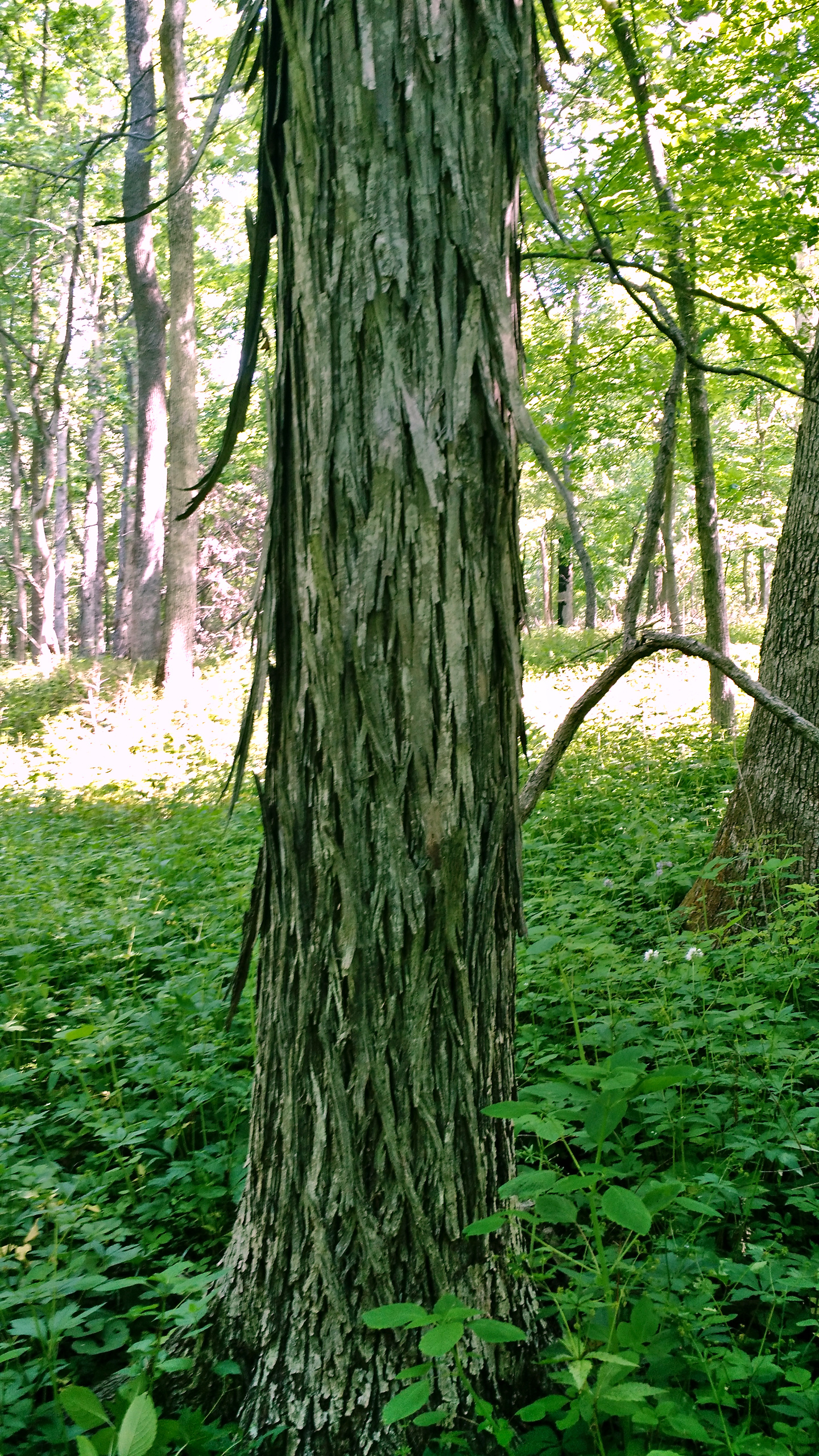
Shagbark Hickory tree at Allerton Park
Shagbark Hickory at Allerton Park

Jackie and I attended a tree identification workshop at Allerton Park yesterday.

Both my parents are naturalists, and my brother took some botany classes as part getting his PhD in science education, so they all know all the trees we’re likely to see in any of the places where we’ve ever lived. They routinely identify the trees for me when we’re walking. If I’d had any sense, I’d have learned all that stuff myself long ago.

Sadly, I have a lazy brain—the sort that figures that if other people will identify the trees for me, there’s no need for me to learn how to do it myself. So, I had to subject myself to this workshop to try and catch up.

It was a very well done workshop. We spent about half an hour going over basic terminology of tree characteristics—alternate versus opposite, simple versus compound, pinnate versus palmate, petioles versus petiolules—then we spent about three hours hiking through Allerton Park on the south side of the Sangamon River, before breaking for lunch. After lunch we spent another three hours hiking on the north side of the river, looking at the trees found over there.

We learned to identify maybe 30 species, with enough repetition of the more common species that we might actually be able to remember them.

It was good.

With all the time and effort I’ve been putting into fitness of late, I’ve been feeling just a little smug—I’m in so much better shape than I was nine or ten years ago. But this outing showed me that any such smugness is unjustified—everybody in our group of 20 or so, including some people older than Jackie and me, held up just fine to the rigors of five or six hours on our feet in the woods, some of it hiking off-trail. Jackie and I held up just fine too, but I was pretty tired at the end. (And managed to jam my ankle at some point, which wasn’t a problem during the event, but got sore in the night.)

It was a good reminder that endurance is a very complicated thing. Being in shape to walk briskly for 10 or 15 miles is not the same as being in shape to alternate walking and standing for the same number of hours. Adding effort in a mental dimension—trying to learn the trees, keeping an eye out for things like poison ivy, nettle, and tripping hazards—also makes things more taxing, something that’s easy to forget.

Now we need to get back to Allerton reasonably soon—before we forget everything—and see how many of those trees we can still identify.

I think Champaign-Urbana is great. The university gives it cultural and scientific amenities far beyond its size. It’s a cheap place to live, which not only enables my lifestyle, it enables the lifestyle of any number of clever creative people who choose to live where they can make enough from their art to support themselves.

Just about the only thing that CU really lacks is relief—that is, a variation in height from one place to another.

What I mean to say is: it’s really, really flat. Take for example, this image:

Looking toward Yankee Ridge

That’s the hilly direction. I’m looking toward Yankee Ridge, which is about three miles away from where I’m standing. It may not look like much, but that hill in the distance is a big deal when you’re on a bicycle. At least, it is if you’re used to riding in Central Illinois.

Given the terrain, we don’t get enough hiking on hills, unless we make an effort to go to the hills. So, that’s what we did yesterday. We drove to Fox Ridge, a nearby state park which has some hills.

I remember hiking in Fox Ridge last summer, shortly before our big Kal-Haven trail hike, and finding that we were in pretty good shape for dealing with the hills, despite our very limited practice. That was less true this spring. I was a bit tired from my unexpectedly fast run the previous day, and we were both a bit out of shape from a lack of hills over the winter.

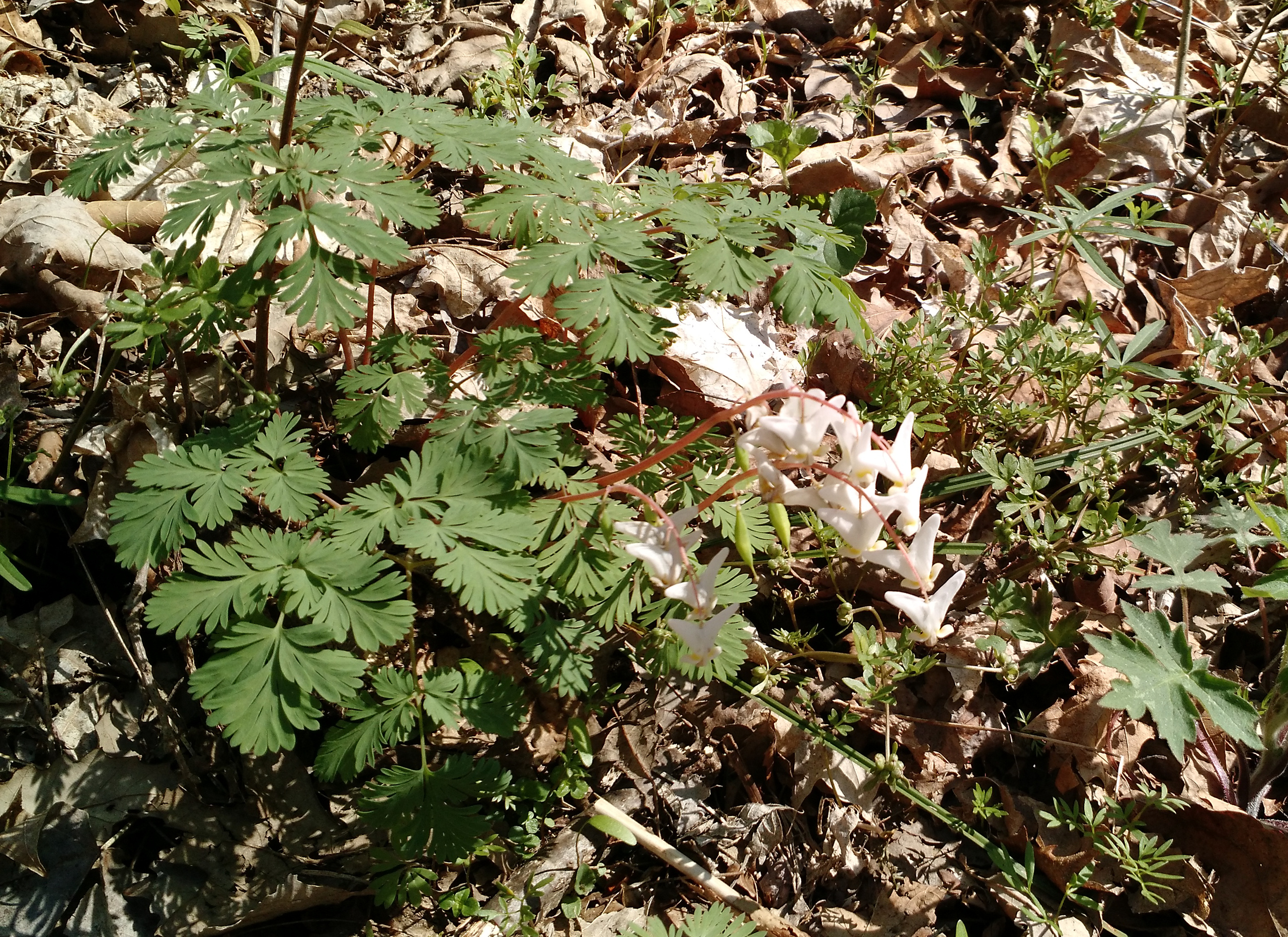
Still, we did okay. We saw some spring wildflowers, like these dutchman’s breeches:

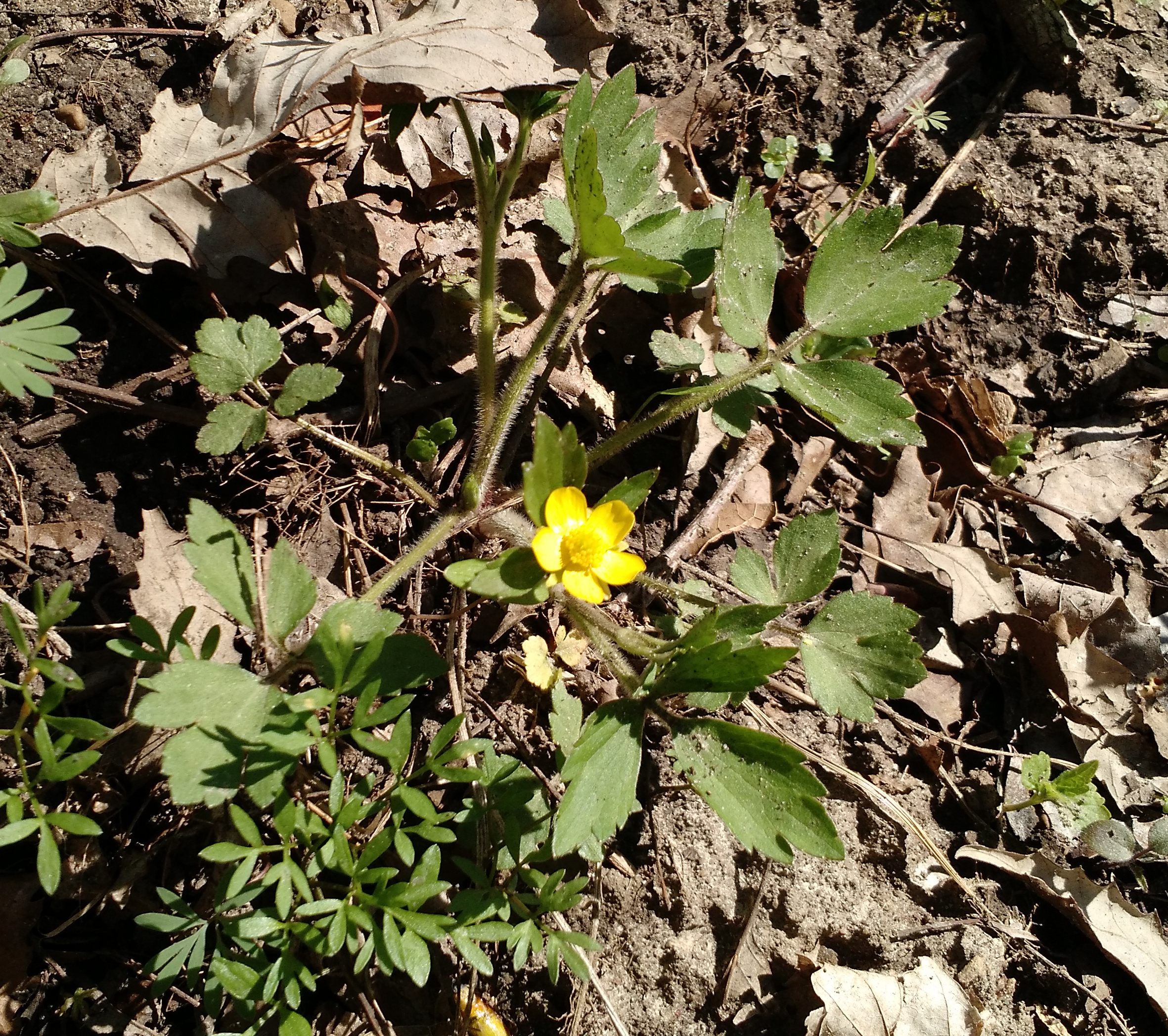
img_20160416_101623469_26401844861_oAnd this buttercup:

img_20160416_101630244_26468029235_o

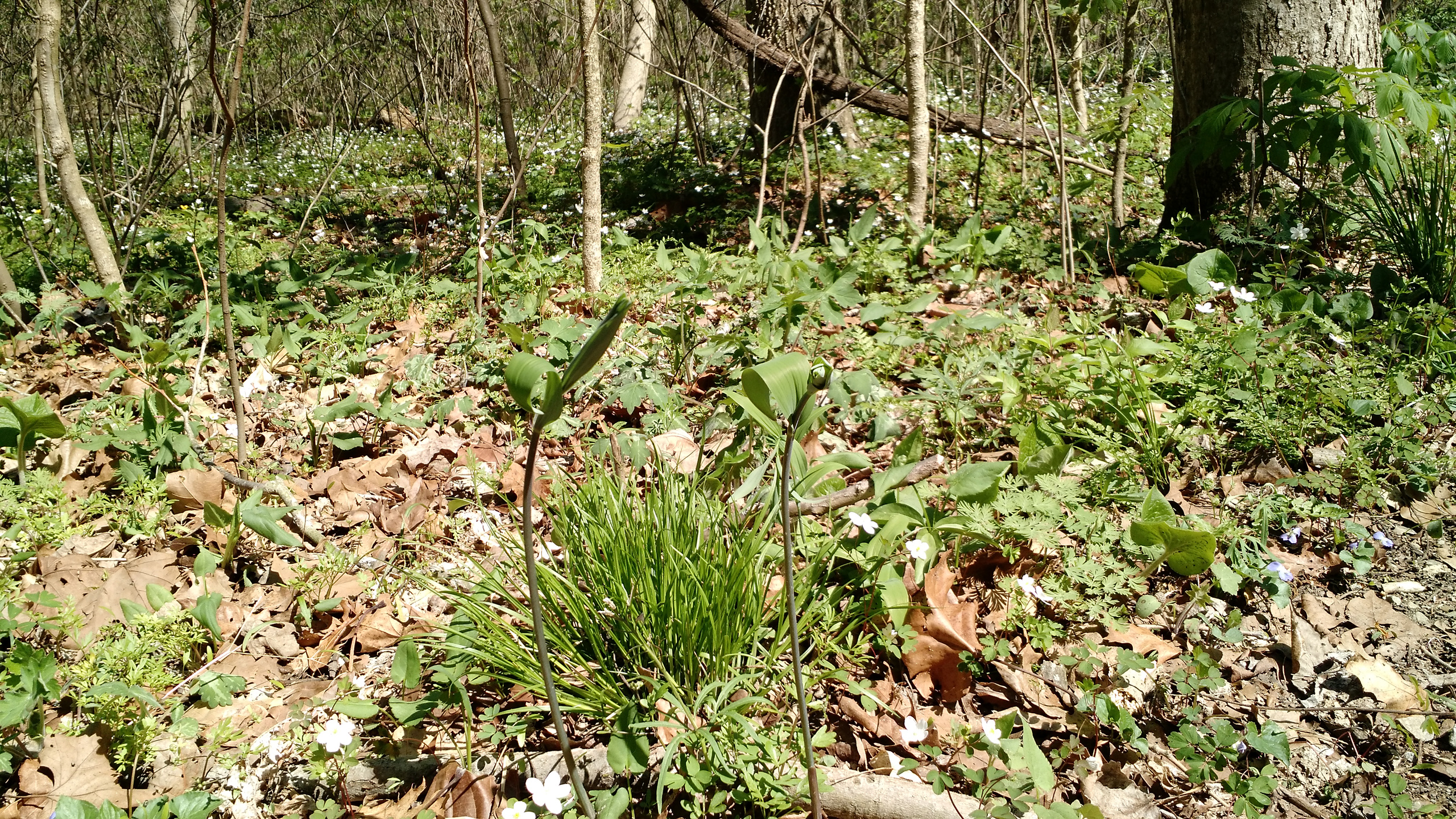
And this solomon’s seal:

img_20160416_110056171_26401892471_oTotal hiking was probably only a little over 3 miles, but the hills made it a very different sort of hike than our much longer hikes closer to home. Plus, we got to spend time in the woods.

So, that’s another bonus of Champaign-Urbana: We’ve got Fox Ridge State Park just 50 miles away.

There’s a dearth of good walking routes from Winfield Village to Champaign and Urbana.

From west to east, the choices are Prospect, Lyndhurst/Fox Drive, Neil/Route 45, First Street, and Race Street. The first two are okay if we’re heading to western or central Champaign, but are pretty out-of-the-way if we’re headed to campus or to Urbana. The latter two lack sidewalks and entail long walks along busy roads, which makes them pretty unsatisfactory.

A few weeks ago, I saw a pack of cross-country runners turn up a rather faint double-track on this side of the railroad, which alerted me to the fact that it’s possible to go that way.

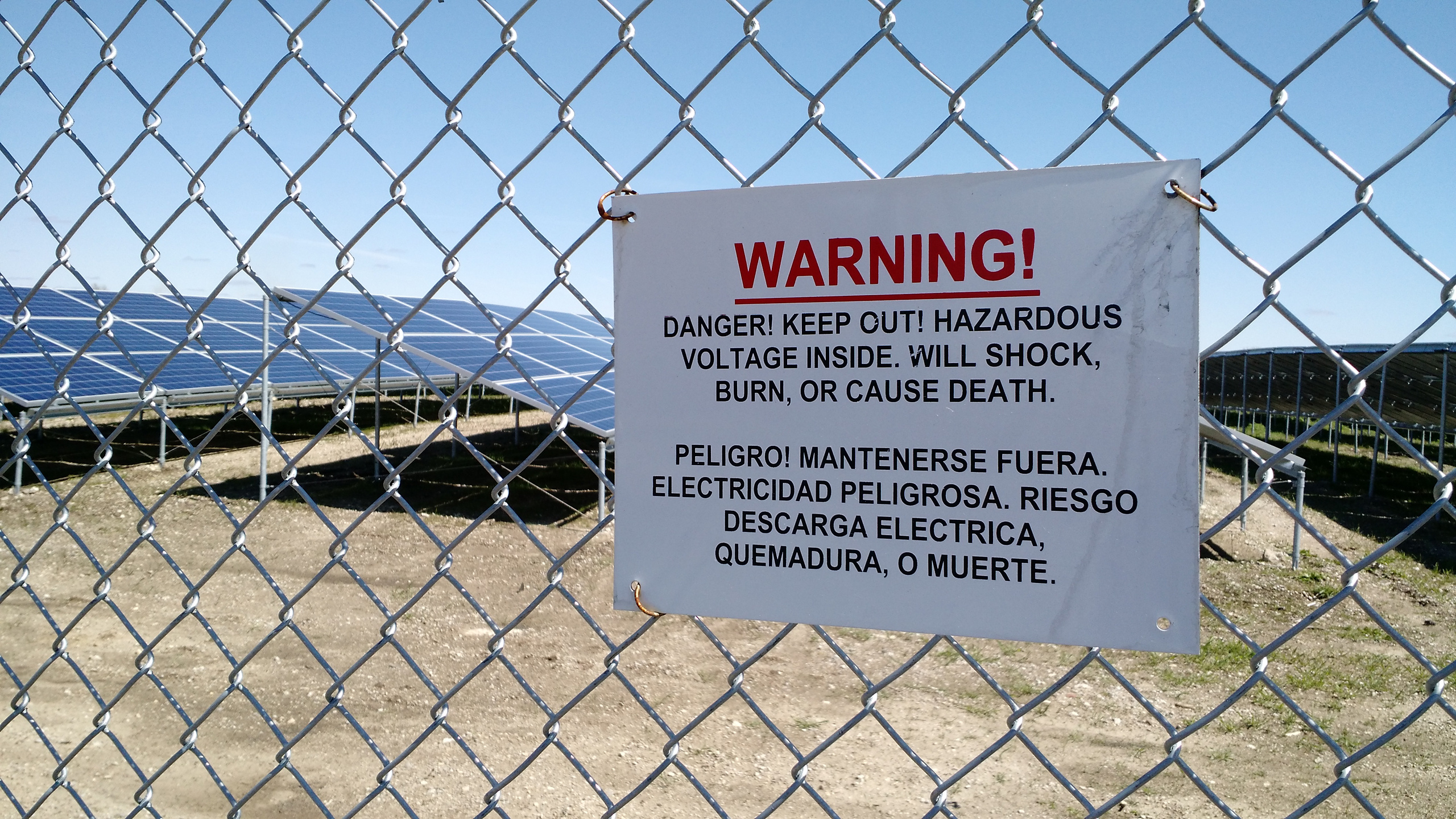
img_20160409_132552803_25726287304_oI was doubly interested in going that way, both as a possible alternative route north, and because about one mile north of us there’s a large installation of photovoltaic panels that the University has been calling its “solar farm,” and this bit of double-track leads right to it.

The track runs along the west side of what seems to be research crop fields for the University, although that bit of it may be an easement to provide access to a recently constructed line of pylons for some high-tension power lines.

The solar farm seems to producing quite a bit of electricity on sunny days like today.

Having walked to the solar farm we turned east. Having come that far instead of having to walk a mile along First Street, we only had a quarter of that distance to cover before we reached Windsor and were able to get on a proper sidewalk.

We took a nice tour around the more obscure corners of the research park, including a little diversion past the Fire Service Institute’s training facilities. Then we crossed Route 45 and made our way down to Schnuck’s to pick up a couple of groceries and head on home.

Total walking was 7.7 miles, in my case added to a 3.5-mile morning run.

I had not done much running since settling into the low-carb thing. Together with the walk, it’s a bit of a test of whether I’m seeing any of the endurance benefits I’m hoping to see. (Answer: Maybe. I certainly didn’t get hungry or feel a need to fuel up during the walk. But then, neither did Jackie.)

All last year I ran less than in recent years. Initially it was simply because of all the walking to prepare for our big hike. A very long walk takes a very long time, so it was harder to fit in runs. Plus, I learned the hard way that after a very long walk I’m prone to injure myself if I try to run too soon.

I didn’t want to quit running. I enjoy running, and I want to be able to run, both of which seem like good reasons to run. So what I did was drop most of my short and medium runs in favor of walks, but keep the (ideally) weekly long run.

Over the winter I haven’t been getting my long runs in weekly. I’ve just been running when the weather made it seem like it would be fun, which has worked out to just a couple of times a month.

Yesterday was one of those times.

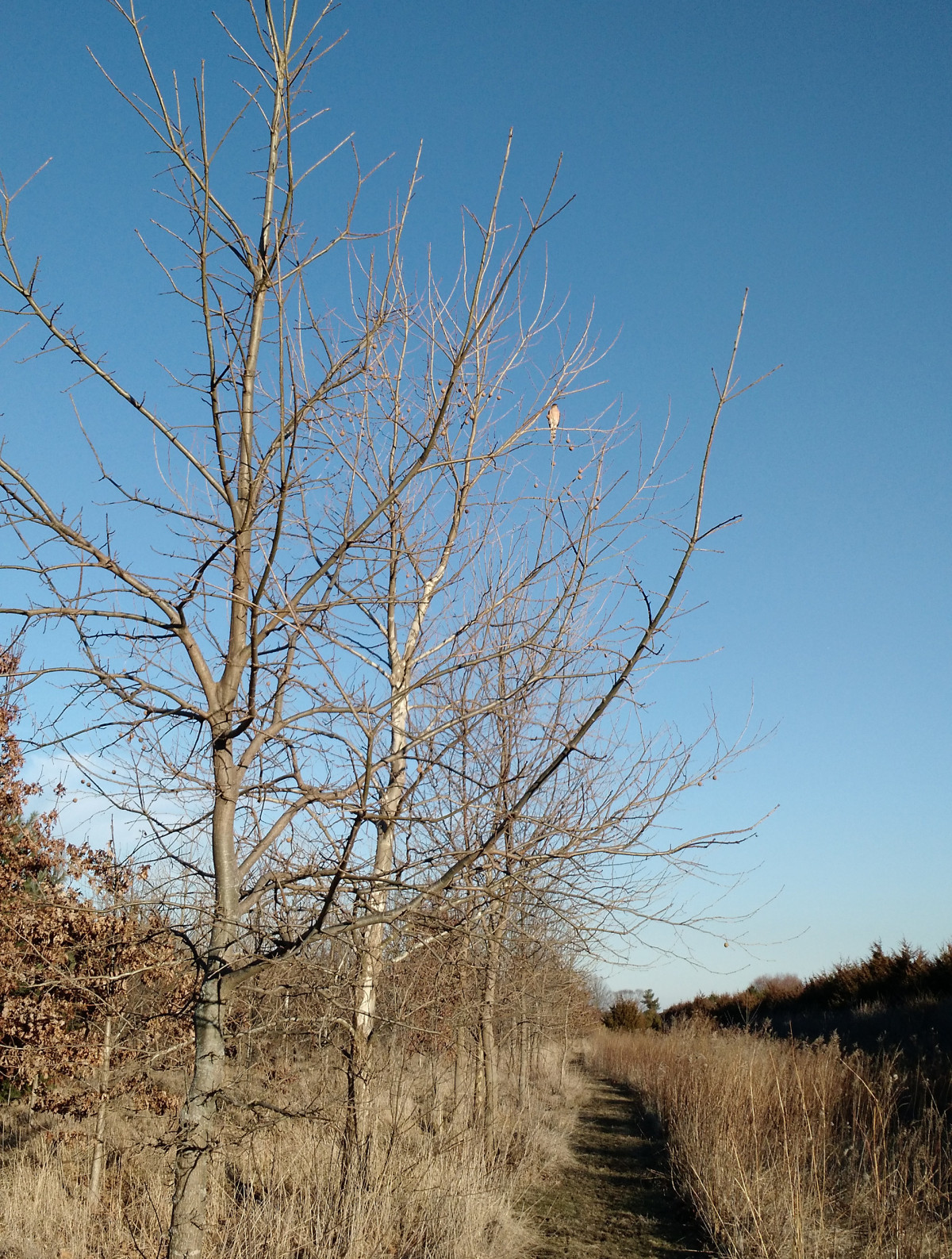
Fairly often I see wildlife when I’m out running in the woods and prairie near Winfield Village. Unless it’s a turtle, I don’t usually manage to get a picture, but yesterday there was a hawk on a branch directly over the trail, and he sat there long enough that I did mange to get a photo (at the top of the post).

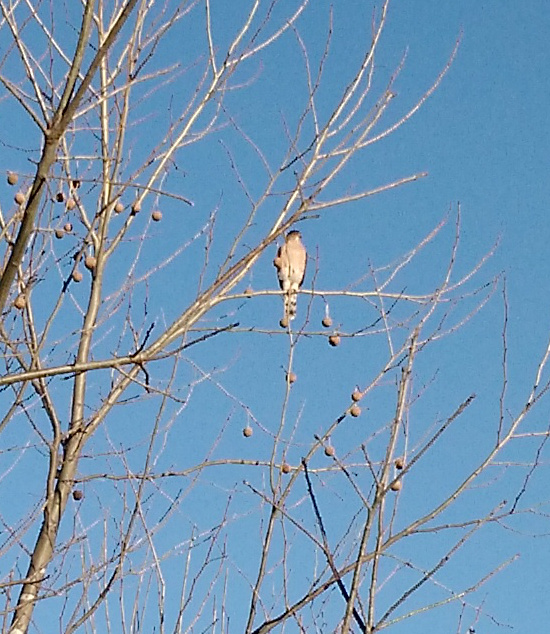
Of course, it’s almost pointless to take a picture of a bird unless you have a very long lens, but here’s the photo anyway—zoomed in enough that you can tell that I actually did see a hawk.

zoomed hawk

I like to have something around which to organize my walking. Training for our big Kalamazoo to South Haven hike worked great, but having completed that I was looking for something new.

Via Nerd Fitness’s How to walk to Mordor page, I found this little page on Walking to Rivendell, and I think that just might be what I was looking for.

Way back in 2003, some clever people got the idea to go through The Fellowship of the Ring (and a handy Atlas of Middle Earth) and note down all the legs of Frodo’s journey from Hobbiton to Rivendell. Then, as they did their own daily walking, they tracked their progress, noting each milestone as they passed it. (Five miles along; crossed the Great Road from the Brandywine Bridge and entered Tookland.)

Jackie doesn’t seem to have the same strange urge I do to organize walks around some arbitrary or fantasy goal, but she has embraced the idea with some enthusiasm, and decided that we should begin at the beginning and follow the path of Bilbo’s journey to Rivendell. It begins with a hurried dash from Bag End to The Green Dragon in Bywater, then down the Great East Road to a camp site a couple of miles past the three farthing stone, for a total of 11 miles.

We won’t match Bilbo’s journey day by day, but we thought we’d at least start with an 11-mile walk to get into the spirit of the thing.

So yesterday we did.

To make the mileage come out right (and to avoid a boring bit of the walk that we do all the time), we took the bus to campus and started our walk there.

From the Research Park (just across the street from my old office) we walked through campus and on to the Urbana Library (where we returned a library book and checked out another), then went across the street to Lincoln Square Village where we had lunch in their little food court. We went back to the library where we split a brownie for desert and lingered over coffee. Then we headed west across the north end of campus, paused briefly in the Engineering Quad so I could play just a bit of Ingress, and proceeded to the water amenities at 2nd street.

We’d had lunch early, so it was at just about this point that the vitamin D window opened. It was preternaturally warm and sunny, so I took off my jacket and put it in my pack and we spent a half hour or so comprehensively walking the paths through both halves of the water amenities (with my arms exposed to the deadly ultraviolet light of the sun) before heading on to downtown Champaign. We walked through West Side Park, near our 2014 summer place, and then turned south and walked past our 2014–2015 winter palace.

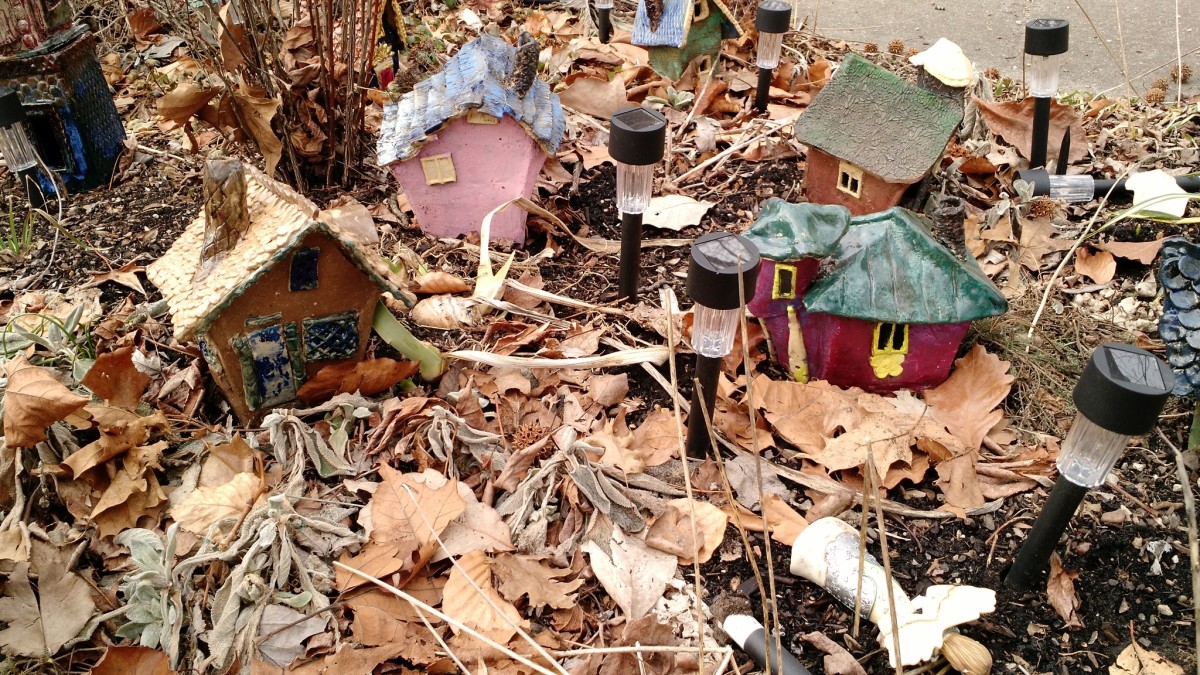
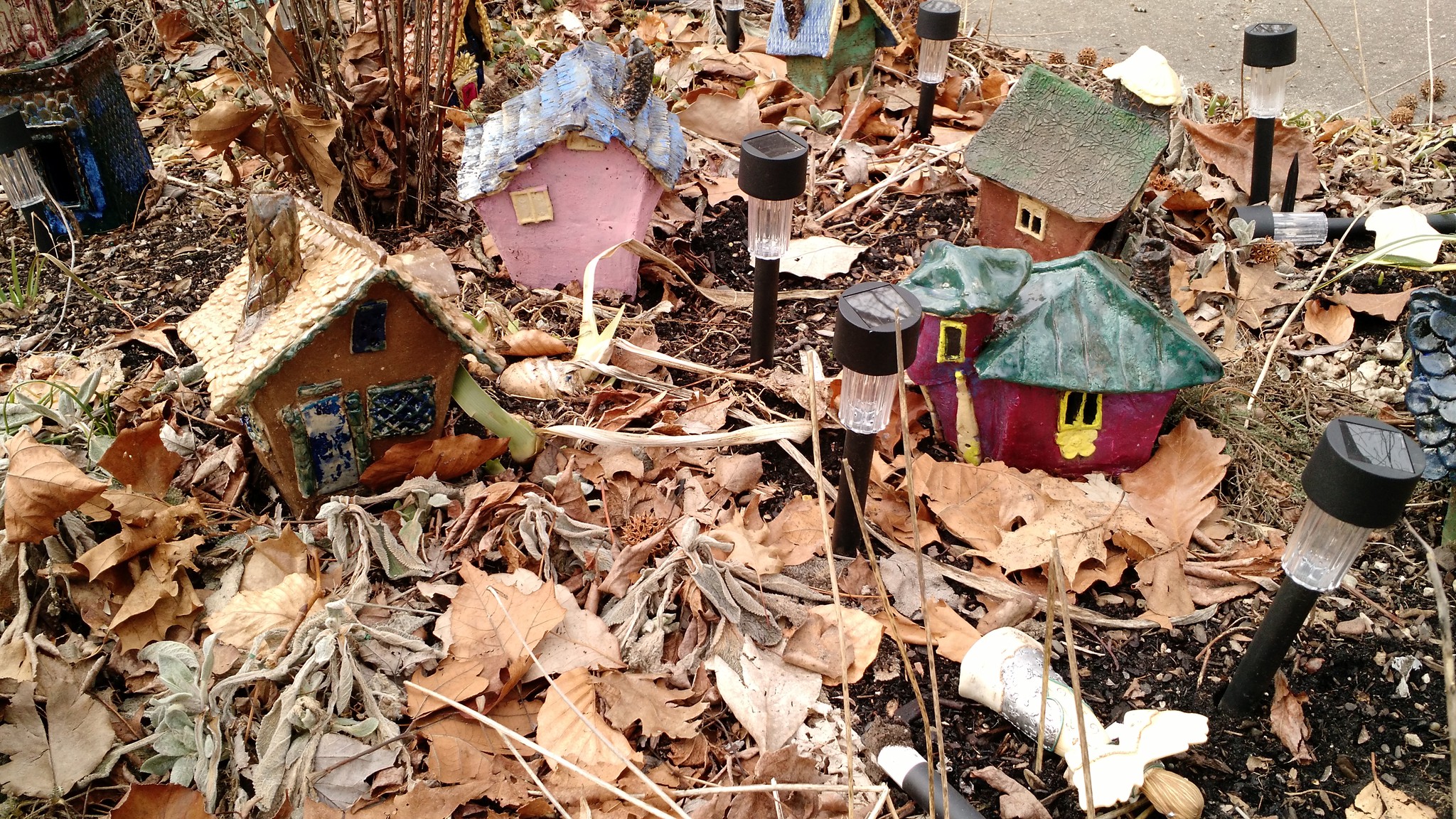
Not far south of there, we passed a house where the grassy verge between the sidewalk and the road was filled with these tiny ceramic houses:

img_20160130_140716526_24689044956_o

Not exactly Rivendell’s last homely house, but I felt they were adequately in the spirit of elven houses anyway.

From there we proceeded to Hessel Park, and thence along familiar paths to home.

I neglected to run Endomondo, but Google Fit claims I walked 11.1 miles.

It was a great walk! Jackie had a sore shoulder and didn’t want to carry a pack, so I carried not only the library book, but also the first aid kit, our lunches, and water for two.

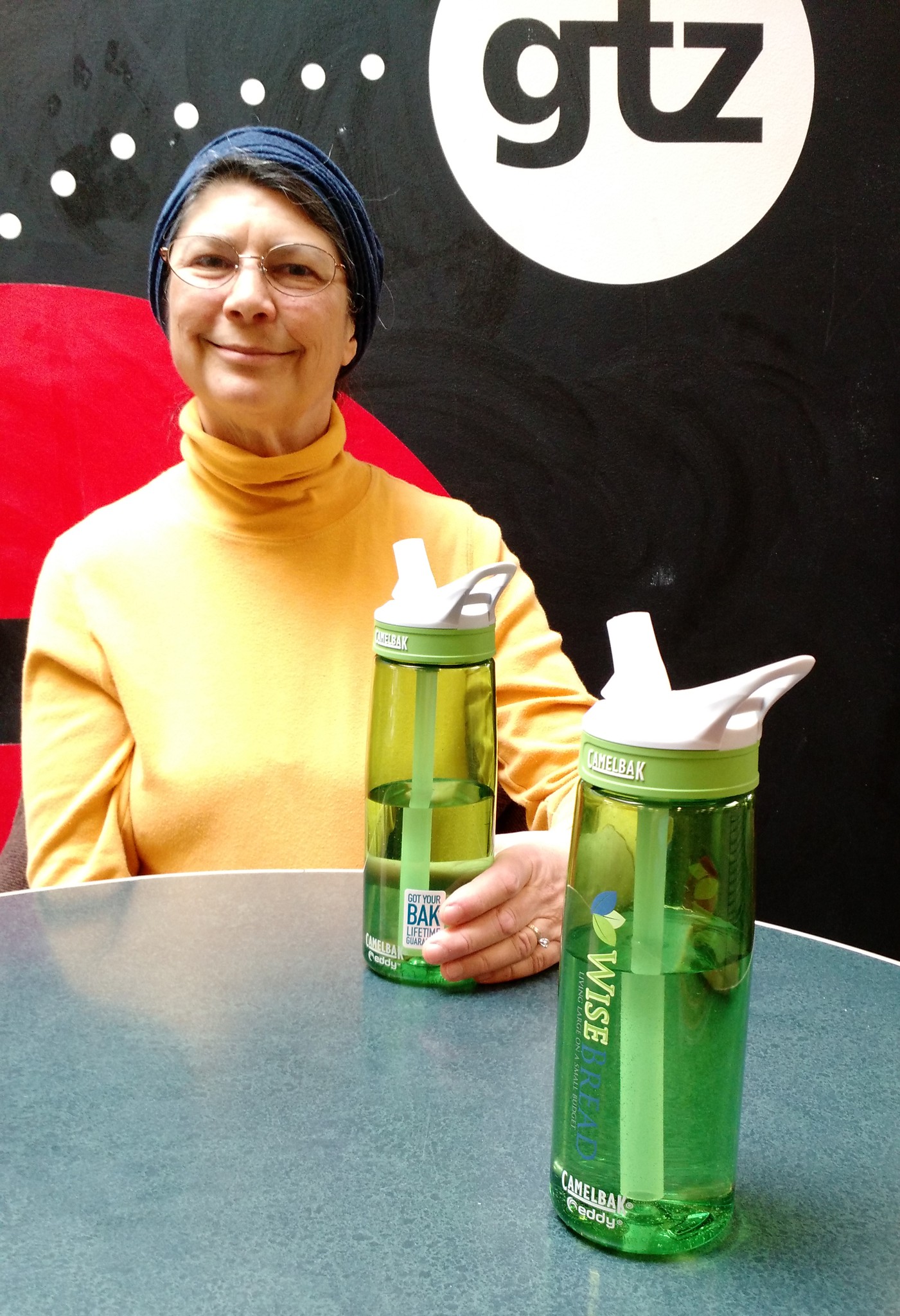
Jackie with our water bottles

Speaking of water, last year Jackie bought one of these Camelbak water bottles, and was very pleased with it. I was happy enough using bicycle-style water bottles. But—by sheerest happenstance—the kindly admins at Wise Bread gave me (as a thank-you gift for being one of their writers) the exact same water bottle as Jackie’s—except that mine has the Wise Bread logo.

These bottles are a little bigger than the ones I carried last year. That together with the library book made my pack a little heavier—enough to be noticeable, but not too much for a walk to Rivendell.

I wore my minimalist boots, which seemed like a nice compromise between my regular hiking boots and going barefoot like a hobbit. In the summer I plan to get back to barefoot walking in a big way (although it may be a while before I’m taking my long walks barefoot).

A year or more ago, I came upon a pretty good article (linked at the bottom of this post) with some good, basic exercises intended to provide a base for parkour training. I’d had it in my head to do those exercises last winter and be ready to do some serious parkour training in the spring. I even did some. Then spring came, and I realized that I hadn’t done them consistently enough to have done myself much good. I felt like I’d wasted the winter.

I ended up not pursuing parkour the way I’d planned, mainly because I didn’t want to risk even minor injuries during the run-up to our big Kal-Haven Trail walk, but also because I really didn’t have the base to train seriously.

I want to avoid that this year, so I thought I’d sketch out a plan for building my base for parkour—and as long as I was doing that, I figured I might as well document it here for easy reference.

To help me focus, I’m holding the list to just four things (on top of my usual walking, running, taiji, etc.).

Squatting

My goal here is to get to where I can do a full, deep squat, and then hang out comfortably in that position. I can get down into a deep squat, but to do so I have to curl forward and stretch my arms forward, to get my center of balance over my feet and not topple over backwards. I’m pretty sure this is due to flexibility issues, rather than strength issues.

I came across a pretty good page on diagnosing and addressing squat flexibility issues, which would have me believe that tight calf muscles and tight hip-flexor muscles are likely culprits.

I’m already doing calf stretches, both straight-knee and bent-knee. I’ll try and be a bit more consistent about that.

The suggested exercise for hip flexors is a crescent lunge, which looks pretty good. Based on other stuff I’ve read, I suspect that I also want to work on releasing my psoas, so I’ll include that as well.

me squattingIn addition to all this prep work, I’ll also spend some time squatting with some sort of support or another. I know three ways to do this. First, elevate the heels, so that calf tightness doesn’t limit the squat. Second, just hang onto something (like a door frame or a tree trunk) so that I can avoid toppling backwards. Third, do goblet squats, where the weight of the dumbbell works to shift my center of gravity forward.

I might also try prisoner squats. I won’t be able to go all the way down, but it’ll give me a chance to keep my back nice and straight, and then see how low I can go with a straight back.

Success will be when I can get all the way down with a straight back, and then use my hands to manipulate things that are nearby.

Toe Stretches

Last summer, when I started doing some barefoot walking for the first time in years, I was surprised to discover how much a lack of toe flexibility was limiting me. It interfered with quadrupedal movement in particular, but also all sorts of transitions to and from a standing position while barefoot.

quadrupedI’ve started working on toe flexibility. My main exercise so far is assuming quadruped position, and then—keeping my weight back on the balls of my feet—sinking my knees toward the ground. When I find the spot where my weight shifts forward onto the toes themselves, I ease off.

Along with that, I’m doing other foot mobility exercises: Lifting my toes individually, spreading my toes, relaxing my foot enough that it can conform around objects, etc.

Last summer I did quite a bit of barefoot walking, and was surprised and kind of sad to find that a few decades of wearing shoes seemed to have fused my feet into solid lumps.

Success will be when I can keep my weight back on the balls of my feet and still get into position for things like planks, push-ups, and lunges.

Hanging

Hanging from a bar or a branch is one of the things I got started on last winter, and then got distracted and wasn’t consistent about.

hangingLonger term, I want to be able to do pull-ups, but hanging is the place to start. I had worked up to hanging for 30 seconds last summer, but I did a bit of hanging yesterday and found that about 15 seconds was as long as I could manage. I’m ahead of where I started—a few years ago I wouldn’t have been able to support my weight with my hands; I’d have been afraid to even try, for fear that I’d hurt something. Still, not being able to hang for even 30 seconds is discouraging. (Not to mention life-threatening, if I find myself in an action movie.)

The progression is straightforward: hanging, then negative pull-ups (where you use a step to get up to the top of pull-up position, then lower yourself), then pull-ups. From what I’ve read, once you can do a 10 or 12 negative pull-ups, you can probably do a pull-up. We’ll see.

I don’t have a perfect situation for this: The benches in the fitness room here are too low to get me up to the top of pull-up position. I can probably use one or another of the pieces of playground equipment. I looked yesterday, but the most likely playground had kids playing at it, so I didn’t try.

Being able to do a pull-up is a key capability for various parkour moves, such as wall climbs.

Success will be a single pull-up in good form from a dead hang.

Wall Dip

This is where you put your hands on top of a wall and use them to push yourself up—like a push-up, but with your feet unsupported. I can currently do about one rep of this.

The progression for working up to these is just doing a wall support, where you hold yourself up in the top position.

I don’t know of a good wall for doing this exercise anywhere in Savoy, which seems odd. I wonder if architecture and construction fashions have changed—campus is full of low walls that are prefect for this sort of thing.

wall supportHappily, the edge of the window seat in my study is an adequate support, so there’s a spot to do this that’s literally less than one step away from where I’m sitting as I type this. It’s not a perfect spot, because it’s kind of low, so I have to bend my knees to get my feet off the ground, which means that I can’t use my feet against the wall to help. That’s fine for practice wall supports and wall dips, but it means that I don’t have a good place to transition my practice to more specific parkour skills like wall climbs.

Success will be when I can do a dozen or so wall dips with good form.

So, that’s my winter parkour-prep program. With some consistency, I should come into the spring with enough strength and flexibility to jump right into serious training on parkour-specific moves.

Just for completeness, here’s the article I mentioned at the beginning, with a set of basic exercises for building strength for parkour training. I almost didn’t link to it because I don’t like the title, but it’s really pretty good.

This was the year that Jackie and I finally managed our long-planned  day-hike of the Kal-Haven Trail: 33.4 miles from Kalamazoo to South Haven. It took three years to make the fitness piece and the schedule piece come together close enough to the summer solstice that we could complete the hike in daylight.

That project dominated my movement practice for the year, especially because I was being so careful not to injure myself, out of fear that an otherwise-minor stubbed toe or turned ankle or bruised heel might make the hike impossible, meaning a delay of yet another year.

Another thing that happened is that my taiji teacher asked me to take over teaching his classes. I was already teaching some last year, and since September, I’ve been teaching all of them.

Now at the end of the year, I’ve had another little project: trying to get in 90 minutes of movement every day in December. That started off great: in the first three weeks I only missed 2 days. It rather tapered off in the week of Christmas itself (missed 5 days), but I got back with it this last week to finish the year strong.

I haven’t previously written annual review posts of my movement practice, and it would be pointless to try to create them retroactively. But I did want to trace the key turning points that brought me here. If you’d asked me 8 years ago if I’d be a taiji instructor I’d have dismissed the notion out of hand, and when I’ve tried in the past to remember how I got here, I had trouble remembering. However, I have written plenty of posts on those topics. I’ve used those posts to try to reconstruct my journey from trying to get fit through exercise to simply trying to get plenty of diverse movement.

I’m a bit unsure where to start. I always tried to “get enough exercise,” even before I started thinking through what “enough” would be (and long before I came to think that “exercise” wasn’t the best way to think about it). A few datapoints:

  • I have a running log from 1991, a year in which I lost a good bit of weight and ran enough to be able to complete a 5.5-mile trail race. I hurt my Achilles tendon, and by the time it healed (many months later) I was completely out of shape.
  • I have notes in my Clarion Journal about running in the summer of 2001, and I ran enough in 2003 that some of that fitness carried forward—in 2004 I came into the spring with enough fitness that I was able to complete a 7.1-mile trail race in June.
  • In that same period, I was bicycling a lot—it was something I could do with Jackie, who doesn’t care to run. I found that bicycling to work let me replace my 20-minute commute with a 25-minute bike ride, meaning that I got 50 minutes of aerobic exercise with just an extra 10 minutes per day. Bicycling home was also a great way to decompress at the end of a day at work. In the summer of 2005, Jackie and I spent a couple of months training for, and then rode together, a century ride.

At each of those peaks, I averaged about 100 minutes of exercise per day, which was what I could fit into a week when I had a regular job. (During most of that period, I didn’t tend to count walking as exercise unless I went out for a long hike on trails, an error that I gradually corrected over the next few years.)

I have a rather sad post from April of 2008 in which I lament my failure to take advantage of the extra time I should have had, once I quit working a regular job, because I was spending so much time writing. (I was writing about 5 posts a week for Wise Bread in that period, and also working on a novel.) I resolved to “make exercise–that is, fitness–my number 1 priority.”

In drafting this post, I wrote a long history of my movement practice as documented in my blog here, but I can’t imagine it’s of any interest to anyone but me, so I stuck it off in a text file. Instead, here are the key turning points:

And that brings us up to 2015.

In March I had a practice session with the parkour club at the University. I intended to go back (and still mean to), but haven’t made it yet. This was also around when I first heard about MovNat and natural movement as a thing.

In May I wrote the post that I guess I’ve been groping towards here: Human movement capabilities, talking about my journey from “getting enough exercise” to moving like a wild human.

I expect next year will be a lot like this year. We won’t have a 33.5 mile hike, but I’m sure we’ll have several in the 15–20 mile range. I’ll run. We’ll probably get our bikes out again. I’d like to get back to train with the parkour club again.

Over the winter, I’m planning to work on a few basics.

For the lower body, I want to get to the point where I can comfortably squat—where I can hang out in a squat and do stuff. I want to develop some extra toe flexibility, so I can do the quadrupedal movement thing barefoot.

For the upper body, besides the quadrupedal movement (which turns out to be a really excellent whole-body exercise, as well as being useful), I want to do more hanging. I have no idea how long it will take to get from hanging to pullups, but I’m planning to get it done.

It was interesting to see that my exercise regimen from 2012—the one that prompted me to declare victory—is not actually too different from what I do now. I do five hours of taiji each week, rather than just three. I try to walk 90 minutes every day, rather than 60 minutes just four days a week. I’ve shifted to body-weight exercises instead of weights or machines. (I’ve also gotten a bit lazy about the weights. This winter I’ll step that up.)